At 11:47 p.m., when most of Manhattan had become a pattern of illuminated windows and distant traffic, Marcus Reed pushed a blue cleaning cart across the marble lobby of Meridian Tower.
The wheels made a small uneven sound because the front-left caster had developed a flat spot that purchasing still had not replaced. Marcus knew exactly which screw had worked loose inside the wheel assembly, and he knew it would take less than five minutes to fix.
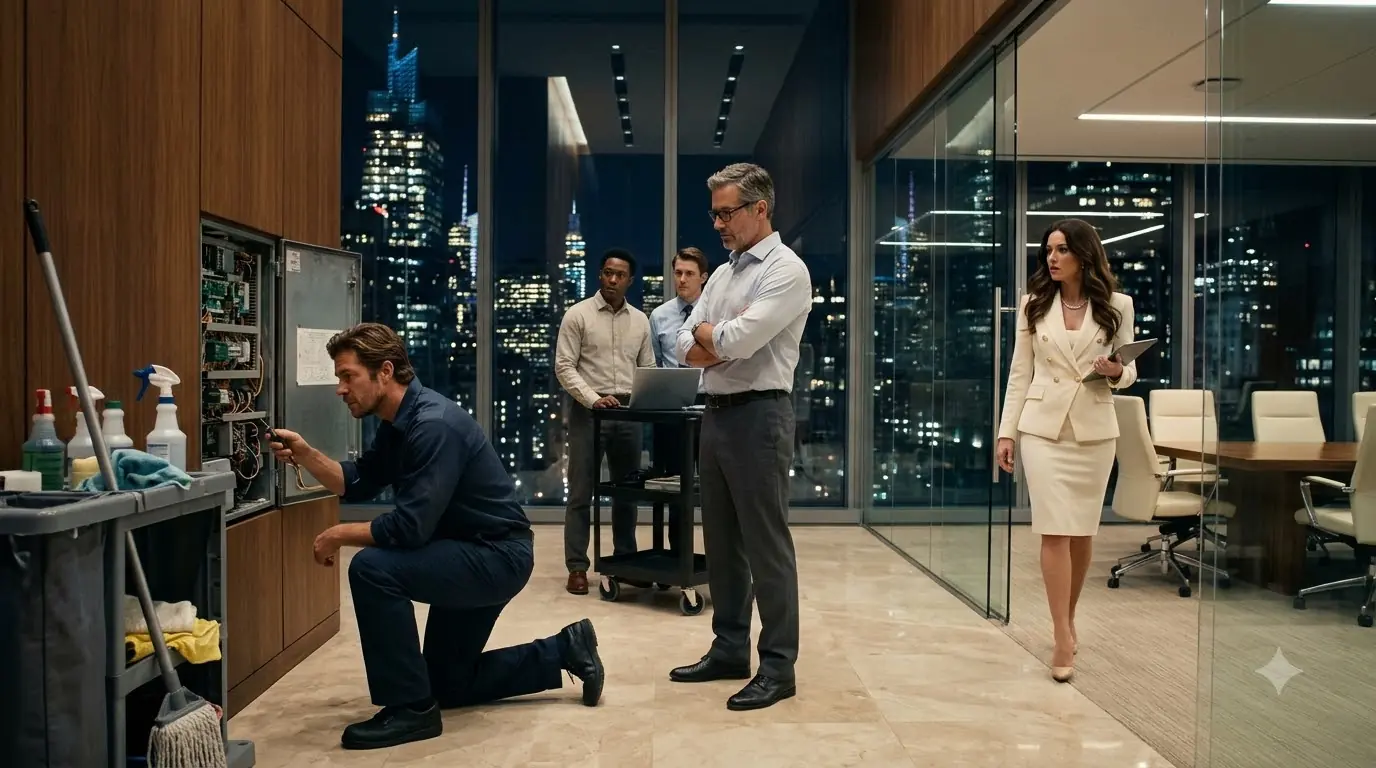
But the cart belonged to the contractor, his supervisor had asked him not to perform unauthorized repairs, and he had learned that doing a good thing without permission could sometimes create more trouble than leaving a small bad thing alone.
A few employees were still moving through the building, their faces pale in the light from their phones. Outside the revolving doors, October rain glazed the sidewalks and made the headlights of passing taxis look like long red and white ribbons. During business hours, Meridian Tower seemed designed to make people feel that nothing important happened below the executive floors. At night, when the polished desks were empty and the elevators traveled without crowds, Marcus could see how much work it took to maintain that illusion.
He had been cleaning the building for twenty-two months, long enough to know which offices left coffee cups behind their monitors and which conference rooms always had a projector cable coiled beneath the table. He knew that the twelfth-floor copy machine overheated if someone printed more than forty sheets without opening the cabinet door. He knew that the automatic sink in the women's restroom on seventeen sometimes ran for twelve seconds after a person walked away. He also knew exactly which executives said good evening to the cleaners, which looked through them, and which waited until he had turned his back before checking whether a drawer had been touched.
Marcus was thirty-eight, a Black American man, broad-shouldered and quietly handsome, with close-cropped dark hair and the beginnings of silver near his temples. His uniform was charcoal gray, the company's temporary staffing logo stitched over one pocket, and his work shoes had been resoled twice. He carried himself with the steadiness of someone who understood machinery, schedules, and the cost of a preventable mistake. The people who passed him saw the uniform first, and often nothing else.
At the main elevators he stopped to check his phone, a habit he repeated several times each night even when there was no notification. A message waited from his eight-year-old daughter, Emma, sent from the tablet she used at the apartment upstairs from their neighbor's kitchen. Dad, remember my science presentation tomorrow. You promised. Beneath the words she had added three drawings of stars and a tiny crooked heart, the same heart she used to put on notes she hid inside his lunch bag.
Marcus's face softened. I remember, he typed. Front row if they let me. You're going to do great, kiddo.