Under the freezing snow, an eighteen-year-old trudged back toward the overcrowded foster home, cold, hungry, and exhausted.
At his lowest moment, he found the wallet of a wealthy elderly woman with more than $4,500 inside. Enough to feed him and every child in the shelter for an entire week.
Yet, even when faced with such a huge temptation, he chose honesty and returned the wallet to the old woman.
What he did not know was that this simple act would lead him into a new future he had never dared to imagine.
The snow came down in sheets, turning Detroit’s downtown into a frozen maze. Eighteen-year-old Daniel Thompson pulled his threadbare jacket tighter, but the cold had already seeped through to his bones.
The zipper had broken weeks ago, and there was no money to replace it. There never was.
Beside him, the wind howled through the canyon of glass towers, each one glowing with warmth he had never known. Through the lobby windows, he could see people in expensive suits laughing over coffee, their lives so far removed from his own that they might as well have been on different planets.
Daniel’s stomach cramped with hunger.
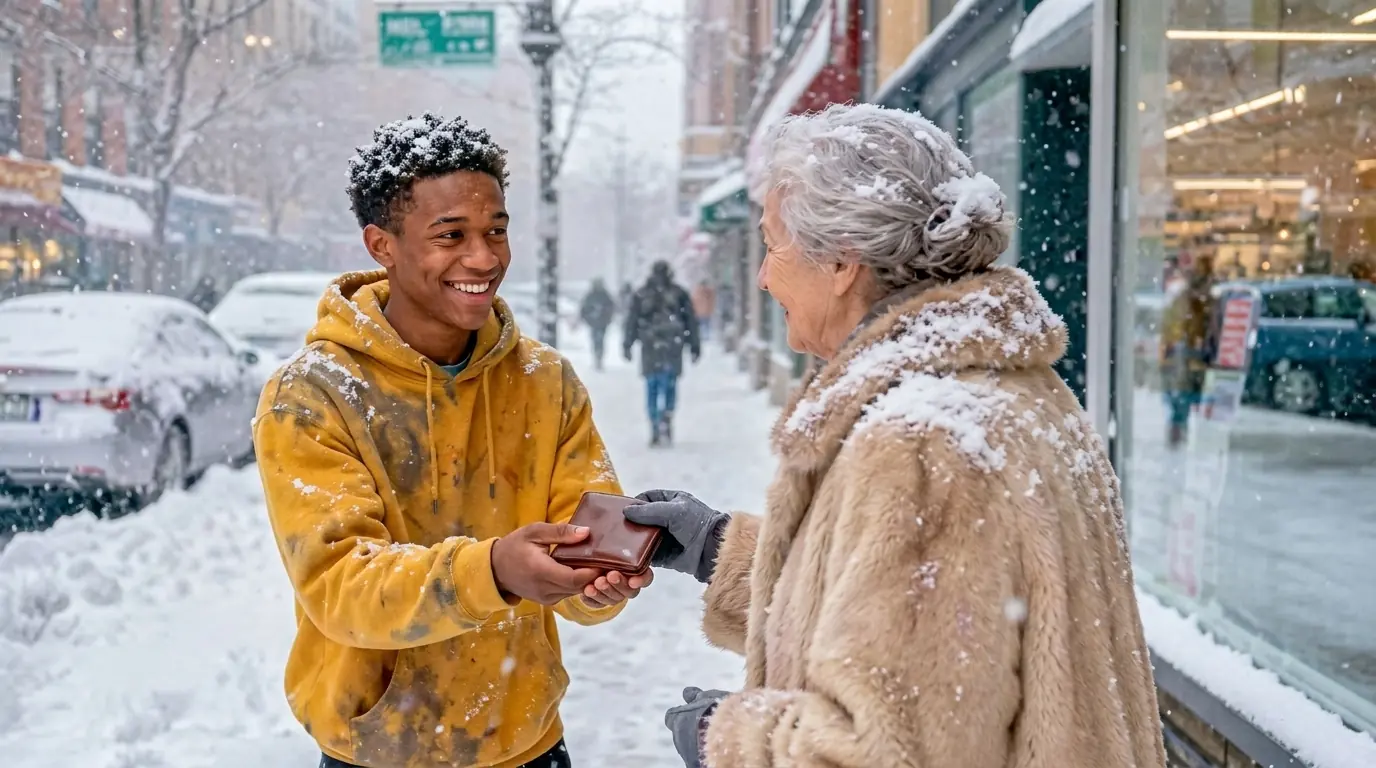
Lunch at Riverside House had been three hours ago. A thin slice of bread with peanut butter, shared between eighteen kids who all needed more. His portion had been even smaller because he had given half to little Emma, who was only six and cried herself to sleep most nights.
His hands were numb. He shoved them deeper into his pockets, but there was a hole in the left one, and his fingers just pushed through to the frigid air outside.
He had been meaning to fix that hole for weeks, but thread cost money, and money was something he did not have.
Everything cost money.
Existing cost money.
And Daniel was running out of time.
In a few months, he would age out of the system. He would be on his own. No support, no safety net, no family to fall back on, just him and whatever he could scrape together before that deadline arrived like a wall he could not stop.
The thought kept him awake most nights, panic rising in his chest as he calculated and recalculated how he would survive, where he would go, what would happen when the only home he had disappeared.
“Just got to make it back,” he muttered to himself, pushing forward through the storm.
That was when he saw her.
An older woman, maybe seventy-five or more, stood on the corner ahead. Everything about her screamed wealth. The long cashmere coat that looked like it cost more than a year of groceries. The leather handbag with gold hardware that gleamed even in the dim afternoon light. The pearl earrings visible even from twenty feet away.
The way she held herself like the sidewalk belonged to her, like the world bent to accommodate her presence.
She was talking on her phone, one hand gesturing sharply as she spoke, clearly agitated about something important. Business probably. Stocks. Investments. Things people like Daniel would never understand because they lived in a different universe entirely.
“Yes, I understand the portfolio needs rebalancing, but…”
She stepped off the curb, still talking, her attention completely absorbed in whatever crisis was unfolding in her privileged world.
Her foot hit a slick patch of ice hidden beneath fresh snow.
She stumbled and caught herself on a streetlight, but her purse swung wide. A brown leather wallet flew out, tumbling through the air like a bird shot mid-flight before hitting the ground with a muffled thud.
The woman did not notice.
She kept walking, still talking into her phone, her voice fading as she disappeared around the corner, completely oblivious to what she had lost.
The wallet sat there in the snow for maybe three seconds.
Then the wind pushed it.
Slowly at first, then faster, sliding along the icy sidewalk toward the storm drain, where it would disappear forever into Detroit’s underground, lost in the labyrinth of sewers and forgotten things.
Daniel was already moving.
He ran, his worn sneakers slipping on the ice, his arms windmilling to keep his balance.
The wallet was eight feet from the drain.
Six feet.
Four.
Daniel dropped to his knees, his jeans immediately soaking through. The cold concrete bit into his skin through the wet fabric like teeth.
His hand shot out, fingers scraping against wet leather just as the wallet reached the edge of the grate, teetering on the edge between salvation and loss.
Got it.
He stayed there for a moment, kneeling in a puddle of slush that had already soaked through his jeans to his skin. His hand clutched tight around the wallet.
Snow fell on his face, melting into his eyes, dripping from his chin. His knees throbbed where they had hit the concrete, probably scraped raw beneath his jeans.
“Man, you okay?”
An older teenager passing by paused, looking concerned. He was bundled in a thick parka, warm and dry, the kind of coat Daniel dreamed about.
“Yeah.”
Daniel pushed himself up, wincing as gravel and ice stuck to his scraped knees. He looked down at the wallet in his hands.
It was heavy.
Real leather. Soft and expensive. The kind that got better with age instead of falling apart. The kind that probably cost more than Daniel had spent on clothes in his entire life.
The stitching was perfect. The leather was supple and rich. Even wet and cold, it felt like quality.
He turned it over, and his breath caught.
Daniel opened it.
The first thing he saw was the cash.
Bills. Lots of them. Crisp and new, stacked thick in the main compartment.
His eyes flicked over the numbers.
Twenties. Fifties. Hundreds.
More money than he had ever held in his life.
He carefully pulled out the stack, trying to count.
Thirty. Forty. Fifty.
He stopped.
There had to be at least $4,500 here.
$4,500.
That was food.
Real food.
Hot meals for months. That was protein and vegetables and fruit that was not bruised. That was eating until he was full, not just until the pain stopped.
That was cooking real dinners for the little kids at Riverside. Watching their faces light up when they got seconds, when there was actually enough.
That was new shoes that did not have holes. Shoes that kept his feet dry. Shoes that did not give him blisters.
That was a winter coat that actually kept him warm. One with real insulation and a hood that worked. That was socks without holes, underwear that was not falling apart, jeans that fit properly.
That was textbooks for next semester without having to choose between eating and studying. That was not having to check out books from the library and pray nobody else needed them.
That was being able to afford the online access codes that professors required, the ones that cost $100 and made the difference between passing and failing.
That was a security deposit on an apartment when he aged out of the system in one year.
That was first and last month’s rent.
That was furniture from Goodwill instead of sleeping on the floor.
That was not being homeless with nowhere to go and no one to help.
That was a future that did not end in a shelter or a street corner.
That was everything he needed.
Everything he dreamed about in the desperate hours between midnight and dawn, when sleep would not come, and his stomach growled, and the weight of his uncertain future pressed down on his chest like a stone.
Daniel swallowed hard, his throat tight.
His fingers moved through the rest of the wallet on autopilot, his brain still stuck on those bills, on what they could mean, on the life they could buy.
Credit cards.
Black ones. The kind he had heard were for rich people who spent more in a day than Daniel saw in a year.
A driver’s license.
He pulled it out, tilting it to catch the light from a nearby streetlamp that had just flickered on in the gathering dusk.
Catherine Anne Whitmore.
The address was in Grosse Pointe, one of the wealthiest neighborhoods in Michigan. Maybe one of the wealthiest neighborhoods in America.