Knit’s Recovery After Losing Her Owner and Waiting Six Months
Reader Theme:
Font Size:
24px
Knit’s Recovery After Losing Her Owner and Waiting Six Months
PART 2 — CURRENT CONDITION UPDATE
Knit is now living in a quiet medical foster home while our veterinary team treats a serious protein-losing kidney disorder. She is stable, eating more consistently, and beginning to engage with her new surroundings. However, her condition will require continued medication, testing, and careful observation.
The kidneys normally filter waste from the blood while retaining proteins and other substances the body needs. In Knit’s case, the filters within the kidneys appear damaged. Albumin and other important proteins are passing through them and being lost in her urine.
This condition is called protein-losing nephropathy. It can develop from inflammation within the kidney filters, immune-system disease, certain infections, inherited disorders, or other underlying illnesses. In some dogs, the precise original cause cannot be identified.
Knit’s initial bloodwork showed a severely reduced albumin level. Albumin helps keep fluid inside blood vessels. When the level becomes too low, fluid can leak into surrounding tissues or body cavities.
That process likely caused the soft swelling around Knit’s lower legs and the small amount of fluid seen inside her abdomen. She was not yet struggling to breathe, and chest imaging did not show a dangerous accumulation around her lungs.
Her urine protein-to-creatinine ratio was markedly elevated, confirming that the protein loss was far beyond what could be explained by stress or a minor urinary issue. The sample was collected carefully, and a urine culture was submitted to rule out infection.
The culture did not grow significant bacteria. This made a simple bladder infection an unlikely explanation for the abnormal result. Repeat testing on a second sample again showed severe protein loss.
Knit’s kidney filtration values were only mildly elevated when she arrived. This means the kidneys are still performing much of their waste-removal function, but they are not retaining protein normally. A dog can have serious glomerular disease before traditional kidney values become dramatically abnormal.
Her blood pressure was also high. Hypertension can both result from kidney disease and cause further injury to the kidney filters. Left untreated, it may also damage the eyes, brain, heart, and other organs.
Knit has started medication to lower her blood pressure and reduce the amount of protein escaping through the kidneys. The dose must be adjusted carefully because lowering blood pressure too far could reduce circulation and make her weak.
Her pressure is checked under calm conditions because fear can temporarily raise the measurement. Knit rests beside a familiar caregiver for several minutes before the cuff is placed around her leg or tail.
During the first examination, she trembled and attempted to stand each time the cuff tightened. The team obtained several readings and used the most consistent measurements rather than relying on a single number.
She now tolerates the procedure more easily. Her caregiver sits near her head while Knit holds the edge of her sweater. Recent readings show improvement, though the pressure remains above the ideal range.
Knit is also receiving medication to reduce the risk of blood clots. Dogs who lose significant protein through their kidneys may also lose natural substances that help prevent abnormal clotting. Combined with inflammation, this can place them at risk for a clot traveling to the lungs or another organ.
The medication lowers that risk but cannot remove it entirely. Knit’s caregivers watch for sudden breathing difficulty, collapse, severe weakness, coughing, a painful limb, confusion, or a sudden inability to walk.
She has not shown any of those emergency signs. Her breathing remains quiet while she sleeps, and her resting respiratory rate is recorded each day to establish a reliable baseline.
The small amount of abdominal fluid does not currently require drainage. Removing it unnecessarily could cause further protein loss and introduce infection. The team will intervene only if the fluid becomes uncomfortable, compromises breathing, or makes eating difficult.
Knit’s abdominal measurement is recorded regularly at the same location. Her caregiver also watches whether the abdomen becomes tight, enlarged, or painful. The swelling has not increased since treatment began and may be slightly reduced.
Additional testing has been performed to search for an underlying trigger. Knit tested negative on an initial panel for common tick-borne illnesses and heartworm disease. A broader infectious-disease panel was submitted because some chronic infections can damage kidney filters.
Chest X-rays and abdominal ultrasound did not reveal an obvious cancerous mass. Her liver, spleen, and lymph nodes appeared generally normal. Both kidneys had mild changes in texture, but neither was obstructed or severely shrunken.
A test for immune-related disease did not provide a definitive answer. Kidney biopsy is sometimes used to identify the exact type of glomerular damage, but it carries a bleeding risk and may not immediately change the treatment plan.
For now, the internal-medicine specialist has recommended medical management and close monitoring rather than an invasive biopsy. That decision may be reconsidered if Knit’s protein loss worsens, her kidney function declines rapidly, or she fails to respond as expected.
Her diet has been changed gradually. Knit now receives a veterinary renal-supportive food with controlled sodium and carefully balanced protein. The goal is not to eliminate protein, which her body still needs, but to avoid excessive amounts that could increase the kidneys’ workload.
The food also contains nutrients intended to support kidney health and reduce inflammation. Warm water is mixed into each meal to promote hydration.
Knit refused the new diet when it was first offered by itself. The foster caregiver began blending a small amount with the food she already recognized and increased the proportion over several days.
She now eats two moderate meals daily and usually finishes both. Her appetite is best when the bowl is placed beside her bed and the room remains quiet.
Knit is slightly underweight, but the veterinary team does not want to force rapid weight gain. Her nutritional plan must balance calories, kidney support, and the severe loss of protein. Her body weight and muscle condition are checked weekly.
She has gained a small amount since entering foster care. Her ribs are still easier to feel than they should be, and the muscles over her hips remain thin. However, she no longer appears to be losing weight.
Her albumin level has risen slightly on the most recent blood test. It remains below the safe range, but even a modest improvement suggests that treatment may be reducing the loss or helping her body recover.
The urine protein ratio has also decreased, though it is still significantly abnormal. The veterinary team will need several measurements over time before deciding whether the response is adequate.
Knit’s kidney filtration values have remained stable rather than worsening. Her potassium and other electrolytes are within acceptable limits. These results allow the current medications to continue, but they will be checked regularly because the treatment itself can alter kidney values and blood pressure.
Her water consumption and urination are monitored at home. Knit drinks more than some dogs her size, but the amount has not increased suddenly. She urinates without straining and has not had accidents while resting.
Her foster caregiver measures the water placed in the bowl and records an approximate amount remaining each day. The goal is not to restrict her access but to identify meaningful changes.
Knit’s coat was dry and shedding unevenly when she left the shelter. Protein loss, stress, and inconsistent grooming may all have contributed. Skin examination did not reveal mange mites, a major infection, or open wounds.
She receives gentle brushing in brief sessions. At first, she became tense if anyone approached while the sweater lay nearby. The caregiver began grooming only when Knit chose to leave it on the bed.
Knit now allows her shoulders, back, and sides to be brushed. The coat has started to feel softer, and the heavy loose undercoat is gradually disappearing.
The swelling in her lower legs made her skin more vulnerable to irritation. The caregiver checks each leg for redness, warmth, cracking, or areas where fluid might leak through damaged skin. None has developed.
Her nails were overgrown and reduced her traction. They were shortened gradually so she could stand more comfortably without placing unnecessary stress on her joints.
Orthopedic examination showed mild stiffness in her hips but no fracture or severe arthritis. Most of her weakness appears related to low protein, reduced muscle, and months of limited activity.
Knit’s walks are short and slow. She wears a padded harness and stays on level ground. Long walks, running, and strenuous play will wait until her albumin and strength improve.
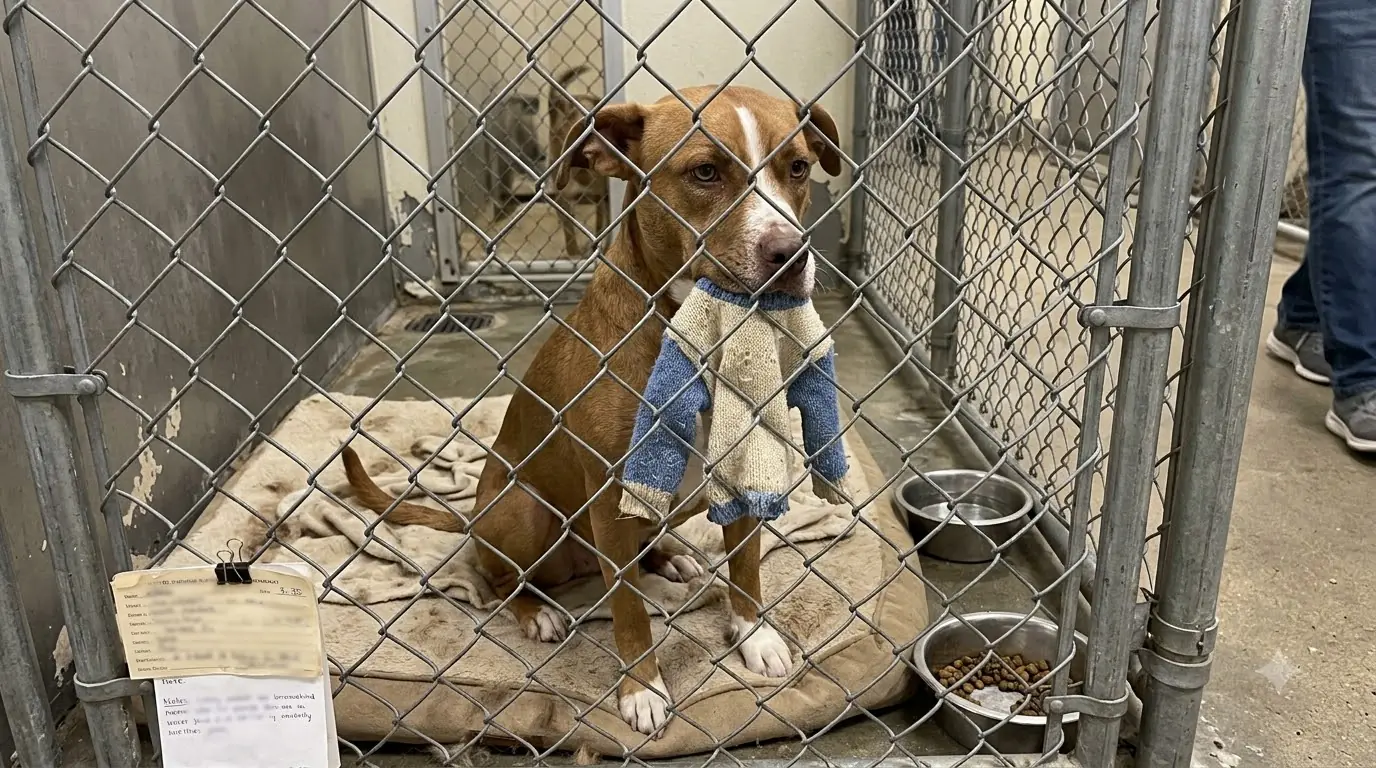
During her first foster outing, Knit carried the sweater in her mouth. She walked only to the edge of the yard, placed it on the grass, and stood over it while smelling the air.
Her caregiver did not pull her forward. After several minutes, Knit picked up the sweater and returned to the house. The entire outing lasted less than five minutes.
She now leaves the sweater on her bed for some bathroom trips. She walks to the grass, explores a small area, and returns without appearing frantic. This is one of the clearest signs that she is beginning to trust the new environment.
Knit’s sweater is treated as a personal possession, not a training object. No one uses it to lure her, tests whether she will surrender it, or removes it unnecessarily.
The sweater no longer fits, and it is not placed on her body. It has several loose threads that could become hazardous if swallowed, so the foster caregiver supervises when Knit carries it.
A textile conservator who volunteers with the rescue helped stabilize a damaged seam using safe stitching without changing the sweater’s familiar scent more than necessary. It was returned to Knit the same day.
While it was being repaired, Knit received a similarly colored fleece cloth to rest with. She accepted the substitute but continued looking toward the shelf where the original had been placed.
When the sweater was returned, she smelled it carefully, lifted it by one sleeve, and carried it to her bed. She circled once, lay down, and rested her chin across it.
Knit has never attempted to tear the sweater in our care. She holds it gently, much as another dog might carry a favorite stuffed toy. Its significance cannot be proven, but it is clearly associated with security and familiarity.
Shelter records explained that the sweater was made by her former owner. It arrived with Knit after the owner’s death and became the only familiar item in an otherwise unfamiliar kennel.
For six months, it absorbed the smells of her bed, her coat, and the people who cared for her. By the time our rescue met her, it represented more than one memory. It had become part of her coping routine.
Emotionally, Knit remains quiet and cautious. She does not rush toward visitors or demand attention. She studies people from her bed and approaches only after their movements become predictable.
During her first evening in foster care, she placed the sweater beneath her chin and faced the front door. Every vehicle sound caused her to lift her head.
She refused to sleep deeply while the caregiver remained across the room. When the caregiver sat on the floor beside the bed, Knit’s breathing slowed and her eyes eventually closed.
The caregiver stayed until Knit entered a deeper sleep. Nothing was taken from her, and no attempt was made to pull her closer. The purpose was simply to show that a person could remain nearby without asking for anything.
Knit now sleeps on her side for several hours each night. The sweater usually rests between her front paws, but she does not always hold it in her mouth.
She has begun greeting her foster caregiver in the morning. She raises her head, moves her tail against the bed, and waits while medication is prepared inside a small portion of food.
Knit takes most tablets easily when they are hidden in her meal. She resisted one bitter medication after tasting it, so the veterinary team provided an alternative formulation. Forcing her mouth open repeatedly would have added unnecessary stress and risked damaging trust.
She responds well to a chin-rest behavior taught by the medical team. Knit places her chin on a padded towel while blood is drawn or her blood pressure cuff is positioned. The behavior gives her a clear, familiar task during procedures.
If she lifts her head, the team pauses whenever medically safe. Allowing that small amount of choice has reduced trembling and made repeat testing easier.
Knit has started following her caregiver from the bedroom to the kitchen without carrying the sweater. She waits at the doorway while breakfast is prepared, then returns to the bed when called.
One afternoon, she remained in the living room while the sweater was in the bedroom. She noticed its absence, looked toward the hallway, and then lay beside the caregiver’s chair instead of going to retrieve it.
These changes do not mean the sweater should be removed. They show that Knit is developing additional sources of safety rather than depending on a single object for every moment of comfort.
Visitors are asked to ignore her initially. They sit sideways, avoid staring, and keep their hands low. Knit usually smells their shoes before deciding whether to remain nearby.
She has met one volunteer several times. During the first meeting, Knit did not leave her bed. During the second, she approached long enough to smell the volunteer’s hand.
On the third visit, Knit carried the sweater into the living room, placed it beside the caregiver’s chair, and allowed the volunteer to rub her chest. She returned to the sweater afterward but did not carry it away.
She has shown no aggression toward people. Still, caregivers respect the warning signs of discomfort, including turning her head away, closing her mouth, stiffening, or positioning herself between a person and the sweater.
Knit has observed a calm adult dog through a secure barrier. She watched quietly, smelled the air, and then returned to her bed. There was no barking or lunging, but direct interaction will wait until her health is more stable.
Her history with cats and young children is unknown. A peaceful home with predictable routines will likely be better for her than a household with constant noise, running, or frequent visitors.
Mental enrichment is kept gentle. Knit searches for pieces of her approved food in folded towels, practices simple stationary cues, and chooses between two containers during scent games.
She does not show much interest in balls or squeaking toys. Her preferred activity is sitting beside a familiar person while holding the sweater loosely between her front teeth.
The next major medical milestone will be repeat bloodwork, urine protein testing, and blood-pressure measurement. The team wants to see a continued rise in albumin and a meaningful decline in urinary protein loss.
If the values improve, Knit will remain on the current plan with adjustments as needed. If protein loss remains severe, another medication may be added to provide greater kidney protection.
If her kidney filtration values worsen, the diet and medication doses will need to be reassessed. Advanced disease could eventually require more intensive supportive care, additional nausea control, fluid therapy, or hospitalization.
Her risk of blood clots will remain a concern until the albumin and urinary protein levels become safer. Anti-clotting medication must not be stopped without veterinary direction, even if Knit appears outwardly healthy.
The rescue team is cautiously encouraged. Knit’s blood pressure is lower, the leg swelling has decreased, her weight is stable, and both her albumin level and urine protein ratio have moved in the desired direction.
She is not yet medically cleared for adoption. Her treatment response must remain consistent, and her long-term medication needs must be established before another transition.
A future family will need to give medication on schedule, maintain her prescribed diet, attend regular blood and urine tests, and recognize emergency signs. They must never restrict water and should monitor changes in appetite, breathing, swelling, urination, and energy.
They will also need to accept the sweater as part of Knit’s life. It may eventually need further repair or safe preservation, but it should never be taken simply to force her to “move on.”
Grief does not follow a schedule, and dogs cannot explain which smells, textures, or routines help them feel connected to a life that disappeared. What we can do is respect what brings them comfort while helping them build something new.
Knit still sleeps with the sweater most nights. But she now leaves it behind for short walks, eats while her caregiver remains beside her, and sometimes chooses a human knee as the place to rest her chin.
Her kidney disease remains serious, and there is no promise that every lost protein can be restored. Today, however, the fluid in her abdomen has not increased, her breathing is comfortable, and her laboratory values show early improvement.
Knit lost her owner, her home, and the routine she understood. She held on to the one familiar thing she had left.
Now the sweater rests on a warm bed, and Knit no longer has to guard it alone.
News in the same category
Sainty’s Recovery After Being Struck and Left Beside the Road
Rex’s Recovery After Six Months Waiting With His Tennis Ball
Clockwork’s Recovery After 22 Months in the Shelter
A Puppy Stopped to Say Goodbye to His Senior Friend Before Leaving the Shelter
Bella’s Recovery After an Owner Surrender and Medical Crisis

A Tiny Dog Was Found Trapped Above Rushing Water Beside a Highway
Nova’s Recovery After Giving Birth to Six Puppies in a Shelter
Iris’s Recovery After Two Years in a Shelter Kennel
Grace’s Recovery After 202 Days in the Shelter
A Mother Dog and Her Five Puppies Were Abandoned in a Cardboard Box
Atlas’s Recovery After Five Months of Watching Visitors Pass
Lucky’s Recovery After Eight Months in a Shelter Kennel
What's next for Shadow after Jackie's death?
A Starving Dog Was Rescued After Being Trapped Without Food for Days
Captain’s Recovery After Seven Months in a Concrete Kennel
Daily’s Recovery After Losing Her Owner at Age 11
A Frightened Dog Was Found Trapped in a Thorn Bush Beside the Highway