Last Night, My Son Hit Me—Then This Morning, Everything Changed
Last night, my son hit me.
Not accidentally.
Not while trying to push past me.
He looked directly into my face, raised his hand, and struck me across the cheek.
The sound was sharper than the pain.
For a moment, neither of us moved.
My son, Nathan, stood in the center of my kitchen breathing heavily.
His right hand remained half raised.
I could see the shock in his eyes.
Not regret.
Shock that he had actually done it.
I touched my cheek.
It was already beginning to burn.
I didn’t cry.
I didn’t shout.
I didn’t threaten him.
I didn’t ask what had happened to the little boy who used to hold my hand whenever we crossed the street.
I simply stood there and let the silence settle between us.
Nathan lowered his hand.
Then his expression hardened again.
“You made me do that.”
I looked at him.
He believed what he had just said.
Behind him, his wife, Lauren, stood near the dining-room doorway with her arms folded across her chest.
She had watched everything.
She didn’t look frightened.
She looked satisfied.
Nathan pointed at me.
“This is my house now. You need to understand that.”
The house had belonged to me for thirty-two years.
I had paid the mortgage after my husband died.
I had repaired the roof.
I had raised Nathan beneath that ceiling.
But over the previous eleven months, my son had begun calling it his house.
At first, it sounded like a figure of speech.
Then it became a warning.
I lowered my hand from my face.
“Go to bed,” I said.
Nathan laughed.
“You don’t give orders anymore.”
I looked past him toward Lauren.
She smiled slightly.
That was when I understood something I should have understood months earlier.
They no longer saw me as family.
They saw me as an obstacle.
I walked upstairs without saying another word.
Nathan called after me.
“Maybe now you’ll finally learn.”
I closed my bedroom door.
Then I sat on the edge of my bed and listened to them laughing downstairs.
At 4:30 the next morning, I got up.
I showered.
Covered the red mark on my cheek as well as I could.
Then I took the good white tablecloth from the linen cabinet.
The one we used only at Christmas.
I polished the silverware.
I made Nathan’s favorite breakfast.
Cinnamon French toast.
Crisp bacon.
Scrambled eggs with cheddar.
Fresh coffee.
Everything was arranged perfectly, exactly the way he liked it.
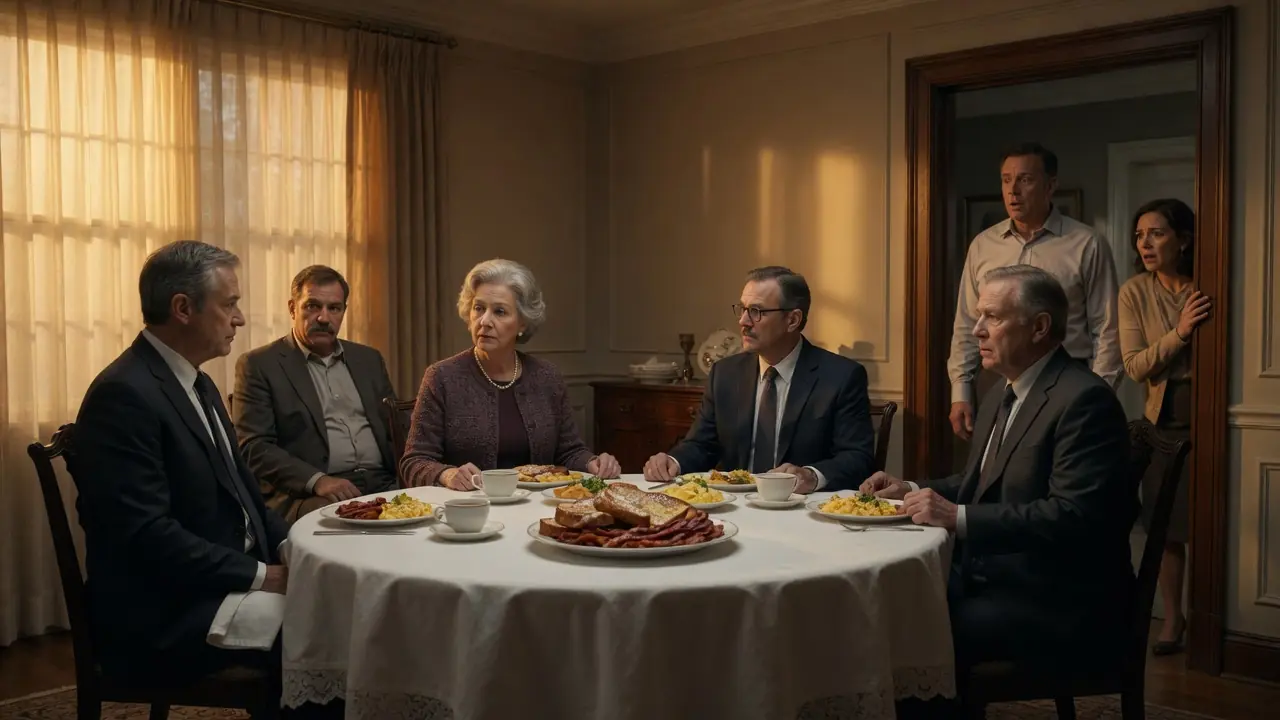
When Nathan came downstairs shortly after seven, he stopped at the dining-room entrance.
He looked at the table.
Then at me.
A smirk crossed his face.
“So,” he said, “you finally learned.”
I smiled.
I did not answer.
Nathan pulled out his usual chair.
Then he noticed the extra place settings.
His smile weakened.
He looked around the dining room.
One chair was occupied by my attorney.
Another by a police detective.
At the far end sat Nathan’s employer.
Beside him was the bank’s fraud investigator.
Lauren entered behind Nathan.
She saw the guests and froze.
Nathan looked at me.
Then higher.
Above the fireplace, a television screen displayed the security footage from the previous night.
His raised hand.
My face turning with the blow.
Lauren watching from the doorway.
The room became completely silent.
Nathan’s mouth opened.
No sound came out.
I poured myself a cup of coffee.
Then I said the first words I had prepared all morning.
“Sit down. We have a lot to discuss.”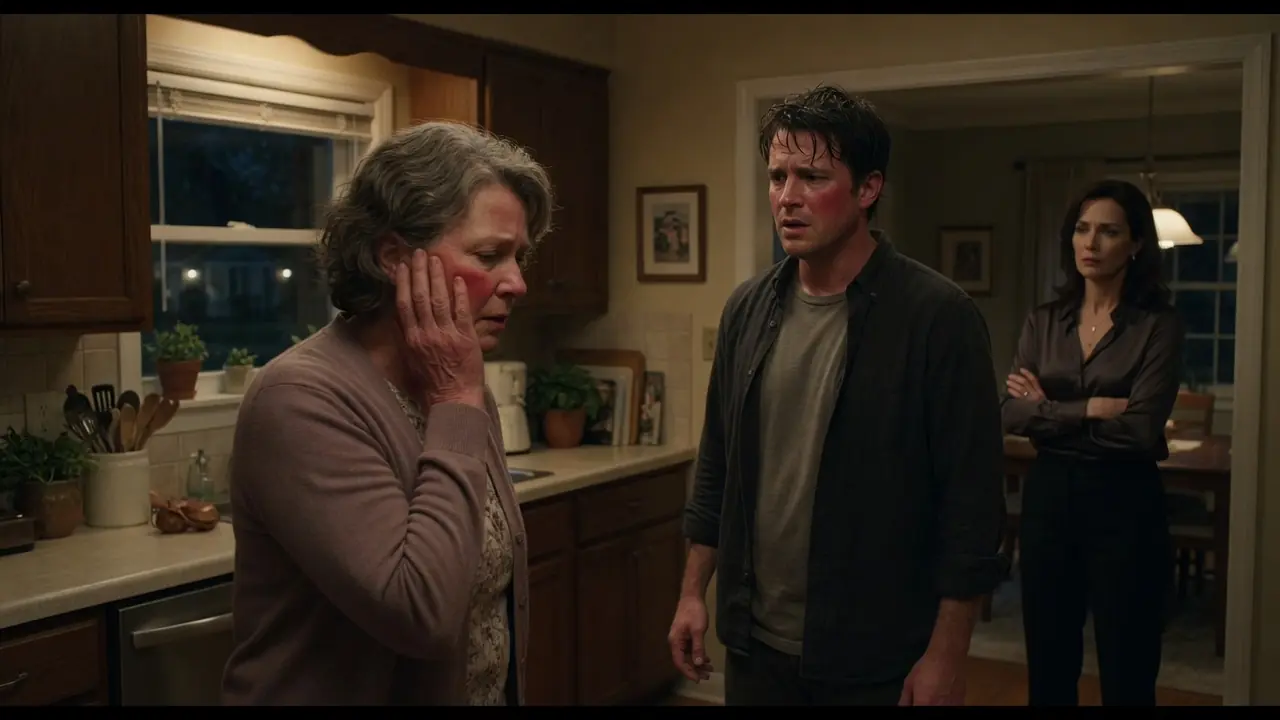
Nathan had not always been cruel.
That is the part people struggle to understand.
They imagine violence arriving fully formed.
A bad child.
A bad marriage.
A bad man.
But Nathan had once been gentle.
When he was five, he cried because he stepped on a beetle.
When he was eight, he spent an entire afternoon building a cardboard shelter for a stray cat.
After his father died, Nathan slept beside me for weeks because he thought I would disappear too.
For most of his life, he called me every Sunday.
He remembered my birthday.
He brought groceries when I had the flu.
If someone had told me ten years earlier that my son would one day strike me inside the house where I raised him, I would have laughed.
Then I would have become angry at them for suggesting it.
But people can change slowly enough that love keeps finding explanations.
Stress.
Marriage.
Money.
Grief.
Pressure.
I found an excuse for every warning until the excuses became more frightening than the truth.
My husband, Robert, died when Nathan was seventeen.
A heart attack took him in the middle of an ordinary workday.
He had been an electrician.
A careful man.
The kind who labeled every wire and saved every receipt.
He left us the house, a modest life insurance policy, and a notebook containing instructions for every practical problem he imagined might happen after his death.
How to reset the boiler.
Which mechanic was honest.
Where the property documents were stored.
On the final page, he wrote:
Make sure Nathan knows this house is always his home, but never let him confuse home with ownership of you.
At the time, I didn’t understand why he chose those words.
Years later, I wondered whether Robert had seen something in Nathan that I had missed.
Or perhaps he simply understood the danger of love without boundaries.
Nathan struggled after his father died.
His grades dropped.
He became angry.
He stopped seeing friends.
I paid for counseling.
He attended twice.
Then refused to return.
I did not force him.
That was one of many moments when I chose peace over structure.
He graduated.
Tried college.
Dropped out.
I told him it was fine.
He worked different jobs.
Quit some.
Lost others.
Each time, I helped.
Rent.
Car repairs.
Credit-card bills.
Training courses.
I believed support would help him regain confidence.
Instead, he learned that every fall had a soft place beneath it.
Me.
At twenty-nine, Nathan met Lauren.
She was beautiful in a polished, controlled way.
Every strand of hair seemed intentional.
Every sentence sounded prepared.
She worked in luxury real estate and spoke often about wealth, status, and people who “knew how to leverage assets.”
The first time she visited my house, she walked from room to room evaluating it.
“Original floors,” she said.
“Large lot.”
“Excellent redevelopment potential.”
I laughed.
“This is my home, not a listing.”
She smiled.
“Everything is a listing eventually.”
I assumed it was a joke.
Lauren rarely joked.
They married after eleven months.
The wedding cost more than Nathan earned in a year.
I paid part of it.
Lauren’s parents promised to cover the reception, then claimed unexpected business problems.
Nathan asked me for fifteen thousand dollars.
I gave him ten.
He complained about the remaining five.
That should have warned me.
Instead, I told myself weddings made people unreasonable.
After the ceremony, he hugged me and whispered, “I don’t know what I’d do without you.”
At the time, it felt loving.
Later, I understood it as a statement of dependency.
For the first two years of their marriage, Nathan and Lauren lived in an expensive apartment.
They drove leased cars.
Ate at restaurants constantly.
Took vacations they posted online with captions about “building the life we deserve.”
They also accumulated debt.
Nathan worked in procurement for a construction company.
His salary was respectable.
It was not enough for the life they performed.
Lauren’s income was unpredictable.
Every few months, Nathan called.
A payment was late.
A client had backed out.
The car needed repairs.
The rent had increased.
I helped until my savings began to shrink.
Then I said no.
Two weeks later, they announced they were moving in with me temporarily.
Not asked.
Announced.
“Our lease ends next month,” Nathan said.
“You have a spare bedroom.”
“For how long?”
“Six months. Maybe less.”
Lauren smiled.
“We’ll help you modernize the place.”
I should have said no.
Instead, I cleared the guest room.
Six months became eleven.
They paid no rent.
At first, they bought groceries.
Then stopped.
Lauren replaced my curtains without asking.
Nathan moved Robert’s tools from the garage into a shed because he wanted space for gym equipment.
They invited friends over.
Used my dining room for business meetings.
Changed the Wi-Fi password.
Each boundary disappeared so gradually that objecting to the next one felt petty.
When I did object, Nathan accused me of being controlling.
“You said this was our home too.”
“I said you could stay temporarily.”
“We’re family.”
That sentence became a weapon.
Family meant I owed them access.
Money.
Silence.
Space.
They owed me nothing in return.
The first time I realized they wanted the house, I overheard Lauren speaking on the phone.
She was in the kitchen.
I was in the hallway.
“The lot alone is worth almost nine hundred,” she said. “Once she transfers it, we can refinance.”
I stepped into the room.
“Once who transfers what?”
Lauren turned.
She did not look embarrassed.
She looked annoyed.
“It’s a client.”
“You said ‘she.’”
“I have female clients.”
Then she walked away.
That evening, I checked the desk where I kept my property papers.
The folder had been moved.
Nothing appeared missing.
I bought a small lockbox the next day.
Nathan mocked me.
“Who do you think is going to steal your deed?”
I looked at him.
He laughed.
The answer was standing in front of me.
A month later, Nathan brought me forms.
He said they were part of an estate-planning package.
“Lauren found a lawyer who can help avoid taxes.”
“I already have an attorney.”
“Yours is old-fashioned.”
“My attorney helped your father and me buy this house.”
“That was thirty years ago.”
I read the first page.
It was not a simple estate plan.
The documents would transfer the house into a family trust controlled jointly by Nathan and Lauren.
I would retain the right to live there, but they would gain authority to refinance, borrow against the property, and make decisions regarding sale.
I closed the folder.
“No.”
Nathan looked surprised.
“You haven’t read everything.”
“I read enough.”
“This protects you.”
“It gives you control.”
“We’re your only family.”
“That does not make you my owners.”
His face changed.
For a second, I saw a flash of anger so intense it frightened me.
Then he smiled.
“You’re being paranoid.”
Lauren began using that word often afterward.
Paranoid.
Forgetful.
Confused.
Difficult.
They said it casually.
Around neighbors.
At the bank.
During a doctor’s appointment Lauren insisted on attending.
A story was being built around me.
I recognized it too late.
My attorney, Helen Brooks, recognized it immediately.
I had known Helen for twenty-five years.
She handled Robert’s estate.
She helped me update my will.
When I showed her the trust documents, she removed her glasses and said, “Do not sign anything Nathan brings you.”
“I wasn’t planning to.”
“Have they asked about your accounts?”
“Yes.”
“Insurance?”
“Yes.”
“Power of attorney?”
“Twice.”
She leaned forward.
“Margaret, this is financial grooming.”
The phrase shocked me.
“That sounds dramatic.”
“It is accurate.”
“He’s my son.”
“That does not make you immune from exploitation.”
I wanted to defend him.
Instead, I told her about the moved property folder.
The overheard phone call.
The comments about my memory.
Helen asked whether I wanted to remove them from the house.
I said no.
Not yet.
I still believed the situation could be corrected through conversation.
Love often survives several pieces of evidence after trust has already died.
Then money disappeared.
Four thousand dollars from a savings account.
The withdrawal had been made online.
The bank record showed access from my home computer.
Nathan denied it.
Lauren said I had probably forgotten making the transfer.
The money entered an account connected to a company I did not recognize.
Helen traced the company.
It belonged to Lauren.
We reported the transaction.
The bank opened an investigation.
Nathan became furious.
“You reported your own family for fraud?”
“I reported an unauthorized withdrawal.”
“You could have asked me.”
“I did.”
“You’re trying to humiliate us.”
Lauren began crying.
She said the transfer was a misunderstanding.
Nathan had borrowed the money to cover a business expense.
He intended to repay it.
No one had asked permission.
That detail meant nothing to them.
I demanded repayment.
Nathan returned half.
Then stopped.
The atmosphere in the house changed.
Cabinets slammed.
Doors closed harder.
Conversations ended when I entered rooms.
Lauren began photographing documents.
Nathan accused me of turning his childhood home into a hostile environment.
One evening, he said, “Dad would be ashamed of you.”
That sentence nearly worked.
He knew exactly where to strike.
Then I remembered Robert’s notebook.
Never let him confuse home with ownership of you.
I called Helen.
We began preparing eviction papers.
Quietly.
The night Nathan hit me began with the garage.
I found Robert’s tool chest open.
Several expensive tools were missing.
Nathan admitted he had sold them.
“We needed money.”
“Those belonged to your father.”
“He was my father too.”
“They belong to me.”
“You don’t even use them.”
“That isn’t the point.”
Lauren entered.
“You’re hoarding things in a house that’s falling apart.”
“This house is not yours.”
Nathan stepped closer.
“You keep saying that.”
“Because you keep forgetting it.”
His jaw tightened.
“You’d rather let everything rot than help your own son.”
“I have helped you for years.”
“You control everything.”
“I paid for everything.”
“You think money makes you powerful.”
“No. Ownership gives me legal rights.”
The sentence enraged him.
He grabbed the eviction notice from the counter.
“You’re throwing us out?”
“I’m giving you thirty days.”
“You can’t do that.”
“I can.”
“This is my home.”
“No. It is where you are staying.”
Lauren said, “Nathan, she’s confused.”
I turned toward her.
“I am not confused.”
Nathan stepped between us.
“You need to stop.”
“Stop what?”
“Acting like a victim.”
“I haven’t said I’m a victim.”
“You called the bank. You called a lawyer. Now you’re evicting us.”
“Because you stole money and tried to gain control of my house.”
His face became red.
“You don’t understand anything.”
Then he hit me.
The security camera captured everything.
Nathan had installed the cameras himself after claiming the neighborhood was becoming unsafe.
He controlled the app.
But he did not know I had requested separate access through the security company.
Helen’s suggestion.
The kitchen camera recorded the argument.
The blow.
Lauren’s reaction.
Nathan’s statement that I made him do it.
And his declaration that the house belonged to him.
When I reached my bedroom, I downloaded the footage.
Then I called Helen.
She answered on the second ring.
“He hit me,” I said.
Her voice changed.
“Are you safe?”
“For the moment.”
“Lock the door.”
I did.
“Call the police.”
“I’m not ready.”
“Margaret.”
“I need one night.”
“Why?”
“Because this does not end with him denying it.”
She became quiet.
Then said, “What are you planning?”
“A breakfast.”
The first person I invited was Detective Samuel Ortiz.
He had been assigned to the bank fraud complaint.
We had spoken twice.
I sent him the video.
He called immediately.
“You need to leave the house.”
“No.”
“Mrs. Whitmore, your son assaulted you.”
“I understand.”
“Do you have somewhere safe?”
“My bedroom door locks.”
“That is not enough.”
I told him Nathan had a meeting at nine and usually left the house by eight.
I asked whether officers could arrive at seven.
Ortiz resisted.
Then he understood I was not asking for revenge.
I wanted witnesses.
I wanted the house, the fraud, and the assault addressed in one controlled setting.
He agreed on the condition that officers remain close.
The second person was Helen.
The third was Nathan’s employer, Marcus Green.
That invitation required explanation.
During the bank investigation, we discovered the company receiving some of my money had also received payments from Nathan’s employer.
The transfers appeared connected to vendor invoices Nathan had approved.
Helen suspected a conflict of interest.
Possibly kickbacks.
I did not accuse him.
I sent Marcus the account information and asked whether he wished to attend a meeting concerning Nathan.
He called me at 5:40 in the morning.
His voice was guarded.
“Where did you get these records?”
“My bank.”
“Is Lauren connected to Bellstone Consulting?”
“She owns it.”
There was a long pause.
“I’ll be there.”
The bank’s fraud investigator also agreed to attend because the unauthorized transfer remained active.
By sunrise, the table was set.
Not for breakfast.
For consequences.
Nathan came downstairs wearing a pressed shirt and expensive watch.
The bruise on my cheek was visible despite makeup.
He saw it.
His eyes flickered.
Then he smelled the French toast.
His confidence returned.
He believed food meant surrender.
He believed my silence meant fear.
“So,” he said, “you finally learned.”
Then he noticed Helen.
She sat with a leather folder before her.
Detective Ortiz sat beside her in plain clothes, his badge resting on the table.
Marcus Green sat near the window.
The bank investigator, Aisha Reynolds, had a laptop open.
Two uniformed officers waited in the hallway beyond the kitchen.
Lauren entered and froze.
Nathan looked at the television.
The footage played silently.
His hand crossing the screen.
My face turning.
His own mouth forming the words:
You made me do that.
Nathan reached for the remote.
Ortiz stood.
“Don’t touch anything.”
Nathan turned.
“What is this?”
I pulled out my chair.
“Sit down.”
“I’m not sitting.”
Marcus spoke.
“You should.”
Nathan recognized his voice.
“Mr. Green?”
Marcus did not answer the greeting.
He looked at Lauren.
“Are you the owner of Bellstone Consulting?”
Her face lost color.
“No.”
Aisha turned the laptop.
“State records identify you as the registered owner.”
Nathan looked at her.
“This is about my mother’s bank complaint?”
“Partly,” she said.
Helen opened her folder.
“It is also about the attempted property transfer, unauthorized account access, sale of personal assets, and last night’s assault.”
Nathan looked at me.
“You called all these people?”
“No,” I said. “Your choices did.”
Lauren recovered first.
“This is a setup.”
Detective Ortiz looked at her.
“The camera was installed by your husband.”
“She provoked him.”
Nathan turned sharply.
“Lauren.”
She realized too late what she had said.
Ortiz’s expression hardened.
“You witnessed the assault?”
“No.”
“You just described provocation.”
“I heard an argument.”
The video continued behind them.
Lauren was clearly visible.
The room became quiet.
Marcus slid several printed invoices across the table.
“Bellstone received one hundred and eighty-six thousand dollars from vendors approved by Nathan.”
Nathan stared at him.
“That’s not what it looks like.”
“What does it look like?”
“Consulting work.”
“What services?”
Lauren answered.
“Market analysis.”
Marcus looked at her.
“For a construction materials supplier?”
“Yes.”
“Your company was formed six weeks before the first payment.”
She said nothing.
Nathan looked toward the hallway.
The officers remained still.
No one had arrested him yet.
That made him more afraid.
Aisha explained the bank transfers.
The four thousand dollars from my account was not the only access.
Someone had attempted to open a home-equity line using scanned documents.
The application listed Nathan and Lauren as future trustees.
The transfer documents contained my electronic signature.
I had never signed them.
Nathan’s face changed.
He turned toward Lauren.
“You said she agreed.”
Lauren’s eyes widened.
“Don’t.”
“You told me she signed.”
“You knew what we were doing.”
“Not that part.”
Their alliance began collapsing in front of us.
Helen watched without interrupting.
Then she placed the eviction notice on the table.
“The original thirty-day notice is withdrawn.”
Nathan looked relieved for half a second.
Helen added a second document.
“This is an emergency protective-order application and immediate termination of occupancy based on assault and suspected financial abuse.”
His relief vanished.
“You can’t remove me today.”
Ortiz spoke.
“She can request it. A judge will decide.”
“This is my mother.”
“That does not create a right to remain in her home after striking her.”
Nathan looked at me.
“You’re really doing this?”
I met his eyes.
“You did it last night.”
He began crying.
It happened suddenly.
The angry man disappeared.
The frightened child returned.
“Mom.”
I hated the effect that word had on me.
My body remembered every fever.
Every school morning.
Every time he called from college because he felt alone.
But the television still showed his hand crossing my face.
Love remained.
Trust did not.
“I’m sorry,” he said.
“For what?”
“For losing control.”
“That is not what you said last night.”
“I was angry.”
“You said I made you do it.”
“I didn’t mean that.”
“You said this was your house.”
“I grew up here.”
“That gave you memories. Not ownership.”
His face crumpled.
“You’re choosing strangers over your son.”
“No. I am choosing evidence over manipulation.”
Marcus asked Nathan to surrender his company phone and access badge.
Nathan stared at him.
“You’re firing me?”
“You are suspended pending investigation.”
“For helping my wife’s business?”
“For undisclosed vendor relationships, possible self-dealing, and falsified procurement records.”
Nathan looked at Lauren.
She backed away.
“I told you those invoices were legal.”
“They were your idea.”
“You approved them.”
“You said everyone does it.”
Detective Ortiz raised a hand.
“Both of you should stop speaking until you have counsel.”
They ignored him.
Panic had made them careless.
Within minutes, each accused the other of designing the scheme.
Lauren claimed Nathan used his mother’s information.
Nathan claimed Lauren forged the signatures.
Aisha recorded the statements.
Ortiz listened.
Helen looked at me.
I understood why she had warned me not to confront them alone.
People who lie together often tell the truth when consequences separate them.
Nathan was arrested for domestic assault.
Not dramatically.
No one pinned him to the floor.
Ortiz informed him of the charge.
The officers placed him in handcuffs.
Nathan began sobbing.
“Mom, please.”
I did not move.
Lauren tried to leave.
Aisha asked her to remain available for the fraud investigation.
She called an attorney and locked herself in the guest room until officers escorted her out later that morning.
By noon, the house was silent.
For the first time in eleven months, every room belonged to me again.
It did not feel victorious.
It felt empty.
I sat at the dining table.
The French toast had gone cold.
Nathan’s chair remained pulled back.
On the television, the frozen image showed his hand in the air.
I turned it off.
Then I cried.
Not because I regretted what I had done.
Because I finally allowed myself to grieve what he had done.
The investigation widened quickly.
Bellstone Consulting had received payments tied to contracts Nathan influenced.
Several vendors paid inflated fees.
In return, Nathan approved favorable purchasing agreements.
Lauren moved portions of the money through accounts connected to her real estate business.
Some of it funded their lifestyle.
Some covered debt.
Some was used to prepare the home-equity fraud.
They planned to gain control of my property, borrow against it, and use the proceeds to cover the missing vendor money before an internal audit.
The trust forms were not estate planning.
They were part of a rescue plan for a financial scheme already collapsing.
Nathan had not moved into my home because he needed temporary stability.
He moved in because the house was an asset they believed they could control.
That truth hurt more than the slap.
The violence lasted one second.
The deception lasted almost a year.
Nathan pleaded not guilty at first.
He claimed the blow was accidental.
The video contradicted him.
Then he claimed emotional distress.
The court ordered counseling and prohibited contact with me.
The financial charges were more serious.
His employer’s audit found falsified records, undisclosed relationships, and deliberate overpayments.
Lauren turned against him.
She negotiated cooperation.
Nathan eventually accepted a plea agreement.
He avoided a long prison sentence but received probation, mandatory treatment, restitution obligations, and a permanent felony conviction connected to financial misconduct.
His career ended.
His marriage followed soon after.
Lauren filed for divorce before sentencing.
She described herself as manipulated.
Nathan described her as the mastermind.
The truth was less convenient.
They had encouraged the worst in each other.
For months, relatives called me.
Some supported me.
Others said I had gone too far.
My sister-in-law said, “He only hit you once.”
Only.
My cousin said I should have handled it privately.
Privately was where the abuse had grown.
A neighbor asked whether arresting my son was worth destroying his future.
I answered:
“He risked my safety and stole my money to protect that future.”
People are often more disturbed by consequences than by the behavior that causes them.
Especially when the person causing harm is family.
Nathan wrote letters.
The first blamed Lauren.
The second blamed work pressure.
The third blamed me for enabling him.
That one contained partial truth.
I had enabled him financially.
I had rescued him repeatedly.
I had confused helping with preventing consequences.
But enabling did not cause the assault.
It did not forge signatures.
It did not create fake companies.
Responsibility remained his.
His fifth letter was different.
He wrote:
I always believed there would be a point where you stopped me. Then I hated you when you finally did.
I read that sentence several times.
It was the first sign that therapy might be reaching him.
I did not respond immediately.
I changed the locks.
Sold the gym equipment.
Recovered some of Robert’s tools from the pawnshop.
Not all.
I repainted the guest room.
Removed Lauren’s curtains.
Reset the Wi-Fi password.
Small acts.
But each one restored a piece of the house.
Helen helped create a new trust that protected the property from future coercion.
This time, Nathan had no control.
My will still included him.
Not the house.
A smaller inheritance placed under conditions requiring financial counseling and demonstrated stability.
Some friends asked why I left him anything.
Because consequences did not require me to stop loving him.
They required me to stop giving love access to destroy me.
A year after the breakfast, Nathan requested supervised contact.
The court approved a meeting through a family therapist.
He looked older.
Thinner.
His arrogance had disappeared.
He sat across from me in a plain office.
For several minutes, he said nothing.
Then he looked at my cheek.
The bruise was long gone.
“I still see it,” he said.
“So do I.”
He began crying.
“I’m sorry I hit you.”
I waited.
“I’m sorry I stole from you.”
I continued waiting.
“I’m sorry I moved into your house pretending I needed help when I was already thinking about using it.”
That was the truth I needed him to name.
He looked down.
“I thought everything you had would eventually become mine.”
“Yes.”
“So taking control early didn’t feel like stealing.”
“That is entitlement.”
“I know.”
“Do you?”
He nodded.
“I thought being your son meant you could never really say no.”
I felt tears rising.
Not because the words were beautiful.
Because they were accurate.
“You were wrong.”
“I know.”
I did not hug him that day.
He did not ask.
We met again three months later.
Then again.
Trust returned in grains.
He found work at a warehouse.
Nothing prestigious.
No access to purchasing accounts.
He attended therapy.
Paid restitution.
Lived in a small apartment.
For the first time in his adult life, he supported himself without performance.
He once said, “I used to think ordinary work was humiliating.”
“What do you think now?”
“That lying to avoid ordinary work was humiliating.”
Progress often sounds less dramatic than collapse.
But it matters more.
Lauren received a reduced sentence after cooperating.
She never apologized to me.
She sent one message saying Nathan had always been unstable.
I deleted it.
She had watched him hit me.
Then smiled.
That was enough.
The dining room changed after that morning.
For months, I could not use the good tablecloth.
It reminded me of handcuffs.
Cold coffee.
Nathan crying.
Eventually, I washed it again.
One Thanksgiving, I placed it on the table.
Helen came.
Detective Ortiz came with his wife.
Aisha brought dessert.
My neighbor brought flowers.
No one sat in Nathan’s old chair.
Not because it was forbidden.
Because he had not yet earned an invitation.
Two years later, he did.
Before coming, he asked:
“Are you sure?”
“Yes.”
“What should I bring?”
“Accountability.”
He laughed nervously.
Then arrived with bread.
During dinner, Nathan stood.
I tensed.
Old fear lives faster than reason.
He lifted his water glass.
No wine.
“One time, I came into this room and thought breakfast meant my mother had surrendered.”
No one spoke.
He looked at me.
“I was wrong. It meant she had finally stopped protecting me from myself.”
His voice broke.
“I’m sorry.”
I nodded.
Again, I did not say it was fine.
It never would be.
But it was different.
Different was enough.
People often ask who was sitting at the breakfast table.
They expect mobsters.
Federal agents.
A secret family.
The truth was more practical.
An attorney.
A detective.
A fraud investigator.
An employer.
People carrying evidence and authority.
But the most important guest was the version of me Nathan believed no longer existed.
The woman who could say no.
The mother who understood that saving her son did not mean shielding him.
The homeowner who remembered the house belonged to her.
The person who stopped confusing silence with peace.
Last night, my son hit me.
The next morning, I made his favorite breakfast.
He thought it meant I had learned obedience.
He walked into the dining room smiling.
Then he saw the extra chairs.
The legal documents.
The badge.
The frozen video of his raised hand.
His smile disappeared.
Everything changed in that moment.
Not because powerful people had arrived.
Because I had finally invited witnesses into a problem I kept trying to solve alone.
Nathan believed family privacy protected him.
It didn’t.
It only protected the abuse.
That morning, the table was set for truth.
And for the first time in his life, my son had to sit down and face a consequence I could not remove for him.