An arrogant professor entered the lecture hall with an air of overwhelming authority, carrying a complex problem she believed no student could possibly solve.
It was her subtle way of asserting dominance, declaring that in this room she alone stood at the pinnacle.
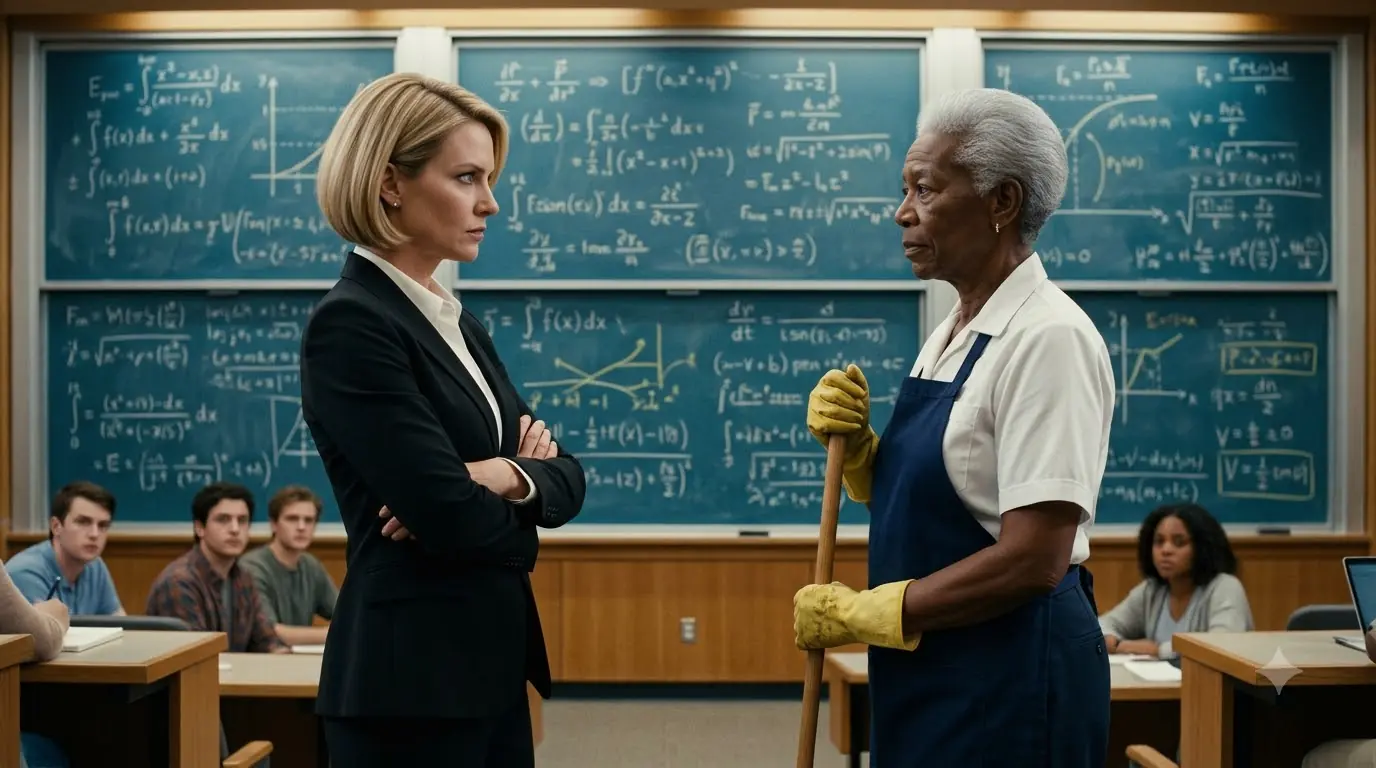
What she did not expect was that the person who would solve the problem with ease was an elderly janitor she had always looked down upon. With only a few strokes of the marker, the professor would be left speechless, reminded that genius sometimes rises from the most humble places.
That morning, the atmosphere in the large lecture hall at Bay Area University was unusually lively. Students filled the room to capacity, with seats taken even before the lecture began, and those arriving late had no choice but to stand along the walls or squeeze onto the stair steps.
Everyone was eagerly awaiting a special lecture by Professor Linda Martinez, a well-known figure in both social media and academic circles, famous for her sharp critiques and her willingness to challenge celebrated people whom she considered products of privilege and luck. The title projected across the screen read: “Genius or Privilege: The Truth Behind Success Myths.”
“Today is going to be a spectacular fall from grace,” one student whispered excitedly to a friend as they looked at the title slide. Linda entered the classroom five minutes late, not because of traffic or another obligation, but because she had done it deliberately.
She believed arriving a little late created a star effect, making the audience even more eager for what she had to say. When the door finally swung open and Linda appeared in high heels and a perfectly tailored blazer, the entire room seemed to hold its breath.
“Sorry to keep you waiting,” she said with a light smile, adjusting her glasses and setting her coffee on the lectern. “Let’s get right to it. Today I will show you why those whom the world praises as geniuses are often nothing more than products of a privileged system, one where opportunity is not equally distributed.”
As she spoke, the screen behind her changed to images of famous technology billionaires, including a large portrait of a man the media routinely celebrated as a genius, someone Linda referred to simply as Elon for the sake of her argument.
“They tell you he is a genius,” Linda continued. “They tell you the formulas behind electric cars, space rockets, and artificial intelligence systems all come from one superior mind. But what is the truth?” She clicked to a slide showing government subsidies, investment networks, and large institutional support connected to famous technology companies.
“The truth is that no one person creates these things alone,” Linda said. “When you are born with a ticket to the most prestigious doors, all you have to do is walk through them. Meanwhile, others, no matter how talented, are blocked at the threshold.”
Many students nodded. The lecture had begun to feel like a demystification session, and the room was fully under Linda’s control. She could sense it, and she enjoyed the power of guiding the room’s thinking, especially when the subject involved challenging the romantic story of one extraordinary individual overcoming everything through brilliance alone.
To reinforce her argument, Linda had prepared what she considered her secret weapon: a doctoral-level rocket-trajectory problem filled with layered integrals, variable matrices, nonlinear functions, boundary conditions, and enough complexity to intimidate even senior engineering students.
“Here,” Linda said, turning to the board. With sharp, confident strokes, she began writing. “This is the type of problem that highly trained engineers struggle with when optimizing rocket trajectories, estimating fuel use, adjusting flight angles, and accounting for changing atmospheric conditions.” By the time she finished, the problem occupied almost half the board.
Linda set the marker down and turned back toward the room. “Now, tell me. Do you think the famous person on the previous slide could solve this by himself? Or would he simply sign off on a solution prepared by a team of specialists?” She paused, letting the question hang.
“More importantly, who here wants to try?” Linda asked. “Who wants to prove that genius is as simple as the media makes it sound?”
The room fell silent. Not one hand went up. The students who had been murmuring and nodding moments earlier now stared at the board with expressions ranging from confusion to alarm. Even the most confident engineering students kept their hands down.