LOSING OLD FRIENDS CAN MAKE AGING FEEL DIFFERENT
Some friendships carry more than companionship. They carry decades of your life.
An old friend may remember the neighborhood where you grew up, your first job, the person you were before you became a parent, the mistakes you made in your twenties, or stories you've told so many times that neither of you needs to explain the background anymore.
As people grow older, that circle can gradually become smaller. Friends move away, develop serious health problems, lose mobility, or die. Retirement may also remove the workplace relationships that once made social contact almost automatic.
Grief after losing a longtime friend can therefore involve more than missing one person. You may also miss the version of yourself that existed when they were beside you.
Yet later life doesn't have to mean the end of meaningful friendship. New relationships can still develop at 60, 70, 80, and beyond—even if they begin differently from the friendships formed decades earlier.
Why Old Friendships Can Feel Irreplaceable
Long-term friendships have something newer relationships cannot immediately reproduce: shared history.
A friend you've known for 40 years may remember events that younger family members never experienced.
You don't have to explain who everyone was.
You can mention a name from decades ago and they immediately understand.
You can laugh about something that happened when you were 25 and, for a moment, that part of life feels surprisingly close again.
These relationships can become especially meaningful later in life because they connect different chapters of a person's identity.
When an old friend dies or becomes unable to maintain the relationship, the loss can therefore feel unusually deep.
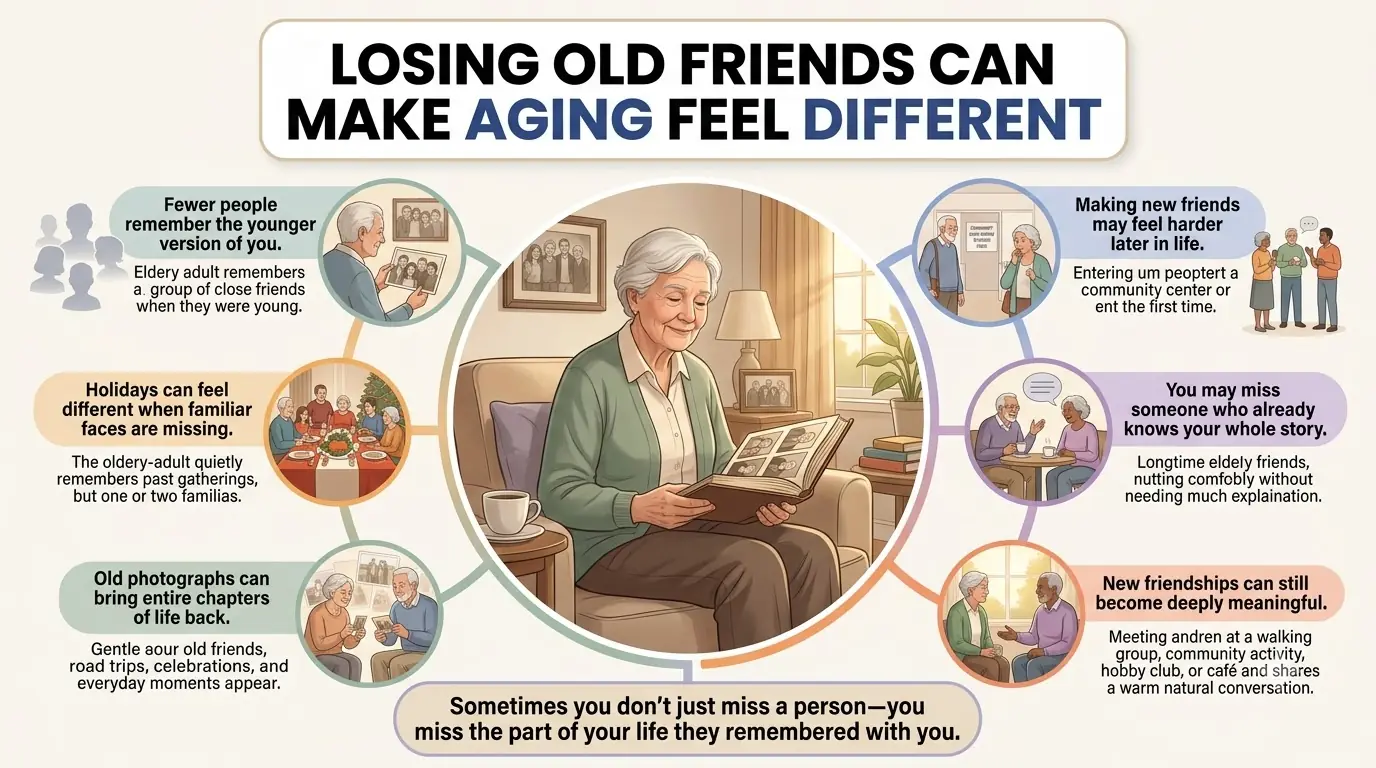
1. The People Who Remember Your Younger Years May Become Fewer
As we move through life, different people know different versions of us.
Coworkers may know our professional selves.
Adult children know us primarily as parents.
Grandchildren know us as grandparents.
But childhood and longtime friends may remember who we were before any of those roles existed.
They remember our younger ambitions, embarrassing moments, early relationships, old neighborhoods, and people who disappeared from our lives decades ago.
As those friends become fewer, an older adult may feel that fewer people remain who personally remember those chapters.
Photographs and stories preserve memories, but shared memory is different.
There's something uniquely reassuring about saying:
“Do you remember when...?”
and having another person genuinely remember.
2. Holidays Can Feel Different When Familiar Faces Are Missing
Holidays often make absence particularly noticeable.
The family may still gather.
There may still be food, conversation, children, and traditions.
Yet someone's usual chair is empty.
A familiar voice is missing.
A tradition associated with a particular person suddenly feels different.
Grief doesn't always become smaller in a straight line.
Someone may feel relatively comfortable for months and then experience a strong wave of sadness around a birthday, holiday, anniversary, song, restaurant, or familiar place.
This can be a normal part of bereavement.
Families don't necessarily need to avoid mentioning the person who died.
For many people, remembering someone openly—sharing a story, looking at photographs, or continuing a meaningful tradition—can provide connection rather than making grief worse.
3. Old Photographs Can Bring Entire Chapters Back
A photograph can contain much more than an image.
It may remind someone of a house that no longer exists, friends they haven't seen in decades, a spouse who has died, a family vacation, or a version of themselves they haven't thought about recently.
Memory cues such as photographs, music, familiar objects, and places can bring autobiographical memories to mind.
For older adults, reminiscing isn't necessarily evidence that someone is “stuck in the past.”
Remembering can be a meaningful way of connecting different stages of life.
This is why asking older relatives about photographs can create surprisingly rich conversations.
Instead of simply asking, “Who's that?” try:
“What was happening here?”
“What was this person like?”
“What do you remember most about that time?”
Sometimes the story behind the photograph matters much more than the photograph itself.
4. Making New Friends Can Become Harder
Friendship formation is often easier when life repeatedly puts the same people in the same place.
School does this.
Work does this.
Parenting can do it through children's activities.
Later in life, many of these built-in opportunities disappear.
After retirement, someone may no longer spend eight hours every weekday around coworkers.
Children have grown.
Mobility limitations can make community activities harder.
Giving up driving can reduce opportunities even further.
That doesn't mean older adults become incapable of forming friendships.
It means the environments that once created friendships automatically may need to be intentionally replaced.
Repeated contact remains helpful.
A weekly class, walking group, volunteer role, community organization, hobby group, faith community, or regular gathering gives people opportunities to see one another repeatedly.
Friendships rarely appear instantly.
Familiarity grows first.
5. Sometimes You Miss Being Understood Without Explaining
Longtime friends develop a kind of conversational shorthand.
They know the personalities in your stories.
They understand family history.
They remember what happened before.
They know why a particular place, song, joke, or anniversary matters.
New friends don't have that history yet.
This can make starting new relationships later in life feel tiring.
Someone may think:
“I don't want to explain the last 50 years.”
But new friendship doesn't require replacing an old one.
A person you meet at 75 will never share your childhood memories.
They can, however, share what happens next.
Over time, today's ordinary conversations become tomorrow's shared history.
6. Meaningful Friendships Can Still Begin Later in Life
There's no age at which friendship stops being possible.
New relationships may begin through:
- Volunteer work.
- Exercise groups.
- Community centers.
- Classes.
- Faith communities.
- Neighborhood activities.
- Hobby groups.
- Travel.
- Support groups.
- Introductions through existing friends or family.
The goal doesn't need to be finding a “best friend.”
A walking companion matters.
Someone you regularly have coffee with matters.
A neighbor you enjoy talking with matters.
A person you call occasionally matters.
Different relationships can meet different social needs.
And over time, some of those relationships may become much deeper than expected.
Losing a Friend Is Real Grief
The death of a close friend can sometimes receive less attention than the death of a spouse or immediate family member.
But friendship grief can be profound.
Someone may have known a friend longer than almost anyone currently in their family.
The relationship may have survived marriages, careers, moves, illnesses, children, and decades of change.
There is no rule determining how much someone is “supposed” to grieve based on the formal relationship they had with the person.
Grief reflects attachment.
If the relationship mattered deeply, the loss can matter deeply too.
Multiple Losses Can Accumulate With Age
One difficult aspect of later life is that losses can occur relatively close together.
A person may lose a spouse.
Then a longtime friend develops dementia.
Another friend moves to assisted living.
Someone else stops driving and can no longer visit.
Even when people are still alive, illness and disability can change relationships substantially.
This accumulation of loss can shrink someone's social network much faster than they can rebuild it.
Families may see an older parent spending more time alone and assume they've simply become less social.
Sometimes they're grieving a social world that has gradually disappeared.
Retirement Can Make Friendship Loss More Noticeable
Work provides social interaction even when coworkers aren't close friends.
There are greetings, lunches, meetings, jokes, complaints, and ordinary conversations throughout the day.
After retirement, those interactions can disappear almost overnight.
If longtime friendships are also becoming fewer, retirement can make the social change particularly noticeable.
This is one reason retirement planning shouldn't focus exclusively on money.
It can also help to consider:
- Who will I regularly see?
- What will structure my week?
- Which relationships do I want to maintain?
- Where might I meet people?
- What activities give me purpose?
Social planning can be an important part of adjusting to retirement.
Technology Can Help, but It Doesn't Solve Everything
Video calls, text messages, social media, and messaging apps can help older adults remain connected with people who live far away.
Technology can be especially useful when mobility or transportation is limited.
But digital contact isn't automatically equivalent to meaningful connection.
Some people love video calls.
Others find them frustrating or impersonal.
Technology should be a tool, not an obligation.
If an older adult wants to use it, patient assistance can help overcome practical barriers.
Teaching someone one useful function—such as making a video call—may be more helpful than trying to explain every feature of a device.
How Families Can Support an Older Adult Who Has Lost Friends
You cannot replace someone's lifelong friends.
Trying to immediately “cheer them up” or fill every empty hour may also feel dismissive.
Instead, acknowledge the loss.
Listen to stories about the person.
Ask what they miss.
Help maintain remaining friendships when practical.
Transportation can make a surprisingly large difference. If two older friends no longer drive, they may live only a few miles apart yet rarely see each other.
Families can also help someone access activities they already find interesting rather than pushing them toward generic social events.
Connection works better when it grows from genuine interests.
When Grief or Isolation Deserves Additional Support
Grief varies widely, and there isn't a universal timetable for how long someone should feel sad after losing a friend.
However, professional support may be helpful when emotional difficulties become persistent and significantly interfere with everyday functioning.
Pay attention to changes such as:
- Persistent hopelessness.
- Withdrawal from nearly everyone.
- Loss of interest in most activities.
- Significant changes in sleep or appetite.
- Neglecting personal care.
- Difficulty functioning in everyday life.
- Increasing use of alcohol or other substances to cope.
- Significant cognitive or behavioral changes.
Depression isn't an inevitable consequence of aging or bereavement.
A healthcare or mental health professional can help distinguish grief from depression and identify other conditions that may be contributing.
Friendship Supports More Than Emotional Well-Being
Meaningful social relationships can support healthy aging in several ways.
Friends may encourage one another to:
- Leave the house.
- Walk or exercise.
- Attend appointments.
- Participate in activities.
- Maintain routines.
- Notice health changes.
- Seek help when something seems wrong.
Social connection has also been associated with better overall health and well-being, although these relationships are complex and don't mean friendship alone prevents disease.
What is clear is that humans continue to need meaningful social connection throughout life.
That need doesn't expire at retirement.
New Friendship Doesn't Betray an Old One
Some people feel hesitant about building new relationships after losing someone important.
A new friend isn't a replacement.
No new relationship can recreate decades of shared memories.
It doesn't need to.
Relationships belong to different chapters of life.
Someone who knew you at 20 holds one part of your story.
Someone you meet at 70 may become part of another.
Both can matter.
Continuing to live socially doesn't diminish the importance of people who are gone.
Key Takeaways
- Longtime friends often carry decades of shared memories that newer relationships cannot immediately reproduce.
- Losing an old friend can mean grieving both the person and a shared chapter of life.
- Holidays, photographs, music, and familiar places can unexpectedly bring grief and memories back.
- Retirement and mobility changes can reduce natural opportunities to make and maintain friendships.
- Friendship loss may accumulate as people age, contributing to a gradually smaller social network.
- New friendships can still become meaningful later in life.
- Regular activities and repeated contact can create opportunities for relationships to develop naturally.
- Families can support connection without attempting to replace lost friendships or force social activity.
- Persistent withdrawal, hopelessness, or major changes in everyday functioning deserve professional attention.
Sometimes you don't just miss a person—you miss the part of your life they remembered with you. But the friendships that shaped yesterday and the relationships still waiting ahead can both have a place in a meaningful older life.
Medical Disclaimer
This article is for general educational purposes and is not a substitute for professional medical or mental health advice, diagnosis, or treatment. Grief, loneliness, and adjustment to social losses vary considerably between individuals. Persistent hopelessness, severe withdrawal, loss of interest, significant changes in everyday functioning, or other concerning emotional or behavioral changes should be discussed with a qualified healthcare or mental health professional.