"Son, everything worth keeping in these was gone ten years ago. How much for all four?"
There were laughs and surprised reactions from the men nearby.
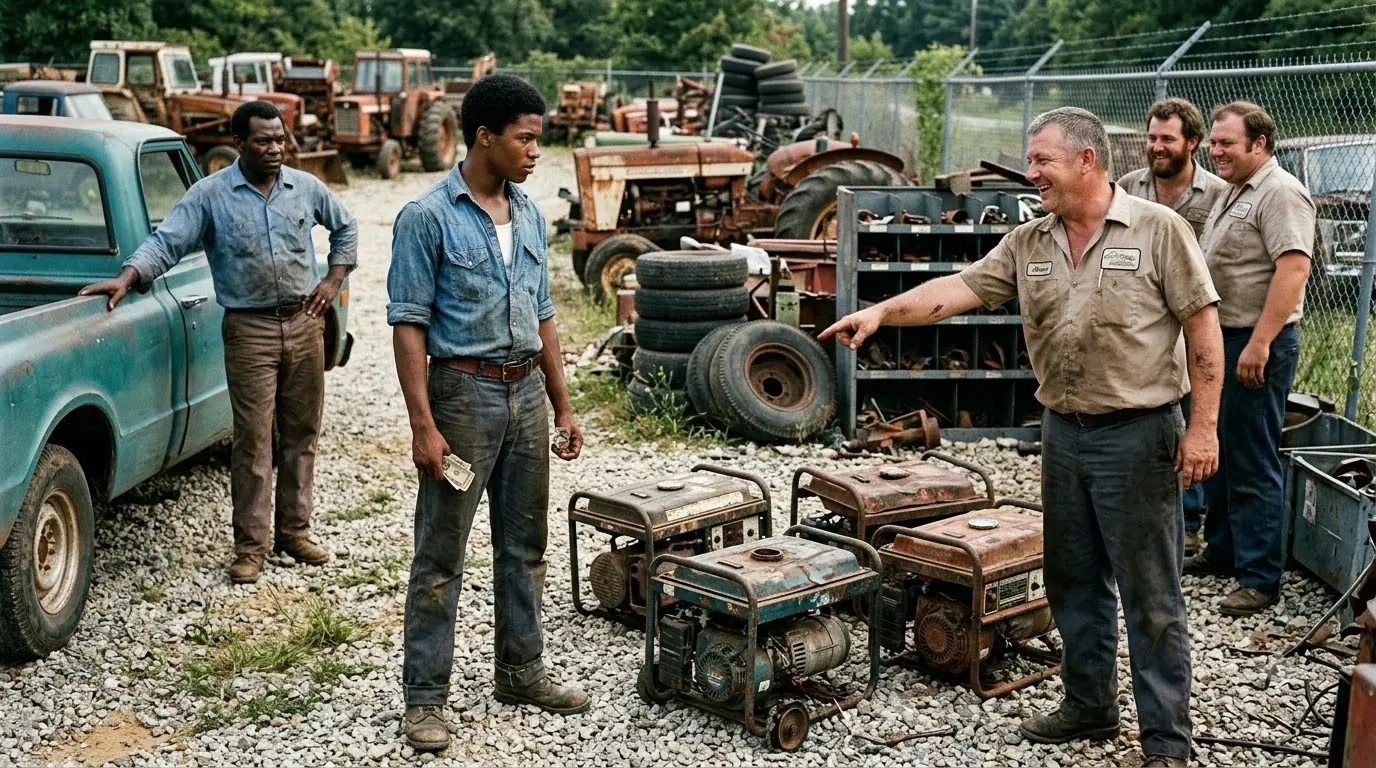
"You actually want them?"
"How much?"
Blaine Garrison shook his head. "I've fixed engines my whole career. Those have been dead longer than you've been alive."
"I'll take all four."
"Go right ahead," Blaine said. "That'll be an expensive education. Son, that's not inventory. That's junk."
In September of 1978, Blaine Garrison stood at South Ridge Farm Salvage and made a mistake he would not understand for another decade. He watched a young Black man count out $31.60 for four rusted generators, declared loudly, first to the boy and then to the boy's father, that the family had just paid to haul trash home, and walked away satisfied.
What he did not notice was how Cedric Boone's eyes moved across those machines. There was no embarrassment in his expression, only the quiet focus of someone already calculating. Blaine had just dismissed the wrong 18-year-old.
The summer Cedric Boone turned 18, most of his friends had already started leaving Andalusia. Some went north to find factory work. Others enrolled in trade programs two counties over. A few simply drifted, taking whatever jobs appeared first.
Cedric understood the urgency. He felt it too, that quiet pressure that came from watching your parents work themselves thin and knowing the clock was running. His father, Howard, drove a delivery truck for an agricultural supply company, hauling seed and fertilizer across Covington County six days a week. His mother started her mornings before sunrise, running the kitchen line at a local school cafeteria.
They never complained. They also never had anything left over at the end of the month.
What set Cedric apart was not ambition. Plenty of people in that town had ambition. It was the particular way his mind worked when something broke.
A neighbor's lawn mower that refused to start. A water pump with a burned winding. A radio that had gone silent after a thunderstorm. Most people looked at a broken machine and saw the end of its usefulness.
Cedric looked at the same machine and wanted to know which specific part had failed, what that failure had done to everything around it, and whether the rest of the machine was still good. He could not explain why this mattered to him. It simply did, the way some things settle into a person before they are old enough to name them.
The man who gave that instinct a language was Raymond Sutter, who lived out on County Road 42 in a house that backed against a long, flat stretch of overgrown field. Raymond was 63 years old, a former serviceman who had spent decades working on electrical systems, first in the Army and later at industrial facilities across the South.
Behind his house sat a workshop that most people in town did not know existed. Shelves of sorted components filled wooden boxes. Analog meters hung from pegboard. Thick technical manuals were stacked by subject.
Cedric first met Raymond when he brought over the family's water pump, which had stopped running after a wet spring. Raymond examined it without speaking for a long moment, then asked Cedric whether he thought the machine was dead.
Cedric said he figured it probably was.
Raymond told him he was wrong.