“Who allowed this filthy beggar to come in here?”
For a moment, Aliyah Owens genuinely believed she had misheard.
The ballroom of the Harrington estate was filled with music, champagne, and nearly three hundred people dressed for a celebration that was supposed to mark the rescue of one of New England’s oldest manufacturing families.
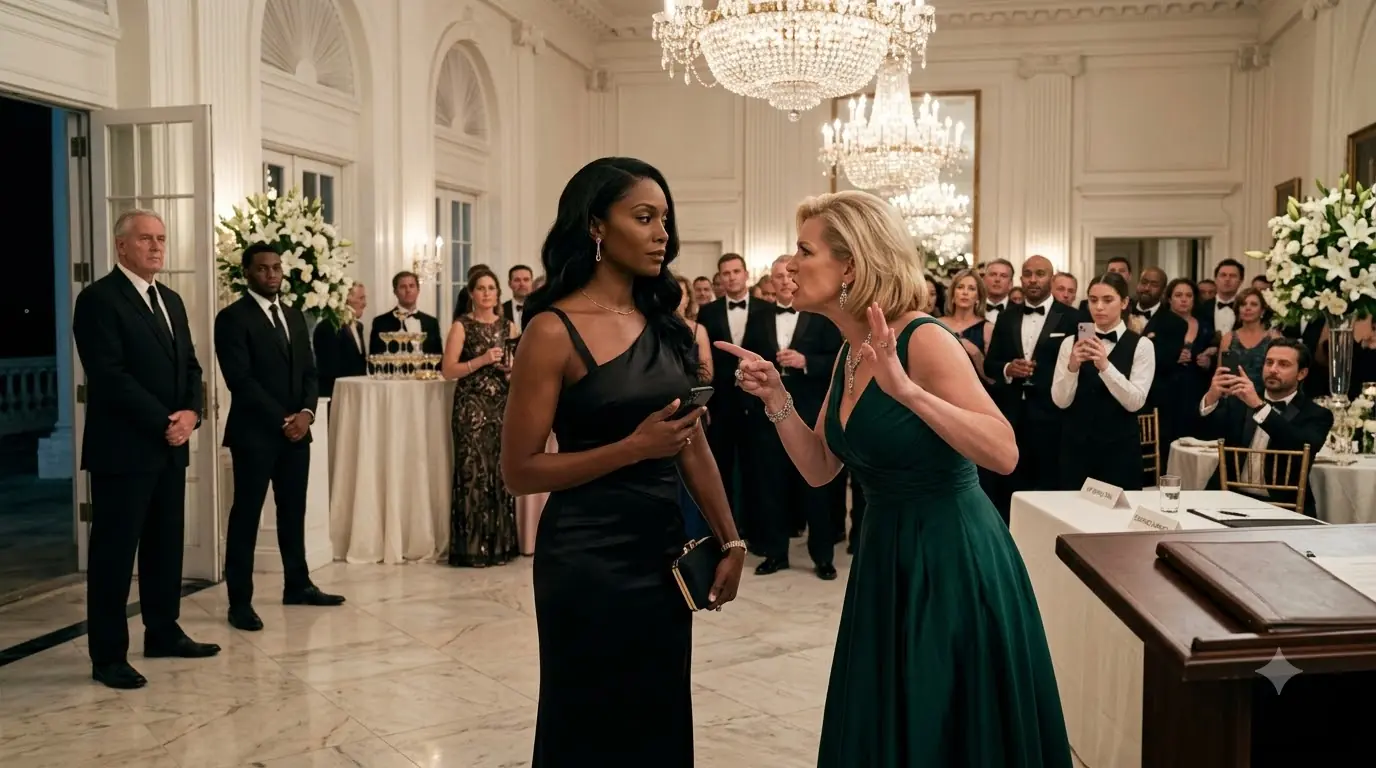
A string quartet played near the garden doors. Crystal chandeliers threw warm light across polished marble. At the center of the room, only twenty feet from where Aliyah sat, a stage had been prepared for the signing of a transaction worth one billion dollars.
And now Constance Harrington was standing over her as though Aliyah had crawled through a kitchen window.
Aliyah looked up slowly.
“Excuse me?”
Constance’s mouth tightened.
“You heard me.”
She was sixty-one years old, elegantly dressed in an emerald gown, diamonds at her ears and throat, silver-blond hair arranged with such precision that not a strand seemed capable of moving without permission. For three decades, Constance had been one of the most recognizable figures in Newport’s old philanthropic circles. She chaired museum dinners, preservation boards, garden foundations, charity auctions, and the kind of committees that placed family names on buildings.
She was also terrified.
Almost nobody in the ballroom knew that.
They saw control.
They saw elegance.
They saw a hostess moving through a perfect evening in a twelve-thousand-square-foot estate overlooking the water.
They did not see the stack of creditor notices in Edward Harrington’s study upstairs.
They did not see the emergency board memoranda.
They did not see the liquidity projections showing that Harrington Textile Group could breach its revolving credit agreement within weeks.
And they certainly did not know that the quiet Black woman sitting at the principal signing table was the only person in the building capable of stopping that collapse.
Aliyah rested one hand beside her clutch.
“Good evening,” she said. “I’m with Ashbrook Equity Partners.”
Constance stared at her.
“No, you’re not.”
“I am.”
“I know every person from Ashbrook attending tonight.”
“No,” Aliyah said. “Apparently you don’t.”
That answer changed Constance’s face.
Only slightly.
But enough.
People accustomed to authority often recognized resistance before they recognized truth.
Constance leaned closer.
“Let me make this very simple. This is a private event. You are sitting at the principal table for a billion-dollar transaction. I personally approved every seating assignment.”
Aliyah nodded toward the side room behind the ballroom.
“My deal team is thirty feet away.”
“I don’t care what story you’ve prepared.”
“It isn’t a story.”
“You expect me to believe that?”
“I expect you to verify it.”
Constance let out a short laugh.
Not because she was amused.
Because the request itself seemed insulting.
“Verify you?”
“Yes.”
“I’m not brainless enough to fall for whatever this is.”
Aliyah’s eyes hardened.
“Then call the side room.”
“I am not calling anyone.”
“That would resolve this in about fifteen seconds.”
“I said no.”
The nearest conversations began fading.
Aliyah could feel people turning without looking directly at them.
Constance could feel it too.
Instead of lowering her voice, she raised it.
That was the beginning.
But not the real beginning.
The real beginning had come four hours earlier in a hotel room three blocks away.
Aliyah Owens had chosen the Newport Inn deliberately.
The room cost sixty-nine dollars.
The radiator knocked every ten minutes.
The carpet was older than some of the analysts on her deal team.
Across the street, a liquor store sign buzzed above a narrow sidewalk wet from an afternoon rain.
Her associates had asked whether she wanted a suite at the Chandler or the Vanderbilt.
She had said no.
One of them had assumed she was making a point about frugality.
Aliyah had not corrected him.
She was actually making a point about privacy.
At forty-three, Aliyah controlled Ashbrook Equity Partners, an investment firm she had built from a one-room Baltimore office into a private capital company managing slightly more than four billion dollars.
She did not have a public-relations department dedicated to turning her into a celebrity.
She did not maintain personal social media.
Her image rarely appeared in business publications.
When Forbes requested a profile, she declined.
When Bloomberg wanted a photographed interview, she offered written answers.
When an investment conference asked to use her photograph in promotional material, she sent the Ashbrook logo instead.
Her partners occasionally complained.
“People should know who built this company,” Marcus Webb once told her.
“They know the company.”
“That isn’t what I said.”
“It’s enough.”
Marcus had worked with her for eleven years, long enough to understand that arguing after that sentence was generally useless.
Aliyah’s anonymity was not insecurity.
It was leverage.
She had discovered early in her career that being underestimated could reveal information no due-diligence report contained.
People spoke differently around someone they considered unimportant.
Receptionists explained things executives concealed.
Managers insulted employees when they believed no investor was listening.
Owners revealed character when they thought there were no consequences.
Aliyah did not manufacture those situations.