The boy walked three miles through freezing darkness before the sun had any intention of rising.
He was thirteen years old, wearing two thin coats that had long ago stopped counting as winter clothing, canvas shoes patched from the inside with duct tape, and gloves that had lost the tips of two fingers.
He had five dollars in his pocket, no money beyond that, and had not eaten what he considered a real meal in three days.
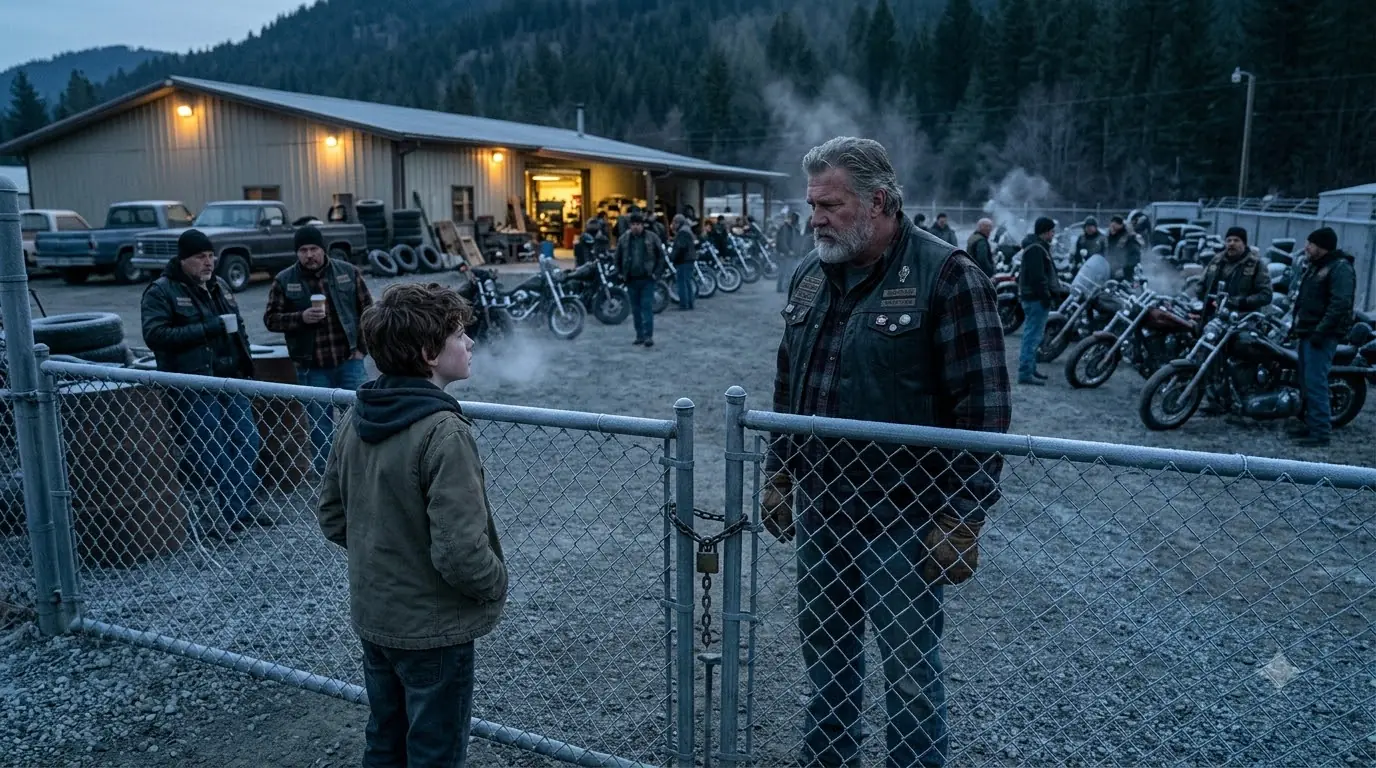
Ahead of him, behind a chain-link fence silvered with frost, nearly a hundred motorcycles sat in rows under industrial lights. Some were idling. Others rested silent on their stands while men and women in leather moved between them with coffee cups, tools, helmets, and the unhurried alertness of people who had been awake long before the rest of the county. The engines that were running produced a deep, layered vibration that Eli Mercer felt first through the road and then through the soles of his shoes.
Nobody rushed him when he stopped at the gate. Nobody waved him closer either. A dozen faces turned in his direction, then more. The attention gathered without ceremony. Eli put both hands on the cold chain link and stared through it until one of the men detached himself from the yard and walked over.
He was a large man somewhere north of sixty, broad through the shoulders, with a gray beard and eyes the color of old storm clouds. His vest carried the Ironbound Riders patch. Beneath the chapter insignia, stitched into a narrow memorial strip darkened by years of weather, was a name Eli knew better than his own handwriting.
CALEB MERCER.
The man stopped on the other side of the fence.
Eli swallowed once. His jaw tightened as if he were holding every remaining piece of himself between his teeth. Then he said the seven words that silenced the entire gate line.
“My dad’s name is on your vest.”
For one second, maybe two, the cold yard stopped moving.
The man’s eyes changed. Not softer exactly. More like a door shifting on its hinges without opening.
“Who are you?” he asked.
“Eli Mercer.”
A longer pause followed.
The man looked at Eli’s face, his shoes, his two coats, the color of his lips, and the way he was standing too still because shivering had become exhausting somewhere along the walk. Then his gaze returned to the boy’s eyes.
“How long since you ate?”
“Yesterday morning.” Eli hesitated. “Piece of bread.”
The man opened the gate.
His name was Doyle.
That was nearly all he offered about himself as he led Eli inside the compound. He gave his name the way a man extended two fingers instead of a hand: enough to establish terms, not enough to invite assumptions.
Around them, the Ironbound Riders resumed what they had been doing. Engines continued warming. Tools clinked against concrete. Steam rose from coffee. A woman rolled a bike backward into a work bay. A man with a shaved head laughed at something someone said near the fuel shed.
Eli followed Doyle through it all with his shoulders hunched against the cold and his senses stretched wide.
He had imagined this place for four years without ever giving the imagining much detail. In his mind, it had always been a single image: leather vests, loud engines, the warning in his father’s voice. The real compound was stranger because it was more ordinary. There were extension cords coiled on wall hooks, a recycling bin by the main building, a whiteboard with ride schedules, two dented pickup trucks, and a stack of cardboard grocery boxes beside the kitchen door.
Doyle stopped in front of a long, low building washed in yellow light.
“Wait here.”
He went inside.
Eli waited.
A man carrying two helmets passed without speaking. Another man crouched beside a motorcycle and ran his thumb along a seam in the chrome with the intense concentration of someone whose entire world had narrowed to six inches of metal. Somewhere, an old country song crackled through a radio speaker. Eli wrapped his arms around himself and tried not to stare at the exhaust drifting into the dark.
The door opened again.
Doyle came out first. Behind him was a woman in her late fifties, though Eli would later decide that age did not sit on Raina Cross in the usual way. It lived in the silver threaded through her dark hair, in the fine lines around her eyes, in the complete absence of wasted movement. She wore a fully patched vest over a black thermal shirt. Pins and emblems accumulated over years lined the leather in a way that made it look less like clothing than skin.
She stopped in front of Eli.
“You’re Caleb’s boy.”
“Yes, ma’am.”
“How old?”
“Thirteen.”
“Where’s your mother?”
“Home.”
Raina’s jaw shifted a fraction.
“You walked here?”
“Yes, ma’am.”
“In that?”
Eli glanced down at himself as if he had forgotten what he was wearing.
“Yes, ma’am.”
Her eyes dropped to his shoes. He became painfully aware of the left one, where the sole had begun separating again despite the tape. He had repaired it twice. He had not expected to feel embarrassed about it until someone looked closely enough to notice.
“Come inside,” Raina said.
The warmth in the main building hit him harder than the cold had. It was not hot, only properly heated, but his body reacted with a dizzy rush that made him grip the back of the nearest chair for half a second before he trusted his knees. Raina saw it. She did not comment.
The room centered on a long wooden table scarred by years of plates, mugs, card games, paperwork, and elbows. A coffee pot sat near the center beside a jar of sugar packets.
Photographs covered one wall. Club members in younger years. Charity rides. Funeral processions. Group pictures in front of diners, hospitals, veterans’ homes, flood-damaged houses, and roadside memorials.
Raina poured coffee into a heavy ceramic mug and put it in front of him.
“Sit.”
Eli did.
He wrapped both hands around the mug. Heat pushed into his fingers almost painfully.