The text arrived at 7:12 on a Tuesday morning, just as I was sitting at my kitchen table with a mug of coffee gone cold. Outside, October had turned the maple leaves along my fence red at the edges, and the quiet suburb outside Chicago looked peaceful enough to make cruelty feel impossible. Then my phone buzzed, and Vanessa’s name appeared on the screen. I already knew, somehow, that whatever she had written would be wrapped in soft words and sharpened underneath.
Eleanor, we decided to keep the family get-together small this year, the message said. Just the three of us and the kids. You understand, right? You probably need your peace and quiet anyway. I read it twice, not because I misunderstood it, but because I wanted to make sure my own son’s wife had truly decided to cut me from the family reunion.
I did not cry when I set the phone down beside my plate. At sixty-four, after thirty-seven years as an accountant and three years as a widow, I had learned that some pain does not deserve a performance. Vanessa knew how to insult a person while leaving enough politeness on the surface to deny it later. That was her talent, and Ryan, my son, had become very good at pretending not to notice.
The reunion had always meant more to me than food and pictures. It was where I watched my grandchildren run through the yard, where I made Paul’s potato salad, and where I could still imagine my husband laughing beside the grill. This year it was supposed to be at Ryan and Vanessa’s house, the four-bedroom home I had helped them buy. Half that house had come from my money, not in vague family feelings, but in real checks, transfers, signatures, and sacrifice.
When Ryan first called about the down payment, he sounded embarrassed. Vanessa sat beside him on speakerphone, using that sweet voice she saved for moments when she needed my help. They were short by just enough to make the deal difficult, and I had already known what they were asking before they asked it. I told myself that a mother invests where her love lives, so I moved money from savings and made their dream easier.
Then closing costs came, then the furnace, then the roof repair, then property taxes during a year Ryan said his bonus was delayed. Vanessa always sounded grateful in the beginning, but gratitude has a way of becoming expectation when the person receiving help is never asked to stop. I paid for lawn service because they were busy, piano lessons because my granddaughter had “potential,” and new patio furniture because Vanessa said the old set looked bad in photos. Somewhere along the way, I stopped being family and became infrastructure.
I walked to the small office off the hallway and opened the filing cabinet. Paul’s old fishing hat still hung on the back of the door, and the room smelled faintly of paper, dust, and the aftershave he used until the day he passed. I pulled out the green folder labeled Ryan and Vanessa: House Support. It was heavier than any family folder should have been.
I closed the folder and placed both hands on top of it. The woman I had been the day before might have called Ryan, asked what was happening, and tried to keep the family from splitting open. But that woman had spent too many years confusing silence with dignity. I was still dignified, but I was finished being convenient.
By nine o’clock, I was dressed in gray slacks, a white blouse, and the navy coat Paul always said made me look like I was about to win an argument. I looked in the hallway mirror and fastened the pearl earrings he had given me for our thirtieth anniversary. My face looked older than I remembered, but not weak. For the first time in a long while, I did not see a widow trying to hold everyone together; I saw a woman who still knew where every key was kept.
My first stop was the bank downtown, the same branch where I had deposited Ryan’s college savings and cashed Paul’s retirement checks. Tom, the manager, came out to greet me with the careful warmth people reserve for longtime customers. “Mrs. Harron,” he said, gesturing toward his office. “What can I do for you today?” I sat down, opened my folder, and told him I wanted to stop every automatic payment connected to Ryan and Vanessa’s household.
Tom’s fingers paused above the keyboard for only a second. “All of them?” he asked. I held his eyes and said, “Mortgage support, pool service, lawn service, insurance supplement, and the joint maintenance account. Effective immediately.” He nodded slowly and began printing forms, because good bankers know when a woman has already made up her mind.
When the last signature was complete, Tom handed me the confirmation sheet. “You have been very generous with your son,” he said quietly. I folded the paper and slipped it into my purse beside Vanessa’s text. “Generosity is still generosity only when it is freely given,” I said. “Once people treat it like a utility bill, it is time to turn off the service.”
From the bank, I drove to the county recorder’s office. There was nothing grand about the building, just fluorescent lights, tile floors, and a vending machine humming near a row of plastic chairs. I requested certified copies of every property document connected to my name, Ryan’s name, and any financial contribution Vanessa might later try to twist into a claim. Knowing the truth was not enough; I wanted proof strong enough to stand on its own.
By noon, I had a folder full of documents and a calmness that surprised me. I stopped for a sandwich, ate half of it in my car, and called Greg Hollis, a real estate agent Paul and I had known for nearly thirty years. Greg answered with his usual cheerful voice, but he grew quiet when I asked for a valuation on my property. “Are you thinking of selling, Eleanor?” he asked. “I am thinking of options,” I replied.
Greg came that afternoon with his measuring tape, tablet, and the discretion of a man who understood not every decision needed a neighborhood audience. “No sign in the yard,” I told him at the door. “No gossip, no calls, and no conversation with anyone in my family.” He looked at me for one careful second, then nodded. “Understood,” he said.
Ryan arrived while Greg was measuring the back room. My son stood in the entryway with his tie loosened and his car keys in one hand, looking like a boy sent to deliver a message he did not want to own. “Mom,” he said, glancing toward the living room, “did you get Vanessa’s text?” I watched him closely because mothers know when their children are ashamed. His eyes moved to the framed photograph of Paul on the mantel, then down to the floor.
“I did,” I said. Ryan shifted his weight and sighed like he had been rehearsing. “It’s just that the kids have sports things, and Vanessa thought a smaller gathering would be easier this year.” I waited, giving him room to choose honesty. He did not choose it. Instead, he added, “We didn’t want you to feel stressed.”
The word stressed sat between us like something dirty placed on a clean table. I thought of the years I had babysat their children during flu seasons, school closures, and last-minute work trips. I thought of the bills I had paid without asking for public thanks. “That works out well,” I said. “I have decided to make some changes.”
Ryan frowned. “Changes?” I picked up the bank confirmation sheet and placed it on the table between us. “You and Vanessa should review your finances tonight,” I said. His face changed in small stages, first confusion, then worry, then something almost like irritation. “Mom, come on,” he said, but his voice had already lost confidence.
Greg walked into the hallway holding his tablet, and Ryan’s eyes snapped toward him. “What’s Greg doing here?” he asked. “His job,” I replied. Ryan looked at me as if the house itself had betrayed him by allowing another man to measure it. “Are you selling?” he asked. “I said I am considering options,” I answered.
“You can’t just...” Ryan began, then stopped himself. The unfinished sentence told me everything. You can’t just stop helping. You can’t just make decisions without us. You can’t just remember that your money is yours. I looked at my son and saw not a cruel man, but a weak one, and somehow that hurt even more.
That evening, Vanessa called three times, but I did not answer. Then came the messages, each one sharper than the last beneath its polished wording. She said I had misunderstood, that I was being emotional, that the children would be confused if their grandmother created tension over a simple family scheduling decision. By the fourth message, she stopped pretending. Eleanor, she wrote, don’t make choices you can’t undo.
I slept better that night than I expected. The next morning, I called a lawyer named Marjorie Feld, a woman Paul had once described as polite until politeness became inefficient. I sent her copies of every document, every transfer, every proof of payment, and every message Vanessa had written. Marjorie called back three hours later and said, “You have been generous, Mrs. Harron, but legally, you have also been careful.” I smiled for the first time that week.
Within two months, I sold my old house quietly and bought a smaller home across town under a trust Marjorie helped establish. It had cream curtains, polished wood floors, a bright kitchen, and a backyard just large enough for roses and a small bench under a maple tree. I paid for it with my own money, signed every page myself, and took possession without inviting a single person to advise me. For the first time since Paul died, I slept in a house where no one else’s needs echoed through every room.
Ryan came by once, standing on the porch with flowers and guilt in his hands. Vanessa stayed in the car, sunglasses covering her face though the sky was cloudy. “Mom, this has gone too far,” he said. I looked past him at the car, where Vanessa watched us like a woman waiting for a negotiation to go her way. “No,” I said. “It has finally gone far enough.”
Winter passed, and with it came a silence that felt painful at first, then peaceful. I missed my grandchildren more than I admitted to anyone, but I refused to buy access to them through Vanessa’s approval. I sent birthday cards, school notes, and small gifts that came from love, not leverage. When Ryan called, I answered politely, but I no longer solved the problems he brought to my doorstep.
In March, Marjorie advised me to install security cameras after Vanessa sent a message asking for “a serious conversation about asset fairness.” I laughed when I read the phrase because Vanessa could turn greed into office language better than anyone I had ever met. Still, I took Marjorie’s advice. A small camera went near the front door, another in the hallway, and one facing the backyard gate.
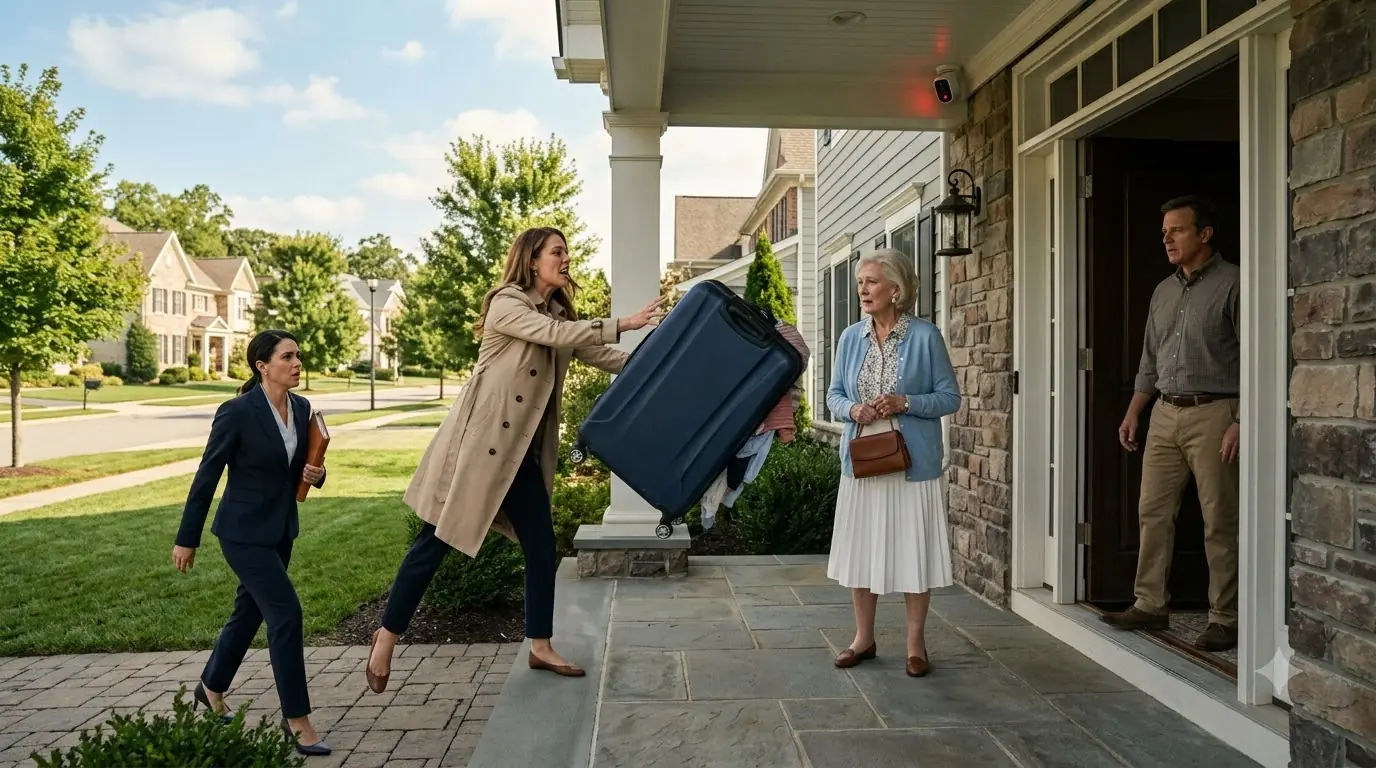
Two weeks later, I was trimming dead leaves from the roses when a car pulled into my driveway. Vanessa stepped out first in a beige trench coat, her blonde hair curled neatly and sunglasses perched on her head like she had arrived for a showing. Ryan followed, looking miserable, and behind them came a man carrying a folder and a tablet. Vanessa smiled at me as if she had practiced in the mirror.
“Eleanor,” she said, walking into my yard without being invited. “We thought it was time to have the house valued properly.” I stood with garden gloves on my hands and pruning shears resting against my palm. The man beside her gave an awkward nod. “I’m Peter Lawson,” he said. “Independent assessor.” I looked at Ryan, waiting for him to tell me this was not what it looked like, but he only stared at the grass.
Vanessa glanced around the backyard, measuring my life with her eyes. “This is a nice place,” she said. “Smaller, obviously, but nice.” Her smile widened when she added, “We just need to understand what resources exist, especially since Ryan has family responsibilities.” There it was, dressed in concern and carrying a tablet. She had cut me from the reunion, lost access to my payments, and now wanted to value the house I had bought for myself.
I removed my gloves slowly and set them on the patio table. “Vanessa,” I said, “who told you that you were allowed to bring an assessor onto my property?” Her smile tightened, but she kept her voice sweet. “Let’s not make this hostile. We’re family.” I looked at Ryan, whose jaw flexed but whose mouth stayed shut. “Funny,” I said. “I was extra stress when there was a reunion, but family when there is property to measure.”
Peter Lawson shifted uncomfortably. “Mrs. Harron, I was told this was a preliminary family estate review.” I gave him a calm look. “You were told wrong.” Vanessa’s expression flickered, but she recovered quickly and pointed one polished finger toward my face. “You are being unreasonable,” she said. “This house should be considered when we discuss the future.”
Inside, near the hallway wall, the small camera blinked red. Marjorie had taught me not to interrupt foolish people too early. Let them speak clearly, she had said, because people often build your evidence for you when they think you are too old to understand. I folded my hands in front of me and asked, “What future are you discussing, Vanessa?”
“The children’s future,” Vanessa said. “Ryan’s future. Our family’s stability.” Her finger stayed pointed toward me, and her smile turned smug. “You cannot just remove support and hide assets because your feelings were hurt over one gathering.” Ryan closed his eyes, and that tiny movement told me he knew how ugly it sounded. But knowing and stopping are not the same thing.
I heard the front door open behind me. Marjorie Feld stepped into the hallway in a charcoal suit, holding a folder thick enough to make Vanessa’s smile falter. A moment later, Deputy Alan Brooks appeared beside her, calm and uniformed, with his hands resting loosely at his belt. Vanessa’s eyes moved from Marjorie to the deputy, then to the camera near the wall. For the first time since I had known her, she looked genuinely surprised.
“Mrs. Harron is not alone,” Marjorie said evenly. “She is the sole legal owner of this property through a properly established trust.” Peter Lawson immediately lowered his tablet. “I apologize,” he said, looking at me with visible discomfort. “I had no idea there was a dispute.” Vanessa’s face reddened as she snapped, “There is not a dispute.” Marjorie opened her folder and said, “There is now a record of attempted unauthorized valuation, coercive language, and trespass after a pattern of financial pressure.”
Ryan finally found his voice. “Mom, we weren’t trying to hurt you.” I looked at him then, really looked, and saw a man who had let his wife carry the cruelty because it kept his own hands clean. “No, Ryan,” I said. “You were trying to benefit from someone else hurting me.” His eyes filled, but this time I did not rush to comfort him. Tears do not erase participation.
Vanessa turned on him. “Say something,” she hissed. “Tell her she is overreacting.” Ryan looked between us, his shoulders sagging under the weight of years he had refused to carry. “I can’t,” he said quietly. Vanessa stared at him as if betrayal had entered the room through his mouth. I watched his face and saw the first painful sign of a spine trying to form.
Marjorie handed Vanessa a formal notice. “You are not to enter this property again without written permission,” she said. “Any further attempt to pressure Mrs. Harron financially will be documented and addressed through counsel.” Deputy Brooks gave a polite nod that carried more authority than shouting could have. “Ma’am, it would be best if you left now,” he said.
Vanessa looked at me with fury shining beneath her polished face. “You would do this to your own family?” she asked. I stepped closer, not enough to threaten, only enough to make sure she heard me without misunderstanding. “No, Vanessa,” I said. “I finally stopped letting my own family do this to me.” Her mouth opened, but no useful words came out.
Peter Lawson apologized again before leaving, his face flushed with professional embarrassment. Vanessa stormed toward the driveway, but Ryan stayed behind for a moment. He looked smaller than he had when he arrived, not because I had beaten him, but because truth had stripped away the excuses he had been wearing. “Mom,” he said, his voice rough. “I’m sorry I let it get this far.”
I wanted to say it was alright because mothers are trained by love to soften the consequences for their children. But it was not alright. “I am glad you said that,” I told him. “Now live like you understand it.” He nodded slowly, then walked to the car where Vanessa waited with her arms crossed and her pride burning through the windshield.
After they left, the house became quiet again. Marjorie stayed for tea, and Deputy Brooks accepted a glass of water before returning to his patrol car. I sat at my kitchen table, watching the afternoon light fall across the cream curtains, and felt my hands begin to tremble only after the danger had passed. Marjorie noticed but did not make a show of it. She simply reached over and touched the folder. “You did very well,” she said.
That night, I made chicken soup from Paul’s old recipe and ate it in the quiet kitchen of my new home. I thought I would feel lonely, but what I felt was space, clean and wide and unfamiliar. The bills on the counter were mine, the keys in the bowl were mine, and the silence around me belonged to no one else. For years, I had confused being needed with being loved, and the difference had nearly cost me myself.
Weeks passed before Ryan called without Vanessa in the background. He asked if he could come by alone, and I told him yes, but only if he came as my son, not as a messenger. He arrived with no flowers, no excuses, and no prepared speech. He sat at my kitchen table, looked at the wall where Paul’s photograph now hung, and cried with the quiet shame of a man finally seeing himself clearly.
“I kept telling myself I was keeping peace,” he said. “But I was just making you pay for it.” I poured him coffee and sat across from him, letting the words settle. “Peace that requires one person to disappear is not peace,” I said. He nodded, wiping his face with both hands. “I know that now.”
He began bringing the children on Saturdays. At first, they were awkward, unsure whether my house had rules Vanessa had not approved. Then they discovered the cookie tin, the backyard bench, and the old photo albums full of their father as a boy with grass stains on his jeans. I did not speak badly about their mother, because children should not be used as courtrooms. But I did show them, through every meal and story, that love does not require humiliation as payment.
Vanessa did not apologize for a long time. When she finally did, it came in a letter, three pages long and carefully written. Some parts sounded sincere, while others still smelled faintly of self-defense. I read it once, placed it in a drawer, and decided not every apology required immediate access. Forgiveness may belong to the heart, but trust belongs to evidence.
In the spring, I hosted my own reunion in the backyard of my new home. It was smaller than the old gatherings, but the food tasted better because no one at the table treated my presence like an obligation. Ryan grilled burgers, the children chased each other around the maple tree, and Marjorie came with a lemon cake because she said legal victories deserved dessert. I looked at the chairs arranged in a circle and realized no one had the power to exclude me from a table I had built myself.
Vanessa arrived late, standing at the gate with no assessor, no clipboard, and no pointed finger. She looked nervous in a way I had never seen before. Ryan opened the gate, but he glanced at me first, asking permission without words. I nodded once, because control was not what I wanted; respect was.
Vanessa walked up to me with her hands clasped tightly in front of her. “Thank you for allowing me to come,” she said. I looked at her face, searching for the smugness that used to live there so easily. It was not gone entirely, but it had been humbled. “You are welcome here as long as you remember whose home this is,” I said.
She nodded, and for once she did not argue. It was not a perfect ending, because real families rarely have perfect endings. There were still boundaries, still careful conversations, and still moments when old habits tried to return. But now I had documents, locks, cameras, a lawyer, and most importantly, a voice I no longer handed over for the sake of keeping everyone comfortable.
Sometimes, when I sit by the window in the morning with hot coffee in a mug Paul once bought me, I think about that first text. You probably need your peace and quiet anyway. Vanessa had meant it as dismissal, but in the end, she had given me a prophecy. I did need peace and quiet, but not the kind that comes from being pushed out of a family room. I needed the kind that comes from closing the door on people who mistake kindness for permission.
My name is Eleanor Harron, and I was cut from a reunion in a house I helped pay for. So I bought my own home, stopped funding disrespect, and waited for the truth to knock. When Vanessa arrived with an assessor, she thought she would find an aging widow alone and easy to pressure. Instead, she found a woman with proof on the table, cameras on the walls, the law at the door, and no intention of disappearing again.