Noah’s Recovery After a Quiet Winter at the Rescue Center
Reader Theme:
Font Size:
24px
CURRENT CONDITION UPDATE
Noah is now spending his nights somewhere warm, and that simple change has already made a noticeable difference.
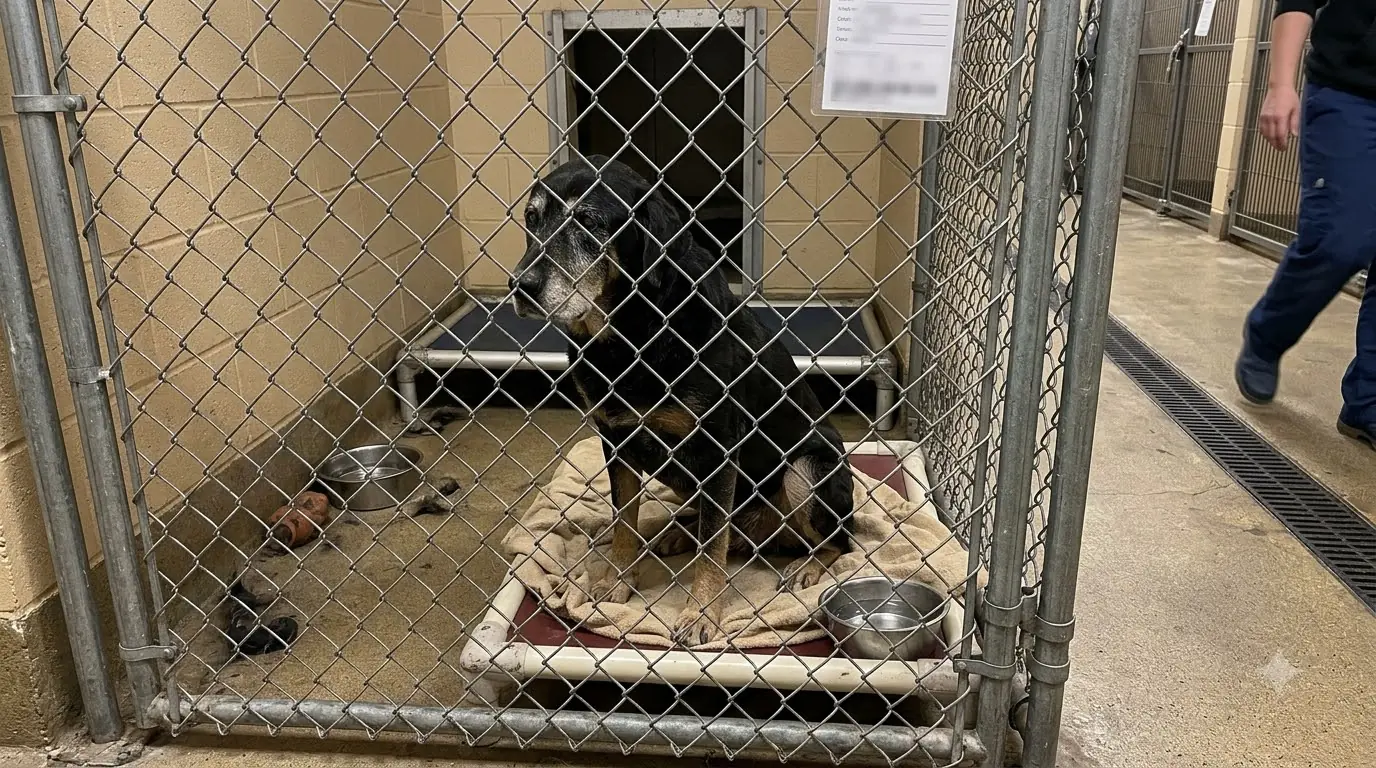
After his quiet moment beneath the falling snow, our veterinary team completed a more thorough examination to understand why he had been moving so carefully during colder weather. Fortunately, we did not find a life-threatening illness or acute injury. Noah’s greatest physical challenges are related to being underweight, irritation to his paws, and moderate stiffness affecting his hips and hind legs.
X-rays showed early degenerative changes consistent with arthritis. There were no fractures or signs of a recent traumatic injury. His veterinarian believes cold temperatures were making the existing joint discomfort more noticeable, which explains why Noah sometimes took several slow steps after standing before his movement became easier.
He has now started a conservative treatment plan.
Noah receives veterinary-approved joint support, carefully monitored pain relief when necessary, and several short periods of gentle activity rather than long walks. His sleeping area includes a thick orthopedic bed so his hips are never resting directly against a cold, hard surface.
Keeping him warm has become especially important.
Since moving indoors full-time, Noah has already started standing more comfortably in the mornings. He still stretches slowly when he wakes, but the hesitation we initially noticed is becoming less pronounced.
His paws are improving as well.
Repeated exposure to snow, moisture, and cold surfaces had left the pads dry and irritated. They were gently cleaned and treated, and his outdoor time is now carefully monitored. After every snowy walk, his paws are dried and checked before he settles back inside.
There has been no serious tissue damage, and the veterinary team expects the irritation to resolve with consistent care.
Nutrition is another major part of Noah’s recovery.
Beneath his thick coat, he was thinner than he initially appeared. His ribs were not dramatically visible, but examination showed that he had lost muscle around his hips and shoulders.
Rather than trying to make him gain weight quickly, our team developed a gradual feeding plan.
Noah receives measured portions of nutritious food several times each day. His weight is checked regularly, and the goal is slow, steady improvement while rebuilding muscle through appropriate activity.
His appetite has been excellent.
He has already learned the sound of the food container opening and usually appears near the kitchen before his bowl is ready.
That enthusiasm is encouraging.
Emotionally, Noah remains the same quiet dog who first caught our attention outside.
He rarely demands affection.
Instead, he waits until someone sits nearby.
Then he slowly approaches.
Sometimes he places his head against a volunteer’s knee. Other times he simply lies beside them and closes his eyes.
The staff members caring for him have learned that Noah seems happiest when companionship does not come with expectations.
He does not need constant entertainment.
He appears content simply knowing someone is there.
His behavior around the courtyard statue has continued to interest everyone.
Noah still visits the area during supervised outdoor time when the weather is appropriate.
He often pauses near the same spot.
Sometimes he sits.
Sometimes he looks upward for several seconds before continuing his walk.
We are careful not to assign a spiritual meaning to behavior we cannot fully explain. Noah may associate the location with a familiar scent, a comfortable routine, or simply a place where he once felt calm.
But the image of him sitting beneath falling snow remains difficult for our volunteers to forget.
His golden-brown coat stood sharply against the white ground.
Snow moved quietly through the air.
Everything behind him seemed almost colorless.
And there was Noah, completely focused on the statue.
He lowered his head.
His front paws came close together.
For several seconds, he remained perfectly still.
Whether it was stretching, learned behavior, balance, or something entirely his own, the moment looked remarkably peaceful.
Since then, we have seen more ordinary signs of Noah becoming comfortable.
He has started playing.
For the first several days indoors, toys seemed to mean very little to him. He sniffed them and walked away.
Then one afternoon, a volunteer rolled a soft ball only a few feet across the floor.
Noah watched it.
He walked over slowly, picked it up, and carried it to his bed.
The next day, he did it again.
Now he has a small collection of toys beside his blanket.
He does not play with them constantly, but occasionally he chooses one and carries it from room to room.
His sleep has improved considerably too.
Initially, Noah woke whenever someone walked through the hallway.
Shelter environments teach dogs to pay attention to footsteps because footsteps can mean food, walks, cleaning, visitors, or another change in routine.
Now Noah sleeps through many of those sounds.
Staff frequently find him stretched across his orthopedic bed with his head resting heavily on the blanket.
Sometimes he sleeps on his side with all four legs relaxed.
That may not sound significant, but deep, relaxed sleep is one of the small behaviors we look for when a dog begins feeling secure.
His tail tells another part of the story.
Noah was never a dog who greeted everyone with explosive excitement.
His tail wags are slower.
When a familiar caregiver enters, he usually lifts his head first.
Then the tail begins moving against the bed.
A few steady thumps.
Sometimes that is his entire greeting.
It is enough.
His walks remain gentle because of his joints.
Noah enjoys moving through fresh snow, but we limit the amount of time he spends in extreme cold. On clearer days, he walks slowly around the property, stopping frequently to investigate scents.
He has become noticeably more interested in his surroundings.
Instead of simply following whoever holds the leash, Noah now chooses where he wants to sniff.
He watches birds.
He investigates footprints.
He pauses when the wind carries an unfamiliar scent.
These are ordinary dog behaviors, and seeing them emerge tells us that his world is becoming about more than simply enduring each day.
His next veterinary appointment will include another weight check and mobility evaluation.
If his arthritis continues responding well to conservative treatment, we will maintain his current plan. If discomfort increases, the veterinarian may discuss additional pain-management options or physical rehabilitation.
Gentle strengthening exercises may eventually help rebuild the muscle he has lost.
For now, there is no reason to rush him.
Noah needs consistency more than intensity.
Warmth.
Good food.
Comfortable bedding.
Short walks.
Medical monitoring.
And patient people.
Those things are already changing him.
He has gained a small amount of weight.
His paws look healthier.
He rises more comfortably.
He finishes his meals.
He sleeps more deeply.
And he is beginning to seek people out instead of waiting for them to approach him.
Noah is not yet at the end of his story.
He still needs a permanent home willing to continue caring for his joints and protecting him during harsh winter weather.
He may always move a little more slowly when temperatures drop.
He may always prefer quiet companionship to noisy excitement.
And perhaps, when snow begins falling again, he will still want to stop beside that statue for reasons only Noah understands.
Until his family finds him, we will continue giving him everything we can.
Tonight, he will not sleep outside beneath the snow.
His paws will be warm.
His stomach will be full.
His orthopedic bed will be waiting.
And tomorrow, if Noah chooses to walk back into that white courtyard, pause before the statue, lower his golden head, and quietly bring his paws together again, someone from our rescue will be nearby.
Not to interrupt him.
Just to make sure that when he finally turns around, he knows he no longer has to face the cold alone.
News in the same category
She Blamed Me for Her Cheating… Until I Revealed Why I Really Came to That Hotel
She Told Her Husband, “I Feel Single Even When You’re Sitting Right Next to Me”… Then He Found Out Why She Had Already Started Leaving

He Returned Early From His Business Trip and Found His Wife Kissing Another Man… He Walked Away Without Saying a Word
She Came Home Early and Found Her Husband in Their Bed… But She Didn’t Scream
The Two Gym Bullies Took Over His Daughter’s Birthday — Then One of Them Put Hands on Him
The Fighter Crashed the Block Party — Then Threw Gloves at the Quiet Dad
The Black Belt Wouldn’t Let Her Tap — Then a Stranger Stepped Onto the Mat
The Cop Refused to Release Her — Then the Captain Recognized Her Father
The HOA Woman Was Relaxing in His Pool — Then She Saw Something Swimming Toward Her
The HOA Woman Was Sunbathing in His Pool — Then Something Moved Behind Her
The HOA Woman Planted “Evidence” in His Car — Then Had Him Pinned Down
Bailey and Cooper’s Journey While Waiting Together for a Home
The Gym Champion Charged the Old White Belt — Then the Whole Room Froze
The Cop Smashed Her Phone — Then Slammed Her Against the Car
White Officers Forced An Older Woman Onto Her Car Hood — Then One Man Across The Street Stopped Cold

She Accused the Old Man of Stealing the Ferrari — Then Police Surrounded Him