Lot seven sat beneath a roof that had been leaking longer than I had been alive, surrounded by equipment nobody had bothered to wash for years.
The tractor was a 1967 John Deere 4020, green paint nearly swallowed by rust, one rear tire flat at the bottom, and a broken exhaust cover pointing toward a hole in the barn roof.
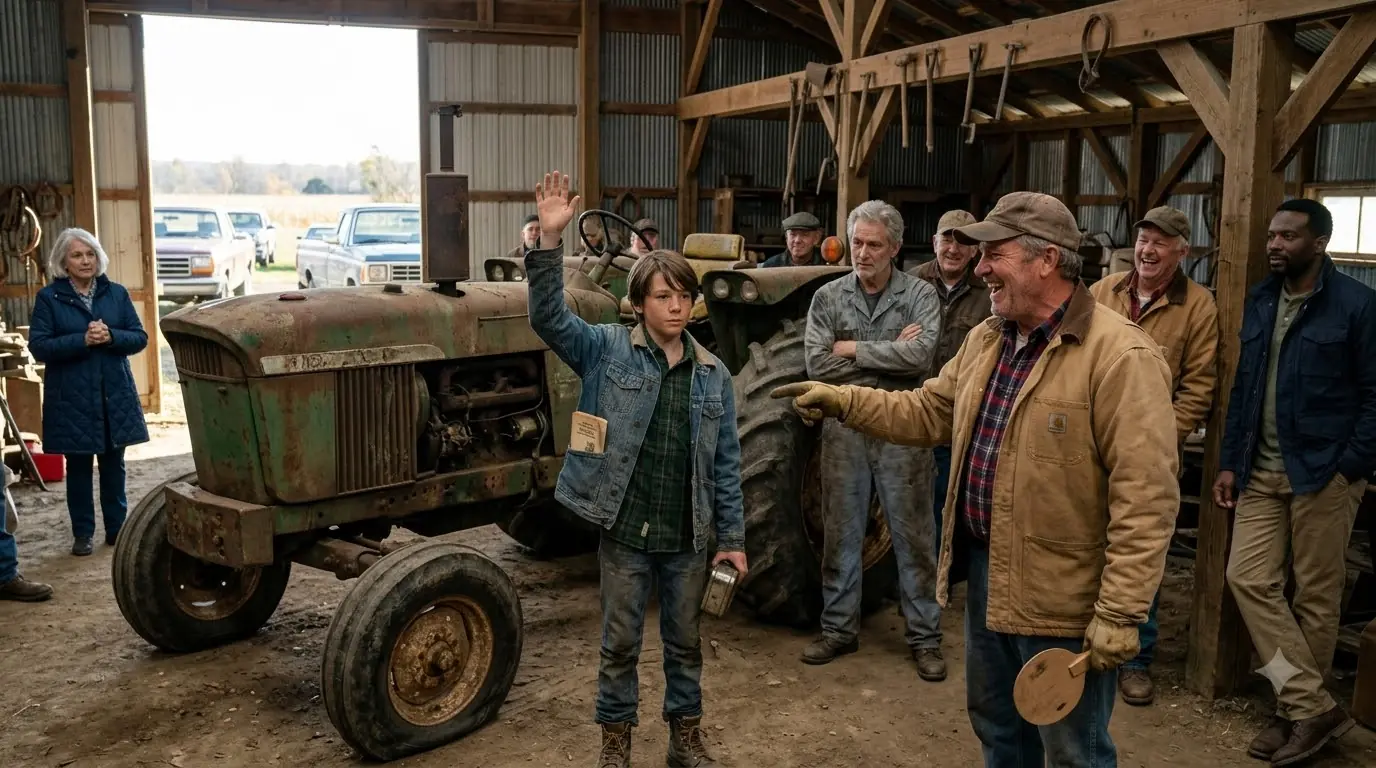
A paper tag tied to its steering wheel read PARTS ONLY in black marker. By the time the auctioneer reached it, most of the men in the building had already decided what it was worth.
Two hundred dollars, according to Floyd Meeker. Maybe less, if a man counted the trouble of hauling it home.
Floyd was the kind of fellow who could say something mean in a friendly voice and expect everyone to laugh with him. He had a thick red face, a silver belt buckle nearly the size of my palm, and twenty-five years of machinery dealing behind him. That morning he stood beside the tractor with one boot planted on a rear wheel and told the crowd it was good for scrap, a few usable parts, and not much else. He chuckled when he put his opening bid in. Then I raised my hand.
I was twelve years old, wearing a faded brown jacket that had belonged to my grandfather, and holding a bidder's paddle registered in my grandmother's name. There were two hundred people in that auction barn. For a moment, nearly all of them turned to look at me.
"Son," Floyd said, so loudly that people near the door leaned forward to listen, "that thing hasn't run in twenty years. You planning to ride it home by wishing at it?"
A few men laughed. I felt the heat climbing the back of my neck, but I kept my hand up until the auctioneer looked my way.
"I know it hasn't run," I said. "I think I know why. And I know how to find out if it can be fixed."
Floyd's smile widened, though his eyes lost some of their amusement. "You think? That's a pretty expensive word for a kid with no toolbox."
I had a toolbox. More than that, I had my grandfather's service manual, his pencil notes, and eleven weeks of winter ahead of me if I could persuade someone to let me try. But I wasn't going to explain any of that to a man who had already decided not to listen. I simply looked at the auctioneer, Gary Sims, and waited for him to call the next bid.
At the back of the barn, a tall man in a dark wool coat stopped writing in a notebook. His name was James Okafor, and I did not know him yet. He was director of the Harmon County Farm Bureau, and he had come to the auction to speak with farmers