Oliver's Recovery After Being Found Beside Discarded Furniture
Reader Theme:
Font Size:
24px
PART 2 — CURRENT CONDITION UPDATE
Oliver's first full day indoors was quiet.
He did not pace.
He did not cry constantly.
He did not throw himself against the kennel door.
Instead, he spent much of the morning curled inside the same small pet bed that had been found beside the discarded furniture.
The bed had been placed in the back of his enclosure after intake.
Oliver climbed into it almost immediately.
For the rescue team, that made sense.
Whatever his history was, the bed was familiar.
Its smell was familiar.
Its shape was familiar.
And after a night outside beside a pile of household belongings, familiarity seemed to matter more to him than anything else.
But we still needed to answer the medical question raised at intake.
Was Oliver staying so still because he was emotionally attached to the discarded belongings, or was movement itself uncomfortable?
His Long Coat Was Hiding More Than Dirt
Maine Coon mixes can look large even when their body condition is poor.
Oliver's thick coat made him appear heavier than he actually was.
Once our veterinary team examined him carefully, it became clear that he had lost noticeable body condition.
His ribs were easier to feel than they should have been.
There was reduced muscle over his back and hindquarters.
He was not in a state of extreme emaciation, but he was significantly thinner than ideal for a healthy 6-year-old cat.
The coat also contained several mats.
Some were superficial.
Others were tighter and closer to the skin.
The worst areas were behind his front legs, along the lower chest, and near the hindquarters.
Those mats mattered because they could restrict movement and pull painfully every time Oliver stretched or shifted position.
That gave us one possible explanation for why he appeared reluctant to move far.
The Mats Had to Be Removed Carefully
We did not try to brush through the tightest tangles.
That would have hurt.
Instead, the veterinary team and grooming staff clipped the worst mats in short sessions.
Oliver was cooperative for brief periods but became tense if handling lasted too long.
His tail would begin moving.
His ears would angle back.
His body stiffened.
So we stopped before he felt the need to escalate.
This meant the grooming process took more than one session.
That was fine.
The goal was not to make him look perfect.
The goal was to make him comfortable.
As the mats came away, we found areas of mild skin irritation underneath.
Fortunately, there were no deep wounds or severe infections hidden beneath the coat.
The skin simply needed time, cleanliness, and monitoring.
His Movement Improved Once the Tightest Mats Were Gone
One of the first things staff noticed after the grooming sessions was how differently Oliver stretched.
Before the mats were clipped, his movements had been cautious.
He took short steps.
He sat down frequently.
He seemed reluctant to extend his hind legs fully.
After the tightest fur was removed, he began moving more naturally.
He stepped in and out of the litter box without hesitation.
He climbed onto a low shelf.
He stretched his front legs forward after waking.
That did not mean the mats were the only reason he had been staying near the old pet bed.
But they were clearly contributing to discomfort.
We Also Checked for Joint Pain
At six years old, Oliver was not especially old.
Still, a large-framed cat with reduced muscle and uncertain history deserved a full orthopedic assessment.
The veterinarian palpated his legs, hips, spine, and joints.
There was no obvious fracture.
No major swelling.
No severe pain response.
Oliver could bear weight normally on all four limbs.
He was simply somewhat weak and deconditioned.
That fit with his low body condition.
When a cat loses muscle, even ordinary movement can become more tiring.
The treatment for that was not medication alone.
It was nutrition.
Rest.
And gradual return to normal activity.
Dehydration Was Mild but Important
Oliver was also mildly dehydrated.
His gums were slightly tacky, and his skin did not return as quickly as expected during the exam.
That was not surprising after spending at least one cold night outdoors with uncertain access to water.
Fresh water was made available immediately.
Wet food was offered as part of his nutritional plan.
Oliver accepted both.
He drank on his own during the first evening.
By the following day, his hydration status had improved.
His urine output remained normal.
He used the litter box consistently.
There was no straining.
No repeated unsuccessful attempts.
No visible blood.
Those simple observations were reassuring.
Oliver Ate With Urgency at First
Food was another clue.
The first meal at the clinic disappeared quickly.
Oliver ate almost as fast as he had when the delivery driver fed him outside.
That behavior could simply reflect hunger.
We could not know how long he had gone without regular meals.
So rather than give him unlimited food immediately, the team divided his intake into measured portions.
He received several smaller meals each day.
This helped reduce the chance of stomach upset and gave us a better way to monitor appetite.
Oliver responded well.
He kept the food down.
No repeated vomiting.
No persistent diarrhea.
Within a few days, he began eating more slowly.
Then he did something we had not seen at first.
He left food in the bowl.
He walked back to his bed.
Later, he returned and finished the rest.
That was a small sign of growing security.
His Weight Is Moving in the Right Direction
Oliver's body weight is now being tracked regularly.
We do not expect dramatic changes from day to day.
What we want is a steady trend.
So far, that trend is positive.
He has gained a small amount of weight.
His appetite remains consistent.
His muscle condition will take longer to improve.
That is normal.
Muscle does not return simply because a cat eats for a few days.
It requires time and normal movement.
As Oliver becomes more comfortable, we are encouraging gentle activity.
Nothing forced.
Nothing strenuous.
Just the opportunity to move.
The Old Bed Became His Safe Place
Emotionally, the small pet bed has been central to Oliver's adjustment.
At first, he spent almost all of his resting time inside it.
If someone entered the room, he lifted his head but stayed put.
If a hand approached too quickly, he pulled his chin down and watched carefully.
He did not swat.
He did not hiss often.
He simply stayed still.
That behavior suggested caution rather than aggression.
So the team stopped trying to draw him out.
The bed stayed.
People came and went.
Meals arrived.
The litter box was cleaned.
Nothing bad happened.
That routine started to change Oliver.
He Began Watching the Room From Outside the Bed
On the third day, a technician entered and found Oliver sitting beside the bed rather than inside it.
He remained there while she replaced his water.
That was new.
Later that afternoon, he stepped onto the low shelf at the front of the enclosure.
He stayed for several minutes.
Then he returned to the bed.
The next day, he did it again.
Gradually, the bed became one place among several rather than the only place where he felt safe.
The Rescuer Kept Visiting
The rescuer who had placed Oliver's bed inside the carrier came back to see him.
At first, Oliver did not approach.
She sat nearby.
She did not reach through the bars.
She spoke softly.
After several minutes, Oliver lifted his head.
Then he stood.
He walked to the front.
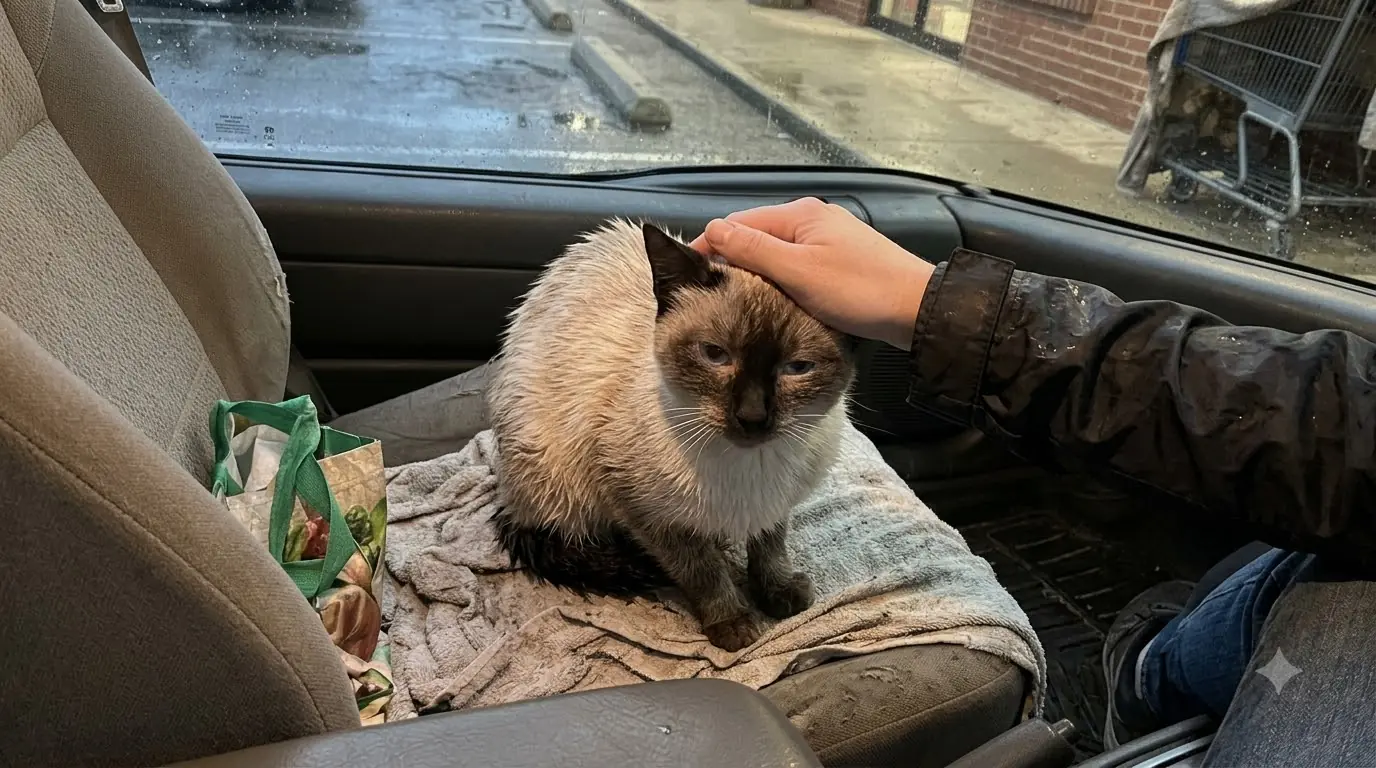
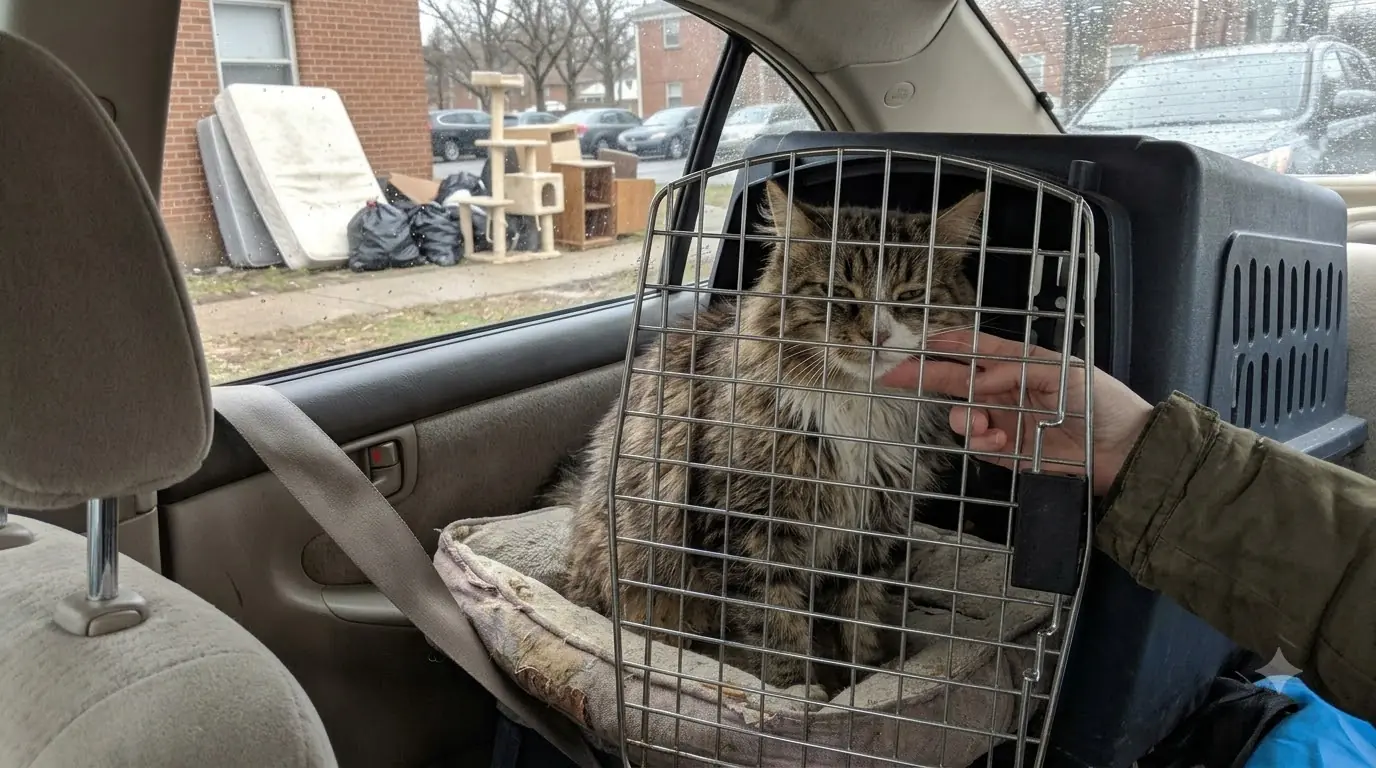
The rescuer offered two fingers just as she had during the car ride.
Oliver sniffed them.
Then he pressed one cheek against them.
That was the beginning of a familiar pattern.
Oliver Likes Cheek Contact More Than Being Picked Up
We quickly learned that Oliver is affectionate in a very specific way.
He enjoys cheek rubs.
He likes to lean his forehead against a hand.
He will sometimes rub his face along the edge of the kennel door.
But he does not like being lifted unexpectedly.
When staff tried to pick him up during one necessary exam, his body stiffened immediately.
So outside of medical handling, we avoid it.
Oliver is allowed to initiate most contact.
That has made him much more comfortable.
His Grooming Behavior Returned
Once the tightest mats were gone, Oliver began grooming himself more effectively.
At first, he focused on his front paws and chest.
Then he began reaching along his shoulders and sides.
That mattered.
A long-haired cat who cannot groom comfortably can decline quickly.
Mats build.
Skin becomes irritated.
Movement becomes restricted.
Oliver now spends several minutes grooming after meals.
His coat is still uneven where mats were clipped.
That will take time.
But the fur that remains is cleaner and softer.
His Litter Box Habits Have Stayed Consistent
Oliver uses the litter box reliably.
That gave us important information about both mobility and hydration.
He enters without difficulty.
He squats normally.
He covers his waste.
His stool became more regular once his feeding schedule stabilized.
There have been no signs of constipation severe enough to require intervention.
That is especially useful in a cat who arrived dehydrated.
Baseline Testing Was Reassuring
Because Oliver was underweight, we needed to consider whether an underlying illness might be contributing.
Weight loss in adult cats can have many causes.
Dental disease.
Kidney problems.
Diabetes.
Hyperthyroidism.
Gastrointestinal disease.
Parasites.
Chronic infection.
Cancer.
Or simply inconsistent access to food.
Oliver's baseline testing did not reveal an obvious severe systemic illness.
That was encouraging.
It did not eliminate every possible condition.
But combined with his strong appetite, improved hydration, stable litter-box habits, and early weight gain, it made nutritional loss and stress more likely contributors.
We continue to monitor him.
If his weight stops improving despite adequate food, further diagnostics may become appropriate.
His Teeth Needed Attention, but Not Emergency Treatment
Oliver's mouth was also examined.
He had mild to moderate dental tartar.
There was some gingival irritation.
But there were no obvious severe oral lesions that explained his weight loss.
He could chew.
He ate both wet and dry food.
He did not drop food from his mouth.
He did not paw at his face.
Dental care will still be part of his long-term health plan.
But it was not the immediate crisis.
The Biggest Question Was Still His Past
Physically, Oliver's condition began making sense.
Poor body condition.
Dehydration.
Mats.
Mild skin irritation.
Weakness.
None of those findings explained why he refused to move far from the discarded furniture.
That part remained emotional.
The scene was unusual.
A mattress.
Garbage bags.
An old cat tree.
A pet bed.
And Oliver lying inside that bed.
The arrangement naturally makes people wonder whether he had been left behind with household belongings.
That is possible.
But we cannot prove it.
We do not know who placed the furniture there.
We do not know whether Oliver lived in the apartment building.
We do not know whether the cat tree belonged to him.
We do not know whether the pet bed was his before that day.
What we do know is that he treated the bed as familiar.
He Returned to It Even After Eating
That detail is important.
When the delivery driver offered food, Oliver ate quickly.
He could have followed the driver.
He could have moved toward the building.
He could have wandered elsewhere.
Instead, he went back to the bed.
That does not prove he was waiting for a specific person.
It does suggest that the bed gave him a sense of security.
Cats rely heavily on scent.
A familiar-smelling object can be comforting during upheaval.
Whether the bed had always belonged to Oliver or simply became his shelter after he arrived, it was clearly important to him.
The Carrier Test Told Us Something Similar
Oliver initially backed away from the carrier.
That reaction was normal.
A strange enclosed object can be frightening.
But when the rescuer placed the little bed inside, his response changed.
He stared.
Then he stepped closer.
He sniffed the opening.
And eventually, he climbed in.
No one had to chase him.
No one had to grab him.
The bed made the carrier less unfamiliar.
That is one reason we kept it with him afterward.
We Looked for a Microchip
Oliver was scanned carefully.
No microchip was detected.
That did not solve the mystery.
Many owned cats are not chipped.
Some are chipped but never registered properly.
Some chips migrate.
So the scan was repeated thoroughly.
Still nothing.
His rescue location and physical description were documented.
Any legitimate claim would need to be verified appropriately.
Until then, Oliver remained in rescue care.
Nobody Nearby Could Confirm His History
Residents had seen Oliver beside the furniture.
Some thought he looked familiar.
Others had never noticed him before.
No one could provide clear ownership information.
That made it even more important not to invent a story.
The emotional circumstances were strong enough without adding details we could not confirm.
Oliver was outside in cold weather.
He stayed close to discarded belongings.
He appeared underweight.
His coat was matted.
He needed care.
Those facts were enough.
He Started Sleeping More Deeply
During the first few nights, Oliver slept mostly curled tightly inside the bed.
His head was tucked down.
His body remained compact.
He woke whenever the room door opened.
By the end of the first week, staff began finding him stretched out.
Sometimes one paw hung over the edge.
Sometimes he rested his chin on the side.
Once, a technician entered and Oliver did not wake at all.
That was significant.
Deep sleep suggests comfort.
Not complete emotional recovery.
But comfort.
The Bed Slowly Stopped Being Necessary
We did not remove it suddenly.
That would have been unnecessary.
Instead, we added another soft sleeping area.
At first, Oliver ignored it.
Then he sniffed it.
Several days later, he sat inside it briefly.
Eventually, he slept there for part of an afternoon.
The old bed remained available.
Oliver simply began making other choices.
That was exactly what we wanted.
The goal was not to take away something familiar.
The goal was to help him discover that safety existed outside it too.
His Energy Began Returning
As Oliver gained strength, his behavior became more active.
He started climbing the low shelf more often.
Then he showed interest in a toy.
A small soft mouse was placed near the front.
Oliver ignored it for most of the day.
Later, staff found it under his bed.
The next morning, they saw him push it across the floor with one paw.
The play was brief.
But it was play.
For an adult cat adjusting to a shelter, that was a positive step.
He Is Still a Quiet Cat
Oliver has not become loud or demanding.
That may simply be his personality.
He gives an occasional low meow when food arrives.
He may chirp softly when a familiar person approaches.
Most of his communication is physical.
He walks forward.
He offers his cheek.
He leans.
He sits nearby.
Those small gestures tell us a lot.
He Has Started Greeting Staff at the Door
One of the biggest behavioral changes happened during morning cleaning.
Initially, Oliver stayed in the back.
Then he began sitting halfway forward.
Now, when one of his regular caregivers arrives, Oliver often walks to the front.
His tail is usually level or slightly raised.
He sniffs the offered hand.
If he is comfortable, he rubs.
Then he may return to his bed or wait for breakfast.
That routine feels very different from the cat who would not move away from discarded furniture.
He Is Becoming Comfortable Without Constant Contact
Oliver likes people.
But he is not dependent on them every minute.
If a volunteer sits beside him, he may approach.
If they leave, he often watches for a few seconds.
Then he settles.
That is a healthy pattern.
We want him to enjoy social contact while also feeling secure when alone.
His Coat Will Need Long-Term Maintenance
Long-haired cats need consistent grooming.
That will be especially important for Oliver.
Once his clipped fur grows back, whoever cares for him will need to brush regularly.
The high-risk areas are predictable.
Behind the front legs.
Under the chest.
Along the belly.
Around the hindquarters.
If Oliver is allowed to become severely matted again, the same discomfort could return.
A future caregiver will need to make grooming routine rather than waiting for mats to become painful.
His Next Medical Steps Are Straightforward
Oliver does not currently need aggressive treatment.
His hydration is normal.
His appetite is stable.
His litter-box habits are normal.
His weight is gradually improving.
His skin irritation is healing.
His mobility is good.
The next steps are routine.
Continue weight monitoring.
Continue coat care.
Complete standard preventive veterinary care appropriate to his situation.
Address dental maintenance at the appropriate time.
Watch for any unexpected change.
A Foster Home Could Tell Us More
The shelter has shown us one version of Oliver.
A foster home could show us another.
In a home, we could learn whether he enjoys windows.
Whether he follows people.
Whether he sleeps on furniture.
Whether he likes quiet rooms.
Whether he prefers to sit beside someone rather than on their lap.
Whether normal household sounds make him nervous.
Those details would help match him more carefully if he becomes available for adoption.
The Old Bed May Go With Him
If Oliver moves into foster care soon, we may send the old bed with him.
Not because we want him to depend on it forever.
Because familiar scent can make transitions easier.
A new room.
New people.
New sounds.
A new routine.
Having one object that already smells safe can help.
Eventually, Oliver may abandon the bed on his own.
That will be his choice.
Recovery Has Become Quiet
Nothing dramatic happens most days now.
Oliver eats.
He drinks.
He uses the litter box.
He grooms.
He sleeps.
He accepts gentle cheek scratches.
He plays for a few minutes.
He gains a little weight.
He learns that breakfast comes every morning.
That is what recovery often looks like.
Not one huge moment.
Hundreds of small ones.
One Afternoon, Oliver Chose the New Bed
A few days ago, a volunteer entered the room and found the old pet bed empty.
For a moment, she thought Oliver might be hiding.
Then she saw him.
He was asleep in the new bed.
His body was stretched out.
His head rested along the edge.
The old bed was only a few feet away.
Oliver had simply chosen something else.
No one moved him.
No one coaxed him.
That decision belonged to him.
For the team, it felt important.
The Old Belongings Are No Longer His Whole World
When Oliver was found, the pile of furniture seemed to define his world.
He stayed beside it.
He slept in the bed.
He returned after eating.
Even during the car ride, he watched the pile disappear.
Now he has other reference points.
The sound of the food cart.
The footsteps of a familiar caregiver.
The clean litter box.
The low shelf.
The new bed.
The rescue volunteer's hand.
Safety is becoming attached to more than one object.
We Still Do Not Know Exactly What Happened
We may never know whether Oliver belonged to someone who lived in that apartment building.
We may never know whether the cat tree and bed had been his.
We may never know whether the belongings were discarded during a move, an eviction, a cleanout, or something completely unrelated to him.
Those questions matter emotionally.
But they do not change what Oliver needs now.
He needs stability.
Nutrition.
Grooming.
Medical care.
And time.
Tonight, Oliver Is Resting Somewhere New
Oliver's old bed is still in his enclosure.
He still uses it sometimes.
But tonight, he is sleeping on the newer bed.
His coat is cleaner.
The painful mats are gone.
His skin is healing.
His hydration is normal.
His appetite is dependable.
His weight is beginning to increase.
His litter-box habits are consistent.
And his movement is much more comfortable.
When one of his caregivers stops at the kennel, Oliver often lifts his head.
Sometimes he walks forward.
Sometimes he stays where he is.
Both are okay.
Earlier today, the rescuer who brought him in visited again.
She offered two fingers through the bars.
Oliver stood.
He walked over.
And just as he did in the car, he leaned his face against them.
Then he turned around.
He walked back to his bed.
And he settled down.
We still do not know what Oliver thought when he watched the discarded furniture disappear through the rear window.
We do not know what those belongings meant to him.
But they are no longer the only things that feel familiar.
Oliver now has food that arrives every day.
People whose voices he recognizes.
A body that is slowly regaining strength.
A coat that no longer pulls painfully against his skin.
And a place where he can sleep without being left beside the curb overnight.
Whatever his past turns out to be, Oliver is safe now.
And for the first time, he is beginning to choose comfort that has nothing to do with the pile of things he was found beside.