Oliver has now been safely at our adoption center for several days, and the difference between the puppy we found beside the highway and the puppy we see today is already significant.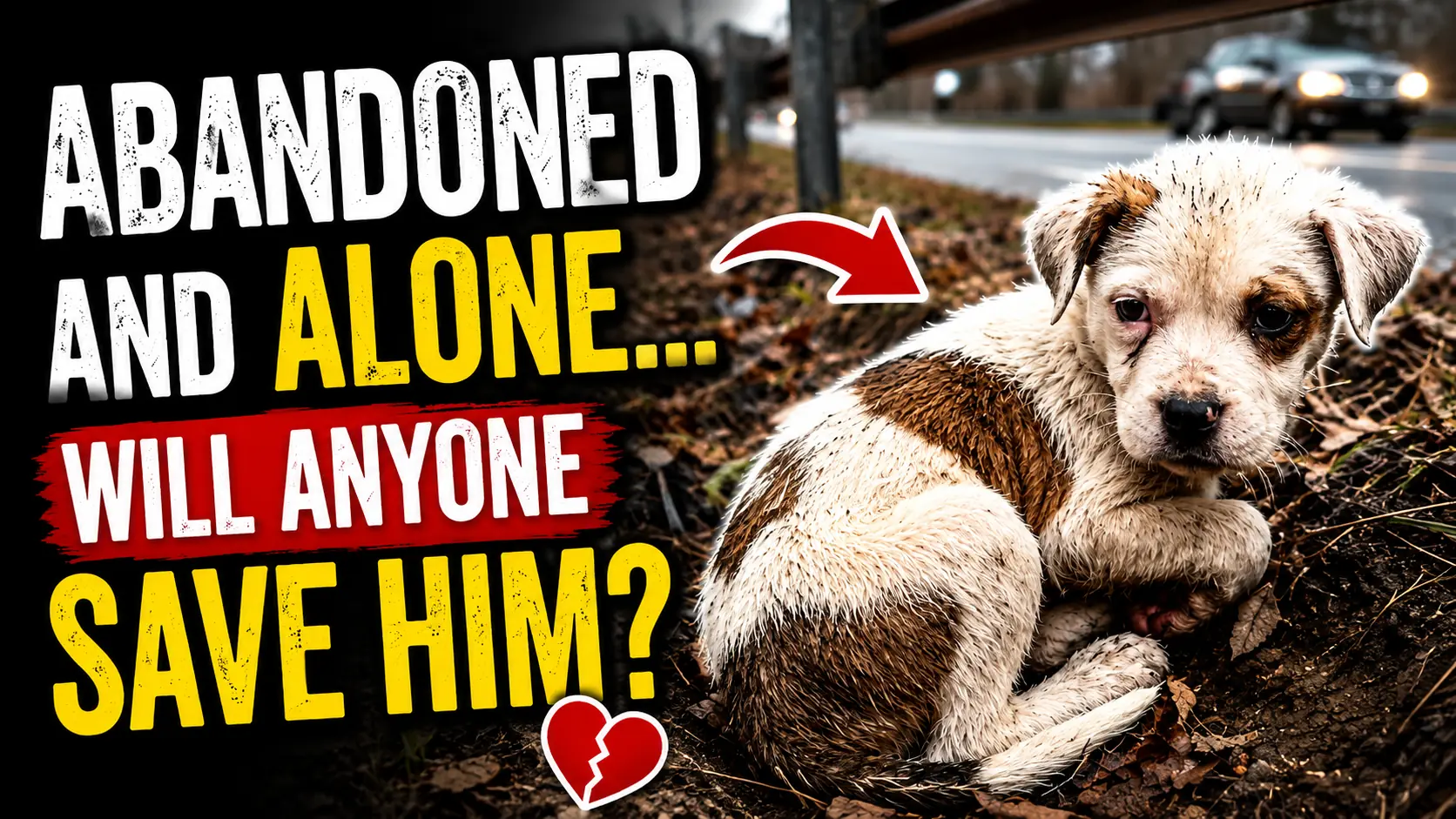
When he first arrived, our veterinary team’s main concerns were his age, dehydration, body condition, and the possibility that he had been exposed to illness while living outdoors.
He was dirty and damp, with mud along his legs and underside. Beneath his coat, he was thinner than we wanted a puppy of his size to be.
There were no obvious fractures or major wounds.
That was the first piece of good news.
His heart and lungs sounded normal, his temperature was stable, and he remained alert enough to follow movement around the examination room.
Basic testing did not reveal an immediate life-threatening illness, but because very young puppies can become sick quickly, Oliver was placed under close observation.
During his first several hours, he received fluids and was kept warm.
Food was introduced carefully.
We did not want to overwhelm his digestive system with a large meal after an unknown period of inconsistent feeding, so he was offered small portions several times throughout the day.
At first, Oliver ate slowly.
He took a few bites, stopped, and looked around the room.
A caregiver sat nearby.
Eventually, he returned to the bowl.
By the second day, he no longer needed encouragement.
Now Oliver knows exactly when food is coming.
The moment he hears a bowl being prepared, his head comes up.
Sometimes he even gives a tiny impatient whine.
For our staff, that sound has become one of the best signs of progress.
His hydration has returned to normal.
His weight is beginning to increase gradually, and his body condition will continue to be monitored carefully as he grows.
The goal is not rapid weight gain.
It is healthy development.
Oliver is receiving a balanced puppy diet appropriate for his age, along with the veterinary care needed to support normal growth.
Because his early medical history is unknown, he has also started the routine preventive care schedule recommended for a young puppy.
That includes age-appropriate vaccinations, parasite screening, deworming when indicated, and regular wellness checks.
His veterinarian will continue monitoring him closely because puppies without reliable early records sometimes require extra attention during the first several weeks.
So far, Oliver is responding beautifully.
His stomach has remained stable.
His energy is improving.
His coat is cleaner.
And most importantly, he is beginning to behave like a puppy.
That did not happen immediately.
During his first night, Oliver seemed exhausted.
He curled tightly into the soft bedding we prepared and slept for hours.
Whenever someone entered the room, he opened his eyes but rarely stood.
We placed a rolled blanket along one side of his bed so he could sleep against something warm and soft.
Oliver immediately pressed himself beside it.
That small detail stayed with us.
A puppy this young normally grows up surrounded by physical contact.
A mother.
Littermates.
Warm bodies sleeping close together.
Oliver had none of that when we found him.
He was alone beside a road.
We cannot know exactly how long he had been separated from his mother or how he ended up there.
What we can do is make sure he no longer has to face that uncertainty.
For the first several nights, caregivers gave Oliver plenty of soft bedding and kept his sleeping area warm and quiet.
He quickly developed a habit of resting with his side pressed against the rolled blanket.
Sometimes he tucked his nose underneath it.
Other times he stretched one paw across the top.
As he has become more secure, that behavior has slowly changed.
Oliver now sleeps in more relaxed positions.
He sometimes stretches completely across the bed.
He occasionally rolls onto his side.
And he no longer wakes at every small noise.
That deeper sleep tells us his body is beginning to trust the environment around him.
His relationship with people has changed just as much.
When Oliver first arrived, he watched hands carefully.
He did not snap or growl.
He simply froze when someone moved too quickly.
So our staff slowed everything down.
People approached from the side instead of reaching directly over his head.
They let him sniff their fingers.
They sat on the floor.
They waited.
Oliver made the next decision himself.
The first time he voluntarily walked into a caregiver’s lap, he stayed there for less than a minute.
The next day, he remained longer.
Now he regularly approaches familiar staff members when they sit with him.
He enjoys being held against someone’s chest after meals.
Sometimes he rests his head beneath a chin and falls asleep.
We are careful not to turn that affection into complete dependence.
Oliver needs to learn that being alone for short, appropriate periods is also safe.
But at his age, healthy attachment is important.
He missed part of the early comfort puppies normally receive, and patient human contact can help him develop confidence rather than fear.
His playful side has finally appeared too.
The first toy offered to Oliver received almost no reaction.
He sniffed it and went back to sleep.
Several days later, a volunteer rolled a soft ball across the floor.
Oliver watched.
Then he stood.
He followed it slowly.
He touched it with one paw.
The ball rolled again.
Oliver jumped backward.
Then he chased it.
That was the first time everyone in the room saw him behave like the young puppy he actually is.
Since then, play has become part of his daily routine.
He likes soft toys he can carry.
He enjoys chasing a ball for several feet.
He occasionally grabs the corner of his blanket and drags it across the floor for reasons known only to Oliver.
Then, after a few minutes, he becomes tired and looks for a person.
That transition—from playing independently to seeking a warm lap—is completely normal for a young puppy.
And it is also why we think so often about what he missed.
Oliver should have had a mother nearby during those early days.
He should have been able to curl against her when he was cold.
He should have had littermates to climb over and sleep beside.
We cannot recreate that perfectly.
No human caregiver can replace a puppy’s mother.
What we can give Oliver is safety, appropriate socialization, veterinary care, warmth, and consistent affection.
Those things matter tremendously.
Our team is also introducing him carefully to normal household experiences.
Different floor surfaces.
Quiet household sounds.
Gentle grooming.
Being handled around his paws and ears.
Short leash sessions appropriate for his development.
Calm interactions with new people.
Every experience is kept positive and brief.
We want Oliver to grow into a dog who approaches the world with curiosity rather than fear.
So far, he is learning quickly.
He has become particularly interested in following caregivers.
If someone walks across the room, Oliver often trots behind.
If the person stops, Oliver sits near their feet.
If they leave, he watches for a moment.
Then he usually returns to a toy or his bed.
That ability to settle again is encouraging.
One of the most important goals over the coming weeks will be helping Oliver become confident without allowing him to become overly dependent on a single person.
He deserves affection.
He also deserves the confidence to know that being alone briefly does not mean he has been abandoned again.
That lesson will take repetition.
Someone leaves the room.
Someone comes back.
His bowl appears again.
His blanket remains where he left it.
Morning follows night.
Nothing terrible happens.
Over time, ordinary routines become security.
Medically, Oliver’s next steps are straightforward.
He will continue his vaccination schedule, receive routine parasite prevention, and have regular weight checks as he grows.
His veterinarian will monitor his joints, teeth, eyes, ears, skin, and overall development during each visit.
If any new symptoms appear, they will be addressed quickly.
At present, however, there is no indication of a major underlying medical problem.
That is a tremendous relief.
The puppy we found beside the road looked exhausted and defeated.
The puppy we see today lifts his head when someone enters.
He eats enthusiastically.
He plays.
He sleeps deeply.
He follows people.
He seeks affection.
His tail has started wagging more often.
The biggest thing missing from Oliver’s recovery is not something medicine can provide.
It is permanence.
The adoption center can keep him safe.
We can feed him.
We can vaccinate him.
We can hold him when he is frightened.
But eventually, Oliver needs to learn what it feels like to belong to one family.
A home where the same person gets up with him in the morning.
Where his bowl has a permanent place.
Where toys end up under the couch.
Where someone knows when he is tired before he does.
Where he can curl up beside a warm body and never wonder whether morning will find him alone again.
We hope his future adopter understands that Oliver is still very young.
There will be training.
There will be accidents.
There may be chewed things.
There will definitely be puppy energy.
He will need patience, structure, socialization, exercise appropriate for his age, and continued veterinary care.
But he will also bring something simple into that home.
Trust.
It is already beginning.
After everything changed around him, Oliver is still willing to approach people.
He still chooses a lap.
He still falls asleep when someone holds him.
That is an extraordinary thing for such a small dog to offer.
We cannot give Oliver back the beginning he should have had.
We cannot place him beside the mother he was separated from.
But perhaps his next family can give him something that lasts much longer.
A person whose warmth becomes familiar.
A home he grows up remembering.
A place where, years from now, the frightened puppy beside the roadside feels like someone else’s story.
For now, Oliver is safe.
He is warm.
He is healthier every day.
And while he still has growing and healing ahead of him, he no longer has to curl alone in the dirt while cars rush past.
The next time Oliver falls asleep beside someone, we hope that person will eventually be the one he gets to wake up beside for the rest of his life.