ONE OF THE QUIETEST FEARS OF AGING IS LOSING YOUR INDEPENDENCE
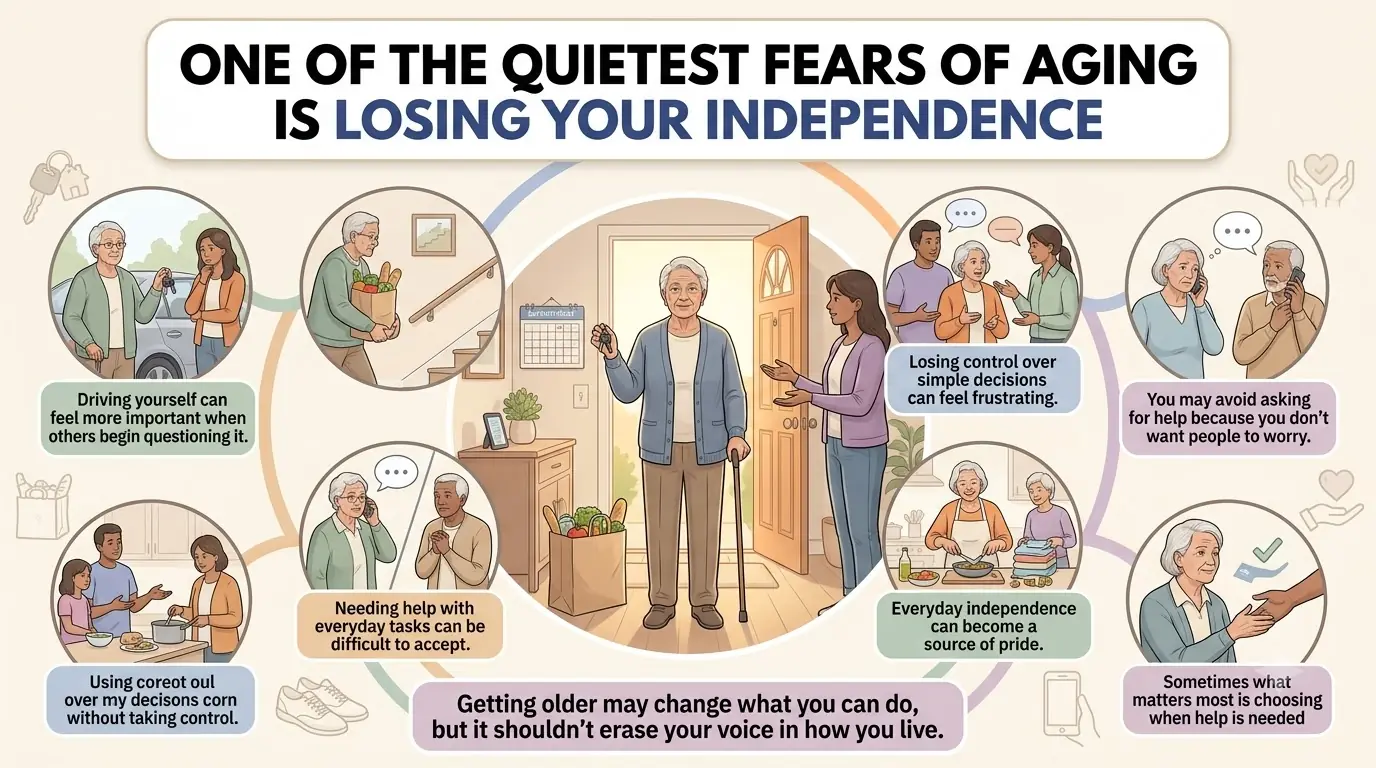
For many people, getting older isn't frightening simply because of wrinkles, gray hair, or another birthday. A deeper concern can be the possibility of gradually losing control over everyday life.
Driving yourself to the store, preparing your own meals, choosing when to leave the house, managing appointments, or deciding how to spend the day may seem ordinary when you've done them independently for decades. But when those abilities become more difficult—or other people begin questioning whether you should still do them—they can suddenly feel extremely important.
Independence doesn't mean refusing all assistance. Most people need help at different points in life. What often matters is maintaining as much choice, dignity, autonomy, and participation as safely possible.
Getting older may change what someone can do. It doesn't automatically remove their right to have a meaningful voice in how they live.
Why Independence Matters So Much in Later Life
Independence is about more than living alone or performing every task without assistance.
It also means having control over decisions.
Where will I go today?
What will I eat?
Who will help me?
When will they help?
Where will I live?
Which activities will I continue?
These choices are closely connected to identity.
When physical or cognitive abilities change, families may understandably become more involved. But there's an important difference between supporting someone and automatically taking over.
For many older adults, maintaining control over even small everyday decisions can help preserve dignity and a sense of self.
1. Driving Can Become About Much More Than Transportation
For decades, driving may simply be a practical part of life.
Then family members begin asking questions.
“Should you still be driving at night?”
“Are you comfortable on the highway?”
“Wouldn't it be safer if I drove?”
Those concerns may sometimes be justified. Vision changes, slower reaction times, cognitive impairment, certain medications, and medical conditions can affect driving safety.
But giving up driving can have consequences beyond losing access to a vehicle.
Driving represents freedom.
Without it, someone may need assistance to:
- Buy groceries.
- Visit friends.
- Attend medical appointments.
- Go to religious services.
- Participate in hobbies.
- Visit family.
- Simply leave home spontaneously.
That's why conversations about driving can become emotionally charged.
When driving truly becomes unsafe, the goal shouldn't only be removing the keys. Families should also create a realistic transportation plan so the person can remain connected to the outside world.
2. Needing Help With Ordinary Tasks Can Be Difficult to Accept
A bag of groceries becomes heavier.
Stairs become more tiring.
Getting to an appointment requires more planning.
Household repairs that once took an afternoon become physically demanding.
These changes can happen gradually.
For someone who has spent decades managing independently, asking another person for help may feel uncomfortable.
The difficulty isn't necessarily stubbornness.
Accepting help can represent a change in how someone sees themselves.
This is especially true for people who spent much of their lives caring for others.
A parent who once drove children everywhere may now need those children to provide transportation.
Someone who once carried everyone's bags may now need someone to carry theirs.
That reversal can require emotional adjustment.
Families can make the transition easier by providing assistance respectfully rather than treating every limitation as evidence that someone is incapable.
3. Having Other People Make Simple Decisions Can Reduce a Sense of Control
Loss of independence doesn't always begin with a major event.
Sometimes it begins with small decisions disappearing.
Someone else decides what groceries to buy.
Someone schedules the doctor's appointment without asking.
Someone reorganizes the house.
Someone decides when the older adult should leave an event.
Individually, these actions may seem insignificant.
Together, they can make someone feel as though life is increasingly happening to them rather than with them.
When an older adult has the capacity to make a decision, include them.
Ask:
“What would you prefer?”
“Would you like help with this?”
“Which option works better for you?”
Even when assistance is necessary, choices can often remain.
4. Some Older Adults Avoid Asking for Help
An older parent may struggle with something for days before mentioning it.
Why?
Sometimes they worry that asking for help once will lead family members to believe they can no longer manage anything.
They may fear that admitting difficulty with driving at night will lead to losing the car completely.
Or that asking for help carrying groceries will make their children question whether they should continue living independently.
They may also simply not want their family to worry.
As a result, some people hide difficulties until the problem becomes more serious.
Families can help by creating an environment where accepting specific assistance doesn't automatically trigger a complete takeover.
Someone can need help with one task and remain fully capable of managing many others.
5. Cooking, Shopping, and Housework Can Become Sources of Pride
Everyday chores aren't always just chores.
Preparing breakfast can represent self-sufficiency.
Shopping can represent mobility and choice.
Doing laundry can represent the ability to maintain one's own home.
Cooking dinner can represent both independence and creativity.
From the outside, a family member may think:
“Why should Dad struggle with groceries when I can do everything for him?”
The answer depends on safety and ability.
If someone can still perform an activity safely and values doing it, taking it away unnecessarily may remove more than work.
It can remove part of their routine and identity.
A better approach may be targeted assistance.
Perhaps someone chooses the groceries while another person carries the heavy bags.
Perhaps they continue cooking but receive help with difficult preparation.
Support can fill the gap without replacing the entire activity.
6. Sometimes Independence Means Choosing When to Accept Help
Independence and assistance aren't opposites.
A person can receive substantial support while maintaining meaningful autonomy.
Someone may use a walker and remain independent.
They may use transportation services after giving up driving.
They may have someone clean the house while continuing to cook.
They may receive help organizing medications while remaining involved in healthcare decisions.
This idea is sometimes described as supported independence.
The goal isn't necessarily to help someone do everything alone.
The goal is to provide enough assistance to make life safer and easier while preserving as much choice and participation as possible.
Why Families Sometimes Take Over Too Quickly
Most families aren't intentionally trying to remove independence.
Usually, they're worried.
An adult child sees a parent stumble and immediately imagines a serious fall.
They notice a forgotten appointment and begin worrying about dementia.
They see an empty refrigerator and become concerned about nutrition.
Those concerns may be reasonable.
But fear can sometimes cause families to move from helping to controlling before understanding what is actually happening.
Before making major changes, consider what the person can still safely manage and whether a smaller intervention would solve the problem.
One difficult task doesn't necessarily mean someone can no longer live independently.
Maintaining Physical Strength Can Help Protect Independence
Many everyday activities depend heavily on muscle strength.
Strong legs and core muscles help with:
- Getting out of chairs.
- Climbing stairs.
- Walking.
- Carrying groceries.
- Maintaining balance.
- Performing household tasks.
Age-related muscle loss can make these activities more difficult.
Regular physical activity, including appropriate resistance exercise, can help older adults maintain strength and physical function.
Balance exercises can also be useful, particularly for people at increased risk of falls.
Exercise needs to match the person's abilities and medical circumstances. Someone with significant heart disease, severe mobility problems, or a history of falls may benefit from guidance from a healthcare professional or physical therapist.
Home Changes Can Preserve Freedom Instead of Restricting It
Sometimes maintaining independence requires changing the environment rather than restricting the person.
Helpful modifications may include:
- Better lighting.
- Secure handrails.
- Grab bars in appropriate locations.
- Removing tripping hazards.
- Frequently used items placed within easy reach.
- Appropriate footwear.
- Mobility aids when needed.
An occupational therapist can also evaluate everyday activities and recommend ways to make them safer.
The goal isn't simply preventing accidents.
It's enabling someone to continue doing as much as possible independently.
When Driving Safety Becomes a Real Concern
Driving deserves special consideration because independence must be balanced with public safety.
Warning signs that deserve attention can include:
- Becoming frequently lost.
- Repeated crashes or near misses.
- Difficulty seeing road signs.
- Confusion in traffic.
- Significant problems with judgment.
- Difficulty responding appropriately to changing road conditions.
Rather than relying entirely on age, driving ability should be considered based on actual functional capacity and applicable licensing requirements.
A healthcare professional may sometimes help evaluate medical factors affecting driving.
If driving must stop, transportation alternatives should be discussed at the same time.
Removing transportation without replacing it can dramatically increase isolation.
When Changes in Independence Deserve Medical Evaluation
A gradual need for more assistance can occur for many reasons.
But a noticeable decline deserves attention, particularly if someone suddenly begins struggling with tasks they previously handled easily.
Possible contributors include:
- Medication side effects.
- Vision or hearing problems.
- Arthritis and chronic pain.
- Muscle weakness.
- Balance disorders.
- Depression.
- Cognitive impairment.
- Neurological conditions.
- Heart or lung disease.
- Recent illness or hospitalization.
Some causes can be treated or improved.
That's why a decline in function shouldn't automatically be explained as “just getting old.”
Sudden Loss of Independence Can Be a Warning Sign
Sudden changes are particularly important.
Seek urgent medical attention if an older adult suddenly develops:
- Difficulty walking.
- New one-sided weakness or numbness.
- Facial drooping.
- Difficulty speaking or understanding speech.
- Severe dizziness or loss of balance.
- New confusion.
- Chest pain.
- Severe shortness of breath.
- Fainting.
A person who was functioning normally yesterday and suddenly cannot manage familiar activities today may have an acute medical problem.
Rapid functional decline shouldn't simply be attributed to age.
How Adult Children Can Help Without Taking Away Control
Supporting an aging parent often requires finding a balance between safety and autonomy.
A few principles can help:
- Ask before taking over.
- Offer choices whenever possible.
- Focus assistance on tasks that are genuinely difficult.
- Allow additional time for activities.
- Include parents in decisions affecting them.
- Address specific safety risks rather than eliminating every activity.
- Support physical activity and mobility when appropriate.
- Help solve transportation barriers.
- Respect reasonable preferences even when they differ from yours.
Sometimes the most useful question isn't:
“What can I do for you?”
It's:
“What would make it easier for you to keep doing this yourself?”
That small difference changes assistance from replacement to support.
Independence Can Look Different Without Disappearing
Aging may eventually require adaptation.
Someone may move from driving to using transportation services.
A cane may become necessary.
Heavy housework may be delegated.
Family members may help manage complicated appointments.
None of these changes automatically means independence has disappeared.
Autonomy can remain wherever meaningful choices remain.
The goal of healthy aging isn't to pretend physical abilities never change.
It's to preserve function where possible, adapt when necessary, and make sure assistance doesn't unnecessarily erase the person's voice.
Key Takeaways
- Independence involves choice and control, not simply doing everything without assistance.
- Giving up driving can affect social connection and freedom as well as transportation.
- Needing help with one task doesn't mean an older adult is incapable of managing everything else.
- Automatically making decisions for someone can unintentionally reduce autonomy.
- Everyday activities such as cooking and shopping may carry significant emotional meaning because they represent self-sufficiency.
- Strength, balance, appropriate home modifications, and assistive devices can help preserve independence.
- Families can support safety without unnecessarily taking over.
- A new or worsening decline in everyday functioning deserves medical evaluation.
- Sudden loss of mobility, cognition, or normal abilities can signal a medical emergency.
Sometimes what an older person wants most isn't for everyone to stop helping. They want the freedom to decide what they can still do, where they need support, and how that support becomes part of their life.
Medical Disclaimer
This article is for general educational purposes and is not a substitute for professional medical advice, diagnosis, or treatment. Physical abilities, cognitive function, safety needs, and independence vary considerably among older adults. Persistent or worsening changes in mobility, balance, memory, or everyday functioning should be discussed with a qualified healthcare professional. Sudden neurological symptoms, confusion, severe breathing difficulty, chest pain, or abrupt loss of normal function may require emergency medical attention.