Penny Finally Stopped Running—Then Her X-Rays Explained Why
Reader Theme:
Font Size:
24px
Alone Beside a Country Road
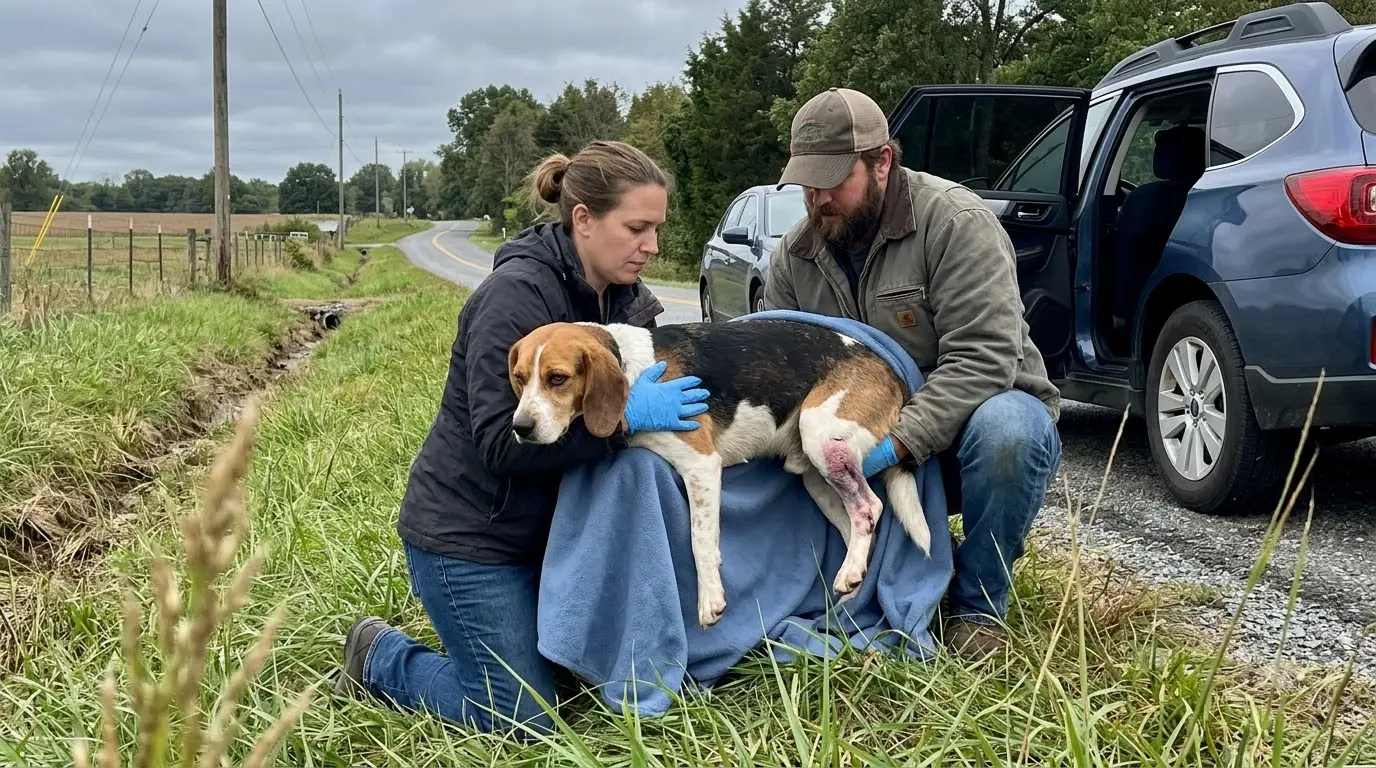
The first person who stopped for Penny thought she might simply be a loose dog.
From a distance, the small Beagle mix was standing near the grassy shoulder of a country road, far enough from the nearest houses that nobody immediately knew where she belonged.
Then Penny tried to move.
That was when it became clear that something was wrong.
She took several uneven steps before lowering herself again. One of her back legs barely touched the ground.
Another vehicle stopped.
Penny struggled to stand.
She moved away from the people approaching her, but she could only travel a short distance before stopping again.
The people who encountered her faced a difficult situation. Penny clearly needed assistance, but chasing a frightened, injured dog beside a road could have made an already dangerous situation much worse.
Eventually, a passing driver recognized that Penny was not going to be able to leave safely on her own.
The driver contacted a local rescue and remained nearby.
Instead of repeatedly approaching Penny, the driver watched from a distance and helped alert other motorists to slow down.
By the time our rescue team arrived, Penny was lying in the grass.
She was awake and watching everything.
Her body remained tense.
Her ears were pulled back, and whenever someone moved directly toward her, she shifted as though preparing to stand.
Nobody knew how long she had been there.
Nobody knew exactly how her leg had been injured.
There were no witnesses who could tell us whether she had been struck by something, fallen, become caught somewhere, or experienced another type of accident.
We would not invent that history for her.
Our responsibility was to address what we could see.
Penny was frightened.
Penny was hurting.
And Penny needed to be moved away from the road without increasing either problem.
The Moment She Stopped Trying to Leave
The rescuers approached slowly with a large blanket.
They did not surround her.
One person remained farther back while another approached from an angle, giving Penny as much space as the situation safely allowed.
Penny lifted her head.
Then she tried to stand.
Her front legs pushed against the ground first. Her uninjured hind leg followed, but when she attempted to place weight on the painful leg, she immediately shifted away from it.
She managed only a few steps.
Then she stopped.
The rescuer stopped too.
For several seconds, Penny simply stood there.
Then she lowered herself.
Her head went down.
The tension in her body softened just enough for the rescuer to carefully place the blanket around her.
Penny did not suddenly become relaxed.
She did not wag her tail or behave as though everything was fine.
She simply stopped trying to move away.
Using the blanket for support and minimizing movement of the injured limb, the team lifted her carefully and carried her toward the rescue vehicle.
Penny watched them.
She remained quiet.
Once she was positioned safely on padded bedding inside the vehicle, one rescuer stayed beside her while another drove.
Penny did not attempt to stand again.
Arriving at the Veterinary Clinic
Our veterinary team had been notified that an injured dog was on the way.
When Penny arrived, staff kept her transfer controlled and quiet.
Because an orthopedic injury was suspected, she was not encouraged to walk into the building.
She was carried inside.
The first priorities were straightforward: assess her overall stability, determine her pain level, and look for injuries that might require immediate intervention.
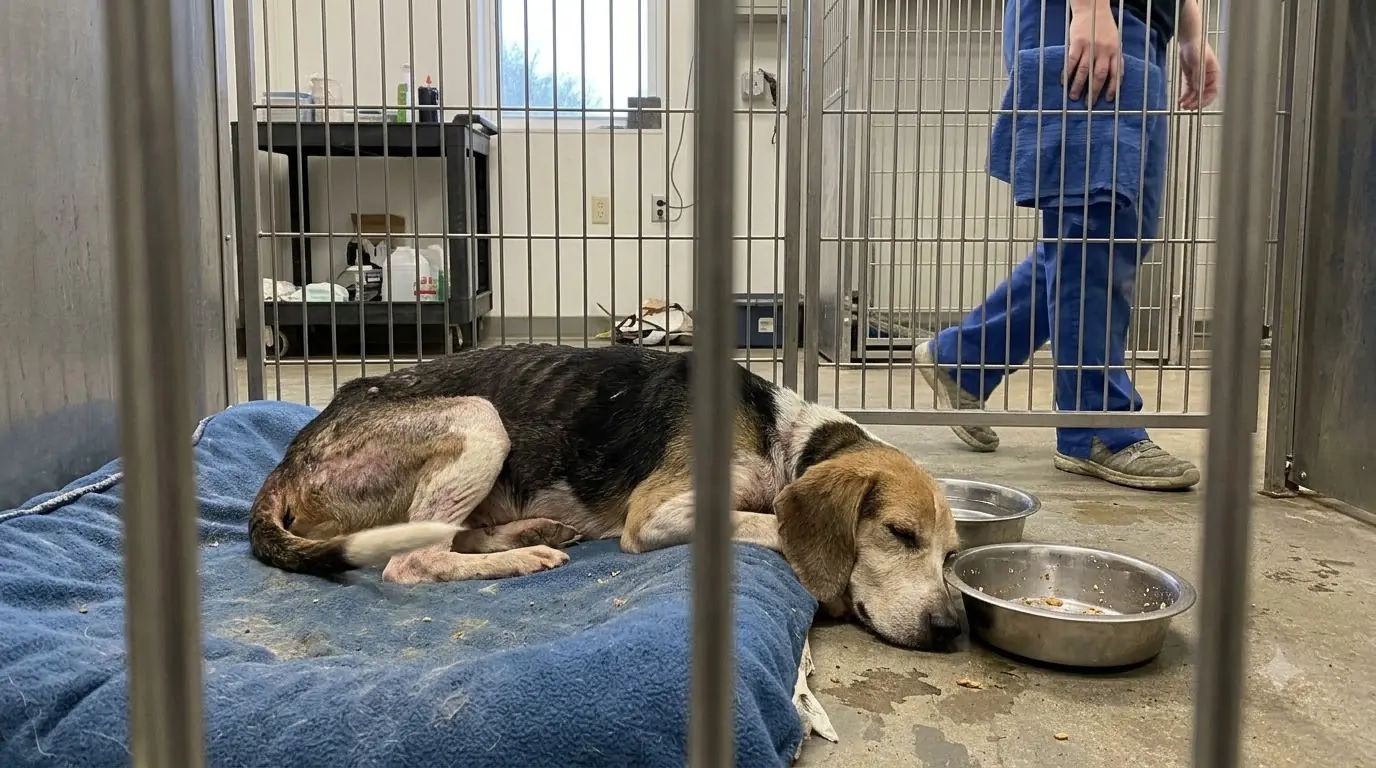
Penny was approximately three years old and appeared consistent with a Beagle mix.
She was dirty from being outdoors and mildly dehydrated.
Her body condition was somewhat lean, though not critically underweight.
Her heart rate was elevated when she arrived, something that could reasonably be associated with pain, fear, or both.
Her breathing settled as the room became quiet.
Her gums were pink.
There was no obvious respiratory emergency.
The most noticeable problem remained her hind leg.
Penny held it away from the floor.
There was swelling around the lower portion of the limb, and she reacted when the veterinarian gently examined the area.
The reaction was subtle but unmistakable.
Her muscles tightened.
Her head turned.
She attempted to withdraw the leg.
The veterinarian stopped applying pressure.
Pain does not have to produce crying or aggression to be significant.
Penny was communicating clearly.
Finally Sleeping
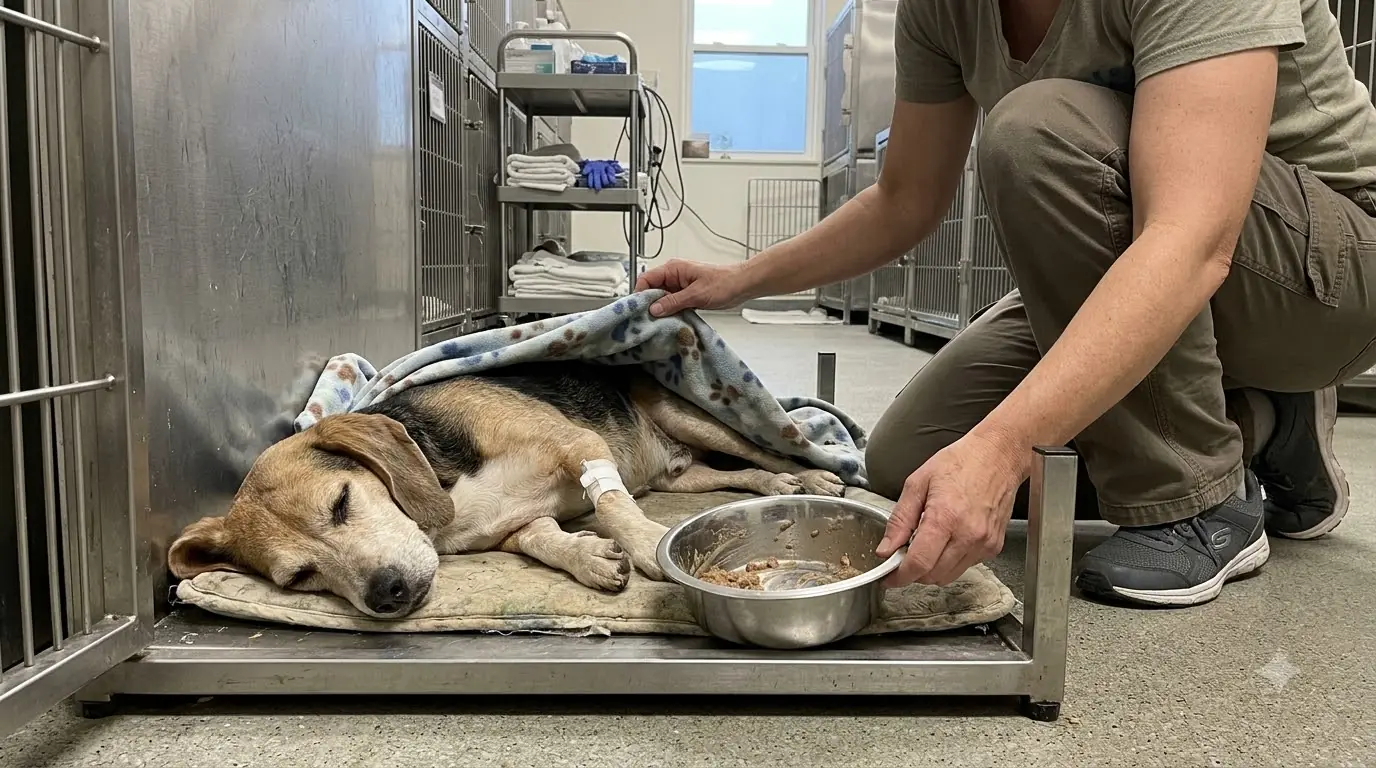
Before detailed imaging could be completed, Penny needed pain relief and time to settle.
She was placed on thick bedding in a quiet treatment area where staff could observe her without constantly handling her.
For several minutes, Penny kept her head raised.
Every sound in the hallway caught her attention.
Then her eyelids began closing.
Her chin slowly lowered onto the bedding.
Eventually, Penny fell asleep.
It was one of the quietest moments of her rescue, but for the people who had watched her repeatedly struggle to stand beside the road, it carried enormous weight.
Penny was not suddenly healed.
She was still injured.
She was still in an unfamiliar place.
But she no longer had to keep moving.
For the first time since she had been found, there was nowhere she needed to escape from.
Finding the Injury
Once Penny had received appropriate pain control and could be examined more comfortably, the veterinary team obtained radiographs of the injured hind limb.
The images provided the answer.
Penny had a fracture involving the tibia, one of the major bones of the lower hind leg.
Fortunately, the fracture was closed, meaning there was no open wound communicating with the broken bone.
There were also no radiographic findings suggesting that the limb was beyond repair.
But this was not an injury that could simply be treated as a sprain and forgotten after several days of rest.
The fracture needed stabilization.
Because Penny was young and otherwise reasonably healthy, the veterinary team believed she had a good chance of regaining comfortable function with appropriate treatment.
That did not mean recovery would be immediate.
Bone healing takes time.
Activity would have to be restricted for weeks, and follow-up imaging would be necessary before Penny could safely return to unrestricted exercise.
Looking Beyond the Leg
Because Penny's history was unknown, the veterinary team did not focus exclusively on the obvious injury.
A complete physical examination was performed.
Blood samples were collected to evaluate her general health and help determine whether she was an appropriate candidate for anesthesia.
Her bloodwork showed mild changes consistent with dehydration and physiological stress but no major abnormalities that prevented treatment from moving forward.
She was given fluids as clinically appropriate and monitored.
Her ears contained some debris but showed no severe infection.
Her nails were moderately long.
Her coat was dusty and tangled in a few areas but did not show evidence of extensive skin disease.
No other major orthopedic injuries were identified on the initial examination.
That was encouraging.
Still, staff continued monitoring her closely because pain can sometimes mask less obvious problems during the first hours after rescue.
Choosing a Treatment Plan
Penny's fracture was evaluated for the most appropriate stabilization method.
Some fractures can be managed with external support such as a splint or cast, depending on their location and stability.
Others heal more reliably with surgical stabilization.
In Penny's case, the veterinary team determined that surgical repair offered the best chance of maintaining appropriate alignment while the bone healed.
The procedure would not make Penny instantly normal.
Surgery would simply create the stability her body needed to begin the healing process.
The rescue approved the recommended treatment.
Until surgery could be performed, Penny remained on strict activity restriction with veterinarian-directed pain management.
She was taken outside only when medically appropriate and with careful support.
Staff monitored her appetite, hydration, urination, bowel movements, comfort, and swelling.
Penny Begins to Eat
During her first night, Penny showed limited interest in food.
That was not unexpected.
Pain, medication, exhaustion, and the stress of entering an unfamiliar environment can all temporarily affect appetite.
Staff offered a small meal and left her undisturbed.
She sniffed it but ate very little.
Water was kept within easy reach so she did not have to stand unnecessarily.
By the following morning, Penny showed more interest.
She ate several bites while a staff member sat quietly nearby.
Later, she finished most of a small meal.
Her water intake became more consistent as well.
Because she was slightly lean, her nutritional status mattered for recovery. However, the goal was not rapid weight gain.
Healing bone and maintaining muscle require adequate nutrition, but excessive calories during weeks of restricted activity can cause unnecessary weight gain.
Her feeding plan therefore focused on a complete, balanced diet in measured portions.
Surgery Day
Once Penny was appropriately stabilized and the veterinary team was satisfied with her preoperative evaluation, she underwent surgical repair of the fractured leg.
Under general anesthesia, the fracture was aligned and stabilized with orthopedic implants selected for the specific configuration of the injury.
Throughout anesthesia, her vital signs were monitored.
The procedure proceeded as planned.
Afterward, Penny was moved into recovery on padded bedding.
Her temperature, breathing, heart rate, incision, and pain level were monitored closely.
When she began waking, staff kept the environment quiet.
Penny initially appeared disoriented, which is common during anesthetic recovery.
A veterinary technician remained nearby.
Gradually, she became more aware of her surroundings.
She did not immediately try to stand.
That was exactly what we wanted.
The repair needed protection.
The First 48 Hours
The first two days after orthopedic surgery required careful monitoring.
Penny received veterinarian-prescribed pain medication.
Her surgical site was checked regularly for excessive swelling, discharge, or other signs of complication.
She was prevented from licking or chewing the area.
Her movement remained extremely limited.
When she needed to change position, staff allowed her to do so carefully rather than repeatedly repositioning her unnecessarily.
Bathroom breaks were short and controlled.
Initially, a support sling helped reduce the risk of slipping while Penny adjusted to using the recovering leg.
She urinated normally.
Her first bowel movement after surgery took longer, which was not unexpected given her reduced food intake, stress, anesthesia, and limited activity.
Staff monitored her abdomen and comfort.
Once her appetite normalized and she began eating consistently, her bowel habits returned to a regular pattern.
Learning That Hands Could Help
Penny's behavior changed gradually.
During the first days, she watched hands closely.
If someone reached too quickly toward her injured side, she became tense.
Staff adjusted accordingly.
They approached from where she could see them.
They spoke softly before touching her.
They avoided unnecessary handling.
Nobody attempted to prove that Penny was friendly by hugging her or leaning over her.
Pain can change how any animal responds to touch.
Respecting that fact protected both Penny and the people caring for her.
As her pain became better controlled, she began initiating small interactions.
She sniffed a technician's fingers.
Later, she accepted gentle scratching beneath her chin.
One afternoon, a staff member sat beside her kennel while completing paperwork.
Penny shifted closer.
She rested her nose against the person's shoe and fell asleep.
It was not dramatic.
But for Penny, it was progress.
The Beagle Starts Appearing
As Penny felt better, her Beagle-like curiosity became increasingly obvious.
Her nose began working constantly.
She investigated every meal before eating.
She sniffed blankets after they came back from the laundry.
She became extremely interested whenever someone opened a container of treats nearby.
Her ears lifted when food carts moved down the hallway.
That curiosity was encouraging because it meant Penny was beginning to engage with her environment rather than simply enduring it.
At the same time, her increasing energy created a new challenge.
Penny felt better before her bone was fully healed.
That is common during orthopedic recovery.
A dog may become eager to run or jump weeks before the repaired bone is ready for those forces.
Our job was to protect Penny from her own enthusiasm.
Going Into Foster Care
Once Penny no longer required hospitalization, she moved into a carefully selected foster home.
Her foster caregiver had experience with dogs recovering from orthopedic procedures and understood that “feeling better” did not mean “fully healed.”
Penny's living area was intentionally small.
Rugs provided traction.
Furniture was arranged so she could not jump onto sofas or beds.
Stairs were blocked.
A comfortable bed was placed inside a recovery pen where Penny could rest without being completely isolated from household activity.
For the first several days, she watched everything.
She listened to the refrigerator.
She sniffed the air whenever meals were prepared.
She watched her foster caregiver walk from room to room.
Eventually, she began sleeping through ordinary household sounds.
Bathroom Breaks Became Adventures
Penny was taken outside on a leash for short bathroom trips.
At first, these were strictly functional.
Outside.
Bathroom.
Back inside.
But Penny's nose had different ideas.
Every blade of grass apparently required investigation.
Her foster caregiver had to balance mental enrichment with medical restrictions.
Penny was allowed to sniff calmly while standing or taking a few controlled steps, but she was not permitted to pull toward squirrels, run across the yard, or suddenly change direction.
Her urination remained normal.
Her bowel movements were regular once she had adjusted to her diet and medication schedule.
No persistent gastrointestinal problems developed.
Those details were documented during recovery because normal elimination can provide useful information about comfort, hydration, appetite, and general health.
Two Weeks After Surgery
At approximately two weeks, Penny returned for a scheduled examination.
The surgical incision was healing appropriately.
There was no evidence of infection.
Swelling had decreased.
Penny had begun placing the foot more confidently during slow walking, though her gait remained abnormal.
That was expected.
The veterinary team emphasized that visible improvement did not mean the fracture was completely healed.
Her activity restrictions continued.
Her pain medication plan was adjusted based on her progress.
The foster caregiver received instructions for carefully controlled movement.
The next major milestone would depend on follow-up radiographs.
The Hard Part of Recovery
For Penny, the hardest stage was not necessarily the first week.
It was the period when she felt energetic again but still could not safely behave like a healthy 3-year-old dog.
She wanted to explore.
She wanted to follow smells.
She occasionally tried to bounce when her foster caregiver picked up the leash.
That energy was encouraging, but every burst had to be managed.
Mental enrichment became especially important.
Food puzzles that could be used without vigorous movement gave Penny something to investigate.
Treats were hidden inside folded towels while she remained lying down.
She practiced calm behaviors for small food rewards.
Her foster caregiver rotated safe chew items.
Penny became particularly good at identifying which cabinet contained her treats.
A Brief Concern
Several weeks into recovery, Penny appeared slightly more uncomfortable one morning.
Her foster caregiver noticed that she was placing less weight on the repaired leg.
Rather than waiting several days to see what happened, she contacted the veterinary team.
Penny was examined.
There was no obvious implant failure or new injury.
Her incision remained normal.
The veterinarian suspected that she had simply overused the leg during one of her increasingly enthusiastic bathroom outings.
Her activity was reduced temporarily, and her treatment plan was reviewed.
Within the following days, Penny returned to her previous level of comfortable weight-bearing.
The episode reinforced an important lesson.
Recovery does not always progress in a perfectly straight line.
Small setbacks need attention, especially after orthopedic surgery.
Follow-Up Imaging
At the appropriate stage of healing, new radiographs were obtained.
The images showed progressive bone healing.
The repair remained stable.
That was excellent news.
But the veterinarian did not immediately remove every restriction.
Bone remodeling continues after early healing becomes visible.
Penny's exercise was increased gradually.
Her walks became slightly longer.
The support sling was no longer routinely necessary.
She was allowed more controlled movement around a restricted portion of the house.
Running and jumping were still prohibited.
Rebuilding Strength
Weeks of reduced activity had affected Penny's muscle strength.
This was particularly noticeable in the recovering hind leg.
That did not mean the surgery had failed.
Muscle loss is expected when a limb is used less during recovery.
Her rehabilitation therefore shifted toward gradually rebuilding strength.
Short controlled walks became part of the routine.
The duration increased slowly according to veterinary guidance.
Penny was encouraged to walk at a steady pace on stable surfaces.
Slippery flooring was avoided.
Her foster caregiver continued monitoring for increased limping after activity.
If Penny appeared more uncomfortable later in the day, the next session was shortened.
The goal was progressive conditioning, not exhaustion.
Her Body Condition Improves
Penny had arrived somewhat lean.
During recovery, her weight gradually moved toward a healthier range.
Her ribs became less prominent.
Her coat looked cleaner and healthier.
At the same time, the team carefully avoided allowing her to become overweight.
That was particularly important after an orthopedic injury.
Extra weight increases the mechanical load on joints and recovering limbs.
Her meals were measured.
Treats used during training were included when considering her daily intake.
Penny probably would have argued that this policy was unnecessary.
Like many Beagle mixes, she developed a remarkable ability to appear desperately hungry shortly after finishing dinner.
Her foster caregiver learned not to negotiate with those eyes.
The Emotional Changes
Penny's physical recovery was easy to document with radiographs and gait assessments.
Her emotional progress was quieter.
The dog who had repeatedly tried to move away from people beside the road began choosing proximity.
She followed her foster caregiver around the limited area she was permitted to access.
When her caregiver sat nearby, Penny often positioned herself close enough that one paw touched a foot.
She still occasionally became tense if unfamiliar people approached too quickly.
Visitors were asked to let Penny initiate contact.
Usually, after several minutes of sniffing from a comfortable distance, curiosity won.
Her nose moved first.
Then her body followed.
Sleep Became Deep and Ordinary
At the clinic, Penny's first deep sleep had felt significant because she had been so exhausted.
In foster care, sleep eventually became ordinary.
That was an even better sign.
She no longer woke every time someone walked through the room.
She stretched across her bed.
Sometimes she rolled partly onto her back while sleeping.
During quiet afternoons, her foster caregiver could work nearby while Penny snored softly from her recovery pen.
Safety had become predictable enough that Penny did not need to remain constantly alert.
What Happened Before the Road?
We still do not know.
Penny's history before she was found remains unverified.
There was no reliable information explaining exactly how she sustained the fracture or why she was alone.
It would be easy to create a dramatic explanation.
We will not.
Her injury could have resulted from several different types of accidents, and without evidence, assigning blame would be irresponsible.
Penny does not need an invented tragedy to make her rescue meaningful.
The facts are enough.
She was injured beside a road.
She could not travel safely.
A driver stopped.
A rescue responded.
Veterinary professionals treated her fracture.
A foster caregiver protected her recovery.
Those are the parts of Penny's story we can confidently tell.
Returning to Normal Movement
As additional weeks passed, Penny continued improving.
Her walks became longer under veterinary guidance.
She used the repaired leg consistently.
The pronounced limp that had been obvious during intake became increasingly difficult to notice during ordinary slow walking.
That did not mean Penny would never experience stiffness or orthopedic problems later in life.
A repaired fracture can have long-term considerations, particularly if nearby joints were affected or if degenerative changes develop with age.
Her future family would need to tell their regular veterinarian about her orthopedic history.
If limping returned, it should be evaluated rather than dismissed.
For now, however, Penny was doing what everyone had hoped.
She was healing.
Preparing Penny for Adoption
Adoption planning began only after Penny reached appropriate medical milestones.
The rescue wanted potential adopters to understand her history and future needs.
Her orthopedic records would go with her.
Her adopter would be expected to maintain a healthy body weight and provide appropriate regular exercise once fully cleared.
Future veterinary monitoring would remain important.
Behaviorally, Penny would benefit from people who understood that trust is not something humans are entitled to demand from a dog.
She was affectionate.
She was curious.
She enjoyed companionship.
But she still appreciated introductions that gave her time to investigate before strangers reached for her.
That was not considered a failure of rehabilitation.
It was simply part of knowing Penny.
A Different Kind of Walk
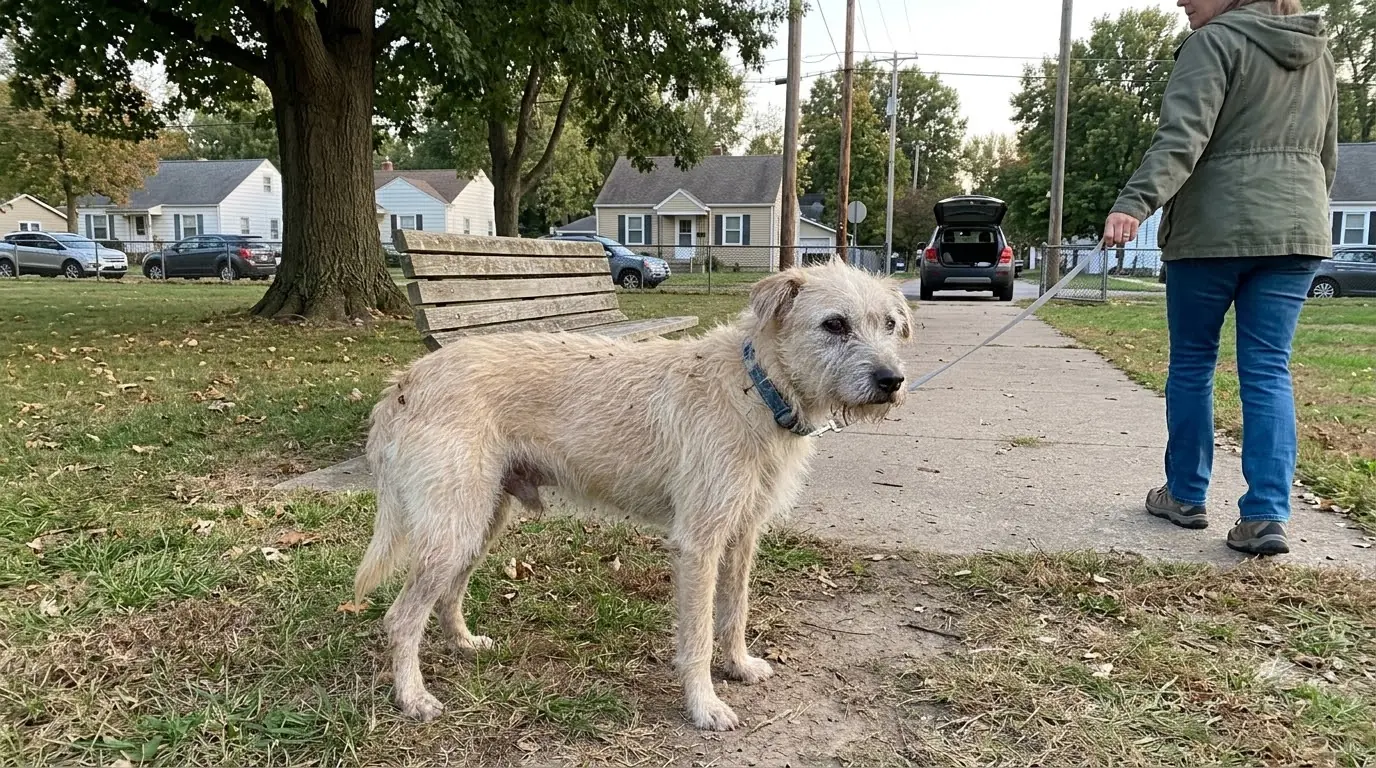
One afternoon, after veterinary approval for a longer controlled walk, Penny's foster caregiver took her along a quiet neighborhood path.
It was nothing like the road where she had been found.
There were no vehicles rushing past her.
Nobody was trying to catch her.
Penny walked on a loose leash.
She stopped frequently to sniff.
A mailbox required extensive investigation.
So did a patch of clover.
Her foster caregiver waited.
Penny eventually lifted her head and continued walking.
Her gait was comfortable.
Her tail moved gently behind her.
For a rescue team, moments like that matter precisely because they are so ordinary.
The goal was never to turn Penny into a symbol.
The goal was to help a hurt dog become a dog again.
Her Final Recheck Before the Next Chapter
At a later follow-up examination, Penny's veterinarian was pleased with her progress.
Her weight was appropriate.
Her surgical site had healed.
Follow-up imaging showed continued satisfactory healing.
Her muscle strength had improved with gradual exercise.
She was using the limb comfortably during routine activity.
Her rehabilitation plan could continue advancing, though her caregiver was still advised to avoid sudden excessive exercise.
Penny would eventually be able to enjoy a much more normal activity level.
Like any dog with a significant orthopedic history, however, she would benefit from sensible exercise and monitoring throughout life.
There was no promise that the repaired leg could never bother her again.
There was something better than a promise.
There was a realistic plan.
Penny Today
Penny eats enthusiastically.
She drinks normally.
Her bathroom habits are regular.
She sleeps comfortably.
Her body condition has improved.
She walks using all four legs and has steadily rebuilt strength in the one she once refused to place on the ground.
She still loves investigating scents more than moving efficiently from one location to another.
She has discovered that blankets are excellent for sleeping and occasionally useful for burying treats.
She seeks out familiar people for affection.
When she is uncertain, she is allowed to step away.
When she approaches, people let her make that choice.
Her recovery has taken weeks rather than days.
That is exactly how responsible orthopedic recovery should look.
The Moment We Remember
There are many milestones we could choose from Penny's story.
Her successful surgery.
Her first comfortable steps.
Her follow-up radiographs.
Her first longer walk.
Her improved weight.
But the moment our team continues to remember happened before any of those things.
It happened beside the road.
Penny had spent her remaining energy trying to move away whenever someone stopped.
Then our rescuers arrived with a blanket.
She tried one more time to stand.
She could not go far.
Finally, Penny lowered her head.
She stopped struggling.
And she allowed herself to be carried.
At the clinic, after her pain had been addressed and she was placed somewhere warm and quiet, Penny finally slept.
Nobody knew yet whether she would need surgery.
Nobody knew exactly how long rehabilitation would take.
Nobody could promise what her future would look like.
What we knew was much simpler.
She was no longer beside the road.
She did not have to keep trying to walk on an injured leg.
She did not have to decide whether every approaching person was someone she needed to escape.
Penny could rest.
Everything else—diagnostics, surgery, medication, controlled exercise, foster care, follow-up imaging, rehabilitation, and adoption planning—came afterward.
Today, Penny's world is very different from the grassy shoulder where she was found.
Her leg has healed steadily under veterinary supervision.
Her strength continues to improve.
Her confidence has grown without being forced.
And the little Beagle mix who once used every bit of energy she had to move away from people now regularly chooses to walk toward the ones she trusts.
Her story is not finished.
There will be veterinary care throughout her life, just as there should be for any companion animal. Her orthopedic history will remain part of her medical record, and her future family will need to pay attention if her mobility ever changes.
But Penny is safe enough now to have ordinary concerns.
What is for dinner?
Who has the treats?
Why can't she sniff the same patch of grass for ten more minutes?
And where is the softest blanket in the house?
For Penny, those ordinary questions are a remarkable change.
Healing did not happen the moment she stopped struggling beside the road.
That was simply the moment healing was finally allowed to begin.