A seven-year-old girl walked into the most dangerous roadside diner in northern Arizona, soaking wet, shaking like a leaf in a hurricane. And she walked straight past every safe looking face in the room, past the truck drivers, past the highway patrol officer eating pie at the counter, straight to the largest, most terrifying man in the building. A man with a scarred face, a marine's dead eyes, and a leather cut that had seen more blood than most soldiers. She put her small hand on his arm, leaned up on her toes, and whispered seven words that would detonate both their lives. Please pretend to be my dad.
40 seconds later, the front door opened, and the man who walked in wasn't looking for coffee. This is the story of Jackson Grim Mercer, a broken man who stopped believing in anything worth fighting for until a frightened child decided he was the safest thing in the room. What follows is not a clean story. It is not a comfortable one, but it is the truest kind of story there is. The kind where the most dangerous man in the room turns out to be the only one willing to stand between a little girl and the darkness hunting her.
The storm came down off the Kaibab plateau like something with a grudge, turning Interstate 40 into a river of black ice and red tail lights and the kind of wind that found every gap in a man's jacket and made itself at home. Jackson Mercer had ridden through it anyway. He always rode through the weather that made other people pull over, not because he was brave or reckless, but because stopping required a destination, and Grim hadn't had one of those in 3 years.
He'd pulled into the gravel lot of a diner called Milepost 2011 at 11:47 on a Tuesday night in the first week of December, parked his Harley soft tail between two 18-wheelers that offered some windbreak, and sat for a moment with the engine ticking down beneath him, rain drumming the back of his cut, chin dropped toward his chest. The neon sign above the door buzzed and flickered, half the letters dark, the rest casting a sickly pink light across the puddles in the lot. The kind of diner that smelled like it had been frying the same oil since 1987. The kind of place that existed specifically for people who had nowhere else to be at midnight in a storm.
He went inside because the alternative was sitting in the rain. And his left knee, the one the IED had rearranged back in Helmand Province, had been grinding like loose gravel since Nevada. The interior was what he expected. Eight booths with cracked vinyl. A counter with six stools. A pie case with three slices left under fluorescent lights that hummed at a frequency designed to give a man a headache. A teenage waitress who looked at him the way most people looked at him. A quick assessment, a micro flinch, the practiced neutral expression that meant she'd clocked the size of him, the ink on his neck, the cut with the Iron Remnants MC patch on the back, and had decided the safest course was professional distance.
Grim took the booth farthest from the door, sat with his back to the wall. Old habit, marine habit, the kind of habit that took up permanent residence in a man's body and never paid rent. The waitress brought a menu he didn't open and a glass of water he didn't touch. Coffee, he said. Black, she brought it. He wrapped both hands around the mug and looked at the rain coming down against the window and let his mind do what it always did at this hour. Find the faces.
Ortega, who had laughed at everything until the morning he didn't. Reyes, who had carried a photograph of his daughter in his left boot because he said it was the closest to his heart he could manage in full kit. And Danny Walsh, who had been Grim's spotter for two tours and who had died on a Tuesday, which was why Grim still hated Tuesdays with a specific personal hatred that no amount of writing had burned out of him. He was on his second coffee when the door opened. Not the front door, the side door near the restrooms which led to a small hallway and then to a back exit that connected to the service alley.
He noticed it because he noticed everything. Another habit, another piece of himself he hadn't been able to leave overseas. A shape small and low moving along the far wall of the diner, trying to be invisible. A child. She was seven, maybe eight, though hunger and fear had a way of making children look younger than they were. She was soaked through. Not damp, not rainspotted, but the kind of soaked that meant she'd been outside in the storm for a long time. Her hair was matted flat against her face.
She wore a yellow rain slicker that was several sizes too large for her, bright enough to have been chosen by someone who wanted to make sure she could be found, and a pair of sneakers that squelched with every step. She was carrying a stuffed bear under one arm, clutched so tight against her ribs that the bear's stitched face was nearly flattened. She moved through the diner like a creature that had learned recently and at some cost that being noticed was dangerous. Her eyes swept the room in a pattern that no 7-year-old should have. Systematic, assessing exits, measuring distances.
When her gaze reached the highway patrol officer at the counter, something shifted in her face. Not relief, not the instinct most children had toward uniforms, something else. She looked at him the way she might look at a locked door. She kept moving. Grim watched her without turning his head, using the window glass as a mirror, which was also an old habit. She made one full circuit of the diner, staying close to the wall, and then she stopped. She'd arrived at some kind of decision. He could see it in the stillness that came over her before she moved again. The way a person got still before stepping off a ledge.
She walked directly toward him. The waitress was watching now. The cop hadn't noticed. The truck driver was asleep. The couple in the corner were staring at their separate windows. The girl stopped at the edge of his table. Her eyes were brown and enormous, and she was shaking, though he couldn't tell anymore if it was cold or something else. She looked up at him without flinching, which was something most grown men failed to manage on first encounter with Jackson Mercer's face, and she measured him the way someone measured a tool for a specific and urgent purpose. Then she put her small hand on the edge of his table and leaned close enough that he could smell rain and something sweeter underneath it. Some child's shampoo, something that had been applied hours ago and survived the storm.
"Please pretend to be my dad," she whispered. He looked at her, said nothing, just for a little while. Her voice didn't shake, but her jaw was tight, the kind of tight that happened when a person was using every available resource not to cry. "I'll explain later, please. He's outside." The door opened, not the side door, the front door, letting in a blade of cold air and rain. The man who entered shook the water from a dark wool coat and looked around the diner with the calm, unhurried expression of a person who was accustomed to finding what they were looking for.
He was somewhere in his mid-40s, lean, the kind of composed that came from training rather than temperament, not police, not the kind of nervous that went with bounty work. His clothing was expensive in the understated way that meant real money, not new money, old money, the kind that didn't need to announce itself. He had the easy bearing of a man who had made difficult decisions in clean offices and then sent other people to carry them out. His eyes swept the room. They landed on the girl's yellow slicker almost immediately. Something about the way he looked at her did something complicated in the space behind Grim's sternum.
He had seen interrogators. He had sat across from men who did terrible things and felt nothing about it afterward. He recognized that particular quality of emptiness that looking at an object like whatever else might be uncertain in this situation, one thing was not. This man was not this child's father. He was not anyone's father. He was something else entirely. Grim reached out and put his arm across the back of the booth seat, a gesture that was either invitation or shelter, depending on how you looked at it, and he looked at the girl and tilted his chin very slightly in a direction that meant sit down. She slid into the booth beside him without hesitation, like she'd been waiting for exactly that gesture her entire life.
The man in the wool coat was already moving toward them. He stopped at the edge of the booth. Up close, he was even calmer, even more carefully composed, the product of some kind of discipline or some kind of absence. Grim wasn't sure which. He looked at the girl. He looked at Grim. He produced a smile that had been assembled from the correct components, but had missed something essential in the construction. "There you are," he said to the girl. His voice was mild and precise. "Your mother's been worried."
The girl's hand found Grim's forearm under the table, her fingers locked tight. Her breathing was controlled in a way that it shouldn't have been for a seven-year-old. She was practicing, not moving. Grim looked at the man for a long moment. "She's good," he said. The man's assembled smile held. His eyes did the thing that people's eyes did when they were recalculating. "I'm sorry, my girl," Grim said. "She's good." He picked up his coffee with the hand she wasn't holding, brought it to his mouth, and held the man's gaze over the rim. We're in the middle of something. The silence lasted about 4 seconds. Long enough for the man to complete whatever calculation he needed to complete. Long enough for Grim to read it. The micro adjustment in his posture. The brief glance at the cop at the counter. Not a reach for help, a measurement of obstacle, the reassembling of the smile.
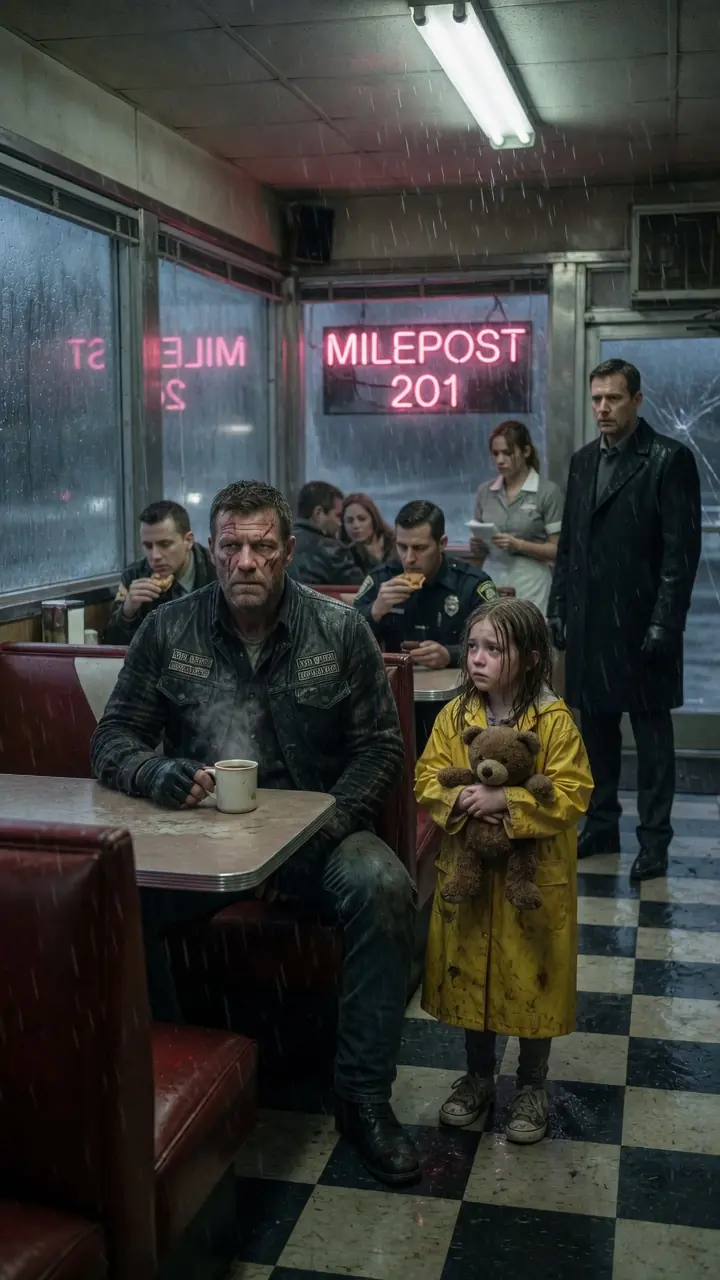
"Of course," the man said. I apologize for the interruption. He let his eyes drop to the girl one more time, a look that communicated something precise and private that Grim interrupted by shifting his body slightly, blocking the line of sight. Enjoy your evening. He walked back toward the door. Not fast, not slow, the walk of someone who was not leaving. Grim set his coffee down under the table. The girl's grip had not loosened. "What's your name?" he said quietly, not looking at her. A pause. Avery, how old are you, Avery? Seven, almost eight. He picked up the laminated menu and made a show of studying it. You going to come back in? No. A beat. He'll wait outside. He has people outside. How many people? Another pause. Longer. At least two cars. I saw them before I came in. He looked at the menu for another moment. Breakfast served all day. He thought about Danny Walsh and about the kind of choices that announced themselves when you weren't looking for them. Is your mother here? The pause this time was so long that he finally looked at her. She was looking at the table at the grain of the form Mica at some middle distance where something had happened to her face. A closing, a going inward, like a window shuttered against weather.
"No," she said. He waited. "She's gone." The word gone arrived in a register that was too composed for 7 years old, which meant she had already passed the stage of processing it and had arrived at the stage of carrying it. She swallowed. "She told me if something happened to her, I should find someone who looked like they weren't afraid of anything." She glanced up at him. The brown eyes were dry. Whatever tears had been available, she'd already spent them somewhere on the road behind her. "You looked like that." Grim was quiet for a moment. Your mom smart. A very small thing happened at the corner of her mouth. Not quite a smile. Yeah. All right. He set the menu down. Finish your water. Don't look at the window. Tell me what happened, but keep your voice down and keep your eyes on the table.
The waitress came back and he ordered two slices of pie. One for himself that he wouldn't eat. One for the girl who needed calories and something warm in her hands. And while the waitress moved away, he tilted slightly toward Avery and let her tell it. She told it the way someone told a story they had rehearsed because they understood at some fundamental level that they might only get one chance to tell it correctly. Her mother's name was Clare. Claire Solless, who had been a paralegal for a firm in Phoenix that handled federal litigation, who had spent 18 months working on a case that connected what looked like a straightforward land use dispute to something underneath it. Payments, shell companies, transactions that ran through a nonprofit to an account that belonged to a man named Harland Fitch, who was among other things a federal judge for the Ninth Circuit.
Clare Solless had put it all together carefully, methodically, the way a careful person did when they understood what they were looking at was dangerous. She had made copies. She had told no one at the firm. She had done it all correctly. And then 3 weeks ago, she had sent Avery to stay with a friend from school for what she called a few days while mommy handles something. And 2 days after that, the friend's mother had gotten a phone call that she hadn't explained to Avery in any detail. And then there had been men outside the house who weren't police, or at least didn't act like police. And Avery had left through the back fence at 2:00 in the morning, the way her mother had shown her, the way they had practiced twice without explaining exactly why they were practicing.
She had the bear. Her mother had told her about the bear. If anything ever happens, the bear goes with you. Don't open it. Don't show anyone. Just hold on to it. Grim looked at the stuffed bear on the table between them. It was a common enough brand, brown, one ear slightly worn at the tip, the kind of bear that accumulated those specific worn patches from being held in one particular way for years. He didn't touch it. He looked at it for exactly as long as was necessary and then looked away. Where'd you come from tonight? He said, "Before you came in here, walked from the truck stop about 2 mi back." She said it without drama. I got a ride from a lady to Flagstaff and then I walked to the highway and I've been walking since the afternoon.
He thought about that. A 7-year-old girl walking 2 miles in the dark and the rain on the shoulder of I40. The man outside, he said. You know who he is? His name is Cole. She said it with a particular flatness that was worse than fear. He used to come to our house. He said he was a friend of my mom's, but she always got quiet when he called. After she went away, he was the one who, she stopped, pressed her lips together. He was the one who came to the school and told me my mom was in the hospital and I needed to come with him. She looked up at Grim steadily. She wasn't in the hospital.
The pie arrived. He watched her look at it, the hunger breaking through the composure for just a moment. And then he watched her pick up the fork and start eating with a deliberateness that was almost heartbreaking, controlled, measured, like she understood that eating too fast might look desperate. And desperate was something she couldn't afford to look outside. Through the rain streaked window, Grim could see the parking lot. Two vehicles he hadn't registered when he came in. A dark SUV parked at the far edge of the gravel, lights off, and a sedan pulled partially behind the dumpster, engine almost certainly still running. The cop at the counter was finishing his pie. In about 10 minutes, maybe 15, he would either leave or he would use the restroom and Grim would have a window. Maybe he ran the problem the way he'd run problems in the field. Assets, one motorcycle, one exit through the rear. Whether that was brutal, but might be cover liabilities. the girl's size, the weather, the sedan that would be faster than him on the highway, the unknown number of people involved.
He thought about going to the cop. He thought about it seriously, the way he tried to be fair in his own reasoning. He thought about Avery's face when she'd looked at the officer and then looked away. He thought about a federal judge and the kind of resources that attended a federal judge who had reason to make problems disappear. He thought about the number of times in his life he'd seen official channels work quickly and cleanly in favor of the person with least power. He thought about Danny Walsh, who had trusted the right channels at exactly the wrong moment. He picked up his coffee, drank, set it down.
When I pay the check, he said, "We're going out through the back. There's a hallway by the restrooms." He kept his voice at the level of ambient conversation, something that could be mistaken for a man talking to his daughter about nothing in particular. We go out the back and we go left away from the lot. There's going to be weather. You're going to get cold. You can be cold. Can you do that? She looked at him. Not the look of a child asked if they were brave. The look of someone assessing whether the plan was sound. Yes. Your boots going to stay on in mud? She looked down at her feet. He watched her genuinely consider the question. They're tied double. Good.
He put his hand flat on the table. Hold the bear inside the jacket once we're outside. Both hands on me once we're on the bike. You do not let go. If I say hold, you hold. If I say duck, you put your head down against my back and you do not come up until I tell you. You understand? Yes. Tell it back. She told it back precisely in order. He listened to her do it and thought about the mother who had raised this particular child and about what that cost that kind of preparation and about where that woman was right now. He left $40 on the table. Too much for two coffees and two slices of pie, but he didn't want change and he didn't want the waitress coming after them.
He stood and the girl slid out of the booth and stood beside him and he pulled off his leather jacket and draped it over her. It fell to her knees. She held the bear against her chest and pulled the jacket closed with both hands and looked up at him. And there was something in that moment, the look on her face, which was not relief exactly, but a specific and terrible trust. The trust of someone who had run out of options and chosen the last available door that settled in Grimm's chest like weight. He walked to the back hall at normal pace. She stayed at his side, step for step, not grabbing at his hand, not pulling, just matching him the way a soldier matched pace. Present, controlled, economical.
The hall smelled like industrial cleaner and wet mop. The back door had a push bar that clattered when it opened and led in a wall of cold rain and December wind. He looked left. The service alley ran behind the diner, dark, bordered by a chainlink fence, and beyond that the back edge of the property where the gravel gave way to scrub brush and rock. They went left. The rain was serious and immediate and cold enough to sting. The alley was dark, lit only by the overflow of the diner's exterior light, and the mud was ankle deep in places where the gravel had washed away. He moved fast, and she moved with him. The jacket bundled tight around the bear, her sneakers punching through puddles, her breathing audible and steady. He'd parked the soft tail between the two 18-wheelers, which put it in shadow and around the corner from the direct line of sight from both the SUV and the sedan. They reached it in 40 seconds.
He straddled the bike, and she climbed on behind him with a matter-of-fact efficiency that told him she'd been on a motorcycle before, or at least had the spatial understanding to do it correctly without being shown. arms around my waist, he said. Lock your hands. She locked her hands. He didn't start the engine immediately. He sat with the key, thinking. Once he started it, the sound would carry. The two cars in the lot would hear it. He had maybe 6 8 seconds between ignition and the point where they could cut him off on the lot exit. He started it. The Harley's engine turned over with its characteristic bark and settled into its low, chestde idle. He felt her arms tighten. He didn't wait. He rolled forward, coming out from between the 18-wheelers at the far end of the row, away from the diner's entrance, cutting behind the building rather than through the main lot. He heard a car door. He gave it throttle.
The back of the lot connected to a service road that ran parallel to the interstate for about a/4 mile before rejoining the on-ramp. He hit the service road doing 30. The Harley's single headlight cutting a cone through the rain, the wind immediate and brutal and trying to get inside everything. He heard tires on gravel behind them. The sedan, he thought, moving fast. He went east on the on-ramp and then immediately cut north on an unmarked road he'd noticed coming in. A two-lane that climbed into the high country, away from the interstate into the darkness. He pushed the speed up to 60 on wet road and then 70, and the sedan stayed with him. The girl had her head against his back. He could feel her breathing through his shirt. He could feel the shape of her hands locked together at his sternum. The sedan's headlights were about 400 yd back. Professional gap, not closing aggressively, not falling back, matching his speed and waiting. He killed his headlight just for 20 seconds at a stretch he'd memorized. Straight, no curves, no cross traffic. The darkness was total and immediate, and the rain made the world into pure sound. He heard the sedan's engine continue at the same distance, and then heard the driver react. heard the speed drop, the headlights sweep as the driver tried to find him. He turned off the road and onto a dirt track that went into the trees. Traveling by feel and the gray edge of ambient light 20 m an hour through scrub oak and juniper, the bike slipping in the mud, his left knee screaming, he went half a mile in and stopped. Cut the engine. Rain, wind, the creek of branches, his own breathing, and the girls. Nothing else. He sat and listened for 2 minutes. No engine sounds, no tires on the dirt track. The sedan had either missed the turn or decided against following onto unknown terrain in the dark. He let out a breath. The girl behind him said nothing. Her arms were still locked around him. After a moment, she lifted her head from his back and he felt the small shift of her weight. "You okay?" he said. "Yes." A pause. "Are they gone for now? What do we do now? He looked at the darkness ahead of them, at the trees moving in the wind, at the rain coming in sideways, at the thin stripe of light at the edge of the horizon that was not dawn. Dawn was hours away, but was some atmospheric trick of the cloud cover, some false warmth. He had no plan that extended beyond the next mile. He had his bike, his phone, a half tank of gas, and a 7-year-old girl who was carrying something inside a bear that had already gotten her mother disappeared and had multiple professionally calm men driving expensive cars in the rain to retrieve her. He had also somewhere in the last 45 minutes made a decision. He hadn't announced it to himself. He hadn't reasoned his way to it. It had simply happened the way the most important decisions happened quietly in the moment between one heartbeat and the next. He wasn't giving her back.
"We're going to find somewhere dry," he said. "Then we're going to figure out the rest." He felt her nod against his back. He reached forward and touched the throttle. Then he stopped. He reached back instead and found her hands locked at his sternum and covered them briefly with his own. the single gesture and nothing more because he wasn't a man who explained himself in words and because there was nothing to say anyway that wouldn't be less than what the gesture already carried. Then he put his hand back on the grip and started the engine again. They went north into the mountains into the dark and the rain and the cold that pressed in from every side, and behind them the lights of the interstate receded like something that belonged to a different world, which Grim understood now it did. Whatever world this was, this dark wet pine smell darkness, this girl's arms around him, this specific and unasked for weight, he was in it now. He didn't know yet what was inside the bear. He didn't know what Clare Solless had found or who Haron Fitch really was, or how far the rot actually went. He didn't know that the man called Cole was the specific and patient kind of professional who had never in 11 years of that particular work failed to recover a target. He didn't know that within the hour Cole would be on the phone with someone whose name appeared on buildings. And that conversation would end with a number of resources deployed that no seven-year-old and no biker should ever have been required to face. He knew only that she was cold and that he was moving and that the last time in his life he had felt anything close to this particular quality of necessary. Not useful, not capable, but necessary. The way a person was necessary to another specific person rather than to a mission or a unit or a country. The last time had been two years before Danny Walsh died on a rooftop in Mara when Walsh had looked at him across the distance between their positions and given him a single nod that meant, "I'm here. I see you. We're doing this."
The trees closed around them. The rain didn't let up. 50 mi north in a ranger station that had been decommissioned two seasons ago, there were four walls and a roof and darkness that had no one in it. He knew about it because he'd sheltered there once before, years ago, passing through on a different kind of night that had also involved rain and the desire to put distance between himself and a version of his life he didn't want anymore. He didn't know that tomorrow when he finally opened the bear, when Avery, after a long silence in that cold, dark station told him it was okay, told him mom said if I found someone I could trust, they should know. He would find something that reoriented the gravity of everything. Not just Clare Solless's careful documentation. Not just the account numbers and the communications and the photographs, but a name. A specific name written in Clare's neat paralegal hand underlined twice with a single annotation beside it. This one kills people himself. And that name would be the same name that was at this very moment being spoken quietly on the other end of Cole's phone call. The station was still an hour away through dark and rain and mountain road. The girl pressed her face against the back of his jacket and held on. Behind them, somewhere on the interstate, two sets of headlights turned north. The ranger station smelled like wetwood and abandonment, and something underneath both of those things. Old smoke, old cold, the specific quality of air in a space that had been sealed against weather for so long that it had become its own kind of weather. Grim got the door open with a credit card and 20 seconds of patience, a skill he'd acquired in a different life and never unlearned. And they went inside with the rain coming hard at their backs.
He found a lamp on the shelf above the cold iron stove. A battery lantern, the kind rangers kept for emergencies, and when he clicked it on, it threw a pale yellow circle across the room that was enough to see by without being enough to see from outside. One room, four walls, a workbench along one side, two metal folding chairs, a cot frame without a mattress, a stove he wasn't going to light because smoke from a decommissioned station would read wrong to anyone looking on the shelf, the lamp, a first aid kit with a broken clasp, three cans of soup so old the labels had faded to near white, and a folded emergency blanket that crinkled like foil when he pulled it down. He shook it out and held it toward Avery. She was standing in the center of the room, dripping, his leather jacket hanging off her to her knees, the bear still pressed against her chest. She looked at the emergency blanket and then at him, and then she set the bear very carefully on the workbench, positioned it sitting upright, facing the room, which was a thing a child did with a beloved object, and also he understood the thing someone did with something they were keeping watch over. And she let him wrap the blanket around her shoulders. She didn't thank him. She just pulled it tight and sat down on the floor, back against the workbench, knees up, and looked at nothing.
He sat on one of the folding chairs and looked at his phone. Two bars. Enough. He stared at the screen for a while without doing anything with it. Outside, the rain came straight down and then sideways and then straight down again, and the wind moved through the trees in long waves that pressed against the walls of the station like something testing for weakness. His knee had gone from grinding to a low, steady burn. He'd been managing it with ibuprofen and stubbornness for so long that the stubbornness had started to feel like a medical strategy. The problem with the phone was the number he needed to call. He hadn't called it in 14 months. He'd left it the way he'd left most things, not cleanly, not with explanation, but by creating enough distance that the absence explained itself. He'd left the chapter house in Tucson on a Tuesday morning before anyone was up. his cut on the back of the chair, his key on the table, no note, because a note would have required him to say things he didn't know how to say. He'd been told afterward through the one channel he hadn't fully closed, that Priest had not taken it quietly. Priest never took anything quietly. He looked at Avery. She had her eyes closed now, the emergency blanket wrapped tight, her breathing slow and deliberate. The breathing of someone managing themselves, not the breathing of someone asleep.
The bear sat on the workbench with its onew worn ear and its stitched face patience. He thought about what she'd said. She told me to find someone who wasn't afraid of anything. Clare Solless had done her homework on instinct or on love, which in the end was the same thing. She had looked at the world clearly enough to understand what kind of problem she was building toward, and she had prepared her daughter for it, and the preparation had worked well enough to get Avery to a diner on I40 at midnight during a storm instead of into the back of Cole's car. That was not nothing. That was, in fact, everything. But the preparation ended here in a decommissioned ranger station in the mountains north of Flagstaff with a man who had no more plan than she had. He dialed. It rang three times. Unknown number, said a voice that hadn't changed at all, low and unhurried, with the particular texture of someone who had smoked for 30 years, and considered it a fair trade. Which means either you're a debt collector or you're someone I know who doesn't want to be known. Grim said nothing for a moment. The silence on the other end did something complicated, shifted, became a different kind of silence. Well, Priest said, I'll be god damned. I need help. You need help? The voice was absolutely level. 14 months, no word. Your cut left on a chair like a parking ticket. And now you need help. Yes. Another silence. Longer. Anybody dying? Not yet. Where are you? Station road off 89A north of Flagstaff. I'll send coordinates. How many on you? At least two vehicles, possibly more by now. I don't know the full number yet. Okay. A pause and he could hear background sound. The iron remnants chapter house. The low sound of a television. Boots on concrete floor. The specific atmosphere of a building full of men who had nowhere else they needed to be at 2:00 in the morning. I'm going to send Rook and Dutch up ahead. You sit tight. Priest. Yeah. There's a kid with me. The silence this time was different from all the previous silences. Heavier, more specific. How old? Seven. Christ. She's not part of anything she chose. Her mother. He stopped, looked at Avery, who had her eyes open now, watching him without expression. He turned slightly away. I'll explain when you get here. 2 hours, Priest said. Maybe less if Dutch doesn't drive like a responsible citizen. A pause. Jackson. Yeah. I'm glad you called. A beat. I'm glad you didn't die out there in 14 months of solitude. He didn't turn around. Don't make me say that again. He went out. Grim stood alone at the small room for a moment. Through the wall, he could hear Avery saying something to Cassin in a voice that had found in the past 20 minutes a small fraction more volume than it had carried in the diner. Not safety. It was too early for safety, but the cautious forward edge of it, the testing of the possibility. He put his hand against the wall and pressed until he could feel the structure of it. Solid, cold here. Dutch appeared in the doorway with his medical bag already open. Sit down, he said, and take your boot off. Grim sat.
Outside, the rain was thinning. To the east, the first pale edge of something that might eventually become dawn was marking the horizon. And somewhere on the road between here and the mountains, Cole would be making phone calls of his own, in a calm and precise voice, to men whose names were not in any public record, adjusting for the absence of the tracker signal, recalculating, closing the distance. By the time Dutch had finished with Grim's knee and wrapped it tight with the efficient certainty of a man who had patched wounds in a great many worse circumstances, the decision that had been forming all night in the rain, on the mountain, in the station, in priest's quiet catalog of what this was going to cost had completed itself. There would be no quiet resolution. There would be no handoff to authorities, no trusting of channels that Vos's people had already proven they could reach inside. The only path between Avery and the people hunting her ran directly through the iron remnants, through the men in this building and the men priest would call in the morning through engines and leather and the specific loyalty of people who had chosen each other in the full knowledge of what that choice entailed. Grim understood this with a clarity that was not comfortable and was not frightening. It was something else. The thing that happened when a man who had been riding without direction found unexpectedly and against all prior evidence that there was somewhere he was supposed to be.
He was pulling his boot back on when his phone lit up with an unknown number. He looked at it. A text message. No preamble, no introduction, just an address. A storage facility 20 mi south of Flagstaff. And below it, four words that made the temperature in the room drop several degrees. We have the mother. He stared at the screen. Clare Solless was alive, which meant everything he'd assumed about the shape of this, the grief Avery was carrying, the gone she'd said with the voice of someone past the active stage of loss, was wrong in a way that changed everything and complicated everything and meant that the people hunting Avery were not trying to close a chapter. They were trying to use her to get Grim read the text twice. Not because he didn't understand it the first time, but because the brain did a thing when information arrived that was too large. It ran the same data through again, looking for an error in the processing, some fault in reception that would make the content different the second time. There was no fault. The four words held. We have the mother. He was on his feet before he'd made a conscious decision to stand. boot half-laced, bone in his hand, the blood moving in his body in a way that was specific to certain kinds of moments. Not fear, not adrenaline exactly, but the hyper clarified state that preceded action, where every detail in the room sharpened, and every exit registered simultaneously. Dutch was still crouched by the chair where he'd been finishing the rap job. first aid bag open on the floor, and he looked up at Grim's face and read whatever was on it with the diagnostic speed of a man accustomed to reading bodies under pressure. What? Dutch said, not a question. A demand. Grim held the phone out. Dutch read it. He stood up slowly. He had a quality, Dutch, of becoming more still as situations became more serious. The opposite of most people who expanded into crisis with noise and movement. Dutch compressed. His face settled into something that was not expression so much as preparation. Priest. Dutch said. Priest. Grim agreed. They found him in the main room already on the phone. One of the calls he'd said he'd make in the morning, apparently already in progress despite it being 5:15 in the morning because Priest operated on a timeline that had never much consulted the clock. He looked at Grim's face and ended his call midsentence. Grim gave him the phone. Priest read it. He handed the phone back. He stood with his hands at his sides and he looked at the wall with the expression of a man integrating a variable that fundamentally altered the equation.
Storage facility, he said, 20 mi south. Yes, they want the drive or they want Avery or both. The message is designed to be ambiguous. It's designed to make you move fast and without thinking. Priest looked at him steadily. Which means the storage facility is either where they actually are or it's where they want you to go. I know you're going anyway. It wasn't a question. Priest was reading him the way he always read him. Not looking for the answer, confirming the one he already had. Yes, Grim said. Priest breathed out slowly. He moved to the desk and stood with both hands on it, not looking at Grim, looking at the desktop, at the maps and papers pinned to the board on the wall. Aldrich Voss has been on the Senate Judiciary Committee for 9 years. He's been managing federal judicial appointments for six. If he has a federal judge in his pocket, he put him there, which means there are probably more than one. He sat down in the desk chair. "You understand what the woman found. She found the architecture," Grimm said. "Not just a transaction, the whole system. And they found her before she could get it out." Yes, the kid is the last copy of her mother's work and the last living witness who knows what her mother knew. Priest was quiet for a moment. He looked at the drive, then he looked at Grim with an expression that carried underneath the steadiness, something that Grim recognized from field situations. The expression of a man who has completed his assessment and arrived at a conclusion he doesn't want, but is prepared to act on. They're not going to stop, priest said. No, this Cole, he'll know by now that the tracker went dark. He'll have recalibrated. He'll have more people. Yes, coming here is the right move, Priest said. Though his voice made it clear he was completing the logic rather than expressing comfort because this is the most defensible position we have, but it also means we brought this place into it. Grimm looked at him. I know. I'm sorry. priest waved the apology off, not dismissively, but the way you waved off a payment that wasn't in dispute. Levven Cassen knew the terms when they agreed to the terms. Dutch Rook. He folded his hands on the desk. What I need to know is whether you understand what this costs if it goes wrong because Voss has federal reach. If this goes wrong, we're not looking at local law trouble. We're looking at I know what we're looking at. Do you senator with a judge in his pocket and a private enforcement arm? Grimm said he can have agencies pointed at us within a phone call. I know. And you called anyway. I called anyway. Priest looked at him for a long moment, then quietly because of the kid. Grim thought about Avery walking through the diner, her small hand on the table edge, the eight words, and the absolute specific trust behind them and the fact that she had walked past the cop passed every safe seeming option the room offered and stopped at him.
Because of the kid, he said in the kitchen he could hear low voices, cassins and averies and the sound of a pan on the stove and some small ordinary domestic sound that should not have been able to exist in the middle of this and did. Priest looked at the scene assembled there. Clare at the table now. Dutch kneeling doing a proper assessment of her ribs. Cassen in the back. Rook a shadow in the main room. And he looked at Grim last. And whatever he'd been about to say underwent a revision. I need to tell you something. Priest said to Grim. His voice had a quality in it that Grim recognized as the precursor to information that changed the shape of a situation. Grimm looked at him. I made two calls on the ride back. Priest said, "The journalist I mentioned, woman named Keller out of Phoenix, she's been trying to build a Voss story for 18 months. She wants the drive. She can have people here within 4 hours." He paused. That's the good news. And Grim said, "I also called a contact I have at the Marshall Service. someone I trust, someone outside the federal task force structure entirely. I wanted a temperature reading." Priest came fully into the kitchen and lowered his voice, which meant what came next was not for Clare. Not yet. He looked at Grim directly and held it the way he held things that required him to be absolutely certain the information was received correctly. Voss knows we have the girl. He's had a description of your bike since last night. and Jackson. He has a federal warrant in process. Obstruction. Endangerment of a minor. He paused. The warrant names you and the iron remnants. The room was not louder, but it was more present. Grim could feel it on his skin. He's using the system, Grim said. He's using the system to get the girl out of our hands and back into his with the legal machinery justifying the transfer. Priest's voice was flat. Once she's in custody under a federal obstruction warrant, she's accessible and the inside man in the task force can manage what happens after that. Dutch had looked up from Clare's ribs. How long before the warrant is active? Grim said. My contact said by morning. Maybe sooner. It's already morning. Yeah, Priest said. It is. Grim looked at the window above the kitchen sink. Outside it was the gray blue of very early dawn. The light that was not yet day but had stopped being night. The rain was gone. The sky was the clean, cold color of something that was about to clarify. The math was simple. The math was a gap that was either bridgeable or not. And they were standing in that gap right now. And the gap was approximately the size of everything. Grim became aware that Avery had tightened her grip on his hand. She was watching him and priest and the exchange between them with the reading precision of someone who had been interpreting adult conversations from their subtext for weeks. And she had arrived at the correct conclusion before he had finished arriving at it himself.
She knew not every specific, not every term, but the shape of it, the closing in, the narrowing of options, the quality of a moment just before something breaks. She looked up at him and her eyes were doing the thing that they did. The absolute direct look that asked nothing, made no demand, but was simply there, present and clear as anything he had ever looked at. And she said very quietly, so that only he could hear it, "What do we do now?" And before he could answer, the sound arrived from the road, "Not motorcycles, not the deep familiar Harley rhythm that meant family and weight, and something survived. Vehicles, multiple moving fast without lights, the sound of their engines high and constrained and purposeful. Rook appeared in the doorway from the main room and his face had the quality it got when the situation had crossed from serious into a different category entirely. Seven vehicles, he said, coming up the access road. He paused. The pause contained something. And Jackson, they're not Cole's people. Grim looked at him. They're ours, Rook said. Iron Remnants, Albuquerque Chapter and the Phoenix Auxiliary. He met Grim's eyes, and his own were 26 years old and a 100 miles older than that. Priest called them. Grim turned to look at Priest, who was standing in the kitchen doorway with his phone in his hand and the expression of a man who had been making decisions for the past 3 hours that he was prepared to be accountable for. "You called them," Grimm said, without telling me. I called them, priest said. Because what's coming next isn't four men with handguns at a storage facility. He held Grim's gaze without apology, without softening. You came to me for help. I'm giving you help. All of it. Outside. The sound of engines filled the lot. Headlights crossed the kitchen window in sweeping arcs as vehicle after vehicle turned off the access road. Then beneath the engine sound, the first Harley, deep and deliberate, the sound of something with weight. Then another, then several at once, building into the layered rolling sound that Grim had known for 20 years, and that landed in the body differently than any other sound on earth. Avery was standing beside him with her hand in his and her bear under her arm and she was looking at the kitchen window where the headlights were crossing and she said nothing but her grip tightened. Clare Solless had risen from the table. Dutch's hands were at her ribs steadying but she was standing. She looked at the window. She looked at Grim. Who are they? She said. The only people left, Grim said, who Voss can't reach. He moved toward the door. Aver's hand held for one more second and then released. And he felt the release the same way he'd felt the grip as a specific and irreversible thing. He went through the main room and out the front door into the gray dawn with priests behind him, and stood on the porch as the iron remnants filled the lot, 12 motorcycles, six additional vehicles, tr trucks mostly, the kind that carried people and gear across long distances, and faces he knew and faces he didn't. 43 years of combined combat service represented in leather cuts and scar tissue and the particular bearing of men who had been through things that didn't have good names. And standing at the center of all of it, having just come off the lead bike, was a woman who put a cold shock of recognition through Grimm's entire system because he had not known she would be here and because her presence changed the shape of the situation in a way he had not prepared for and could not entirely process. He looked at Priest. priest said nothing. He had the face of a man who had made a decision that he was prepared to be accountable for. Her name was Mara Voss. Not by blood, by marriage. A marriage that had ended eight years ago in a courthouse in Phoenix with paperwork and silence and nothing else because Aldrich Voss did not do anything loudly that he could do quietly. She had been married to him for 4 years. She had left with two things. a scar above her left eyebrow that she kept her hair across and everything she had learned about the man she'd married which was considerable and which she had been building into something usable ever since. Grim had known her as Mara Cassell which was the name she used now but her mother's name reclaimed. He had known her for 3 months 2 years ago when she had come to the Iron Remnants with a proposition that priest had ultimately declined because the risk architecture was wrong at the time. She had ridden with them for those three months as an independent, a provisional arrangement, and she had been the most tactically precise person in any room she entered, and the most personally dangerous person Grim had ever shared a meal with. And then she had gone, the way people went when their purpose moved on, and he had not thought about her since in any way he'd examined directly. She was standing in the lot in the gray dawn in a riding jacket with the Phoenix auxiliary patch on the shoulder and she was looking at him with the expression of someone who had been briefed on the situation and had already completed her assessment and was ready to move to the operational phase. Jackson, she said, Mara priest behind him said nothing, which was its own sentence. She crossed the lot toward him and stopped at 4 feet and looked at his face with the reading precision he remembered. The way she compressed everything about a person into the first 10 seconds of contact and came out the other side already knowing what she needed to know. He's going to come here, she said. Not Cole Voss himself. When the warrant didn't produce results fast enough, he moves to personal resolution. He's done it before. He came to our house once when a problem wasn't being handled the way he wanted. Her voice was absolutely level. He brings six. Always six. He thinks it's enough. How do you know he's coming here? Grim said. Because I told him where you were. The stillness that moved through the assembled men in the lot was physical. Grim felt it against his skin. She held his gaze without flinching. I've been inside his circle for 18 months. He thinks I'm an asset. I've been building what I've been building. She paused. I sent him this location because I needed him off the federal machinery and onto a road. On a road. He's a man with six men in a federal building. He's untouchable. She let that land. I needed him here. I needed you here. I needed it to be this. Grim looked at Priest. Priest said, I found out an hour ago and you called her anyway. I called her because she's been running a parallel operation to Clare Soliss for 18 months without either of them knowing about the other. And because between the drive and what she carries in her head, Keller has everything she needs to end him. He paused. And because Mara knows how he moves, Grim turned back to her. How long? He left Phoenix 40 minutes ago, she said. Six men, two vehicles. He'll take the back route. He knows the area. He'll want to come in from the north, from the treeine, not the road. She looked at the building behind him. He'll want it quiet and contained. No witnesses. That's his preference. How many people in that building do you want kept alive? All of them, Grim said. Then we have 20 minutes. What followed was the compressed accelerated work of people who had done versions of this before in various configurations and who had the shared language that made 20 minutes function as 40. Priest moved through the assembled writers with the authority of a man who did not need volume to be heard, and the lot reorganized itself. Vehicles repositioned, sight lines established, the building's three entry points assigned and waited. Rook took the north tree line with two men from Albuquerque who moved like they'd done overwatch before, because they had. Dutch stayed inside with Clare and Avery in the back room, the room with no exterior windows, with Casson at the door. Grim stayed at the front. It was not discussed. It was simply where he was. Mara stayed beside him. That also was not discussed. 15 minutes in, the building was quiet, and the lot was empty of visible bodies, and the pre-dawn light was the color of cold steel on every surface, and Grim stood at the edge of the porch with his hands at his sides and his knee grinding its complaint at a frequency he had stopped registering, and he breathed. "You should have told us," he said. not anger statement. If I told anyone, it would have moved through the chapter, she said, and someone in the chain would have made a decision that protected the chapter instead of closing the target. That's not a criticism. It's how organizations work. She paused. I needed it clean. Using yourself as bait. I've been bait for 18 months. He looked at her profile. The scar was visible at the edge of her hairline in this light, a pale raised line. That was the remaining record of something she had never described in detail. He had not asked. He understood now, in a way that he hadn't when he'd known her before, what the scar's origin probably looked like. Does Avery know who you are? He said, a pause. No, she knows me through the chapter through priest. She doesn't know the connection. Her jaw set. She doesn't need to know tonight. She'll know eventually. Eventually is not tonight. He accepted that. He sat with it. Avery appeared in his doorway and looked at them both and then at Grim specifically. My mom wants to know if you want breakfast. Cassan is making eggs. He looked at Mara. Go, she said. He went inside. The kitchen was warm in a way the chapter house rarely achieved. the stove going, the smell of coffee and eggs filling the low ceiling room. Cassan was at the stove with the focused attention he brought to everything. Clare was at the table with both hands around a mug, her face still carrying its damage, but her eyes clear and awake with the specific quality of someone who has come through the worst and arrived intact. Rook was at the counter eating standing up, and he looked at Grim when he came in with an expression that was 26 years old and had something in it that was almost a question. Grim looked back at him. "Good work last night," Grimm said. "Just that." Rook looked at his plate. The corner of his jaw moved. He nodded once, short and tight, and looked back at his food. Grim sat down across from Clare. She looked at him over her mug for a moment. "I need to say something to you." "You don't. I do." She set the mug down. She walked into that diner and made a decision about who was safe. She's never been wrong about people. Not once in her life. She paused. She wasn't wrong about you. He looked at the table at the grain of the wood. Had his own hands around the coffee Dutch had given him. Still warm. She knew what she was doing. He said your kid. She assessed the room and she made a choice. You raised that. Clare's face did something complicated and then settled. Heron is in Oregon, Crescent Bay. Her name is Rita. She met his eyes. I have your number now. I'm going to give it to Avery. Whatever you're comfortable with. He said nothing for a moment. Whatever she needs. Clare nodded. She picked up her mug. Avery came in and sat beside her mother and leaned against her. And Clare's arm came around her without either of them making a production of it. The automatic fit of two people who were each other's home. Avery looked at Grim across the table with the brown eyes. "Are you going to leave now?" she said. The question arrived with the directness she brought to everything. No softening, no performance, the question she actually had. He thought about the road, about the long habit of movement, the particular quality of forward motion as its own answer to questions he hadn't known how to ask differently. He thought about 14 months of it, of covering ground without destination, of the way the miles had accumulated into a weight rather than a release. He thought about a diner at midnight in the rain and a small hand on his arm and the specific and irreversible nature of being chosen. Not today, he said. She seemed to find this acceptable. She looked at the table and then looked back up at him. Will you teach me to ride when I'm old enough? Kyson set a plate of eggs in front of Grim without comment. Yeah, Grim said. I'll teach you. priest appeared in the kitchen doorway, the full length of him filling it, his face carrying the particular quality it had after something significant had concluded. Not satisfaction, not relief, but the specific gravity of a man who had expended something real and was accounting for it honestly. He looked at the assembled people in the kitchen. He looked at Grim last, some long-standing thing between them. The weight of the 14 months, the cut on the chair, the Tuesday morning departure shifted in the look. Not resolved, not discharged, but acknowledged, which was the first necessary step. Priest came in and poured himself a coffee and stood at the counter. "Keller wants to talk to Clare this morning," he said. "We have time before the story runs." Clare nodded. "Mar is staying through the testimony process." priest continued. Phoenix auxiliary will provide cover during the legal period. He looked at Grim. You have somewhere to be. The kitchen was warm. Outside the window, the sky had arrived fully at dawn. Not the cold steel of an hour ago, but something genuinely pale and new, the color of a day that had not yet made any decisions. The sound of Harley's out front had gone quiet, men at rest, the specific silence of engines that had done their work. Grim looked at Avery. She was eating eggs with the same careful, focused attention she brought to everything. The bear was on the table beside her, positioned facing the room. "Not immediately," he said. Priest looked at him for a moment. Then he turned to the window and looked at the dawn and drank his coffee, and the kitchen held all of them, the living and the damaged, and the loyal and the found in its warm, imperfect, ordinary light. 3 months later, the story that Keller had run became the kind of story that rewrote the public record. Aldrich Voss was indicted on 14 counts. Haron Fitch resigned from the federal bench and was subsequently arrested. The inside man, a task force senior agent whose account number matched Claire's annotation precisely, was identified, arrested, and flipped. The network that Voss had built over 9 years came apart with the specific speed of structures that depend entirely on the continued silence of everyone inside them. Clare Solless testified for 11 days. She did it with the same careful precision she had brought to the original documentation, methodical, exact, nothing exaggerated and nothing withheld. Mara testified beside her on the days that required Mara's 18 months, and the two women sat next to each other in a federal courthouse in Phoenix and gave the thing they had each separately and at great cost prepared to give. Avery and her aunt Rita drove down from Crescent Bay for the final day of testimony. Grim was in the courthouse hallway when they came in. He'd been in the building for the preceding 3 days, not testifying, not official, simply present, the way certain people were simply present when it mattered. Rita was a smaller version of Clare, quieter, with Avery's same quality of looking at things directly. She shook Grim's hand and looked at him for a moment and said, "She told me about you." He hadn't known what to do with that, so he'd nodded. Avery had walked beside him down the courthouse hallway and told him about school in Crescent Bay, about the ocean, about a teacher she had who was strict about deadlines in a way she respected. She talked the way she did everything, precisely with attention. He walked beside her and listened and thought about the specific strangeness and the specific rightness of being in a place he had not expected to arrive at. Rita took Avery north on the day the verdict came in. Before she left, she stood with Grim in the courthouse parking lot in the thin December cold. December again, a year almost exactly around, and she held the bear against her chest, which she still did, which she might always do, and she looked up at him. "Crescent Bay in the summer," she said. "You should come." "Maybe," he said. She looked at him with the brown eyes. "That means yes," she said. "You told me." Maybe means yes. He smiled. He couldn't help it. It was an unfamiliar sensation, still the specific movement of those particular muscles, but it was less unfamiliar than it had been a year ago, and the direction of travel was clear. She hugged him once, brief and fierce, the specific hug of someone who knew the value of what they were holding. He put his hand on top of her head for a moment, then she went. He stood in the parking lot as the car pulled out and held still while it went, and then he walked to where his soft tail was parked at the edge of the lot, the one remaining spot of shade beneath a bare limbed tree, and he sat on it without starting it. He sat with his hands on his thighs, and he looked at the sky above the courthouse, pale blue, winter clear, the kind of sky that offered nothing except its own openness. Priest pulled in beside him a few minutes later and they sat side by side on their bikes in the empty lot, engines quiet. Rook's been asking about you, Priest said. Tell him I'll be back before Christmas. I'll tell him to expect you when he sees you. A pause. That's what I'll tell him and that's what I mean. Grim looked at him. Priest looked back, the gray green eyes held steady and direct. You came back, he said quietly, without ceremony. That's what matters. You came back. The engine turned over on the first try, the way it always did, the deep familiar barrel sound that filled the chest from the inside. Priest started his own. They sat for a moment with the engines running and the winter light on everything and the year behind them with its full weight and cost. the thing it had taken and the thing unexpectedly entirely unasked for that it had given back. Then Grim put it in gear and they rode out of the lot together and the road opened ahead of them and for the first time in a very long time it looked less like escape and more like direction. Somewhere in Crescent Bay the Pacific came in cold and gray and certain against a shore that had been receiving it for longer than any of them had been alive. Summer was 7 months away. It was enough.