The afternoon sun hung low over the small Midwestern town of Ashford when Terrence Whitmore pushed open the glass door of the police station and stepped inside.
His boots made a soft scraping sound against the old beige tile. The lobby smelled of stale coffee, printer toner, floor cleaner, and paper that had been sitting in metal filing cabinets for twenty years.
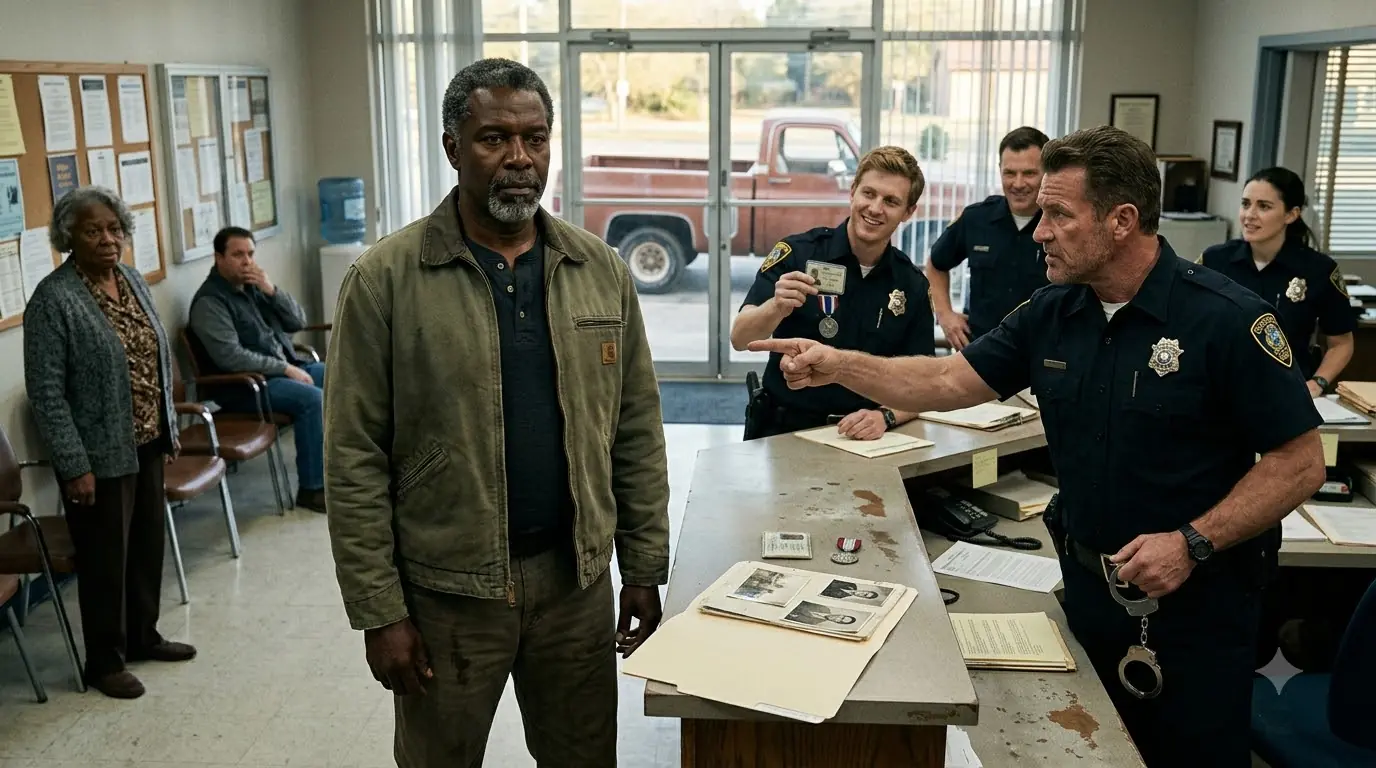
Somewhere behind the front counter, a radio crackled with a dispatcher’s voice while a ceiling fan turned lazily above the waiting area, moving warm air without cooling anything.
Terrence paused just inside the entrance.
He was fifty-seven years old, broad across the shoulders, with dark skin weathered by decades of sun and service. His close-cropped hair had gone mostly gray at the temples, and his beard carried the same silver along the jaw. He wore a faded brown field jacket that had been carefully repaired at one elbow, an ordinary pale shirt, dark trousers, and scuffed work boots.
Nothing about him suggested wealth.
Nothing suggested influence.
Nothing suggested that photographs of him once hung in command centers thousands of miles from Ashford.
He carried a manila folder beneath one arm.
That was all.
Outside, through the glass doors, his twenty-year-old Ford pickup sat beneath a maple tree with one rust spot above the rear wheel and a dent in the tailgate he had never bothered repairing.
Terrence had come to the police station for the most ordinary reason imaginable.
His wallet had been stolen.
That morning, he had driven to Miller’s Hardware to buy replacement hinges for the gate behind his house. He spent almost twenty minutes comparing two sizes because one was cheaper but the other was galvanized and would survive another Ohio winter.
When he returned to the parking lot, he noticed his coat pocket hanging open.
The wallet was gone.
So was his current driver’s license, two credit cards, forty-six dollars in cash, his retired military identification, and a folded photograph of his late wife, Evelyn.
The money did not concern him much.
The photograph did.
The hardware store had exterior cameras, and the manager had told Terrence the police would probably need an official report before requesting the footage.
So Terrence drove three blocks to the station.
Before leaving the hardware store, an employee had also returned a small metal keepsake box found beneath a shopping cart near Terrence’s truck. Terrence normally kept it in the same inside pocket as his wallet, and whoever had reached into the coat apparently dropped it while fleeing.
The old box now rested inside his manila folder.
It contained several photographs, a photocopy of an older military credential, his Silver Star citation, and a few documents he had planned to deliver to the local veterans’ center later that afternoon.
Terrence expected the police report to take fifteen minutes.
He had basil seedlings waiting in the bed of the truck.
By four o’clock, he intended to be home.
Behind the front counter, Officers Bryce Langley and Owen Pike were discussing lunch.
Neither looked toward Terrence immediately.
“So I told her,” Pike was saying, “if she wants Thai food, she can drive all the way across town herself.”
Langley laughed.
“Should’ve married somebody who likes burgers.”
“I did. She changed.”
“That’s how they get you.”
Terrence stood quietly.
Thirty seconds passed.
Then a minute.
He did not interrupt.
Patience had carried him through situations far more serious than being ignored at a front desk.
Finally, Langley glanced over.
His eyes moved first to Terrence’s face.
Then to the old jacket.
Then the boots.
Then through the glass at the battered pickup.
The judgment was quick.
Almost invisible.
Terrence still saw it.
He had spent too many years reading rooms not to.
“What can we do for you?”
Langley asked.
Terrence placed the folder gently on the counter.
“My wallet was stolen outside Miller’s Hardware at approximately eleven twenty this morning. The store has exterior cameras. I need to file a report so I can begin replacing the identification that was inside.”
Langley pulled a form toward himself.
“Name?”
“Terrence Elijah Whitmore.”
“Address?”
Terrence gave it.
Langley typed.
“Date of birth?”
Terrence answered.
“Any suspects?”
“No.”
“See anybody near the truck?”
“No.”
“Then there’s probably not much we can do.”
“I understand.”
Langley looked faintly surprised by the lack of argument.
Terrence continued.
“The store manager said he would preserve the camera footage if your department requested it.”
“Maybe.”
Terrence nodded.
“That is why I’m here.”
Langley glanced at the folder.
“What’s that?”
“Supporting identification.”
“Thought you said your ID got stolen.”
“My current identification did.”
Terrence opened the folder.
Inside were three photographs, the photocopy of an older military credential, several pages of official correspondence, and the metal box.
Langley picked up the copied card.
His eyebrows rose.
UNITED STATES ARMY.
WHITMORE, TERRENCE E.
GENERAL OFFICER.
RETIRED.
Langley read it again.
Then looked at Terrence.
Then at the jacket.
Then at the pickup.
A grin appeared.
“You were a general?”
“Yes.”
Langley turned toward Pike.
“Hey, Owen.”
Pike came closer.
“What?”
Langley held up the document.
“We got ourselves a general.”
Pike looked at Terrence.
Then laughed.
Terrence remained still.
Langley opened the small metal box.
Inside was a decoration on an old ribbon.
He lifted it between two fingers.
“Silver Star?”
Terrence’s jaw tightened almost imperceptibly.
“Yes.”
“For what?”