He’s not on the list. I checked twice. The other volunteer, a younger woman in an orange safety vest, glanced over her shoulder and lowered her voice. So, tell him.
Neither of them moved. The old man in the faded blue shirt hadn’t looked up. He was working a length of red and white barrier tape through his hands, folding it, not rolling it the way most people would, folding it in thirds, precise as origami. When the last fold was done, he set it on the table with no sound at all. No slap, no slide, just placed it there like he was returning something borrowed. Then he reached for the next length.
The man with the clipboard shifted his weight. Sir, I need to see your credentials.
Walter Pruitt didn’t answer right away. His hands kept moving, steady, unhurried. I know, he said finally.
He’d been at it since 6:15. The street was still dark at that hour, the November sky holding onto night the way it does in the upper Midwest, reluctant, gray, bruised at the edges where the street lights pushed against it. Leaves moved across the asphalt in small dry rushes. The bunting on the barricades stirred without enthusiasm.
Walter’s truck was backed up to the staging gate at the corner of Fourth and Jefferson, tailgate down. He moved to it, reached in without looking, and lifted the first folded chair with the ease of someone who has made this exact motion enough times that his hands no longer need instruction from his brain. He carried two at a time. Always two.
Set them in position, spaced them, ran his thumb along the gap between them, not measuring exactly, something closer to confirming. Then he went back to the truck. No one watched. That was part of it, maybe. The whole city still asleep behind its curtained windows while he laid out the rows in the cold, his breath coming in small visible puffs, his boots careful on the wet asphalt.
He counted without moving his lips. That took years to learn. Early on, back when the habit was new, his mouth would form the numbers and he’d catch himself doing it and feel something he couldn’t name. Not shame, exactly, more like exposure. Like a thing that was supposed to be private was trying to surface. So he’d trained himself out of it. Kept the count internal. Clean.
30. 31. 32. The chairs were old aluminum folding chairs, the kind with the thin rubber feet that catch on concrete. Some of them he’d had for a decade. The newer ones had different hinges, a slightly brighter aluminum, and he kept those clustered toward the middle so they’d be less visible from the reviewing stand. He wasn’t sure why that mattered. It just did.
43. 44. A gust moved down Main Street and the bunting snapped once, hard, then went quiet. 45. 46. He set the last one down, straightened it with two fingers, stepped back and looked at the row from the end, the way you’d look at a line of men in formation, taking in the whole shape of it.
47 chairs. He stood there for a moment. The cold was serious now, working through the chambray shirt at his collar where the fabric had gone thin. He didn’t button it higher. He just stood there. Then he walked back to the truck.
In the bed, behind where the folded chairs had been, there was one more. A single aluminum folding chair, still in its collapsed position, lying flat on the truck bed liner. He’d put it there before he left the house this morning. He would take it home tonight the same way he’d brought it, unopened. He didn’t touch it. He put the tailgate up slow and deliberate, and the latch caught with a sound that felt too loud in the empty street.
11 years he’d been doing this. 11 Veterans Days. Never explained the count to anyone who helped him set up, though a few had asked, casually, the way you ask about something that seems odd but probably isn’t. He’d said it was for the row configuration. Once he’d said the space worked better with an odd number. People accepted that because people accept things that are offered with enough calm. The truth was not something he offered.
47 was a number he kept the way you keep a debt. Not proudly, not even consciously anymore. Just kept it the way your lungs keep breathing because the alternative was unthinkable and the body knew that even when the mind was trying not to.
He picked up his clipboard from the front seat, looked at the chair rows one more time from the gate, and walked toward the staging area. The 48th chair stayed in the truck.
Hey, you need any help setting up the check-in table?
Done, he said.
She looked at the table. Pens capped and arranged parallel, forms stacked, corners aligned, coffee urn centered. She looked back at him and nodded slowly, the way people do when they have underestimated a situation.
Her name was Danny Reyes and she’d been volunteering with the veterans check-in team for three years. She knew most of the regulars. She didn’t know this one. She found a spot near the barricade and started reviewing her roster. Veterans would begin arriving in forty minutes for formation assignment. She had a system. She had a good system.
She started laying it out and then paused because the old man in the blue chambray shirt was walking the staging area in a slow, deliberate grid pattern and she couldn’t stop watching him. He wasn’t fixing anything obvious. He was adjusting the angle of a barricade stake by maybe two degrees, sliding a folding table back an inch until some internal standard was satisfied.
He’d stop, look at a section of the route, look at the crowd area, look at the intersection, then move on. His hands were at his sides most of the time, and when he reached for something, a cone, a cable, a loose zip tie, he handled it with this economy of motion that seemed almost unconscious, like the movement came from somewhere deeper than intention. She’d seen veterans move like that before. Not all of them. Some of them.
He came back toward the check-in table, and she noticed the jacket. Old field jacket, faded to a green that was almost gray, the kind of washout that takes real years and real use. The VFW patch on the chest she recognized. The American flag on the shoulder. Standard. But on the left sleeve, low, almost at the cuff, there was another patch. Small, subdued, the way tactical patches get subdued. No bright thread, no color. The design pressed down into near invisibility by sun and time, and probably washing it wrong.
She almost didn’t register it. Her eyes just slid past it, the way eyes do with things that don’t announce themselves. Then she looked again. She didn’t recognize it. That was the thing. She’d processed three hundred veterans through this parade in three years. She knew the SEAL trident. She knew the Ranger tab and the Special Forces crest, and the recon insignia. She’d seen enough patches to have opinions about them. She did not know this one.
It was roughly circular. Whatever was in the center was too faded to read from four feet away. The border text was there, but it was sun-bleached to almost nothing. The patch itself had the look of something that had been worn so long it had become structural, not a decoration, but part of the jacket itself.
Walter set a cone back in position, straightened, and his eyes did that sweep. Unhurried, methodical, the reviewing stand, the rooftop line, the north entrance, the crowd barricades, and she had the strange specific feeling of watching someone check a room the way you’d check a room if you’d once had very good reasons to check rooms.
She looked back at her roster, looked back at the patch. She wrote a small question mark in the margin of her notebook and circled it. She didn’t know why yet. Some things you notice before you know what you’re noticing.
Walter moved past her table without stopping, adjusted the last barricade stake by that same invisible margin, and went to stand at the staging area entrance to wait for the veterans to start arriving, forty minutes early. Still.
You need to be behind the barricade line.
Walter didn’t turn immediately. He finished watching a city maintenance truck roll past the Fourth Street intersection, noted which way the driver’s head moved, then turned. The man coming toward him was maybe fifty, wearing an orange safety vest over a fleece pullover, and carrying a clipboard with a laminated credential clipped to the top corner. He held it slightly out from his body, the way people hold things they want you to notice.
Volunteer staging is public side, the man said. You’re in the restricted corridor.
Walter looked at him, not through him, at him. The slow, even kind of look that takes in the whole face.
I’m with the VFW post, Walter said. Steward.
I’m Gerald Fosbrook, parade operations. He tapped the credential. And the restricted corridor is restricted. I don’t care which post you’re with.
Walter reached into the breast pocket of his field jacket and produced a laminated card. VFW Post 2244, volunteer steward, his name printed in plain block type. He held it out without a word.
Fosbrook took it, looked at it for about two seconds, handed it back. That’s a volunteer card, not a staging credential. Staging credentials are issued by the city, orange lanyard. He gestured at his own. You don’t have one.
I’ve worked this parade eleven years, Walter said. The words were flat, no protest in them, just information offered.
Then you know the process, Fosbrook made a small motion toward the barricades. Sir, I need you to step back to the public zone. If you’re a steward, your post can verify with the city office and get you a proper lanyard.
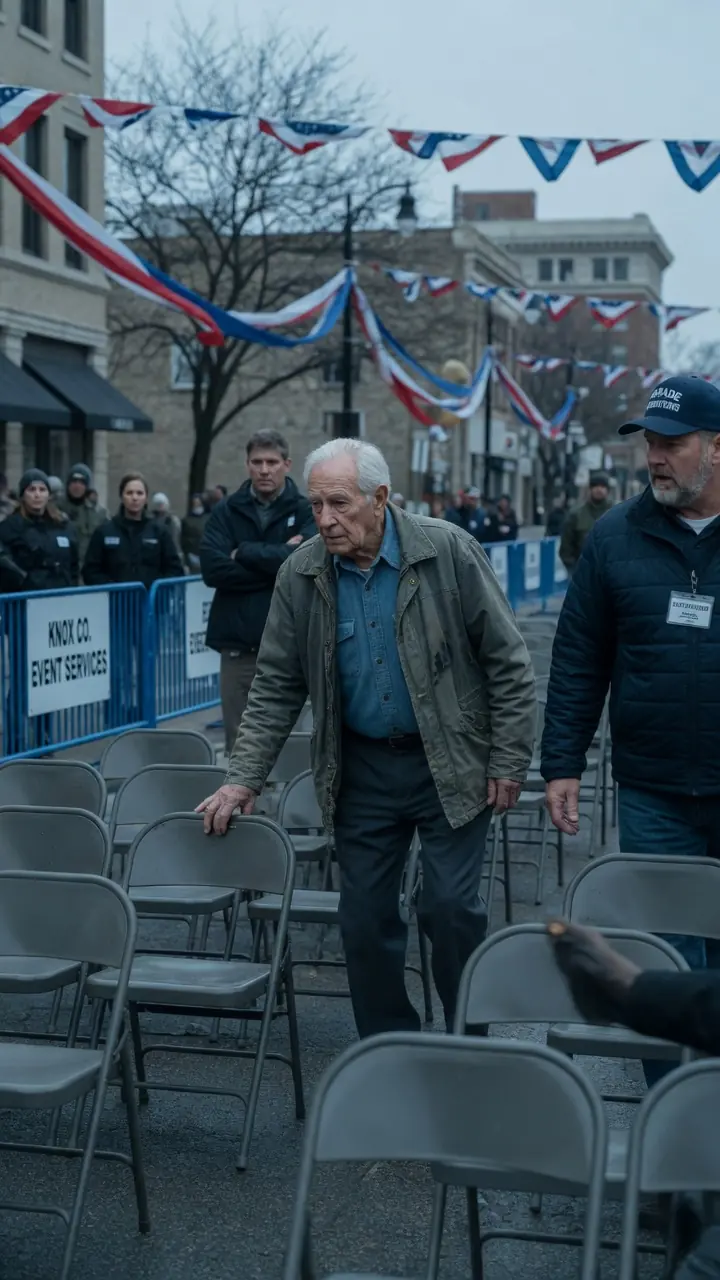
The morning was cold and quiet, just the sound of leaves scraping pavement and a distant generator humming somewhere near the reviewing stand. Walter’s hands came to rest at his sides, flat. His breathing, if you were watching, slowed down instead of speeding up. He looked once at the barricade line, once at the reviewing stand up the block, once at Fosbrook’s clipboard. Then he nodded.
I’ll need to come back through to finish the chair setup, Walter said.
If you get a staging credential, yes. The city office opens at nine. That’s right. Parade steps off at nine-thirty.
Fosbrook’s expression didn’t change exactly, but something in it tightened. I understand the timing is inconvenient. Those are the rules. I don’t write them.
He did write them, or someone exactly like him did, and the rules were fine rules for keeping chaos orderly, and Walter knew that. And so he said nothing else. He picked up his coffee cup from the corner of the registration table, lifted it without a sound, capped the pen that had been lying uncapped near the sign-in sheet, and set it parallel to the table edge. Then he walked toward the barricade line.
He didn’t look back at Fosbrook. He didn’t look at the forty-seven chairs arranged in their rows twenty yards behind him, or at the registration table where Danny Reyes had gone very still and was watching Fosbrook with an expression she was working to keep professional. Walter just walked to the barricade, lifted the tape, and stepped through to the public side.
He stood there with his coffee. The generator hummed. A color guard from the high school came around the corner in a loose cluster, glancing at phones, and Walter watched them find the right entrance and file through, and nobody checked their credentials. He drank his coffee.
The staging area behind him had forty-seven chairs in it, arranged exactly right, and a registration table that still needed someone to manage it, and an entrance where a steward was supposed to stand. He drank his coffee and waited.
Sir, I’m going to need you to step outside the barricade. This is the last time I’m asking.
Walter set his coffee cup down, no sound. Rim to table, clean and level.
Fosbrook had his phone out now, the clipboard tucked under one arm so he could dial. He wasn’t looking at Walter while he did it. He was looking past him, down the street toward the nearest intersection where a patrol officer had been stationed since 6:30. It was the look of a man who had won arguments this way before, many times, probably. The phone, the authority, the backup, the sequence.
Walter watched him dial. His breathing slowed. Anyone paying attention would have noticed it, the chest settling, the shoulders dropping just slightly, the hands coming to rest flat against the sides of his thighs. His eyes moved once, deliberately. The barricade entrance, the registration table, the tent’s two open sides, Fosbrook, the street, then back to Fosbrook. He did not speak.
Officer Briggs, Fosbrook said into the phone. This is Fosbrook. I’m the parade marshal on sector two. I’ve got an individual in the restricted staging area who cannot produce valid credentials. I need you to come assist with removal.
A pause. Fourth in the staging tent. Yeah, thank you.
He hung up, looked at Walter for the first time since dialing. He’ll be here in two minutes. You can wait or you can walk out on your own, either way.
Walter said nothing. The leaves skittered across the asphalt outside the tent. Somewhere down the parade route, a high school band was doing a sound check, a broken phrase of something patriotic starting and stopping. The overcast had thickened since dawn. The cold had that particular November quality, not sharp, just persistent, the kind that settles in at the collar and doesn’t leave.
Walter stood exactly where he was.
Forty yards away, in the credentialing tent near the parade’s assembly point, Danny Reyes had stopped typing. She had a veteran’s packet open on the table in front of her, half processed, and a radio in her hand. And she was looking at the photo she’d taken on her phone twenty minutes ago. A low-quality shot of a small patch on a field jacket, sun-faded to the point of near illegibility.
She almost hadn’t sent it. It was barely visible. Could have been anything. But it wasn’t anything. She’d looked at it long enough to be certain of that. The shape was wrong for every standard unit patch she knew. Wrong in a specific way. Precise.
Her supervisor had called back in four minutes. He’d sounded different than usual. He’d asked her to describe the man wearing it, asked twice, and then told her to hold and not to approach the individual. He’d said that last part carefully. That was six minutes ago. She was still holding.
The radio clicked. A different voice this time. Quieter. It asked her two questions. What sector was the individual currently in, and was he alone?
She told them. Sector two, staging tent. He was alone.
A pause she could feel the weight of. Copy, the voice said, and then, Keep your current position. Someone will be in contact shortly.
She set the radio down and looked at the photo again. The old man in the navy shirt, standing at a registration table at seven in the morning in the November cold, because the VFW post needed a steward, and he was the one who showed up.
She didn’t know yet that the query had already moved past her supervisor. Past his supervisor. Past the third level, where it had paused for forty seconds while someone made a phone call, then continued upward to a fourth, where it had landed on a desk adjacent to the reviewing stand.
Officer Briggs turned the corner at Fourth and Main and headed toward the staging tent, one hand on his belt, moving without urgency. Walter saw him coming from thirty yards out. He didn’t move.
The officer was young, maybe twenty-six. He had the careful walk of someone who didn’t want to use his hands, but had already decided he would.
Sir. Flat. Professional. I’m going to need you to step out of the restricted zone.
Walter looked at him, not through him, at him. The way you look at something you’ve already assessed and found not to be a threat.
He stepped to the side. Precisely six inches. No more.
Fosbrook moved with him, clipboard clutched to his chest now like a shield. He refused to provide documentation. I want it on record. He refused. I have witnesses.
The officer put his hand on Walter’s arm just above the elbow. Light grip, not yet committed to it.
Walter’s breathing slowed. You could see it happen. His shoulders dropped a half inch. His hands came to rest flat at his sides. His eyes moved, not fast, not nervous, just a slow, methodical sweep. The officer’s grip. Fosbrook’s position. The crowd pressed three deep against the barricade to the left. The gap in the bunting at the east end of the staging area. The distance back to the reviewing stand. He was counting exits. He was counting people. He had done this in rooms smaller than this with worse odds, and he was doing it now at a Veterans Day parade in November, because that’s the kind of thing that doesn’t switch off.
I have a VFW volunteer card, Walter said, still quiet. I’ve presented it.
That card, Fosbrook said, voice climbing now, is not a credential. This parade is a municipal event with liability considerations, and I am the authorized marshal, and this man is—
He didn’t finish. Not because Walter stopped him. Because something changed in the faces of the crowd. People weren’t looking at Fosbrook anymore.
The officer felt it first. His hand on Walter’s arm went uncertain. His head turned.
Dress shoes on asphalt. That’s the sound. Not boots, not sneakers. The particular measured clip of navy dress shoes moving at a pace that had somewhere to be.
Rear Admiral Cecilia Okafor was not running. She didn’t need to run. She was fifty-three years old with thirty-one years of commissioned service and the bearing of someone who had never once in her adult life needed to raise her voice to command a room. She walked like weather moving in. Purposeful, unhurried, inevitable.
She was still fifty feet out when Fosbrook registered her uniform. His mouth closed.
Forty feet. The crowd at the barricade went quiet in a wave, the way quiet spreads when something official is in motion.
Thirty feet. The officer’s hand came off Walter’s arm. He didn’t know why. His body knew before his brain caught up.
Twenty feet. Danny Reyes was there somewhere in the staging area, and she had stopped breathing entirely.
The admiral stopped in front of Walter Pruitt. She was looking at his face, not his jacket, not the patch. His face. Like she was checking something against a memory she’d carried for seventeen years and finding it accurate.
Her right hand came up. Full salute. Dress uniform, formal. Held. Not a gesture, a statement.
Fosbrook still had his hand on Walter’s sleeve, the fingers barely touching now, barely even there, and he did not let go immediately. The release was slow, like a man waking up and not yet sure what year it was. He took one step back.
The admiral held the salute for three full seconds, then she lowered her hand and spoke, and her voice was steady and clear and carried to the barricade and beyond.
Cold water.
One word.
Fosbrook’s clipboard dropped to his side. He didn’t speak. The crowd didn’t speak. The leaves moved across the asphalt, indifferent to all of it.
Walter looked at the admiral for a moment, then he nodded. Once. The way you acknowledge a debt you both understand and neither of you plan to mention.
Admiral Okafor stopped eighteen inches from Walter Pruitt and came to attention. Not the casual, polished posture of a reviewing stand dignitary. Full attention, chin level, heels together, every degree of it deliberate.
Her right hand came up. The salute held for three full seconds. In eleven years of working this parade, Walter had never once been saluted. He stood there with his hands flat at his sides and the morning air cold on his face and something behind his eyes went very quiet and very far away.
Cold water, the admiral said. That was all, just the word. Spoken at a volume the crowd could hear in the tone you’d use to name something you’d carried a long time and treated carefully.
Fosbrook’s grip on Walter’s arm went slack. Not suddenly. Slowly. Finger by finger, the way a man releases something he only just realized he was holding. His hand dropped to his side. He took one step back. He didn’t say anything. The clipboard hung from his other hand like he’d forgotten what paper was for.
The police officer released Walter’s arm three seconds after that. He stepped back, too. Both of them just stepped back. The geometry of the moment rearranged itself around Walter without asking his permission.
Walter’s right hand came up and returned the salute. Clean. Correct. The motion had no rust in it whatsoever. Then he lowered his hand and said quietly, Admiral.
Nothing else. He didn’t explain himself. He never had.
Okafor lowered her salute and held his gaze. She’d had a year in the Bagram rotation, 2007, running logistics support for operations she was never briefed on directly. She knew the shape of them from what came back and what didn’t, from the requests that moved through channels without names attached. She’d known the call sign the way you know a rumor that keeps proving true. She hadn’t known what the man looked like until six minutes ago.
The crowd along the parade route had gone still. Not the polite quiet of an audience, the involuntary kind. The kind that happens when something lands in a public space that wasn’t meant for public spaces, and everyone knows it, and no one knows exactly what they’re seeing, and the air feels different.
Danny Reyes stood twelve feet away with her radio in her hand and her mouth slightly open. She’d looked up the patch, or rather, she’d tried to. Four levels of command later, she’d gotten a phone number instead of a file, and the phone number had connected her to someone who asked her one question. Where is he right now?
And then disconnected. She was still processing that. She looked at the man in the faded blue shirt and the old field jacket. She looked at the subdued patch on his shoulder. Then she looked at an admiral rendering a formal salute to someone who didn’t have a laminated badge, and she thought, Whatever is in that sealed file, it’s not nothing.
Fosbrook hadn’t moved. He was still standing one step back, the clipboard at his hip, and his face was doing something complicated and quiet. The pageant he’d built in his head, the impersonator, the disrupted parade, the firm exercise of his authority was simply gone. There was no argument left to make. There was no version of this morning where his laminated credential outweighed what he had just watched happen. He didn’t look at Walter. He looked at the ground.
The leaves moved. The sky was the same flat November gray it had been all morning. Somewhere down the block a color guard was waiting with flags at half-staff. And the cold was settling into everyone’s collars and the parade would run on schedule.
Walter looked once at the admiral. Then he turned his eyes across the crowd, slow, methodical, exit to exit, face to face. And when they came back to rest, they were calm. He was still present. He was still working.
The radio crackle came from the lead operator’s vest, not loud, just a short burst of compressed static and then a voice, clipped and tight. Sandstone, Wren actual, unconfirmed threat indicator, northern terminus, building vicinity Fourth and Main, requesting eyes.
The tactical team leader, a compact man in a gray softshell, no rank visible, earpiece curling down behind his jaw, pressed two fingers to his ear and turned a quarter step away from the reviewing stand. His other hand came up. His two flanking operators stopped moving.
Walter had already turned toward him, not fast, no urgency in it. He crossed the four feet of space between them the way he’d moved all morning, economically, without announcement, and spoke at a volume that carried no further than the operator’s left ear.
What building are they describing?
The operator looked at him. One second of assessment, whatever he saw, the stillness, the eyes, the fact that the admiral was still standing two feet away, was enough. He repeated the description from the net.
Walter nodded once. That’s the Carver Building, Fourth and Main, northeast corner. You’re looking at the wrong entrance.
He kept his voice flat. Just information. Your drone is watching the main stairwell. There’s a southeast service stairwell that doesn’t read on the building schematic. It was added in a ’98 renovation, never updated in the city file. Maintenance door at the base opens outward, not in, outward, which means it defeats a standard breach stack.
The operator’s eyes had gone very still.
That door lets onto the alley between Carver and the parking structure. From that position, you’ve got an unobstructed line to the reviewing stand from forty yards.
How do you know this building?
2003 domestic security assessment, Walter held the man’s eyes. The file’s classified, but the door’s real. Southeast stairwell, third panel on the left wall has a conduit box someone painted over. Looks like a junction, but it’s hollow. People hide things in it.
The operator had his hand to his earpiece before Walter finished speaking. Short, precise transmission. Building designation, stairwell orientation, door specifications. He didn’t editorialize. He passed it clean, the way you pass something valuable.
Twelve seconds later, two members of the tactical element were moving north along the sidewalk at a walk that looked casual and wasn’t.
Danny was watching from six feet away. She’d seen Walter step past the admiral without a word of explanation, and she hadn’t moved since. Fosbrook hadn’t moved either. He was standing where the admiral saluted left him, clipboard at his side, and there was something in his face now that had nothing to do with authority. Just a man trying to locate solid ground and not finding it.
Admiral Okafor watched Walter return to his original position beside the chair row and said nothing. She understood, probably better than anyone present, that what had just happened was not unusual for this man. This was what he did. This was what he had always done. Quietly, precisely, without paperwork.
Three minutes passed. The operator’s earpiece crackled once. His chin dipped a fraction of an inch. He walked back to where Walter stood. He didn’t say anything. He looked at Walter, and then he gave one single nod. Slow, deliberate, the kind that means something was right that needed to be right.
And Walter received it without expression.
The parade band two blocks south started running through their warm-up. Brass carried far on cold November air.
Walter looked back at his rows of chairs. A folding chair in the third row had shifted two inches left of its line. He walked to it, corrected it with one hand, stepped back, and checked the alignment. Forty-seven chairs, even spacing, exact.
Danny’s voice came from behind him, quiet and careful. Why won’t your name be in the after-action report, either?
Walter didn’t answer right away. He turned back to the row of chairs nearest the barricade and took hold of the first one, folded it with a motion so practiced it made no sound at all, and stacked it against his arm. Then the next. Then the next. Like he was doing arithmetic. Like the answer to her question was somewhere inside the counting.
Danny didn’t push. She just stood there in the cold, watching him work his way down the row while the last of the crowd drifted apart behind her. While Fosbrook’s clipboard hung at his side at an angle that didn’t belong to a man who still knew what to do with himself.
Walter got to the end of the row, stopped. He set the stack of folded chairs on the pavement and straightened slowly. And for a moment, he just looked at the empty space where forty-seven chairs had been. The asphalt was marked in a faint grid where the feet had pressed into it over the years. Little dents, evidence, not much, but some.
He never put in for the commendation, Walter said. His voice was level, not quiet the way a man goes quiet when he’s hiding something. Quiet the way a man goes quiet when he’s carried something so long it doesn’t have weight anymore. It just has shape. He didn’t want the paperwork to exist.
Danny opened her mouth, closed it.
Walter picked up the folded stack and walked it to the truck and set it in the bed without looking at her again. He came back for the next stack. Chair by chair, the grid of dents on the asphalt was all that remained. He counted as he went, not aloud, but his lips moved once, twice, each time he added to the bed. Somewhere around thirty-five, his jaw tightened. By forty-two, he’d stopped looking at anything except the next chair and the stack in his arm.
Forty-seven. He set the last one down in the truck bed and rested both hands flat on the cold metal rail. Just stood there.
The overcast had thickened while they weren’t paying attention and the bunting on the lamppost moved in a slow pull of wind that smelled like the front of a winter coming.
The forty-eighth chair was in the truck bed already. It’d been all morning. It faced outward, leaning against the side rail like it was waiting for something he’d already decided it wasn’t going to get.
He looked at it for a long time. Not the way a man looks at something painful. Slower than that. The way a man looks at a fact he’s already made his peace with. Not because the peace was easy, but because the alternative was to keep fighting a thing that couldn’t be fought.
He reached in and took the forty-eighth chair and folded it flat and laid it in with the others. Not hard, not ceremonially, just folded it and laid it down like it was the last word in a conversation no one else had heard.
He walked around to the driver’s side and stopped with his hand on the door and finally looked at Danny. She was still standing where she’d been, both hands in the front pockets of her jacket, the radio clipped to her shoulder, her expression doing something she probably didn’t know it was doing.
It was the right call, Walter said.
That was all.
He got in the truck and pulled the door closed with that same soundless precision, two hands controlled, the latch catching softly, and sat there for a moment in the cab before the engine turned over.
Danny stood in the empty staging area and looked at the grid of dents in the asphalt and didn’t write anything down because she understood for the first time that some things are kept by not being recorded.
He collapsed the chairs one by one. No hurry, no wasted motion, each one folded, stacked, carried to the truck bed in groups of four. He counted under his breath, not the count of a man doing arithmetic, but the count of a man keeping faith with something.
38. 39. 43. 47.
He stood with his hands flat on the tailgate for a moment. The street was nearly empty. A piece of bunting had come loose at the far end of the block and was tapping against a barricade in the November wind, slow and irregular, like something trying to say a word it couldn’t quite form.
Then he reached into the bed and lifted the forty-eighth chair. He unfolded it facing the street, set it down with both hands, the legs touching asphalt without a sound, straightened up, looked at it once, just a chair, facing no one, facing all of it.
He walked around to the driver’s side and got in and did not look back.
The truck pulled away from the curb the way Walter did everything, quietly, without announcement, leaving behind only the small folding chair standing open on an empty street in the gray November light.