At 7:10 on a Saturday morning, Officer Brock Hagen pushed Clayton Reed against the wet grille of a silver SUV and told him to stop lying about who he was.
By the time a second officer closed steel handcuffs around Clayton's wrists, the first customers of the day had gathered outside the showroom, staring at a scene nobody at Reed Auto Shop would ever forget.
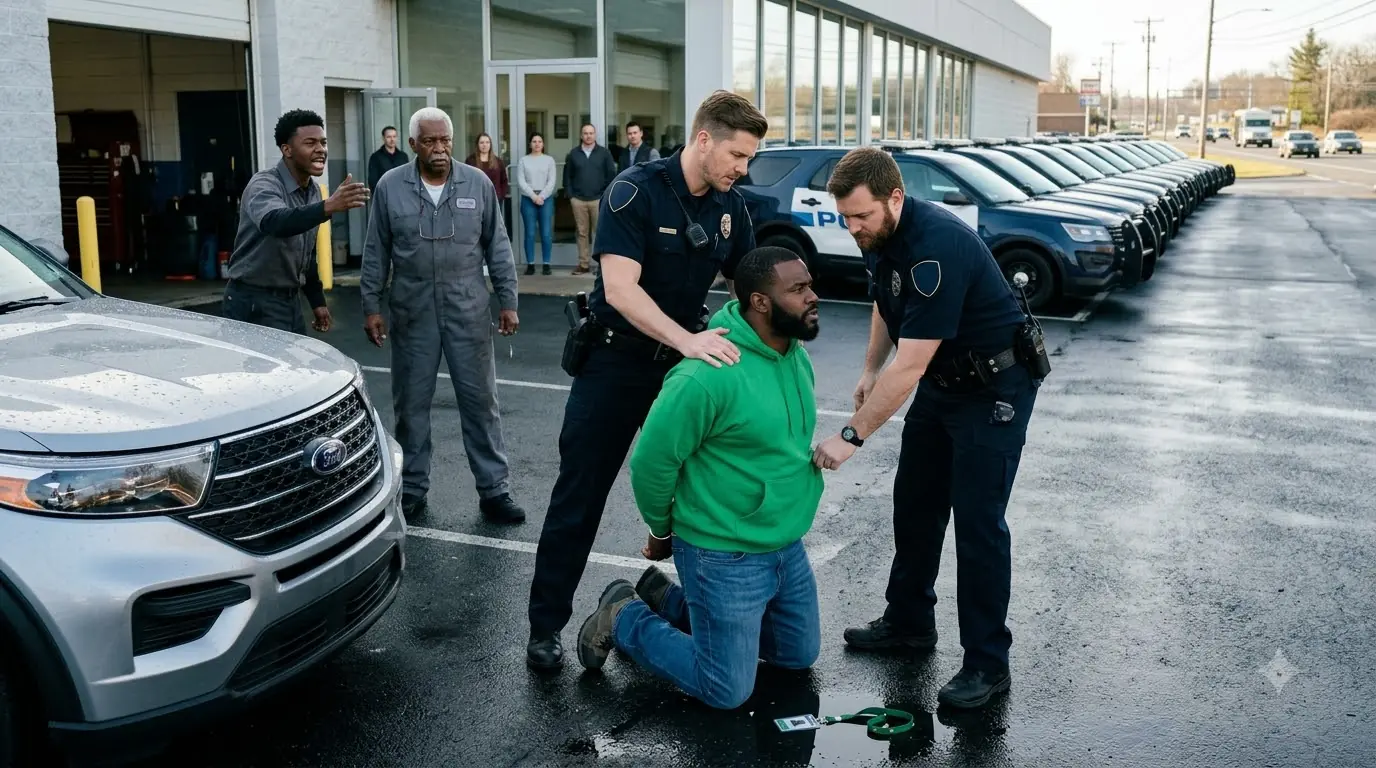
Clayton was forty-one years old. He had worked on that property since he was a boy, paid the wages of everyone standing in the service bays, and signed the contract for the twelve new police cruisers parked along the rear wall. The officers had his driver's license, his employee identification, and several people willing to verify his identity. They ignored every one of them.
What they did not know was that a small black testing remote was in the left pocket of Clayton's green hoodie. The remote belonged to a temporary commissioning system for those twelve cruisers, whose lights, radios, and cameras had been installed by his own mechanics. One press would turn every emergency light in the row on at once. It was a demonstration the city had paid to see on Monday, but the men who had forced him to his knees were about to see it first.
Long before any of that happened, the property on Route 9 had been a muddy patch of gravel with a rusted fence, a two-bay garage, and one faded gas pump that never worked. Clayton's father, Ambrose Reed, had bought it in the summer of 1979 after spending years repairing other men's cars for other men's profit. Banks had refused him. Suppliers had required cash. One landlord had told him that a man like him should be grateful to have steady employment instead of trying to own a business.
Ambrose had signed the deed anyway. His wife had helped him keep the accounts at their kitchen table, and his first mechanic, Sherman Pope, had arrived carrying a toolbox and an employment history nobody else on the road had cared to read. Sherman was twenty-four then, broad-shouldered and eager, with two good hands and more ability than opportunity. Ambrose had looked into his toolbox, asked him three technical questions, and told him to start Monday.
The large red AUTO SHOP sign had gone up that August. Ambrose welded the frame himself, standing on a ladder Sherman held steady in the heat. When they were done, Ambrose backed into the road to see how the white letters looked against the morning sky. He said a red sign was a promise: people should know the shop was open, and the family running it intended to stay.
Forty-seven years later, the sign still hung over the building. The old two-bay garage had become a service department with six bays, a modest showroom, a fenced storage lot, and an electronic workshop for installing specialized equipment in municipal vehicles. Some customers still came because their fathers had bought cars from Ambrose. Others came because Clayton had earned their trust without ever asking them to know the family's history.