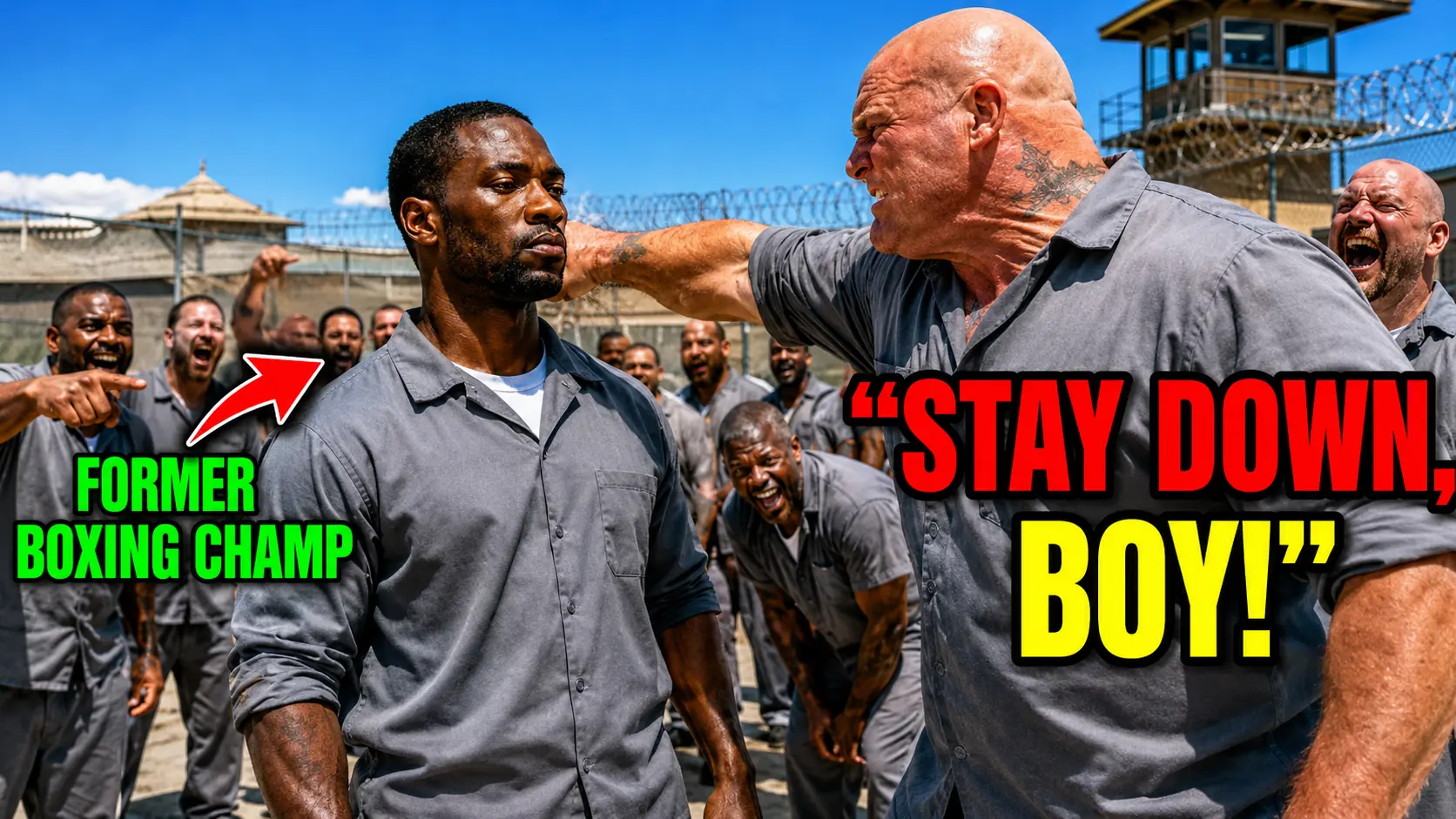
“New fish,” Wade Hartley said. “Smile for me.”
The slap cracked across the yard. Loud. Flat. Final. Fifty men went silent.
“Welcome to my house, boy.”
Blake’s head turned slow, back to center. He said nothing.
Hartley laughed.
“Nothing? No words? I like the quiet ones.” He leaned in. “Quiet ones break pretty.”
A guard watched from the rail, keys swinging. He looked away, slow, like he’d seen this a hundred times.
Blake stood still. Cheek burning. Pulse even. And under the sleeve of his gray uniform, his right hand curled closed—slow, certain—the way it used to before a bell.
The knuckles remembered. Each one had been wrapped in tape a thousand times. Each had ended fights faster than men could blink.
He breathed out. He let the fist open.
Not yet.
Ironwood State Correctional sat two hours past the last gas station, behind three fences and a river of razor wire. The walls held twelve hundred men. The yard smelled of iron, bleach, and old rain. Sound carried strange in there. A cough echoed. A whisper traveled. And everyone learned fast that silence was a kind of currency.
Blake Foster had been inside for nine days.
Before Ironwood, his name meant something. Lightweight champion of the state. Eighteen wins. Zero losses. Fourteen by knockout. Promoters flew in from two coasts. One slid a contract across a diner table with a number that had six figures and a private jet attached.
Blake read it twice. Then he folded it in half and pushed it back.
“My mother’s sick,” he said. “I’m not leaving.”
She had stage three. The treatments cost more than he made, so he took night shifts at a warehouse off Route 9. He trained at dawn, worked till dark, sat by her bed in between. He told himself the title could wait. Titles always wait. Mothers don’t.
Then came the robbery he didn’t commit.
A gas station two blocks from his gym got hit at midnight. The clerk described a tall Black man with a fighter’s build. Blake was tall. Blake was Black. Blake had a fighter’s build. The security tape was grainy. The lineup was rushed. And the public defender had forty other cases that month.
The jury took two hours. The judge gave him six years.
He never raised his voice. Not at the verdict. Not at his mother’s face in the gallery. He just looked at his hands—the ones that had ended fights in seconds—and made himself a promise.
In here, those hands stayed down. One swing, even a fair one, could add years. He would not give them that. He would do his time and go home to her.
That was the plan.
Wade Hartley was the problem.
Hartley ran Block C like a small kingdom. Six-four. Two hundred forty pounds. A neck like a fire hydrant and a laugh that made new men flinch. He had been inside eleven years for putting a man in a coma over a card game. He liked new arrivals. He called them tribute. He took their commissary, their phone minutes, their dignity. And when they had nothing left, he took their fear and kept it like a pet.
What made Hartley untouchable wasn’t his size. It was Officer Dale Pruitt.
Pruitt worked the C-Block floor. He carried his keys low and his eyes lower. When Hartley collected, Pruitt found a reason to be at the far end of the hall. When a camera might catch something, Pruitt remembered it needed cleaning. They never spoke of an arrangement. They didn’t have to. A nod here. A blind eye there. Hartley kept the block quiet, and Pruitt wrote reports that said all was well.
So when Hartley slapped the new man in the yard, he expected the usual. A flinch. A stammer. A tribute paid.
He did not know what he had touched.
He did not know that the quiet man’s hands had been insured for more than Pruitt earned in a decade. He did not know about the eighteen wins, the fourteen knockouts, the reflexes drilled so deep they fired before thought. He saw a slim Black man with downcast eyes and read weakness.
The whole block read weakness.
They were all looking at the wrong thing.
They watched Blake’s lowered head and missed the stillness underneath it. The kind of calm that isn’t surrender. It’s a fighter pacing himself. It’s a man counting rounds.
Blake lay on his bunk that first week and listened to Hartley’s laugh roll down the tier. He thought of his mother’s voice on the phone, thinner each call. He thought of the promise.
Keep the hands down. Go home.
He didn’t know the promise was about to cost him everything.
The chow hall ran on rules nobody wrote down. Where you sat. Who you looked at. How long you held a stare. Blake learned them by watching. He took a corner seat, back to the wall, tray in front of him. Gray meatloaf. Two slices of bread. A carton of milk he was saving for the calcium.
He almost made it through the meal.
Hartley crossed the room slow, with two men trailing him like shadows. The hall noticed before Blake did. Forks went still. Conversations dropped to nothing. By the time the shadow fell across his tray, Blake already knew.
“You’re in my seat,” Hartley said.
There were forty empty seats.
Blake started to rise. He didn’t argue. He just reached for his tray to move.
Hartley got there first. One thick hand flipped it. The tray spun, and meatloaf, bread, and milk hit Blake square in the chest, then slid down to the floor. The carton burst. White ran down his gray shirt like something split open.
The hall laughed. Not all of them, but enough. Enough that the laughter became its own wall, and Blake stood inside it, dripping, alone.
“Clean it up,” Hartley said. “You made a mess.”
Blake looked at him. Just looked. And in that half second, something flickered behind his eyes—fast as a counterpunch—then gone.
He knelt. He gathered the bread. He wiped the milk from the floor with a napkin that fell apart in his hand. He did it without a word, the way a man does a thing he has decided to survive.
Hartley watched, grinning, feeding on it.
“Good boy.”
The injustice of it sat in the room like smoke. Two hundred men and not one stood. Not one said a word. Because every one of them had done the math, and the math always came back to the same answer. Crossing Hartley cost too much.
Blake carried the ruined tray to the bin. His hands did not shake.
And by the door, leaning against the frame with his arms folded, Officer Dale Pruitt watched the whole thing. When Hartley glanced his way, Pruitt did the smallest thing imaginable.
He nodded.
The slap had been a test. The tray had been a message. What came next was a campaign.
Hartley understood power the way some men understand weather. You don’t take it all at once. You take it slow, in pieces, until the other man forgets he ever owned anything.
So he started small. And he made it last.