“You need to leave now.” Jennifer Monroe looked up from her laptop.
At first, she assumed the police officer standing beside her table was speaking to someone behind her.
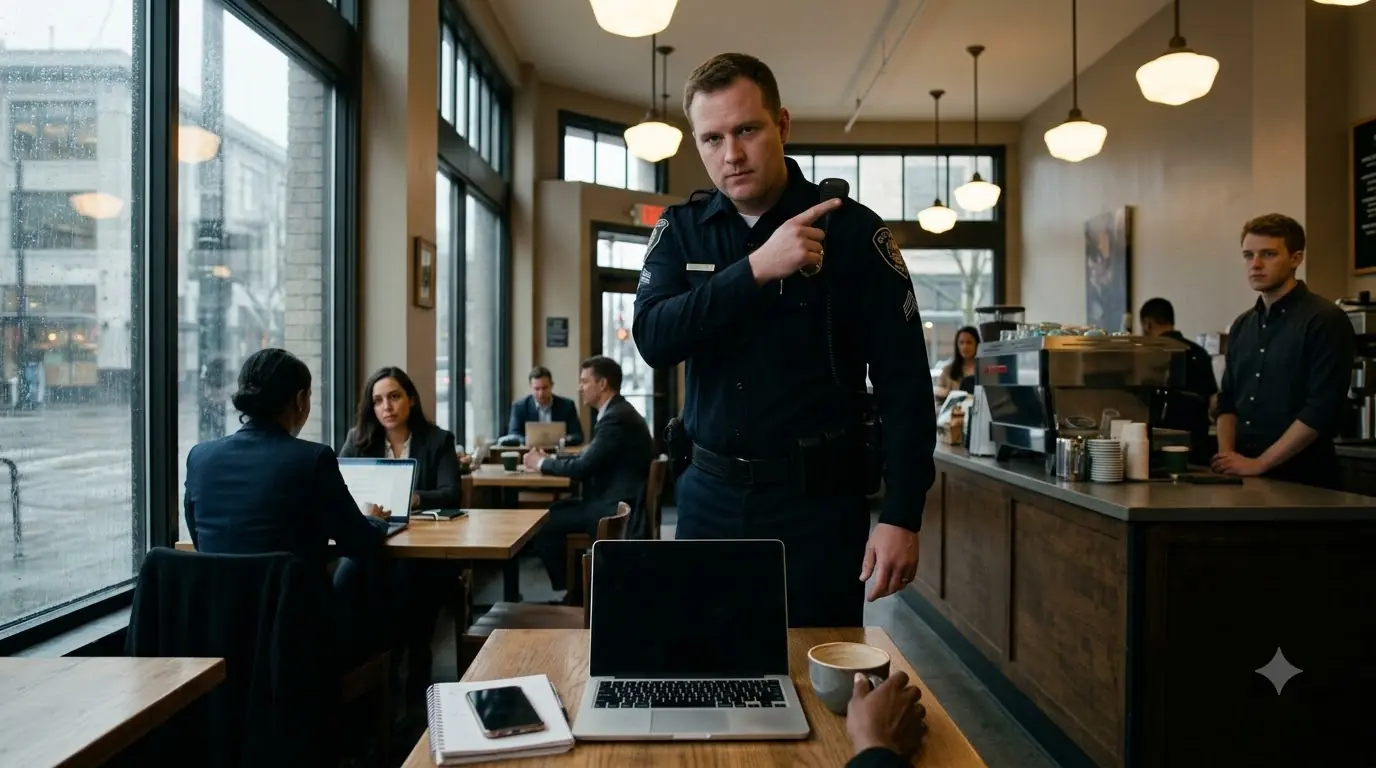
Peak Street Coffee was crowded enough that morning for almost any sentence to belong to somebody else. The line at the counter stretched nearly to the entrance, every two-person table was occupied, and the long communal table near the exposed brick wall was crowded with laptops, charging cables, paper cups, and people trying to finish work before heading to offices downtown.
Then she realized the officer was looking directly at her.
“What?”
“You heard me. You need to leave.”
Jennifer glanced at the black coffee beside her laptop, then at the half-eaten croissant on the small ceramic plate.
“I’m just having coffee.”
The officer’s expression did not change.
“The manager says you’re making people uncomfortable. This is private property. You’re trespassing.”
Jennifer looked around.
A woman three tables away was answering email on a tablet.
Two men in business clothes were arguing quietly over a spreadsheet.
A graduate student had been sitting beside the front window since before Jennifer arrived, surrounded by three books and a cup that had been empty for at least twenty minutes.
Nobody seemed afraid of her.
Nobody was even paying attention yet.
“I bought coffee and food here,” Jennifer said. “I’m a customer. I haven’t bothered anyone.”
The officer stepped closer.
“Are you leaving voluntarily, or do I need to remove you?”
Jennifer studied his nameplate.
BARTLETT.
She had spent sixteen years interviewing suspects, witnesses, accountants, corporate executives, hackers, informants, defendants, and occasionally other law-enforcement officers.
She knew when a person had already reached a conclusion.
This man had.
“You’re making a mistake,” she said.
“Stand up.”
“I’m Special Agent Jennifer Monroe with the FBI.”
Officer Craig Bartlett gave a small, humorless laugh.
“I don’t care if you’re the president.”
Jennifer reached slowly toward her purse.
“Then let me show you my credentials.”
His hand moved closer to his belt.
“Keep your hands where I can see them.”
“You just asked me to identify myself.”
“Slowly.”
Jennifer stopped.
Then, making each movement deliberate, she opened her purse, removed the black leather credential case, and placed it on the table.
She opened it.
The gold badge caught the warm light from the Edison bulbs overhead.
Beside it was her identification card, photograph, name, agency seal, and credential number.
“Special Agent Jennifer Monroe,” she said. “Federal Bureau of Investigation.”
Bartlett looked at it for less than two seconds.
Then he looked back at her.
“Anyone can buy something like that online.”
Jennifer stared at him.
Around them, the coffee shop had begun to quiet.
“You can verify it with one phone call.”
“Stand up.”
“Officer, call the Seattle field office. The main number is public. Give them my name and credential number.”
“I said stand up.”
Jennifer knew at that moment the encounter was no longer about a coffee-shop manager.
It was about a police officer who had been handed evidence contradicting his assumption and had decided the evidence must be false because the assumption felt more trustworthy.
That decision would cost Craig Bartlett his career.
It would eventually cost the City of Seattle millions of dollars.
And it would force several institutions to answer a question none of them particularly wanted asked.
How many warning signs are enough before somebody finally acts?
Craig Bartlett was thirty-three years old and had been a Seattle police officer for eight years.
Eight years was long enough that nobody could reasonably call him inexperienced.
He had worked patrol downtown, spent a short rotation in traffic enforcement, and served several months on a neighborhood emphasis team before returning to regular patrol.
His annual evaluations were rarely terrible.
That was part of the problem.
They used words that looked harmless in personnel files.
“Assertive.”
“Results-oriented.”
“Confident in decision-making.”
“Willing to take command of uncertain scenes.”
Then came the qualifications.
“Can benefit from additional de-escalation awareness.”
“Occasionally interprets questioning as resistance.”
“Should continue improving communication with diverse communities.”
“May become overly committed to initial threat assessments.”
Those sentences accumulated quietly across eight years.
So did complaints.
Eleven in total.
Eight involved allegations of racial profiling, unnecessary detention, or disproportionate force against people of color.
Three had been sustained.
One came from a Black family having a barbecue in a city park.
Bartlett approached after somebody reported a “large disruptive group,” even though the family had reserved the pavilion.
When the father produced the permit, Bartlett continued questioning them about alcohol and noise.
When they asked whether they were free to enjoy their gathering, Bartlett threatened to cite them for failing to cooperate.
Internal review later determined he should have ended the encounter once the valid permit was confirmed.
Written reprimand.
Training.
Case closed.
Another complaint involved a seventeen-year-old Latino boy skateboarding near a shopping center.