“Take off that costume,” Officer Travis Keane said, stepping directly into the Black man’s path. “You’re trespassing in a judge’s hallway.”
Judge Malcolm Reed stopped beneath the fluorescent lights of the Fulton County Courthouse. His formal black robe hung over a charcoal suit, polished shoes, and a dark silk tie, while his reading glasses rested above his forehead. In one hand, he carried an authenticated courthouse credential and the sealed preliminary order for the most important corruption hearing of his career.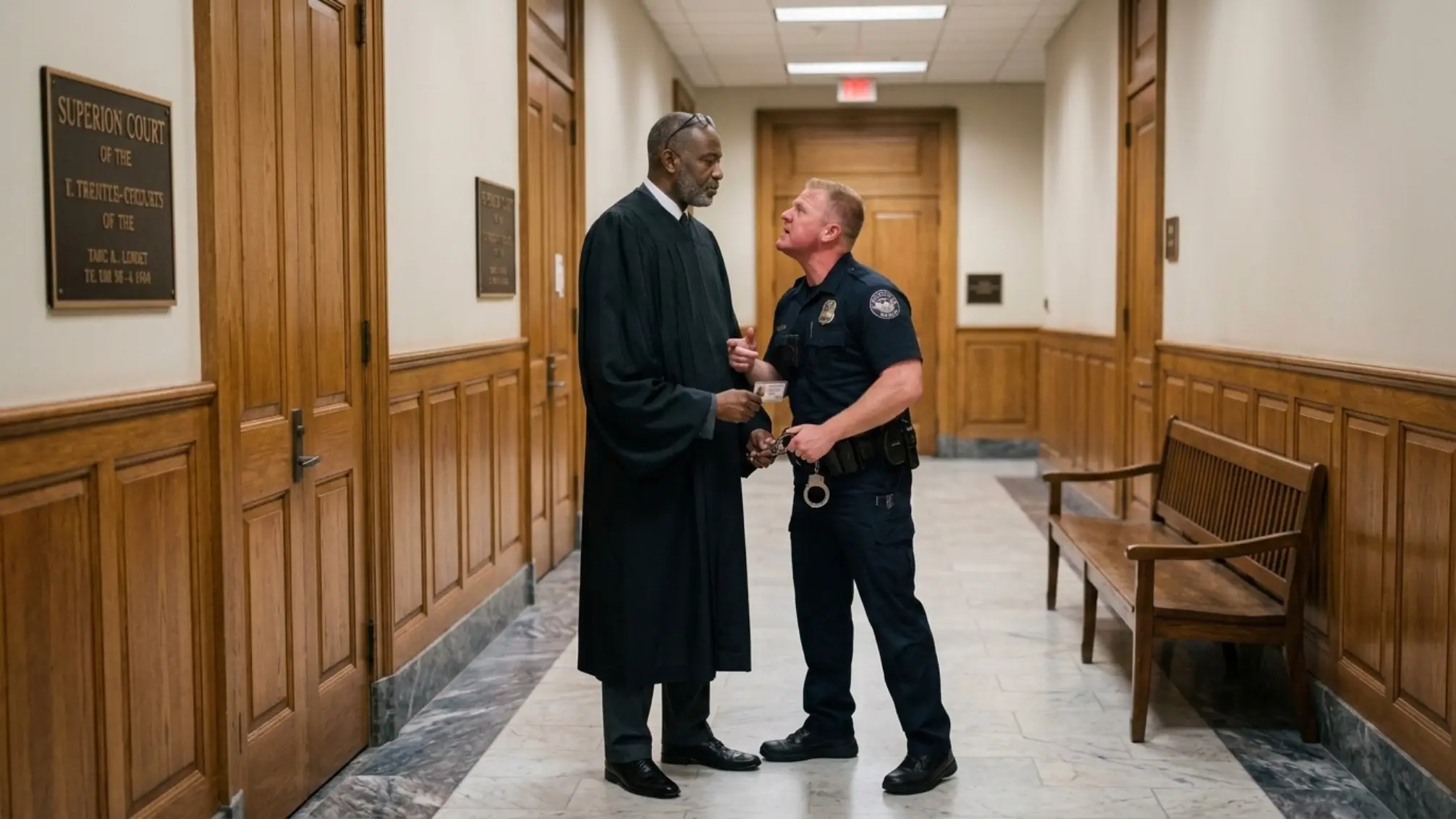
“Put those cuffs away,” Malcolm said calmly, “before your body camera ends your career.”
Keane raised the open handcuffs between them. “Keep threatening me, and I’ll drag you into a cell myself.”
Malcolm extended both wrists. “Do it. Then meet me on the bench when your department goes on trial.”
For one brief second, the officer hesitated.
The courthouse hallway was nearly empty at seven fifteen on a cold Tuesday morning. Most court employees had not yet arrived, and the first public security checkpoint would not open for another forty minutes. Malcolm had entered through the judges’ garage and taken the private elevator to the fourth floor, where Superior Court judges maintained chambers and restricted hearing rooms.
He had used that route for eleven years.
Keane should not have been there.
The Atlanta police officer was assigned to provide temporary security after the courthouse received anonymous threats connected to a public corruption case. According to the schedule sent to Malcolm’s chambers, Keane’s post was supposed to be outside Courtroom Four, not inside the private judicial corridor.
Malcolm noticed that immediately.
He also noticed Keane’s body camera was not recording.
The indicator light remained dark.
“Show me your identification,” Keane demanded.
Malcolm held up the courthouse card already visible in his hand. His photograph, judicial title, and security clearance appeared beneath the official county seal.
Keane glanced at it for less than a second.
“That could be fake.”
“There is a scanner beside the elevator.”
“I don’t need a scanner to know you don’t belong here.”
Malcolm studied the officer’s face. The contempt was not hidden beneath procedural caution. It sat openly in the tightened mouth, the narrowed eyes, and the way Keane looked at the robe as if a Black man wearing it had committed an insult simply by appearing.
“Then call courthouse security,” Malcolm said.
“I’m the security.”
“No. You are a city officer temporarily assigned to this building. The courthouse marshal controls this floor.”
Keane stepped closer. “You don’t tell me what my authority is.”
Malcolm did not move. “The written agreement between the city and the county does.”
The answer irritated Keane more than anger would have.
People accustomed to intimidating others often depended upon fear to establish control. Malcolm’s calm left the officer nothing to dominate except the situation itself, and the facts were already turning against him.
Keane reached for the credential.
Malcolm did not surrender it.
The officer’s hand closed around Malcolm’s wrist.
“Release me,” Malcolm said.
“Stop resisting.”
“I am standing still.”
“You’re refusing a lawful order.”
“You have not issued one.”
Keane twisted Malcolm’s arm behind his back and drove him toward the wall. The judge’s shoulder struck the painted concrete, and the sealed order slipped from his hand onto the floor.
The handcuffs closed around his wrists.
Keane leaned near his ear. “All that courtroom language doesn’t make you important.”
Malcolm looked down at the officer’s inactive camera. “Turn it on.”
“I decide when it records.”
“That policy changed eighteen months ago.”
Keane froze slightly.
The new policy required officers assigned to courts, schools, hospitals, and public demonstrations to activate their cameras before initiating any investigative detention. It had been adopted after the city settled three lawsuits involving officers who claimed their cameras had malfunctioned during disputed encounters.
Malcolm knew the policy because he had reviewed one of those cases.
More importantly, he knew why Keane might not want this encounter recorded.
At nine o’clock that morning, Malcolm was scheduled to preside over an emergency evidentiary hearing involving six officers from Keane’s own precinct. Prosecutors alleged that members of the department’s North Metro Task Unit had planted narcotics, falsified search warrants, seized money without reporting it, and threatened witnesses who challenged them.
Keane was not listed as a defendant.
His name appeared repeatedly in the sealed exhibits.
He had signed vehicle logs connected to unauthorized searches. His badge number appeared in dispatch records that had been altered after two controversial arrests. An informant claimed Keane sometimes delivered cash from illegal seizures to senior officers.
Until that morning, the evidence against him remained circumstantial.
Malcolm wondered whether Keane knew his name had entered the investigation.
“Where are you taking me?” Malcolm asked.
“Downstairs.”
“Which holding area?”
“The one used for trespassers.”
“Have you informed dispatch?”
Keane pushed him forward. “You ask too many questions.”
“An arrest requires documentation.”
“I’ll document it after you’re processed.”
Malcolm glanced toward the sealed order on the floor. “Pick up that folder.”
Keane kicked it against the wall.
The judge’s expression changed for the first time.
Inside the folder was an order authorizing independent investigators to seize digital evidence from the North Metro Task Unit before the morning hearing. Malcolm had signed it shortly before leaving home, but it still required filing with the clerk to become active.
If the order did not reach Courtroom Four by eight, the department would have time to remove records.
That possibility explained Keane’s presence in the hallway.
This was not merely racial harassment.
Someone had sent him to delay the judge.
Malcolm slowed his steps.
Keane pulled harder on the handcuffs. “Move.”
“Who told you I would arrive early?”
The officer’s grip tightened.
Malcolm had his answer.
“Your schedule was sealed,” he continued. “Only the court clerk, the district attorney, the marshal, and counsel for the police union received it.”
Keane shoved him against the wall again. “You think wearing that robe makes you a detective?”
“No. Listening makes me one.”
A door opened behind them.
Court reporter Elena Morris stepped into the hallway carrying a laptop bag and a cup of coffee. She stopped when she saw Malcolm handcuffed against the wall.
“Judge Reed?”
Keane turned sharply. “Go back inside.”
Elena stared at the officer. “Why is the presiding judge in handcuffs?”
“He’s impersonating a court official.”
She looked at Malcolm’s robe, then at his face. Elena had recorded his proceedings for seven years.
“That is Judge Malcolm Reed.”
Keane pulled Malcolm toward the elevator. “You’re interfering with an arrest.”
Elena set down her coffee and removed her phone.
“Start recording,” Malcolm said.
Keane lunged toward her.
“Put that away!”
Elena stepped backward and pressed the record button. “Officer, your body camera is off.”
“That phone becomes evidence.”
“For what crime?”
“Obstruction.”
The private elevator opened.
Courthouse Marshal Denise Holloway emerged with two deputy marshals. She was a broad-shouldered Black woman in her fifties who had overseen judicial security for nearly two decades. Her eyes moved from Malcolm’s cuffed wrists to Keane’s hand resting on his shoulder.
“What happened?” she demanded.
Keane straightened. “I arrested an unauthorized person in a restricted corridor.”
Denise looked at him. “That is Judge Reed.”
“He presented false identification.”
“Did you scan it?”
“I didn’t need to.”
“Did you contact my command desk?”
“He was attempting to enter a restricted area.”
“This is his floor.”
Keane’s jaw tightened. “He refused my orders.”
Denise stepped closer. “Remove the handcuffs.”
“I’m transferring him to city custody.”
“No, you are not.”
The two deputy marshals moved to either side of Malcolm.
Keane placed one hand near his holster.
Every person in the corridor noticed.
Denise’s voice became quiet. “Move your hand away from your weapon.”
“This is my arrest.”
“You are standing inside a county courthouse, violating the interagency agreement that gives you limited authority in this building. You will release the judge now.”
Keane looked toward the elevator.
The calculation in his eyes was visible.
He could not continue pretending Malcolm was an impostor. Elena’s phone was recording, the marshal had identified the judge, and two deputies stood close enough to stop him.
Yet releasing Malcolm would leave the sealed order intact.
Keane pulled Malcolm backward and reached for the folder with his boot.
Denise drew her service weapon but kept it pointed toward the floor.
“Step away from the document.”
Keane turned. “You’re pulling a gun on a police officer?”
“I am ordering an armed man to stop interfering with sealed judicial material.”
“That folder belongs to the suspect.”
“The man you handcuffed is the judge who signed it.”
For the first time, fear appeared in Keane’s face.
He released Malcolm and stepped away.
One deputy marshal unlocked the cuffs while the other recovered the sealed folder. Malcolm rotated his wrists slowly. Red marks circled the skin, but nothing appeared broken.
Denise looked at him. “Do you require medical attention?”
“After the filing.”
“You should be examined now.”
“The order must reach the clerk before eight.”
Keane stared at the folder.
Denise noticed.
“So did Malcolm.
“Take Officer Keane’s firearm, radio, phone, and body camera,” Malcolm said.
Keane stepped back. “You cannot seize my property without probable cause.”
“The camera is city property, and its inactive status during an unlawful detention creates an immediate preservation issue. Your phone may contain evidence of who sent you here.”
“You’re using your position to retaliate.”
Malcolm met his eyes. “No. Retaliation is what brought you to this hallway.”
The deputy marshals disarmed Keane.
His phone vibrated while Denise sealed it inside an evidence pouch. The screen lit long enough to reveal a message preview.
DID YOU STOP HIM?
The sender was saved as Captain R. Cole.
Captain Randall Cole commanded the North Metro Task Unit.
He was also the highest-ranking officer named in the corruption investigation.
Denise held up the phone so Elena’s recording captured the message.
Keane’s face went pale.
Malcolm looked at the hallway clock.
Seven twenty-eight.
“Marshal, escort Officer Keane to the secured interview room. No city personnel may speak with him until the district attorney and independent counsel arrive.”
Keane laughed bitterly. “You think you control my department?”
Malcolm picked up the blue judicial folder. “At nine o’clock, your department will answer to this court.”
He walked toward the clerk’s office.
The seizure order became active at seven thirty-six.
Independent state investigators entered the North Metro Task Unit headquarters twelve minutes later. They found officers attempting to destroy paper records in an industrial shredder and remove computer drives from the evidence office.
Captain Cole was standing beside an open trash bin filled with burned report fragments.
He claimed the cleanup was routine.
Investigators recovered the remnants.
Keane remained in the courthouse interview room, refusing to speak until a police union attorney arrived. He believed the incident could still be characterized as confusion during a security assignment.
That belief ended when technicians examined his body camera.
The device had not malfunctioned.
Keane manually deactivated it six minutes before Malcolm’s expected arrival. The internal buffer had retained the preceding thirty seconds of audio, including a phone conversation.
Captain Cole’s voice was clearly audible.
“Reed comes through the private elevator before seven twenty. Stop him long enough for us to clear the files. If he pushes back, treat him like any other Black guy pretending the rules don’t apply.”
Keane answered, “And if the marshals show?”
“Get him downstairs before they do.”
The recording transformed the morning from misconduct into conspiracy.
At nine o’clock, Courtroom Four was filled beyond capacity. Attorneys, reporters, police representatives, and relatives of people arrested by the task unit occupied every available seat.
Malcolm entered wearing the same robe Keane had mocked.
The red cuff marks remained visible beneath his sleeves.
Captain Cole’s attorney immediately requested Malcolm’s removal from the case, arguing that the morning’s incident made him personally biased against the department.
Malcolm had expected the motion.
“I will not decide criminal liability connected to the assault against me,” he said. “That matter has been assigned to another judge. However, this court retains responsibility for the evidence-preservation hearing already scheduled before today’s events.”
The attorney objected.
Malcolm continued. “The defendants attempted to prevent this hearing by arresting the presiding judge and destroying evidence. The law does not reward interference by granting the objective it sought.”
The room became silent.
The district attorney presented the preserved message from Cole, the camera buffer, and photographs from the task unit headquarters. Investigators testified that officers had removed seventeen hard drives, shredded warrant applications, and altered the property log.
One drive was recovered from the trunk of Cole’s personal car.
It contained a private accounting system.
For five years, the task unit had seized cash from motorists, small-business owners, and suspects who were never charged. Officers entered only part of the money into official evidence. The rest was divided through coded spreadsheets.
More than three million dollars had disappeared.
Keane’s name appeared beside forty-seven entries.
He had not merely known about the operation.
He had participated.
The hearing lasted nine hours.
By the end, Malcolm ordered the entire task unit suspended from active operations. He appointed an independent receiver to control its evidence rooms, barred implicated officers from department databases, and required the city to notify every defendant whose case involved the unit.
The police union condemned the ruling as excessive.
Then the first wrongfully accused man testified.
His name was Marcus Bell, a forty-six-year-old warehouse supervisor stopped while driving home from work. Officers claimed they found narcotics beneath his passenger seat and seized twelve thousand dollars he had saved for a home deposit.
Marcus spent four months in jail before laboratory tests showed the drugs came from an evidence bag opened repeatedly by task-unit officers.
His money was never returned.
Keane had signed the vehicle search form.
Body-camera footage from another officer showed Keane standing beside the car before the alleged drugs were discovered. The video also captured him saying, “He won’t be able to afford a lawyer anyway.”
Marcus stood in Malcolm’s courtroom and looked directly at him.
“He treated me like the ending had already been written,” Marcus said.
Malcolm understood the sentence more deeply than anyone knew.
Keane had looked at a Black man in a courthouse robe and decided he could not be a judge. The task unit had looked at countless Black and Latino drivers and decided they would be believed less than the officers accusing them.
The costume insult was not separate from the corruption.
It was the mindset that made the corruption possible.
The investigation expanded over the next six months. Prosecutors reopened more than three hundred cases. Eighty-seven convictions were vacated because evidence could not be trusted.
Twenty-two officers were suspended.
Nine were charged.
Captain Cole was indicted for racketeering, obstruction, evidence destruction, theft, and conspiracy to interfere with a judicial proceeding. Keane faced additional charges for false arrest, assault, official misconduct, and civil-rights violations.
He initially claimed he did not recognize Malcolm.
The hallway video disproved him.
Elena’s recording captured the marshal identifying Malcolm repeatedly. Keane continued holding him even after learning the truth, because identification had never been the real issue.
Delay was.
Prejudice simply made the assignment easier for him to perform.
During Keane’s trial, his attorney described the encounter as a high-pressure misunderstanding. He said the robe looked unusual in the dim hallway and argued that criminals sometimes carried counterfeit credentials.
The prosecutor placed Malcolm’s courthouse identification on the evidence screen.
Then she showed the scanner Keane refused to use.
It stood six feet from where the arrest occurred.
The jury watched Elena’s full recording. They heard Keane call the judicial robe a costume, threaten to drag Malcolm into a cell, and ignore every attempt at verification.
Then prosecutors played the buffered call from Cole.
Keane’s expression changed as his own voice filled the courtroom.
He had believed turning off his camera erased the truth.
The device preserved enough.
The jury convicted him on every major count.
At sentencing, Keane addressed Malcolm directly.
“I followed an order from a superior officer.”
Malcolm sat in the gallery rather than on the bench. Another judge presided.
“You had a choice,” Malcolm said when invited to deliver a victim statement. “You could have scanned the identification. You could have called the marshal. You could have activated your camera. Instead, you chose the story that made cruelty easiest.”
Keane lowered his eyes.
“You mocked the robe because you believed dignity belonged to someone else. But even after learning who I was, you did not stop. That is why this case was never about mistaken identity.”
The judge sentenced Keane to prison and permanently barred him from law enforcement.
Captain Cole received a much longer sentence after three former officers testified against him. The city recovered part of the stolen money through seized property and pension forfeiture.
The department entered a federal oversight agreement.
New policies required automatic notification when officers entered restricted courthouse areas, continuous body-camera activation during security details, and independent investigation whenever an officer detained a judge, prosecutor, public defender, or courthouse employee.
Malcolm insisted the reforms extend beyond officials.
“The public should not need a robe to be believed,” he said.
That sentence became the central principle of the agreement.
The city created a compensation fund for victims of the task unit. Marcus Bell received his stolen savings, damages for wrongful imprisonment, and a formal public apology.
He used part of the settlement to purchase the small house he had been saving for.
Malcolm attended the housewarming without reporters.
“You didn’t have to come,” Marcus said.
“Yes, I did.”
“Because of the case?”
“Because the system asked you to trust it again after giving you every reason not to.”
Marcus considered that. “I don’t trust the system.”
Malcolm nodded. “Then trust evidence, accountability, and people willing to keep working when institutions fail.”
One year after the arrest, Malcolm returned to the fourth-floor corridor before sunrise. The walls had been repainted, new cameras covered every entrance, and an electronic scanner now required credentials before anyone entered.
He stopped near the place where Keane had forced him against the wall.
Marshal Denise Holloway joined him.
“You’re early,” she said.
“I usually am.”
“Still wearing the costume?”
Malcolm looked at her.
Denise smiled.
He laughed quietly.
It was the first time the word no longer sounded like an insult.
That morning, Malcolm presided over the final hearing connected to the task-unit scandal. The court approved the dismissal of the last conviction dependent upon falsified evidence.
Before leaving the bench, he looked across the courtroom at rows of families, former defendants, investigators, and officers who had helped expose the corruption.
“A robe does not make a judge honest,” he said. “A badge does not make an officer honorable. Institutions are only as trustworthy as the conduct they are willing to examine openly.”
No one moved.
“Authority must never become a shield against evidence. It must create a greater obligation to answer it.”
He closed the case.
The black robe Keane mocked had not protected Malcolm from humiliation, pain, or arrest. It did not make his account automatically true.
The evidence did that.
The inactive body camera, the preserved audio, the message on the phone, the sealed order, the records recovered before destruction, and the witnesses who refused to remain silent all told the same story.
Officer Travis Keane saw a Black man standing in a restricted hallway and decided the robe had to be fake.
He placed him in handcuffs, kicked aside the judicial order, and tried to drag him away before the corruption hearing could begin.
Then the marshal arrived.
The phone lit up.
The body camera revealed the call he believed it had erased.
And two hours after mocking the judge’s robe as a costume, Keane stood inside the real courtroom without his badge, watching the man he arrested take the bench over the case that would destroy his entire unit.