The sheriff thought he had found a man no one would miss. A traveler eating catfish alone at a roadside diner in a county where strangers rarely asked questions twice seemed, to Roland Hask, like the easiest kind of target.
He saw the charcoal jacket hanging beside the booth, the expensive watch at the man's wrist, and the car parked outside with plates from beyond the county line.
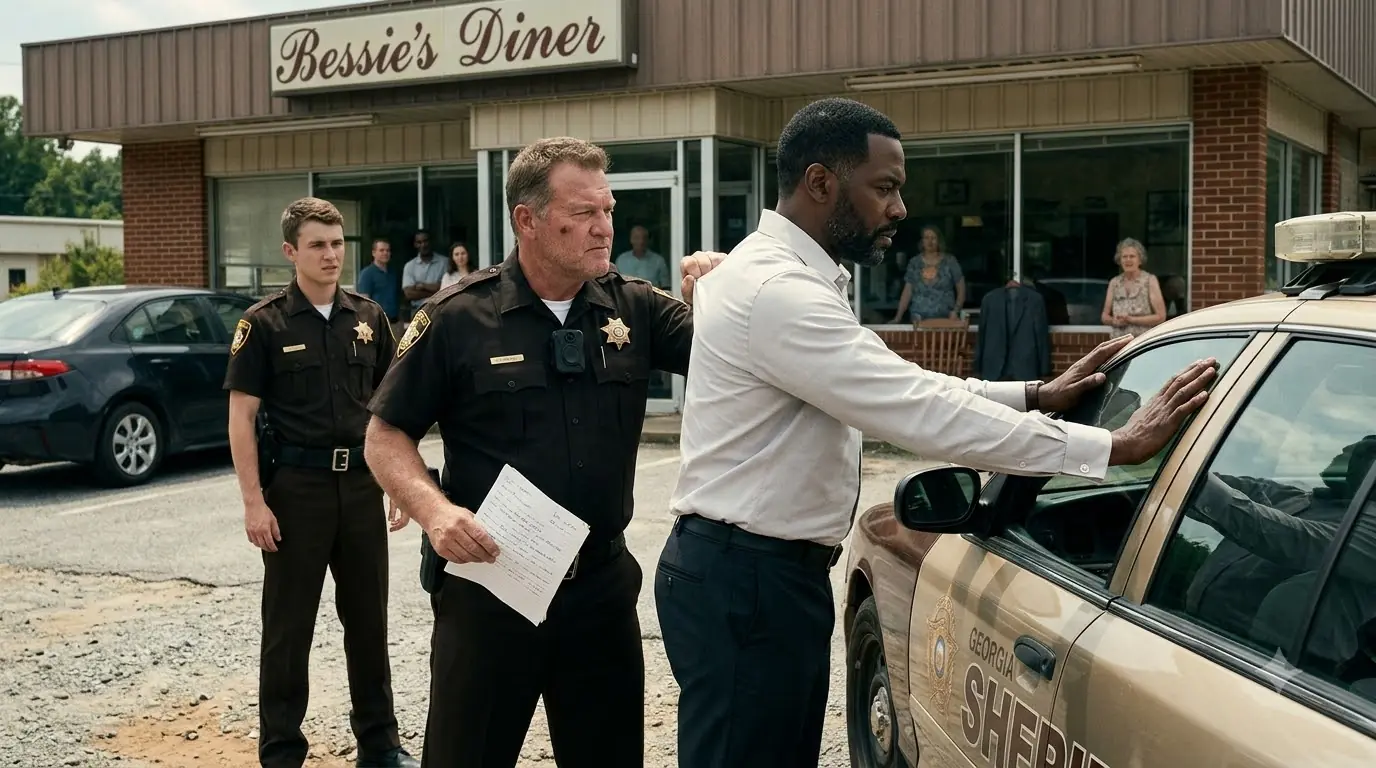
He imagined a wallet, a vehicle, and a set of possessions that could be made to disappear into the routines of his department without anyone important noticing. What he never considered was that a person's right to be left alone did not depend on whether anyone important knew his name.
"Tell me what you're doing in my town," Hask demanded, striking the table with his open palm. The coffee cup jumped against its saucer, and a fork stopped halfway to a customer's mouth two booths away. Behind the counter, Estelle Rowan lowered her coffee pot so carefully that not a drop spilled, although the cup she had been filling remained half empty. The stranger waited for the coffee to settle before looking up. That little pause, controlled and unhurried, angered the sheriff more than any insult could have done.
"I'm having lunch," the man answered. "If there's something specific you need to ask, I'll listen. But I would like to know why you're questioning me." Hask planted his boots wider apart and glanced around the diner to make certain everyone was watching. He had mistaken an ordinary question for a challenge to the entire arrangement by which he ruled Brier Glenn, Georgia. By the end of that afternoon, a telephone call would expose something he had kept hidden for years, and the diner would become only the first place investigators began looking.
Bessie's Diner occupied a low brick building beside the county highway, halfway between a worn gas station and a patch of tall pines. Its blue sign had been repainted so many times that the raised edges of old lettering showed through the newer enamel. Trucks stopped there for biscuits before sunrise, farmers came for coffee after checking their fences, and families crowded the booths after Sunday services. Travelers seldom stayed longer than a meal. That was part of what made the place useful to men who understood how to take advantage of people passing through.
Brier Glenn was quiet in the way a town can be quiet when everyone knows which subjects are safer left alone. The courthouse clock chimed at noon, children played baseball beside the school, and people donated canned food through the same church that organized the Christmas parade. The sheriff attended every ceremony, shook every hand that mattered, and made a point of standing in photographs beside the mayor. His campaign signs remained beside the road long after elections because no one bothered to take them down. Roland Hask had held office so long that his authority was treated less like a public responsibility than a feature of the landscape.