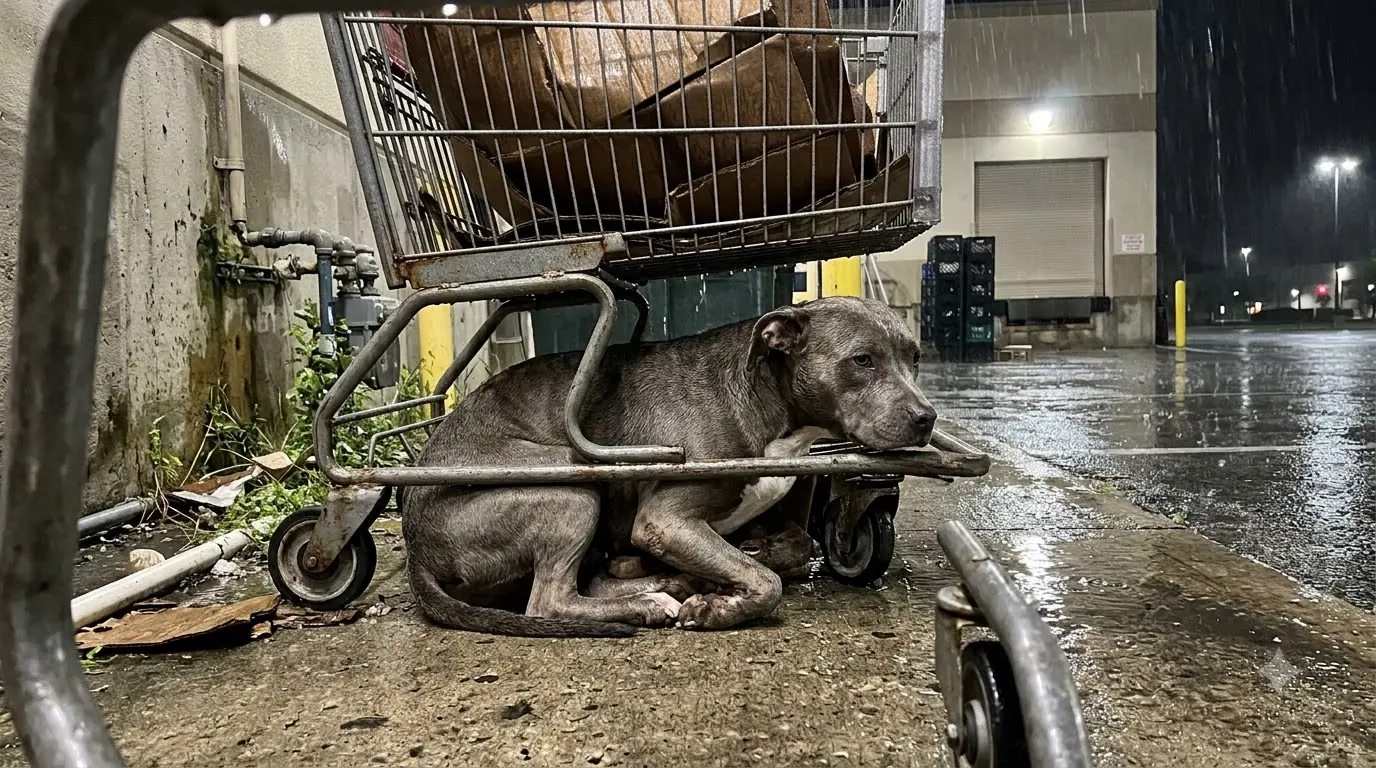
By the time someone stopped to help Millie, the cardboard beneath the shopping cart was almost completely soaked.
The cart had been sitting behind a closed grocery store, pushed against the edge of the building near a service area. Pieces of old cardboard had accumulated inside and underneath it, creating just enough cover for a medium-sized dog to squeeze beneath the lower frame.
For Millie, that space had become a sleeping place.
The 4-year-old Pit Bull mix had been seen around the property on multiple evenings.
She did not appear to travel far.
During the day, she sometimes moved along the edge of the building or disappeared behind nearby structures. As evening approached, she often returned to the shopping cart.
Then she crawled underneath.
She tucked her legs beneath her body and curled herself tightly against the cardboard.
There was no proper shelter from wind or rain.
Still, Millie returned.
We cannot verify how she came to be living there, how long she had been without stable housing, or whether someone had previously been caring for her. We had no reliable history establishing that she had been deliberately abandoned.
What we know begins with the people who noticed her.
And with the storm that finally changed everything.
The Night the Cardboard Stopped Protecting Her
Heavy rain moved through the area one evening.
Water collected across the pavement behind the grocery store and blew underneath the cart.
The cardboard absorbed it quickly.
By late evening, most of Millie’s makeshift sleeping area was wet.
Someone checking the property expected the dog to have left.
She had not.
Millie had squeezed herself beneath the smallest remaining section of relatively dry cardboard near the building.
Her body was curled tightly.
Her chin rested on her front paws.
Rainwater had reached the fur along her legs and underside.
She looked up when the person approached but did not immediately stand.
That was concerning.
A healthy, frightened loose dog may run when someone approaches. A dog who remains motionless could be choosing not to flee, but illness, exhaustion, pain, or cold can also reduce a dog's willingness to move.
The observer contacted local rescue resources rather than attempting to pull Millie from beneath the cart.
Getting Millie Out Safely
When the rescuer arrived, Millie remained underneath the cart.
The first goal was not to grab her.
It was to determine whether she could move voluntarily.
The rescuer crouched several feet away and spoke quietly.
Millie watched.
Her ears shifted backward.
She licked her lips once and lowered her head again.
Food was placed near the edge of the cart.
For several minutes, she did nothing.
Then her nose moved.
Millie stretched her neck forward and sniffed.
She ate the closest piece without leaving her shelter.
More food was placed slightly farther away.
Eventually, Millie crawled forward.
When she stood, the rescuer could see how thin she was.
Her coat was wet, her paws appeared irritated, and she moved with short, cautious steps.
A slip lead was introduced gradually.
Millie initially backed toward the cart, so the rescuer stopped and gave her more time.
On the next attempt, she allowed the lead to be placed.
A dry blanket was waiting in the vehicle.
Millie hesitated at the open door.
Then she climbed inside.
Her First Hours in Our Care
Millie arrived damp, tired, and colder than we wanted her to be.
She was immediately moved into a warm, quiet intake area.
Staff dried her gently with towels rather than overwhelming her with unnecessary handling.
Her temperature was checked.
She was mildly hypothermic but not in a critical state requiring aggressive emergency warming.
We warmed her gradually and monitored her closely.
Millie drank a modest amount of water.
Food interested her immediately, but because she was thin and her recent nutritional history was unknown, we did not simply place an enormous meal in front of her.
She received a measured portion.
Millie ate quickly at first.
Then she stopped and looked around.
After the room became quiet again, she finished most of what remained.
What We Saw Beneath the Wet Fur
Once Millie was dry enough for a better examination, her physical condition became clearer.
She was underweight.
Her ribs and hip points were more prominent than they should have been, and she had reduced muscle mass over her hindquarters.
She was not in the most severe category of emaciation, but her body condition suggested that her nutritional needs had not been consistently met recently.
Again, we could not determine why.
Living outdoors can make regular access to adequate food difficult, but without a complete history, we could not reconstruct exactly what had happened.
Her skin was another concern.
Millie had patchy thinning of the coat along portions of her body, particularly around her lower legs, abdomen, and flanks.
Several areas were red and irritated.
There were small crusted patches from chronic inflammation and scratching, but no graphic open injuries.
Her feet were sore.
The skin between several toes was inflamed, and her paw pads showed irritation consistent with prolonged exposure to rough, wet surfaces.
Millie frequently licked her front feet.
That behavior was documented because persistent paw licking can be associated with pain, itching, infection, allergies, or combinations of those problems.
Her First Complete Veterinary Examination
Our veterinary team examined Millie from nose to tail.
Her temperature improved as she warmed.
Her heart rate and respiratory rate were monitored.
Her lungs sounded clear, and there was no immediate evidence of pneumonia or respiratory distress following her exposure to the storm.
Her eyes were clear.
Her ears contained debris and mild inflammation.
Her mouth showed some plaque but no major dental disease requiring urgent treatment.
Her abdomen was soft without obvious distention or severe pain.
Her joints moved through an acceptable range for a dog her age.
She could bear weight on all four limbs.
The cautious gait observed during rescue appeared to be related primarily to painful feet, fatigue, and general physical condition rather than a major orthopedic injury.
Then the team examined her skin closely.
That was where the more complicated problem emerged.
Millie’s Skin Needed More Than a Bath
It would have been easy to assume that Millie's skin looked poor simply because she had been living outdoors.
But environmental exposure does not explain every skin problem.
Samples were collected from affected areas.
The veterinary team performed skin cytology to look for evidence of bacterial and yeast overgrowth.
Skin scrapings were also performed where appropriate to investigate mites.
Millie had evidence of secondary bacterial skin infection and significant inflammation.
Additional testing identified Demodex mites in numbers consistent with demodicosis.
Demodex mites normally exist in very small numbers in the hair follicles of many dogs. Disease occurs when they multiply excessively, which can happen when normal immune control is disrupted.
In adult dogs, generalized demodicosis deserves careful attention because underlying illness, poor physical condition, certain medications, or other immune-related factors may contribute.
Millie's diagnosis therefore raised another question.
Was there something else affecting her health?
Bloodwork Was the Next Step
A complete blood count and serum chemistry panel were performed.
Millie had mild anemia, though not at a level requiring transfusion.
Her blood proteins were somewhat low, a finding that could be associated with poor nutritional status, inflammation, intestinal disease, or other causes.
Her kidney and liver values did not indicate acute organ failure.
Her blood glucose was within an acceptable range.
Nothing in the initial bloodwork revealed a single severe systemic disease explaining the demodicosis.
A urinalysis was also performed.
It did not show major protein loss through the kidneys.
Fecal screening identified intestinal parasites that could reasonably contribute to poor body condition.
Millie was started on an appropriate deworming protocol.
Her medical team would repeat testing later rather than assuming one treatment automatically resolved the infection.
Testing for Other Infectious Disease
Because Millie had been living outdoors with an unknown preventive history, she received standard screening appropriate to her circumstances and geographic risk.
Heartworm testing was negative at intake.
That was reassuring, although ongoing preventive care would still be necessary.
Her vaccination history was unknown.
Our veterinary team therefore followed appropriate shelter protocols to establish protection without assuming she had previously been vaccinated.
None of these results changed the fact that her skin disease required weeks to months of management.
Treating the Demodicosis
Modern treatment for canine demodicosis can be very effective, but improvement is not instantaneous.
Millie began a veterinary-prescribed antiparasitic medication appropriate for Demodex.
Because she also had a secondary bacterial infection, treatment was selected based on her examination and cytology findings.
Medicated bathing was introduced carefully.
Bathing a dog with inflamed skin is not simply cosmetic.
The products, frequency, contact time, and skin response all matter.
Staff made sure Millie was fully dried afterward and remained warm.
Her feet received particular attention.
The inflamed areas between her toes were cleaned as directed, and her paw licking was monitored.
We avoided repeatedly correcting her for licking.
The behavior was a symptom.
Our job was to address the discomfort causing it.
Food Became Part of Her Medical Plan
Millie's nutritional rehabilitation was just as important as her medications.
Her daily calorie needs were calculated based on her current condition and target weight.
Meals were divided into smaller portions during the early period.
Her gastrointestinal tolerance was monitored.
She had a strong appetite.
That did not mean we could increase food without limits.
Rapid overfeeding in a thin animal can cause gastrointestinal problems and, in severely malnourished patients, potentially dangerous metabolic disturbances.
Millie was not judged to be in the most extreme risk category, but gradual nutritional rehabilitation remained the safest approach.
Her meals contained complete and balanced nutrition with adequate protein to support tissue repair and muscle recovery.
Her First Nights Indoors
The first night, Millie did something that reminded us of the shopping cart.
A large bed had been prepared in her kennel with clean blankets spread across it.
Millie did not lie in the middle.
Instead, she pushed herself toward the back edge.
She curled tightly.
Her paws tucked underneath her chest.
Her nose disappeared near her front legs.
The room was warm.
There was no rain.
Still, Millie made herself as compact as possible.
Staff kept the environment quiet.
No one tried to pull her into a different sleeping position.
By morning, she had shifted slightly.
One leg was stretched out.
That was enough.
She Was Not Immediately Comfortable With Everyone
Millie accepted food from people before she consistently sought affection.
That distinction was important.
Food can motivate a frightened or uncertain dog to approach even when she is not ready for physical contact.
During early interactions, Millie often sniffed an offered hand and then stepped away.
If someone reached too quickly over her head, she ducked.
Staff adjusted.
People sat sideways.
Treats were tossed rather than used to lure her into uncomfortable contact.
When Millie approached voluntarily, she was allowed to sniff.
If she stayed, gentle contact could follow.
If she left, no one followed her around trying to pet her.
Over several days, her choices began changing.
She stayed longer.
Bathroom Habits Told Us She Was Stabilizing
Millie's urine output remained normal after her hydration improved.
She did not show persistent straining or unusual frequency.
Her bowel movements were softer during the first days, which was not unexpected given diet transition, stress, and intestinal parasites.
As her diet stabilized and parasite treatment progressed, her stool became better formed.
Staff recorded changes carefully.
Persistent diarrhea, vomiting, refusal to eat, or worsening lethargy would have prompted further investigation.
Fortunately, Millie continued eating.
Her Feet Improved Slowly
The paw inflammation was one of the problems that affected Millie's daily comfort most noticeably.
During her first days, she sometimes shifted weight from one front paw to the other.
She licked between her toes whenever she settled.
Treatment gradually reduced the redness.
Clean, dry indoor flooring also helped.
Her outdoor walks were kept brief at first.
Staff avoided hot pavement and rough surfaces.
Within a couple of weeks, Millie was walking more comfortably.
She still occasionally licked her feet, so treatment continued rather than being stopped as soon as they looked better.
Her Coat Could Not Recover Overnight
Hair regrowth takes time.
During Millie's first weeks, the visible improvement was mostly in her skin rather than her coat.
The redness decreased.
Crusting became less prominent.
She scratched less.
New hair was not immediately obvious.
That is normal.
Follicles need time to recover after inflammation and mite overgrowth.
Photographs were taken periodically for medical comparison.
The purpose was not to create dramatic before-and-after images.
It was to document whether treatment was working.
Gradually, fine new hair began appearing in some of the thinnest areas.
A Recheck Confirmed Progress
At Millie's follow-up veterinary examination, her weight had increased modestly.
Her hydration was normal.
Her appetite remained strong.
The secondary bacterial infection had improved substantially.
Repeat skin evaluation showed progress in controlling the Demodex population, although treatment needed to continue.
Demodicosis should not be declared resolved simply because a dog's coat looks better.
The veterinary team planned appropriate repeat testing and continued medication until established treatment goals were met.
Her bloodwork was also reassessed.
The mild anemia showed improvement.
Her protein values were moving toward normal as her nutrition and overall condition improved.
No new evidence of a serious underlying systemic illness had emerged.
That was encouraging.
But Recovery Was Not Perfect
One week later, Millie developed increased redness between two toes.
She had also begun licking that paw more frequently.
The foster and medical teams did not assume the original treatment had failed completely.
Skin disease can fluctuate.
The paw was examined.
A localized secondary infection had become more active.
Treatment was adjusted based on veterinary assessment.
Millie's activity on wet grass was temporarily limited, and her feet were dried carefully after outdoor bathroom breaks.
Within several days, the irritation began settling again.
This small setback illustrated why dermatologic recovery requires patience.
Moving Into Foster Care
Once Millie was medically stable and her treatment routine could be safely managed outside the shelter, we looked for an appropriate foster home.
A foster caregiver experienced with medical cases agreed to take her.
The home offered something Millie had not experienced during her early recovery:
ordinary quiet.
Her medication schedule, diet, bathing instructions, parasite prevention, and follow-up appointments were all provided in writing.
Her foster caregiver also received behavioral notes.
Give Millie space.
Allow her to approach.
Do not force affection.
Keep routines predictable.
Her First Rainstorm in Foster Care
Several days after Millie moved into foster care, rain began hitting the windows.
At first, she was sleeping in the living room.
When the rain intensified, Millie's head came up.
She listened.
Then she stood.
Her foster caregiver did not call her over or try to reassure her through forced contact.
Millie walked toward the hallway.
A covered crate with the door secured open had been provided as an optional resting space.
Millie entered.
She turned around.
Then she curled up near the back.
Her foster caregiver placed no interpretation on the behavior.
We could not know whether the sound reminded Millie of nights behind the grocery store.
We could only see that she preferred an enclosed, quiet resting place while the storm passed.
So she was allowed to stay there.
The Next Storm Looked Different
Several weeks later, another evening storm arrived.
By then, Millie knew the household routine.
She knew where meals appeared.
She knew which door led outside.
She knew the sound of her foster caregiver moving through the kitchen.
When the rain began, Millie again listened.
But this time she did not immediately retreat.
She remained on her bed for several minutes.
Eventually, she walked into the hallway and checked the open crate.
Then she returned.
She lay down on the rug several feet from her foster caregiver.
That was not proof that any fear had disappeared.
It was simply a new choice.
For Millie, having choices had become an important part of recovery.
Her Personality Started Emerging
As her skin became more comfortable, Millie became more playful.
She liked soft rubber toys.
She occasionally carried one from room to room.
She discovered food puzzles quickly.
She also developed a habit of bringing an empty puzzle toy back to her foster caregiver and dropping it nearby.
Millie was not a relentlessly high-energy dog.
After play, she enjoyed long naps.
She also began seeking physical affection.
Instead of approaching, sniffing, and leaving, she sometimes pressed her shoulder against her foster caregiver's leg.
If petting stopped, she occasionally nudged the person's hand.
Those behaviors were initiated by Millie.
That made them especially meaningful.
Weight Gain and Muscle Recovery
Millie's weight continued increasing gradually.
Her ribs became less prominent.
The muscles over her hips and thighs began filling in as her nutrition improved and her activity increased.
Her meals were adjusted as she approached a healthier body condition.
The goal was not unlimited weight gain.
Pit Bull-type dogs can be naturally muscular, but healthy body condition still requires maintaining an appropriate waist and avoiding excess fat.
Her foster caregiver measured food rather than estimating portions.
Treats were included in her total daily intake.
Longer Walks Came Later
Once Millie's paws were comfortable and her overall condition improved, her walks became longer.
She enjoyed sniffing more than covering distance quickly.
Her foster caregiver allowed her time to investigate trees, grass, and unfamiliar scents.
Millie walked on a secure leash and harness.
Because her previous life and recall reliability were unknown, she was not allowed to roam freely.
Her endurance improved steadily.
She no longer shifted weight away from her front paws.
She could walk comfortably, return home, drink water, and settle without appearing exhausted.
Follow-Up Skin Testing
Repeat veterinary evaluation continued to show improvement.
The Demodex infestation was coming under control.
Her secondary bacterial infection had resolved clinically, though staff remained alert for recurrence.
Her coat had begun filling in across areas that had previously been thin.
The new hair initially appeared shorter and softer than the surrounding coat.
Over time, the difference became less obvious.
Treatment continued for the duration recommended by the veterinarian.
Stopping too early could increase the risk of relapse.
Millie’s Medical Future
Millie's prognosis became increasingly positive as she responded to treatment.
However, her future family will need to understand her dermatologic history.
If she develops recurrent hair loss, persistent itching, redness, paw licking, skin odor, or new lesions, veterinary evaluation will be important.
Adult-onset demodicosis can occasionally recur, particularly if another health condition later affects immune function.
Routine wellness examinations will therefore remain important.
So will consistent parasite prevention, appropriate nutrition, and skin monitoring.
What We Cannot Say About Millie
We cannot tell people that Millie was deliberately left behind the grocery store.
We cannot say someone placed the shopping cart there for her.
We cannot know whether she once belonged to someone nearby.
We cannot determine exactly how long she slept beneath it.
And we cannot say that every behavior she displays today is the result of her time outdoors.
Those details would make a dramatic story.
They would not necessarily make a truthful one.
What we can say is that Millie was repeatedly observed living behind the closed store.
She used the cardboard beneath an abandoned shopping cart as a sleeping place.
During heavy rain, she remained squeezed beneath the small portion that stayed relatively dry.
And when help finally arrived, she needed medical care.
Preparing for Adoption
As Millie's skin stabilized and her veterinary team became confident in her progress, adoption preparation began.
Potential adopters would receive her full medical history.
They would know about the demodicosis.
They would know about the secondary skin infection.
They would know about the intestinal parasites and nutritional rehabilitation.
They would also understand that her past before rescue remained largely unknown.
Behaviorally, Millie would benefit from people who continue allowing her to make choices.
She has become affectionate, but that does not mean strangers should immediately crowd her.
Introductions should remain calm.
Any resident dogs would need appropriate compatibility assessment and gradual introductions.
Millie No Longer Searches for the Smallest Dry Spot
One evening, her foster caregiver noticed Millie preparing to sleep.
There were several places available.
An open crate.
A dog bed in the corner.
A folded blanket near the couch.
And a large cushioned bed in the middle of the living room.
During her earliest days, Millie almost always selected the most enclosed option.
That night, she walked to the large bed.
She stepped onto it.
Turned twice.
Then stretched across the center.
Her legs were not tucked tightly beneath her.
Her body was not squeezed against a wall.
She simply took up the space available to her.
A few minutes later, rain began tapping against the window.
Millie's ears moved.
Her eyes opened.
She listened.
Then her head lowered again.
She stayed where she was.
Millie Today
Millie looks very different from the wet dog found beneath that shopping cart.
Her weight has moved into a healthy range.
Her muscle condition has improved.
Her intestinal parasite infection has been treated with appropriate follow-up.
Her paws are comfortable.
The bacterial skin infection has resolved.
Her demodicosis has responded well to veterinary treatment, and her coat has filled in significantly.
She continues to receive follow-up care because skin disease is not something we declare cured based only on appearance.
Her behavior has changed too.
Millie eats confidently.
She walks comfortably.
She plays.
She sleeps deeply.
She approaches familiar people for affection.
Sometimes she carries a toy to her foster caregiver and leaves it there before settling nearby.
Storms still get her attention.
Certain unfamiliar sounds still make her pause.
And a future transition into a permanent home may temporarily bring some uncertainty back.
That would be normal.
Recovery is not the erasure of every cautious behavior.
It is the development of enough physical comfort and emotional security to make new choices.
Behind the grocery store, Millie's choices were limited.
When rain soaked the cardboard beneath her shopping cart, she did not have a warm room to enter.
She found the smallest dry corner she could.
She tucked her body beneath it.
She rested her chin on her paws.
And she waited until morning.
Today, when rain begins, Millie still hears it.
But now there is a roof above her.
There is clean water nearby.
There is a measured dinner waiting at the appropriate time.
There are medications and veterinary follow-ups when she needs them.
There are soft places to sleep.
Most importantly, there is no need to squeeze herself beneath a shopping cart just to stay partially dry.
Sometimes Millie still chooses the protected corner of her open crate.
Other nights she sleeps beside the couch.
And increasingly, she chooses the biggest bed in the room.
She circles once or twice, stretches out across the middle, and closes her eyes while the rain falls safely on the other side of the window.
For Millie, recovery has not been one dramatic transformation.
It has been healthy skin returning slowly.
Weight gained carefully.
Paws becoming comfortable enough for longer walks.
Trust offered voluntarily.
Storms becoming sounds instead of emergencies.
And a dog who once tried to occupy the smallest dry corner available gradually learning that she no longer has to make herself small to have a safe place to sleep.