Rescued Dog Rusty Wouldn’t Leave the Suitcase Beside a Rural Bus Stop
Reader Theme:
Font Size:
24px
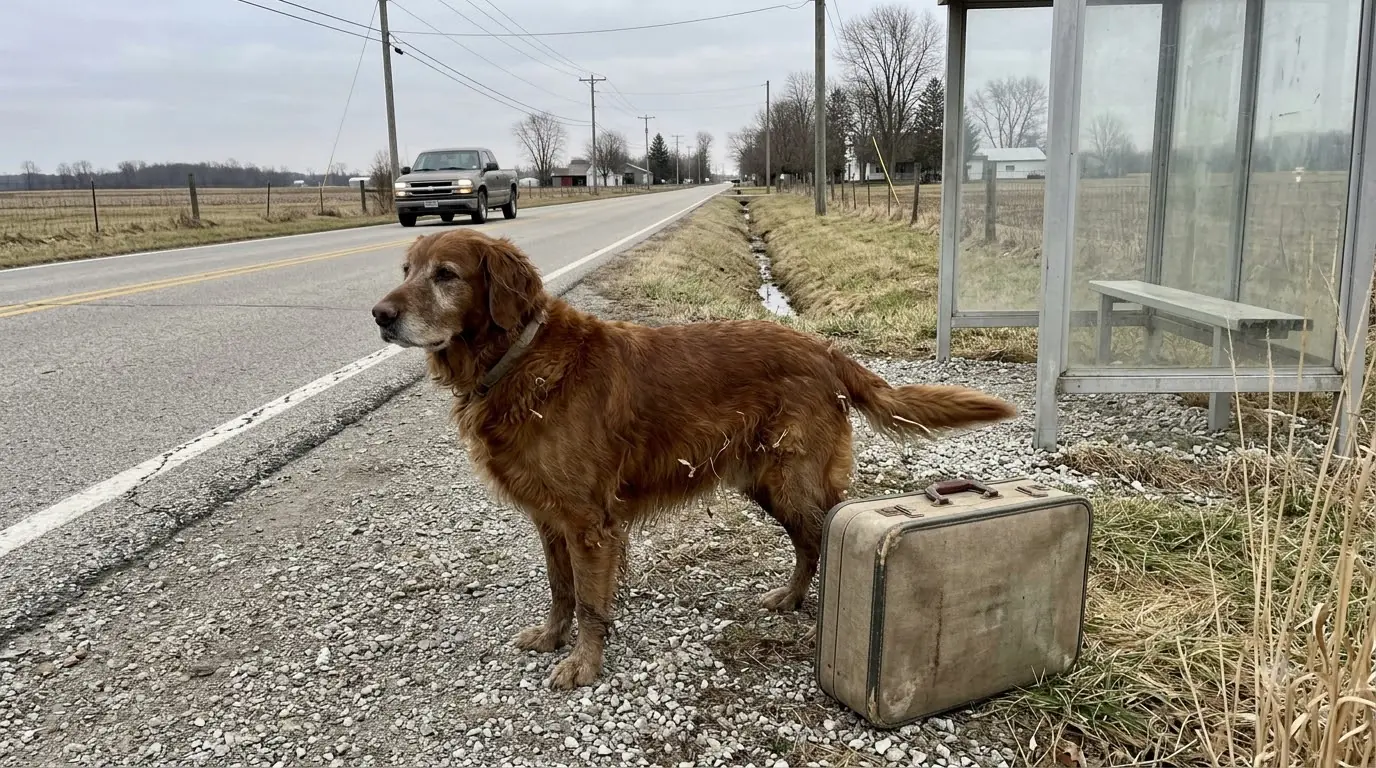
Rusty was lying beside an old suitcase when he was first noticed at a rural bus stop.
There was no person waiting with him.
There was no leash attached to the bench or nearby sign.
The suitcase itself was worn and empty.
But Rusty stayed close to it.
The 7-year-old Golden Retriever mix would occasionally stand and sniff the surrounding grass, yet he never traveled far. When a vehicle approached and began slowing along the road, his behavior changed immediately.
Rusty stood.
His head lifted.
His tail began to wag.
For several seconds, he stared toward the vehicle.
Then it continued down the road.
Rusty watched it disappear before returning to the suitcase.
He sniffed it again, circled once, and curled up beside it.
The pattern repeated often enough that the person who first noticed him became concerned.
We cannot know what Rusty expected when those vehicles approached.
We also cannot verify that the suitcase belonged to someone connected to him. Although the scene naturally suggested many possible stories, rescue work requires us to separate what we observe from what we imagine.
What we knew was simple.
An adult dog was alone beside a rural road, he remained unusually attached to one location, and he needed help.
Approaching Rusty Carefully
A local animal-control officer responded after receiving the report.
Rusty did not run when the vehicle arrived.
Instead, he stood beside the suitcase and watched.
His tail moved slowly, but the rest of his body remained cautious. His weight shifted backward when the officer approached directly.
Rather than reaching immediately for his collar, the officer stopped several feet away and turned slightly sideways.
Rusty sniffed the air.
A few treats were tossed onto the ground between them.
He ate the first one after a short hesitation.
Then another.
Gradually, he stepped closer.
The officer was eventually able to secure him safely with a slip lead.
Rusty did something noticeable when they began walking toward the vehicle.
He looked back at the suitcase.
The officer paused.
Rusty turned toward it and sniffed it once more.
Because the suitcase was empty and there was no identifying information inside, it could not tell us where Rusty had come from.
There was also no way to determine how long he had been beside it.
Rusty was transported to our facility for intake and medical evaluation.
His First Hours at the Shelter
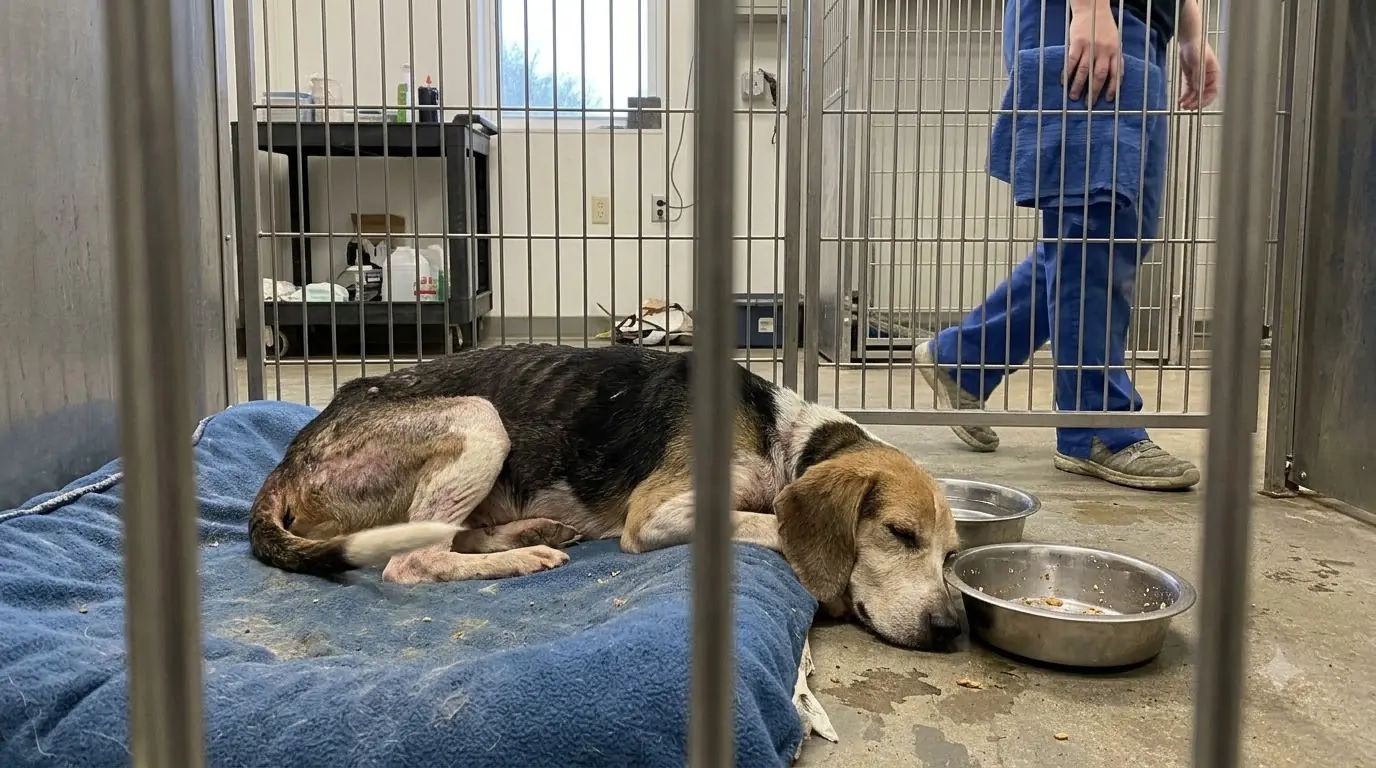
Rusty arrived tired.
He walked independently from the transport vehicle but moved slowly.
His coat had the recognizable golden coloring associated with his breed mix, although it was dusty and somewhat dull.
His body condition was below ideal.
His ribs were easier to feel than expected, and there was reduced muscle over his hindquarters.
He was not critically emaciated.
Still, he was thinner than a healthy adult dog of his frame should have been.
Rusty drank water soon after settling into his kennel.
Staff prevented him from gulping an excessive amount at once and continued monitoring his hydration.
Food was offered after he had time to decompress.
He sniffed the bowl immediately.
Then he looked toward the kennel door.
After several seconds, he returned to the food and began eating.
He did not finish everything.
That first meal was documented carefully.
Rusty Was Friendly, but That Did Not Mean He Was Relaxed
Rusty tolerated handling remarkably well during intake.
He sniffed staff members and accepted treats.
After several calm interactions, he allowed gentle contact around his shoulders and chest.
His tail sometimes wagged when someone approached.
But we did not interpret those behaviors as evidence that he was emotionally comfortable.
A wagging tail can occur in many emotional states.
Rusty also showed signs of uncertainty.
He frequently watched doors.
Sudden noises made him lift his head.
When footsteps moved away, he sometimes stood and followed them with his eyes.
He also hesitated when entering unfamiliar rooms.
Staff gave him time.
No one forced unnecessary social contact.
Rusty could approach when he was ready.
His First Veterinary Examination
The veterinary team performed a complete physical examination.
Rusty was mildly dehydrated.
His gums were slightly tacky, and his overall condition suggested he had not been maintaining ideal fluid intake recently.
His heart and lungs were assessed carefully.
No immediate cardiopulmonary emergency was identified.
His eyes were clear.
His ears had mild debris but no severe infection.
His mouth contained moderate dental tartar and some gingival inflammation. Dental care would be recommended, although nothing seen during the initial examination appeared to explain his entire physical condition.
His abdomen was soft and did not produce an obvious painful response.
The veterinarian examined his skin and coat.
Rusty had mild skin dryness and several small superficial areas of irritation, but there were no major open wounds.
His paw pads were more concerning.
They were dry and irritated, with evidence consistent with spending substantial time walking or resting on rough outdoor surfaces.
There were no deep lacerations requiring surgical repair.
The paws could be managed conservatively with cleaning, protection, rest, and monitoring.
Then the veterinarian watched Rusty walk.
That was when another concern became clearer.
Rusty Was Stiff Behind
Rusty could bear weight on all four legs.
He was not dragging a limb.
He did not have an obvious acute fracture.
But his hind-end movement was stiff.
The first several steps after resting were particularly slow.
His hips appeared less flexible than expected, and his hind-limb muscle condition was reduced.
At seven years old, Rusty was entering an age when chronic orthopedic problems become increasingly common.
Still, age alone is never an adequate diagnosis.
The veterinary team palpated his spine, hips, knees, and other joints.
Rusty showed mild discomfort during manipulation of his hips.
Orthopedic imaging was recommended once he was adequately hydrated and settled.
Baseline Diagnostic Testing
Because Rusty's previous medical history was unknown, we began with baseline laboratory testing.
A complete blood count evaluated his red blood cells, white blood cells, and platelets.
A serum chemistry panel helped assess kidney and liver function, blood glucose, proteins, and electrolytes.
His results did not indicate severe anemia, acute kidney failure, or another obvious life-threatening systemic illness.
There were mild changes consistent with dehydration, which improved with appropriate fluid support.
Urinalysis was also performed.
Nothing in the initial urine results suggested a major urinary emergency.
A fecal sample was screened for intestinal parasites.
Rusty tested positive for hookworms.
Hookworms are intestinal parasites that can contribute to gastrointestinal problems, blood loss, poor body condition, and weakness, depending on the severity of infection.
Rusty was not severely anemic, which was reassuring.
However, the infection still required treatment.
He was started on an appropriate deworming protocol, with follow-up testing planned because parasite treatment should be confirmed rather than assumed successful.
Another Test Changed Rusty’s Immediate Plan
Because Rusty had been found outdoors in a region where mosquito exposure is a concern and his preventive history was unknown, heartworm screening was included in his intake workup.
Rusty tested positive.
That result became the most significant medical concern identified during his initial evaluation.
Heartworm disease is caused by parasitic worms transmitted through mosquito bites. Adult worms can live in the pulmonary arteries and, in more advanced disease, affect the heart and lungs.
A positive screening test does not by itself tell us exactly how advanced a dog's disease is.
Further evaluation was necessary.
Rusty was not coughing persistently.
He was not struggling to breathe.
He had not collapsed.
Those were encouraging observations, but they did not make the infection harmless.
Dogs with heartworm disease can appear relatively normal while still requiring careful treatment.
Confirming and Staging the Disease
The veterinary team performed additional testing to confirm the diagnosis and evaluate Rusty's condition before treatment.
A second method was used as appropriate to support the positive heartworm finding.
Thoracic radiographs were obtained to examine his heart and lungs.
The images showed changes compatible with heartworm infection but did not indicate the most advanced form of disease.
There was no evidence that Rusty was currently in caval syndrome, a severe and life-threatening complication requiring emergency intervention.
That was important.
It meant Rusty could be managed through a standard veterinary heartworm-treatment protocol tailored to his clinical condition.
But treatment would take time.
And one of the most difficult parts for Rusty would be something that sounds simple:
He needed to stay calm.
Why Exercise Restriction Matters
Dogs undergoing heartworm treatment cannot simply continue normal unrestricted activity.
As adult worms die during treatment, fragments can cause inflammation and obstruction within pulmonary blood vessels.
Heavy exercise increases blood flow and can increase the risk of serious complications.
Rusty's activity therefore had to be restricted.
That meant leash walks only for necessary bathroom breaks.
No running.
No vigorous play.
No long exploratory walks.
No chasing toys across the yard.
For a Golden Retriever mix who was becoming more interested in his surroundings as he felt better, that restriction required careful management.
We needed to support his emotional welfare without compromising his physical safety.
Beginning Heartworm Treatment
Rusty's treatment followed veterinary recommendations for heartworm-positive dogs.
He was started on an appropriate heartworm preventive to address susceptible stages of the parasite and prevent new infections.
His veterinarian also prescribed doxycycline as part of the treatment protocol. This medication targets Wolbachia bacteria associated with heartworms and is commonly incorporated into modern heartworm management.
Anti-inflammatory medication was used when medically appropriate according to his individual treatment stage and veterinary assessment.
The adulticide phase would come later.
This staged approach was deliberate.
Heartworm treatment is not a single injection followed by immediate recovery.
It requires preparation, carefully timed medication, exercise restriction, observation, and follow-up testing.
The Suitcase Was Gone, but the Waiting Continued
Rusty did not have the suitcase at the shelter.
It remained part of the location where he had been found, and there was no medical or behavioral reason to transport an old roadside object into the facility.
But some of Rusty's behaviors followed him.
Whenever a vehicle door closed outside, he listened.
When staff members passed his kennel, he often stood.
If someone slowed near his door, his tail began moving.
If they continued walking, Rusty watched them disappear.
He rarely barked after them.
Instead, he eventually returned to his bed.
We could not know whether this behavior was related to whatever had happened at the bus stop.
It might simply have reflected his interest in people and movement.
We did not assign a story to it.
We responded to the behavior we could see.
Building a Predictable Routine
Rusty's days became intentionally predictable.
Morning bathroom break.
Breakfast.
Medication.
Rest.
Brief controlled outing.
More rest.
Enrichment that did not require vigorous activity.
Dinner.
Another short bathroom break.
Quiet overnight period.
Predictability seemed to help.
Rusty began resting more deeply between activities.
Instead of standing every time someone moved through the hallway, he sometimes remained on his bed and simply watched.
That was useful because rest was medically important.
Helping Him Gain Weight Safely
Rusty's thin body condition needed improvement, but heartworm disease and hookworm infection meant nutrition had to be handled thoughtfully.
He was given a complete, balanced diet in measured portions.
Rather than dramatically overfeeding him, we aimed for gradual weight gain.
His appetite improved after his first several days.
The hookworm treatment likely helped as his gastrointestinal health stabilized, although we could not attribute every improvement to one intervention.
His stools were monitored closely.
Initially, they were somewhat inconsistent.
Over time, they became better formed.
Follow-up fecal testing was scheduled to ensure the parasite infection had cleared.
Rusty's weight began increasing slowly.
That was exactly what we wanted.
His Paw Pads Improved
The irritation on Rusty's paw pads responded well to conservative care.
His feet were kept clean and dry.
Long walks on rough surfaces were avoided.
Fortunately, his heartworm exercise restriction also meant he was not spending prolonged periods walking on abrasive ground.
The superficial irritation gradually improved.
There was no evidence of deep infection.
Rusty stopped licking his feet as frequently.
The Hip Stiffness Needed Its Own Answer
Once Rusty was medically stable enough for additional imaging, radiographs of his hips were obtained.
They showed degenerative changes consistent with osteoarthritis.
No acute fracture was identified.
The diagnosis explained much of the stiffness staff had observed after rest.
Rusty's reduced hind-limb muscle mass may also have contributed to his movement pattern.
Normally, controlled exercise and strengthening would form an important part of osteoarthritis management.
Heartworm treatment complicated that plan.
For now, vigorous rehabilitation had to wait.
His veterinarian developed a conservative pain-management strategy compatible with his overall medical treatment.
Supportive bedding and good traction were also important.
The Hardest Part Was Keeping Rusty Quiet
As Rusty began feeling better, exercise restriction became more challenging.
He wanted to sniff farther down the walkway.
He became interested in toys.
When a familiar staff member appeared, his tail wagged more energetically.
Those were encouraging behavioral signs.
But we could not allow enthusiasm to override medical safety.
Instead of physical exercise, Rusty received calm enrichment.
Food puzzles that required little movement were useful.
So were scent-based activities performed in a controlled space.
Staff sometimes placed a few pieces of his measured food in a folded towel so he could use his nose to find them.
The activities were intentionally simple.
The goal was mental engagement without significant exertion.
Rusty Began Seeking People
During his first week, Rusty mostly accepted attention.
Later, he started requesting it.
He approached the kennel door when familiar caregivers arrived.
If they entered and sat quietly, Rusty often moved closer.
He liked chest scratches.
He sometimes rested his chin against a person's knee.
But staff remained careful not to confuse affection with complete emotional recovery.
Rusty still startled at unfamiliar noises.
He still watched exterior doors.
He still became alert when vehicles stopped nearby.
Trust and stress can exist in the same dog at the same time.
His First Adulticide Treatment
After the appropriate preparation period, Rusty reached the adulticide phase of heartworm treatment.
The medication used to kill adult heartworms must be administered under veterinary supervision.
Rusty received the first injection according to the recommended treatment protocol.
Pain management and monitoring were provided.
He was watched carefully for respiratory changes, fever, excessive lethargy, significant coughing, or other complications.
The injection itself can cause soreness.
Rusty was uncomfortable afterward and rested more than usual.
Staff minimized handling and allowed him to choose a comfortable position.
His appetite was slightly reduced that evening but improved the following day.
Most importantly, he did not develop acute respiratory distress.
Rest Became Even More Important
Exercise restriction after adulticide treatment is critical.
Rusty's outdoor trips became strictly functional.
He walked out on leash.
He eliminated.
He sniffed briefly within the allowed area.
Then he returned indoors.
No matter how much he wanted to continue, his activity remained limited.
This period can be difficult for caregivers because the dog may appear healthier before it is medically safe to resume normal activity.
Rusty sometimes stood at the exit and looked outside after his bathroom break.
Staff gently redirected him indoors.
Safety had to come before distance.
A Temporary Setback
About a week after treatment, Rusty developed a mild intermittent cough.
Because coughing during heartworm treatment can signal pulmonary inflammation or complications, the veterinary team evaluated him promptly.
His breathing rate was monitored.
He remained alert.
His gums maintained healthy coloration.
He was not showing labored breathing or collapse.
The veterinarian determined that the cough was compatible with inflammatory changes that can occur during treatment, but Rusty required closer monitoring and adjustment of supportive medication.
His activity remained strictly restricted.
Over the following days, the cough decreased.
We did not treat that improvement as permission to increase exercise.
The dangerous period does not end simply because a symptom disappears.
Completing the Injection Series
After the prescribed interval, Rusty returned for the remaining adulticide injections in the treatment series.
Again, he was monitored carefully.
Again, rest was essential.
He experienced expected soreness but remained clinically stable.
The staff caring for him became very familiar with his quiet routine.
Rusty would eat.
Take his medications.
Walk outside briefly.
Return to his bed.
Listen to hallway activity.
Sleep.
It was not an exciting recovery.
That was exactly what we wanted.
Foster Care Became the Better Option
Once Rusty had passed the period when continuous shelter medical observation was most important, we considered whether a foster home could provide a calmer recovery environment.
A carefully selected foster caregiver agreed to continue his exercise restriction and medication schedule.
The home had few stairs and good traction.
A comfortable bed was placed in a quiet part of the living room.
Rusty's foster caregiver received detailed instructions.
No running.
No off-leash yard time.
No excited greetings.
No long walks because he seemed eager.
No exceptions simply because he looked better.
Rusty’s First Night in Foster Care
Rusty entered the home and immediately began sniffing.
The front door interested him.
So did the rug.
Then the couch.
Then the kitchen.
His foster caregiver kept the exploration slow and controlled.
After several minutes, Rusty found his bed.
He circled once.
Then he lay down.
A vehicle passed outside.
Rusty's head came up.
He listened.
The vehicle continued.
For several seconds, he watched the window.
Then he lowered his head again.
The behavior reminded everyone of the rural bus stop.
But this time, Rusty was indoors.
He was warm.
He had water.
His medications were scheduled.
And someone was staying with him.
Eating and Drinking at Home
Rusty's appetite remained good in foster care.
His meals were measured to support gradual weight gain without allowing him to become overweight.
That balance was particularly important because extra weight would place unnecessary stress on his arthritic hips.
He drank normally.
There was no persistent vomiting or diarrhea.
His bowel movements remained formed after his parasite treatment.
A follow-up fecal examination confirmed that the hookworm infection had responded appropriately to treatment.
His weight continued moving toward a healthier range.
Bathroom Habits
Rusty quickly adapted to the household bathroom routine.
He appeared familiar with eliminating outdoors.
His foster caregiver still offered frequent scheduled breaks rather than assuming he would immediately communicate his needs in a new environment.
There were no persistent urinary problems.
His stools remained consistent.
Because outdoor trips had to stay brief, the foster caregiver learned Rusty's preferred bathroom area and took him there directly.
Rusty often wanted to continue sniffing afterward.
For the time being, he could not.
Sleep Changed First
One of the earliest changes in foster care involved sleep.
At the shelter, Rusty frequently lifted his head when people passed.
At home, he gradually stopped responding to every sound.
He began sleeping on his side.
Sometimes his legs stretched completely away from his body.
His foster caregiver could walk through the room without waking him.
That level of relaxation took time.
It also mattered.
A dog recovering from heartworm treatment needed rest, and Rusty was finally getting plenty of it.
His Relationship With the Front Door
Rusty remained fascinated by the front door.
When a vehicle slowed outside, he sometimes stood.
If someone arrived, he watched carefully.
His tail might begin wagging.
During the first weeks, his foster caregiver prevented highly excited greetings because of the exercise restriction.
Visitors were asked to enter calmly.
Rusty was allowed to approach at his own pace.
Over time, he stopped standing for every vehicle.
Some passed without more than an ear twitch.
Others still brought his head up.
We did not try to eliminate the behavior.
We simply allowed him to learn the new environment.
Managing His Arthritis During Heartworm Recovery
Rusty's hips remained stiff after long periods of sleep.
His osteoarthritis did not disappear as his other medical conditions improved.
For the moment, management focused on comfort.
Supportive bedding reduced pressure on his joints.
Rugs helped prevent slipping.
His body weight was kept within a healthy range.
Veterinary-prescribed pain management continued as appropriate.
More active strengthening exercises would be considered only after his heartworm team determined that normal activity could safely resume.
This required patience.
Treating one condition sometimes means temporarily modifying the ideal treatment for another.
Follow-Up Heartworm Care
Heartworm treatment does not end with the final adulticide injection.
Rusty continued his prescribed preventive medication.
His activity remained restricted for the period recommended by his veterinarian.
Follow-up testing would be necessary months later to evaluate treatment success.
A dog can look completely normal before that testing occurs.
Rusty's caregivers understood that outward appearance could not replace medical confirmation.
He would continue to need heartworm prevention throughout his life.
Gradually Returning to Activity
Once Rusty's veterinarian determined that the highest-risk recovery period had passed, activity was reintroduced gradually.
The first changes were small.
A slightly longer leash walk.
A few additional minutes of sniffing.
More time moving around the house.
No sudden return to strenuous exercise.
His breathing was monitored.
His stamina was observed.
His hips were also considered.
After months of restricted activity, Rusty needed conditioning just as much as freedom.
He could not safely move from near-rest directly into long hikes or running.
Rebuilding Muscle
As Rusty's permitted activity increased, his hindquarters slowly became stronger.
Short controlled walks supported muscle development without overwhelming his arthritic joints.
He remained enthusiastic about sniffing.
His nose often determined the pace.
A patch of grass could occupy him for several minutes.
That was perfectly acceptable.
For an older Golden Retriever mix recovering from heartworm disease, exercise did not need to look impressive.
It needed to be sustainable.
A Healthier Body Condition
By this point, Rusty's appearance had changed noticeably.
His coat looked better.
His body had filled out.
His ribs could still be felt without excessive pressure, but they were no longer prominent.
His hindquarters had begun regaining muscle.
His paw pads had healed.
He ate reliably.
His hydration remained normal.
These were meaningful improvements.
But the most important progress could not be judged from a photograph.
Rusty had completed a difficult phase of heartworm treatment without a major life-threatening complication.
The Emotional Recovery Was Harder to Measure
There is no blood test for trust.
There is no radiograph showing whether a dog expects someone to return.
Rusty's behavioral progress had to be measured through ordinary moments.
He began sleeping while his foster caregiver left the room.
He stopped getting up for many of the vehicles passing outside.
He started bringing a soft toy to his bed.
He followed his caregiver into the kitchen, then returned to the living room without needing to keep the person constantly in sight.
He began choosing where he wanted to rest rather than always positioning himself toward an exit.
None of those behaviors told us exactly what Rusty remembered about the bus stop.
They did tell us that he was becoming comfortable in the life he had now.
The Suitcase Remains an Unanswered Part of His Story
People naturally ask about the suitcase.
We understand why.
A dog waiting beside an empty suitcase at a rural bus stop creates an image that is difficult to forget.
But we cannot responsibly claim that someone deliberately left Rusty there with it.
We cannot prove the suitcase belonged to his previous family.
We cannot say Rusty was waiting for a particular person.
We cannot know whether he had been there for hours or longer before he was noticed.
His past remains incomplete.
Rusty does not need us to invent the missing pieces.
What happened after he was found is documented.
That is the part of his story we can tell with confidence.
Preparing Rusty for Adoption
As Rusty's recovery advanced, our team began considering permanent placement.
His future family would receive his complete medical information.
They would know about his heartworm treatment.
They would understand the importance of year-round prevention and follow-up testing.
They would also know about his hip osteoarthritis.
Rusty would benefit from maintaining a lean body condition, regular appropriate exercise, good traction at home, comfortable bedding, and veterinary monitoring as he ages.
His activity level would need to respect both his age and his joints.
He could enjoy walks.
He could explore.
He could play.
But he did not need to become an endurance athlete.
The Home Rusty Needs
Rusty has shown us that he enjoys people.
He likes calm affection.
He enjoys using his nose.
He appreciates a predictable routine.
He can become excited by arrivals, although that response has become more manageable as he settles.
Potential resident pets would require appropriate introductions based on compatibility.
His future family should also understand that changing homes may temporarily bring back some of his vigilance.
He may watch the door.
He may sleep lightly.
He may follow people.
Adjustment does not always move forward in a straight line.
Patience will matter.
Rusty Today
Rusty is no longer the thin dog lying beside an empty suitcase.
His hookworm infection has been treated and appropriately followed.
His irritated paws have healed.
His hydration and nutrition have improved.
His weight has moved into a healthier range.
His osteoarthritis is being managed rather than ignored.
Most importantly, he has progressed through heartworm treatment under veterinary supervision and continues the required follow-up plan.
His care is not finished.
Heartworm follow-up testing remains important.
Year-round prevention will remain essential.
His arthritis will require lifelong attention.
As he gets older, his medical needs may change.
But Rusty is stable, comfortable, eating well, and gradually returning to an appropriate level of normal activity.
He still notices vehicles.
Every so often, one slows outside the foster home and Rusty raises his head.
Sometimes he stands.
His tail may even begin to move.
Then the vehicle continues.
Rusty watches for a moment.
But he no longer has an old suitcase to return to.
Instead, he turns away from the window.
His foster caregiver may be sitting nearby.
His water bowl is in the same place it was yesterday.
His bed is waiting in the corner.
Dinner will arrive at the usual time.
Rusty walks back across the room.
Sometimes he circles his bed once before lying down.
Then he stretches out and closes his eyes.
We may never know why Rusty stayed beside that suitcase or what he thought each time a vehicle slowed near the rural bus stop.
We do know what happened when one vehicle finally stopped for him.
This time, someone opened the door.
This time, Rusty climbed inside.
And this time, the vehicle did not leave him behind.