Rescuers Found a Senior Dog Returning to the Same Park Bench Every Night
Reader Theme:
Font Size:
24px
The Dog Who Always Came Back
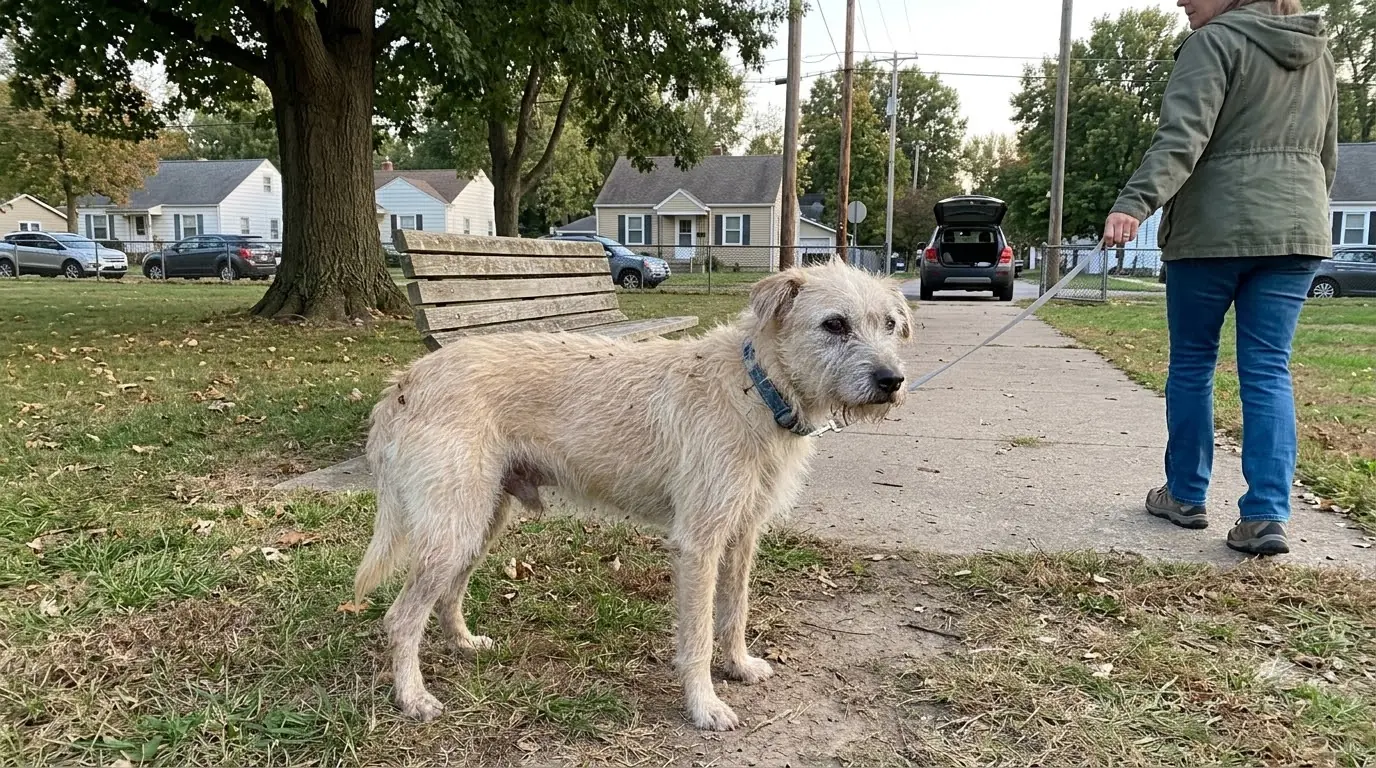
Benny first became familiar to people living near a neighborhood park because of his routine.
He appeared most mornings somewhere near the walking paths, grassy areas, or parking edge.
Sometimes he moved slowly between trees.
Sometimes he rested beneath a picnic table.
People occasionally offered him food and water.
He accepted both cautiously.
But before sunset, Benny almost always returned to the same wooden bench.
The bench sat near one of the quieter sides of the park.
There was nothing obvious about it.
No food bowl.
No shelter.
No blanket.
Nothing that explained why an older Terrier mix would keep returning there.
People began noticing the pattern.
A dog wandering randomly might sleep in different places.
Benny did not.
Whatever he did during the day, the bench remained his evening destination.
Nobody knew why.
And because nobody had witnessed Benny’s life before those days in the park, we could not responsibly invent an explanation.
Maybe the location was simply familiar.
Maybe it felt sheltered.
Maybe a person he had known had once spent time there.
Maybe none of those things were true.
The rescue could only work with what was observable.
Benny was alone.
He looked tired.
And he was beginning to limp.
A Slow Approach
A rescue volunteer began visiting the park around the same time each day.
She did not walk directly toward Benny.
She sat at a distance.
Sometimes she left a few pieces of food nearby and backed away.
Benny watched.
The first day, he would not come close.
The second day, he shortened the distance.
By the third, he was willing to eat while she remained in sight.
There was no dramatic breakthrough.
There was simply repetition.
Same person.
Same calm voice.
Same slow movements.
No chasing.
No cornering.
No reaching before Benny was ready.
For an older dog who appeared uncomfortable physically, minimizing stress was especially important.
Pain can make any animal more cautious.
A dog who normally tolerates handling may react differently when a joint hurts or a tooth is painful.
The volunteer treated Benny’s hesitation as communication rather than stubbornness.
That approach eventually worked.
The Day He Allowed the Leash
When Benny finally came close enough, the volunteer let him sniff her hand.
He did.
Then he stepped back.
She waited.
A few minutes later, Benny returned.
This time, she gently touched the side of his neck.
He remained still.
The volunteer noticed a worn collar beneath the dirt in his coat.
There was no readable identification attached.
She slowly clipped a leash to it.
Benny did not resist.
For a moment, he simply stood beside her.
Then they started walking toward the vehicle.
His gait was uneven.
The limp was more noticeable now that he was moving several yards at a time.
He favored one front leg and took shorter steps with the other.
The volunteer slowed her pace.
Benny followed.
Then, several yards from the bench, he stopped.
He turned his head.
He looked back.
The volunteer did not pull the leash.
She stood with him.
Benny remained still for several seconds.
Then he looked toward her again.
She took one step forward.
Benny followed.
That was the last time he returned to the bench.
His First Night Away From the Park
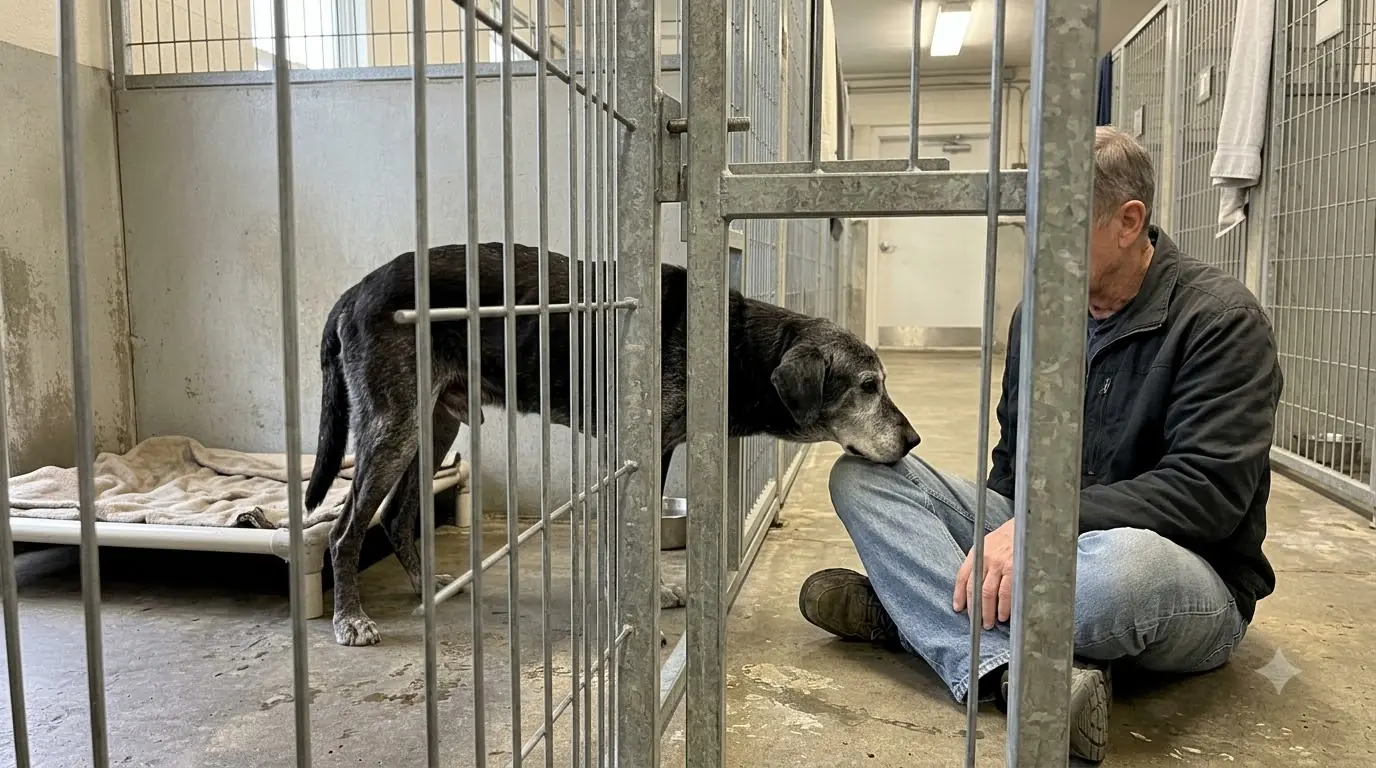
Benny spent his first night in a quiet foster setting rather than a busy kennel environment.
Given his age and stiffness, the rescue wanted him somewhere warm and low-stress while his medical evaluation was arranged.
He explored slowly.
He sniffed the edges of the room.
He investigated the water bowl.
Then he selected a padded bed near the wall.
He did not pace.
He did not bark continuously.
He appeared exhausted.
His foster caregiver offered a small meal.
Benny ate most of it.
He drank normally.
Then he curled into the bed and slept.
That first sleep lasted several hours.
When he woke, he accepted a short bathroom break outside.
He urinated normally.
His bowel movement was formed.
Then he returned indoors and went directly back to the bed.
The routine was simple.
Food.
Water.
Warmth.
Rest.
For Benny, that was enough for the first night.
The Initial Veterinary Examination
The next day, Benny was taken to a veterinary clinic for a complete examination.
Based on his teeth, body condition, and overall appearance, his estimated age of about 9 years seemed reasonable.
His Terrier-type coat was dirty and tangled in several areas.
His nails were overgrown enough to affect how comfortably he placed his feet.
His body condition was slightly below ideal, but he was not critically thin.
His heart and lungs sounded stable.
His temperature was normal.
His abdomen was soft.
No immediate internal emergency was apparent.
The orthopedic exam required more patience.
Benny became tense when his front limbs were manipulated.
He did not snap.
He simply tried to pull away.
The veterinarian paused and allowed him to settle.
Once the exam resumed, the team identified discomfort in both elbows, more pronounced on the side Benny had been favoring.
There was also stiffness through his shoulders.
Because of his age and chronic-looking gait changes, radiographs were recommended.
The Teeth Told Another Story
Benny’s mouth also needed attention.
He had moderate to advanced dental disease.
Several teeth were coated in heavy tartar.
His gums were inflamed.
One premolar appeared especially concerning because of gum recession and possible disease below the gumline.
Dental disease is common in older dogs, but it is not harmless.
It can cause chronic pain.
Dogs often continue eating despite painful teeth, so a good appetite does not prove the mouth is comfortable.
Benny would likely need a professional dental cleaning under anesthesia, along with dental radiographs and possible extractions depending on what was found.
Before that could happen, however, the veterinary team wanted to complete bloodwork and investigate another finding.
A Small Mass Near His Shoulder
During the skin and body examination, the veterinarian found a small, firm lump near Benny’s shoulder.
It was beneath the skin and did not appear ulcerated.
Benny did not react strongly when it was touched.
The mass was not large.
It was also not something that could be diagnosed by appearance alone.
Many older dogs develop benign fatty masses, cysts, or other harmless lumps.
Some masses, however, can represent tumors that require further treatment.
The rescue did not label the lump as cancer.
That would have been premature.
Instead, the veterinarian recommended sampling the mass with a fine-needle aspirate.
Cells collected from the lump could then be examined to determine whether the lesion appeared benign or required more investigation.
Bloodwork Before Treatment
Because Benny was a senior dog and might need anesthesia for dental care, baseline bloodwork was important.
His complete blood count and chemistry panel were generally reassuring.
There were mild age-related changes but no major liver or kidney abnormalities that prevented moving forward with treatment planning.
His hydration was adequate.
His red blood cell count was acceptable.
No significant infection was identified through routine bloodwork.
Those results gave the veterinary team more flexibility.
It meant pain control could be started appropriately.
It also meant dental anesthesia could be considered after the rest of Benny’s medical picture became clearer.
Why Benny Was Limping
Radiographs of Benny’s elbows and shoulders showed chronic degenerative joint changes consistent with osteoarthritis.
There was no acute fracture.
There was no dislocation.
The findings fit what the team had observed.
Benny’s limp was not caused by one dramatic new injury.
It was more likely the visible result of chronic joint disease that had become uncomfortable enough to change his gait.
That diagnosis made sense for a 9-year-old dog.
It also meant there was no one-time procedure that would permanently “fix” the problem.
Arthritis is managed.
It is not simply erased.
Benny’s treatment plan included veterinarian-prescribed pain medication, controlled low-impact activity, maintaining an appropriate body weight, and environmental changes to make movement easier.
The Mass Result
The fine-needle aspirate from Benny’s shoulder was encouraging.
The sampled cells were most consistent with a benign lipoma, or fatty mass.
That meant immediate surgery was not considered necessary.
The mass would still need monitoring.
If it grew rapidly, became firm, changed shape, interfered with movement, or developed other concerning features, the veterinarian would reassess it.
For now, it was recorded in Benny’s medical chart and measured so future changes could be compared objectively.
That was good news.
The more pressing problems remained his joints and mouth.
Starting Pain Management
Benny was started on a veterinarian-directed pain management plan for osteoarthritis.
Within several days, his foster caregiver noticed small but important changes.
He stood up more easily after sleeping.
He hesitated less before stepping outside.
His limp did not disappear completely, but his stride became more even.
He also became more willing to explore.
That improvement did not mean unrestricted exercise was appropriate.
Older arthritic dogs often benefit from regular movement, but too much activity can increase soreness.
Benny’s walks were kept short.
Flat ground was preferred.
Long staircases were avoided.
Inside the foster home, rugs were placed over slippery flooring so his feet had better traction.
His bed was thick and supportive.
His Nails Matter Too
Benny’s overgrown nails were trimmed gradually.
Because the quick can extend farther into chronically overgrown nails, cutting them very short in a single session can cause pain and bleeding.
The team took a conservative approach.
Small amounts were trimmed at a time.
Follow-up trims were scheduled as the quick gradually receded.
This helped improve how Benny placed his feet.
For an arthritic dog, even small changes in posture and traction can affect comfort.
The goal was not cosmetic grooming.
It was function.
Dental Treatment
Once Benny had settled into foster care and his medical evaluation was complete, the veterinary team scheduled his dental procedure.
He was placed under general anesthesia with appropriate monitoring.
Dental radiographs were taken because disease below the gumline cannot always be seen during a basic mouth exam.
Several teeth had advanced periodontal disease.
The most affected teeth could not be comfortably saved and were extracted.
The remaining teeth were professionally cleaned and polished.
Benny recovered uneventfully from anesthesia.
His pain was managed.
He was offered soft food during the early recovery period.
By the following day, his appetite remained good.
Eating After Dental Care
People sometimes assume a dog will struggle greatly after losing several diseased teeth.
In Benny’s case, the opposite happened.
Once the painful teeth were gone and his mouth had time to heal, he appeared more comfortable eating.
He approached his bowl more eagerly.
He chewed without repeatedly pausing.
His foster caregiver noticed that he no longer dropped pieces of food as often.
His diet returned gradually to his normal complete and balanced food once the veterinary team cleared him.
His weight began moving toward a healthier range.
That weight gain was modest and controlled.
For an arthritic dog, becoming overweight would have made mobility harder.
The First Signs of Personality
During his first week, Benny had seemed quiet enough that people wondered whether he simply had a very reserved temperament.
Then he started feeling better.
His personality appeared.
He liked following his foster caregiver into the kitchen.
He liked sitting in patches of sunlight.
He became interested in small food puzzles.
He carried soft toys from one room to another but rarely played vigorously with them.
He was especially fond of one old fleece blanket.
If it was moved, Benny eventually found it.
He would circle twice, settle down, and sigh.
That became one of his predictable habits.
What the Bench May Have Meant
People continued asking about the park bench.
Why had Benny returned to it every evening?
We still could not answer.
Nothing in his veterinary examination provided an explanation.
No owner had been verified from the information available to the rescue.
The worn collar did not contain a readable tag.
His behavior around the bench was meaningful because it was consistent.
But consistency is not proof.
We could not claim Benny had been waiting for a particular person.
We could not say he had been abandoned there.
We could not say the bench was the last place he saw someone he loved.
Those stories would be emotionally powerful.
They would also be speculation.
The most honest answer remained the simplest one.
Benny chose that bench.
We do not know why.
Adjusting to Foster Care
Benny adapted to indoor life more quickly than expected.
He was house-trained or at least had enough prior experience with indoor routines to understand bathroom schedules almost immediately.
He rarely had accidents.
He slept through most nights.
He did not show destructive behavior.
When left alone for short periods, he generally slept.
That did not prove he had recently lived in a home.
It only told us that he was comfortable with many household routines.
He also preferred predictable timing.
Breakfast.
Morning bathroom break.
Rest.
Short afternoon walk.
Dinner.
Evening outing.
Sleep.
Benny seemed happiest when the day made sense.
His Bathroom Habits and Mobility
Benny urinated normally.
His bowel movements remained regular.
That mattered because senior dogs can sometimes struggle to posture comfortably if hips, knees, or elbows are painful.
Benny could squat and rise without assistance once his pain was better controlled.
He still moved slowly.
His foster caregiver gave him time.
Nobody rushed him through bathroom breaks.
On colder mornings, he often appeared stiffer.
The first several steps were short.
Then his movement improved.
That pattern was consistent with chronic arthritis.
If his mobility worsened suddenly, the team knew he would need another examination rather than simply assuming “old age.”
A Small Setback
Several weeks into foster care, Benny had one evening when his limp became more pronounced.
Earlier that day, he had become excited and walked farther than usual during an outing.
There had been no fall.
There was no obvious injury.
Still, the increased soreness was noticeable.
His foster caregiver contacted the veterinary team.
The recommendation was to reduce activity temporarily and monitor him closely.
Within a few days, Benny returned to his baseline.
The episode reinforced a key part of senior-dog care.
Feeling better does not mean chronic joint disease has disappeared.
Activity needs to remain appropriate.
Building Strength Without Overdoing It
Benny’s exercise plan gradually became more structured.
Short, consistent walks were better than occasional long outings.
He was encouraged to move regularly enough to maintain muscle but not to the point of worsening pain.
His foster caregiver avoided steep hills.
They selected quieter paths.
Benny was allowed to stop and sniff.
That worked well for him.
He did not need fast exercise.
He needed movement he could comfortably sustain.
Over time, his hindquarters and shoulders gained a little more muscle.
His stamina improved.
His posture became more confident.
Meeting New People
Benny was not instantly social with everyone.
He liked familiar people.
With strangers, he preferred a slower introduction.
He typically stood several feet away and watched.
If the person ignored him initially, Benny often approached on his own.
If someone leaned directly over him or reached quickly toward his head, he sometimes stepped back.
His foster caregiver asked visitors to let Benny choose.
That strategy worked.
After several minutes, he would usually sniff a hand or pant leg.
Sometimes he accepted gentle chest scratches.
Other times he simply remained nearby.
Both responses were respected.
Senior Dogs Still Need Enrichment
Because Benny could not safely handle intense physical activity, mental enrichment became especially useful.
He enjoyed simple scent games.
Food was hidden under lightweight cups.
Treats were placed inside folded towels.
He was given slow-feeding toys that required problem-solving without excessive movement.
Benny was good at these activities.
He learned quickly.
His nose remained excellent.
His age had not reduced his curiosity.
Sleeping Without Watching the Door
One of the biggest emotional changes happened at night.
At first, Benny selected sleeping positions where he could see the doorway.
If someone walked through the room, his head came up.
Over time, that changed.
He began sleeping on his side.
Sometimes he stretched his front legs fully forward.
His breathing became deeper.
He stopped waking at every small household noise.
The foster caregiver eventually noticed that Benny sometimes slept through her leaving the room.
That was not dramatic.
But it meant he no longer believed he had to track every movement around him.
A Follow-Up Examination
Several weeks after his dental procedure and arthritis treatment began, Benny returned for a recheck.
His mouth had healed appropriately.
The extraction sites looked healthy.
His body weight had increased modestly.
His joints remained stiff, but he was moving more comfortably.
The shoulder lipoma had not changed noticeably.
His bloodwork did not need immediate repetition because there had been no concerning clinical changes, though senior monitoring would continue on a routine schedule.
The veterinarian was pleased with his overall progress.
Benny was not becoming young again.
That was never the goal.
He was becoming more comfortable.
Planning for a Permanent Home
Once Benny’s major medical issues were stabilized, adoption planning began.
The rescue knew his future home needed to understand senior-dog care.
Benny would likely require ongoing veterinary management for arthritis.
His pain-control plan might need adjustment over time.
His weight needed to remain lean.
Regular low-impact exercise would be important.
Dental care would also need to continue.
He had already lost several diseased teeth, so maintaining the health of the remaining ones mattered.
The lipoma near his shoulder would need routine monitoring.
None of these needs were unusual for an older dog.
But they required commitment.
What Kind of Home Would Suit Benny?
Benny did not need constant excitement.
He preferred calm companionship.
A home where someone enjoyed relaxed walks and quiet evenings would likely suit him well.
He liked people but did not demand nonstop attention.
He could rest independently.
He appreciated soft bedding.
Slippery floors were not ideal.
Too many stairs could become difficult as he aged.
A household willing to make simple adjustments for an older dog would help him remain comfortable.
The rescue was not looking for someone who felt sorry for Benny.
We were looking for someone who understood him.
Returning Near the Park
Later in his foster period, Benny passed near the same neighborhood park during a controlled walk.
His foster caregiver intentionally stayed well away from the original bench at first.
Benny sniffed the path.
He watched people.
He walked slowly but comfortably.
Eventually, they passed within sight of the bench.
Benny looked toward it.
He paused.
The foster caregiver waited.
For a moment, his attention remained fixed there.
Then Benny lowered his nose to the grass and continued walking.
That moment did not answer the mystery.
It did not tell us why the bench had mattered.
It only showed that Benny could leave it behind.
His Weight and Body Condition
By this stage, Benny had reached a healthier body condition.
He was no longer as lean as he had been in the park.
At the same time, he was kept below the point where extra weight would stress his joints.
His meals were measured.
Treats were modest.
Exercise remained regular.
His coat also improved.
After careful grooming and several baths spaced appropriately to avoid overwhelming him, his fur became softer and cleaner.
The transformation was subtle.
He still looked like Benny.
Just healthier.
A Different Kind of Senior Rescue
Benny’s story did not involve emergency surgery.
There was no dramatic fracture repair.
No critical-care hospitalization.
No miraculous turnaround.
His rescue was built from smaller needs.
Painful joints.
Diseased teeth.
Overgrown nails.
A benign mass that needed evaluation.
Poor body condition.
Uncertainty.
Those things can be easy to overlook because none of them create a single dramatic moment.
Together, however, they affect quality of life.
Senior rescue often looks exactly like this.
Finding the quiet problems.
Treating what can be treated.
Managing what cannot be cured.
And making daily life easier.
Benny Today
Today, Benny walks comfortably for short distances.
He still has arthritis.
He always will.
Some days are better than others.
Cold mornings can make him stiff.
Long outings are not appropriate.
But he gets up.
He goes outside.
He explores.
He eats well.
He drinks normally.
His bathroom habits are consistent.
His dental pain has been addressed.
His weight is healthier.
The mass near his shoulder remains stable and continues to be monitored.
He enjoys soft beds and slow walks.
He still likes stopping to examine interesting smells.
And he has become very good at identifying the sound of a treat container opening from several rooms away.
The Bench Is Still Part of His Story
We will probably never know what that wooden bench meant to Benny.
Maybe it had been familiar.
Maybe it simply offered a predictable place to rest.
Maybe there is a story behind it that we will never be able to recover.
We do not need to invent one.
The important part is what happened when Benny was given another option.
A volunteer earned his trust.
She clipped on a leash.
They walked away together.
Benny stopped once.
He looked back.
Nobody dragged him forward.
Nobody rushed him.
He was given a moment.
Then Benny turned around and followed.
That quiet decision became the beginning of everything else.
From Waiting to Living
At the park, Benny appeared to be repeating the same day.
Morning wandering.
Afternoon resting.
Evening return to the bench.
Again.
Again.
Again.
Rescue interrupted that routine.
Not with force.
With patience.
Then veterinary care changed the rest.
His painful teeth were treated.
His arthritis was diagnosed.
His nails were managed.
The lump near his shoulder was tested instead of ignored or feared.
His nutrition improved.
His environment became easier on his joints.
And his trust expanded beyond one bench and one volunteer.
What Comes Next
Benny’s future care will remain realistic.
He will need regular veterinary exams.
His arthritis may progress as he gets older.
Medication may need to change.
Additional mobility support may eventually become useful.
His remaining teeth will need monitoring.
The shoulder lipoma will continue to be measured.
None of that diminishes his progress.
A successful rescue does not require a dog to become medically perfect.
It requires creating a life in which chronic problems are recognized and managed responsibly.
Benny now has that.
A Quiet Ending for a Quiet Dog
One evening, his foster caregiver sat outside with him as the sun began to go down.
That used to be the time Benny returned to the bench.
Instead, he lay on a small outdoor mat near her feet.
He watched people pass.
He lifted his head at a distant sound.
Then he relaxed again.
When it was time to go inside, his foster caregiver stood.
Benny stood too.
There was no hesitation.
No look over his shoulder.
He followed her through the door.
For days, Benny had returned to the same bench before sunset because, for reasons we may never understand, that place had become part of his routine.
Now his evenings are different.
There is dinner.
Medication when needed.
A short walk.
A warm bed.
And someone who notices when his steps become slower.
Benny’s story never needed an invented explanation for the bench.
The truth we can see is meaningful enough.
An older dog spent several days returning to one familiar place.
Then someone gave him enough time to trust.
He looked back once.
And he chose to keep walking.