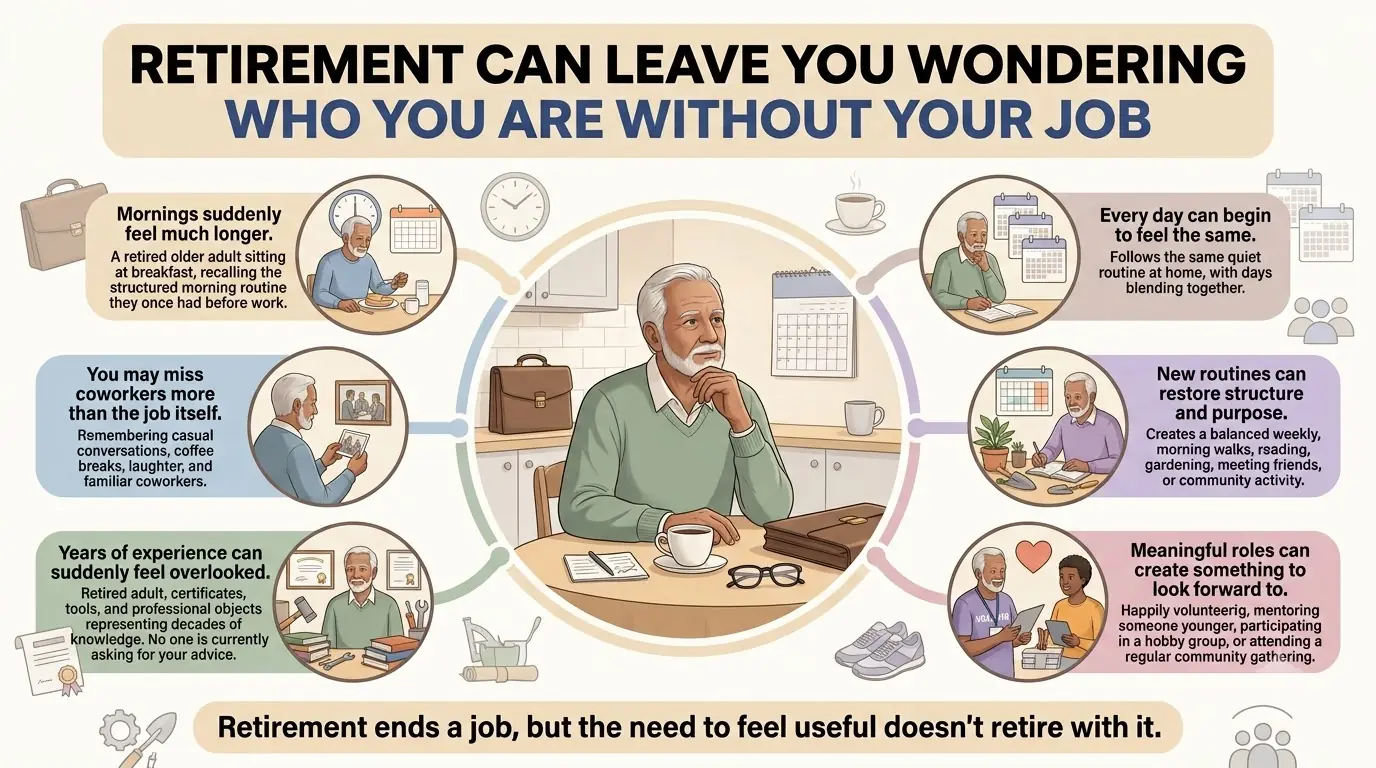
RETIREMENT CAN LEAVE YOU WONDERING WHO YOU ARE WITHOUT YOUR JOB
Retirement is often described as the reward waiting at the end of decades of work. No alarm clock. No commute. No deadlines. Finally, there is time to travel, relax, spend time with family, or simply enjoy slower mornings.
For many people, retirement really is a positive and fulfilling transition. But leaving work can also remove much more than a paycheck. A career may have provided daily structure, friendships, responsibilities, recognition, challenges, and a clear answer to a surprisingly important question: “What do you do?”
When that role disappears, some retirees experience an unexpected period of adjustment. The issue isn't necessarily that they want their old job back. They may miss having somewhere to be, people who expect them, problems that need their experience, and reasons for one day to feel different from another.
Retirement ends employment. It doesn't end the human need for connection, purpose, identity, and meaningful participation in life.
Why Retirement Can Feel So Different From What You Expected
Most people spend decades organizing life around work.
Work determines when you wake up, when you eat lunch, which days feel busy, when you take vacations, and even when you look forward to weekends.
Then retirement can remove that structure almost overnight.
At first, the freedom may feel wonderful.
But after the novelty wears off, a different question may appear:
What am I going to do with all this time?
This doesn't mean retirement was a mistake. Major life transitions often require psychological and practical adjustment.
The goal isn't simply to fill every empty hour. It's to build a new version of everyday life that still contains connection, structure, enjoyment, and purpose.
1. Without a Work Schedule, Mornings Can Suddenly Feel Much Longer
For years, mornings may have followed the same rhythm.
Wake up.
Get dressed.
Eat breakfast.
Commute.
Start working.
Even people who complained about that routine may discover that it provided an important framework for the day.
After retirement, there may be no external reason to get out of bed at a particular time.
That freedom can be enjoyable, but completely unstructured days can eventually feel repetitive for some people.
A new routine doesn't need to imitate employment.
It might include:
- A morning walk.
- Breakfast with a spouse.
- Exercise classes.
- Gardening.
- Reading.
- Volunteering.
- Regular errands.
- Meeting friends.
- Caring for grandchildren.
- Working on a personal project.
The specific activity matters less than whether the routine gives the day a comfortable rhythm.
2. You May Miss Your Coworkers More Than the Job
When people imagine retirement, they often think about the work they're leaving.
They may think less about the people.
Coworkers provide countless small social interactions.
Someone says good morning.
You discuss what happened over the weekend.
A colleague asks for advice.
You complain about a difficult problem together.
Someone tells a joke during lunch.
These conversations may seem insignificant while they're happening, but collectively they can form a large part of someone's social life.
Retirement can remove dozens of these interactions at once.
This may be especially noticeable for people who live alone or whose closest friends were connected to work.
Maintaining selected workplace friendships can help, but retirement can also be an opportunity to develop relationships through hobbies, volunteering, community organizations, classes, faith communities, or other activities.
The goal isn't necessarily to create a huge social circle.
A few meaningful, reliable relationships can matter greatly.
3. Years of Experience Can Suddenly Feel Forgotten
Imagine spending 30 or 40 years becoming good at something.
People ask for your opinion because you've seen similar situations before.
You train younger employees.
You solve problems.
Your decisions matter.
Then you retire.
Suddenly, nobody is asking.
For some retirees, this can create a surprising sense of loss.
The knowledge is still there. The experience hasn't disappeared. But there may no longer be an obvious place to use it.
This is one reason mentoring and volunteering can be meaningful for some older adults.
A retired accountant might help a nonprofit.
A former tradesperson might teach younger family members practical skills.
A retired teacher might tutor.
A former manager might mentor someone early in their career.
Not everyone wants to continue doing anything related to their previous profession—and that's perfectly reasonable.
The important point is that retirement doesn't make decades of accumulated knowledge irrelevant.
4. Weekends Can Feel Different When Every Day Looks Similar
During working years, Friday often feels different from Monday.
Weekends have their own rhythm.
Retirement can blur those boundaries.
At first, having every day available may feel luxurious.
Eventually, some retirees notice that Monday, Wednesday, and Saturday aren't particularly different.
Without structure, it's also easy for physical activity and social contact to decline.
Someone may gradually leave the house less frequently simply because nothing requires them to go anywhere.
Creating a weekly rhythm can help.
Perhaps Tuesday is a volunteer day.
Thursday is lunch with friends.
Saturday involves family.
Certain mornings are reserved for exercise.
Having something scheduled doesn't mean giving up retirement freedom.
It can provide anticipation while still leaving plenty of unstructured time.
5. Finding New Routines Can Matter More Than Staying Busy
There's a difference between being busy and having purpose.
A retiree can fill every hour with errands, television, household chores, and appointments while still feeling that something is missing.
Purpose is personal.
For some people, family provides it.
For others, it may come from:
- Volunteering.
- Creative work.
- Faith.
- Caring for someone.
- Learning.
- Community involvement.
- Physical activity.
- Mentoring.
- Travel.
- Gardening.
- Building or repairing things.
There isn't one correct retirement lifestyle.
Some people want an active schedule. Others have spent decades under pressure and genuinely want a quieter life.
What matters is whether daily life feels satisfying to the person living it.
A successful retirement doesn't need to look impressive from the outside.
6. Having Something to Look Forward to Can Change the Week
Anticipation can provide structure and enjoyment.
It doesn't need to involve an expensive vacation or major event.
It might be Wednesday morning coffee with friends.
A grandchild visiting Saturday.
A weekly exercise class.
Volunteering every Thursday.
Working in the garden.
Attending a community event.
Learning to play an instrument.
Having something on the calendar can give the week landmarks.
This becomes especially important when work no longer creates those landmarks automatically.
Regular activities can also provide social contact without requiring someone to repeatedly make plans from scratch.
Retirement Can Affect Identity
Ask someone to describe themselves and occupation often appears surprisingly early.
“I'm a nurse.”
“I'm a teacher.”
“I'm an electrician.”
“I'm an engineer.”
After decades in a profession, work can become intertwined with identity.
Then retirement changes the sentence:
“I used to be…”
That wording can feel uncomfortable.
But retirement doesn't erase the person who performed the job.
Someone who retires from teaching hasn't lost their ability to teach.
A retired nurse hasn't lost decades of knowledge about caring for people.
A retired builder hasn't forgotten how things work.
Identity can expand beyond occupation.
You can be a parent, grandparent, spouse, friend, mentor, neighbor, volunteer, learner, traveler, gardener, artist, athlete, or countless other things.
Retirement can be less about losing an identity than gradually building a broader one.
Purpose Doesn't Require Productivity
There's an important caution here.
Older adults don't need to prove their worth by constantly producing something.
After decades of employment, retirement can legitimately include rest.
Reading all afternoon isn't failure.
Sitting outside isn't wasted time.
Traveling isn't irresponsible.
Spending a morning doing very little can be perfectly healthy.
Purpose isn't the same as productivity.
A meaningful retirement can contain both contribution and rest.
The balance depends on the individual.
Physical Activity Can Provide More Than Exercise
Exercise is valuable for cardiovascular health, strength, mobility, and balance, but it can also provide structure and social interaction.
A regular walking group, fitness class, swimming session, or recreational activity creates a reason to leave the house.
Resistance exercise becomes particularly important with age because muscle mass and strength tend to decline over time.
Maintaining strength supports everyday abilities such as:
- Walking.
- Climbing stairs.
- Carrying groceries.
- Getting out of chairs.
- Maintaining balance.
- Remaining independent.
Physical activity should match individual abilities and health conditions.
The goal isn't athletic performance.
It's preserving function and creating habits that support long-term quality of life.
Retirement Can Change Relationships at Home
Retirement doesn't only affect the person who stops working.
It can change household dynamics too.
A couple who previously spent evenings and weekends together may suddenly spend most of every day in the same house.
That can be enjoyable.
It can also require adjustment.
Partners may have different expectations about travel, chores, finances, social activities, or how much time they should spend together.
Maintaining individual interests alongside shared activities can be healthy.
Retirement shouldn't automatically mean spouses must do everything together.
Open conversations about expectations can prevent small frustrations from becoming larger conflicts.
Financial Stress Can Affect the Retirement Experience
Retirement isn't purely an emotional transition.
Financial circumstances matter.
Concerns about savings, housing, healthcare costs, or unexpected expenses can make retirement stressful even when someone was psychologically ready to stop working.
Financial uncertainty can also affect social life.
Someone may decline invitations or activities because they're worried about spending money but feel uncomfortable explaining why.
When financial concerns become significant, reputable financial or benefits counseling may help clarify available options.
The emotional experience of retirement can't always be separated from practical realities.
Watch for Social Isolation
Retirement can unintentionally shrink someone's social network.
This is especially important when retirement occurs alongside other changes such as:
- Moving to a new community.
- Losing a spouse.
- Giving up driving.
- Developing mobility problems.
- Losing longtime friends.
- Living far from family.
A person who previously interacted with coworkers every day may suddenly spend most weekdays alone.
Social isolation and loneliness have been associated with poorer mental and physical health outcomes.
That doesn't mean every retiree needs a packed social calendar.
Some people genuinely prefer more solitude.
The question is whether someone has the amount and quality of connection they actually want.
When Retirement Sadness May Be Something More
Adjustment takes time.
Feeling uncertain, bored, or nostalgic occasionally doesn't necessarily mean someone is depressed.
However, persistent changes deserve attention.
Consider speaking with a healthcare or mental health professional if retirement is accompanied by ongoing:
- Sadness.
- Hopelessness.
- Loss of interest in previously enjoyable activities.
- Significant social withdrawal.
- Major sleep changes.
- Appetite changes.
- Persistent fatigue.
- Difficulty concentrating.
- Feelings of worthlessness.
- Significant difficulty functioning in everyday life.
Depression isn't an inevitable consequence of retirement or aging.
Health conditions, medication effects, chronic pain, bereavement, and other factors can also affect mood and motivation.
Professional evaluation can help identify what's happening.
How Families Can Support Someone After Retirement
Adult children sometimes assume their newly retired parent must be delighted to have unlimited free time.
Instead of assuming, ask how the transition actually feels.
Include retired parents in ordinary family life.
Ask for their advice.
Invite them to events without pressuring them to attend.
Encourage interests they genuinely enjoy rather than assigning activities simply to keep them occupied.
And remember that being retired doesn't mean someone is automatically available whenever the family needs childcare, errands, or other help.
Retirement should still belong to the person who earned it.
Building a Meaningful Retirement
There is no universal formula, but several questions can help:
What gives me a reason to get up in the morning?
Which relationships do I want to maintain?
What have I always wanted to learn or try?
How will I stay physically active?
Where can my experience still be useful if I want it to be?
How much structure makes me feel good?
What do I genuinely enjoy when nobody expects anything from me?
The answers may change over time.
Retirement isn't one permanent lifestyle decision.
It can evolve.
Key Takeaways
- Retirement can remove structure, social interaction, responsibility, and professional identity along with employment.
- Missing coworkers and everyday conversations is common and doesn't necessarily mean someone misses the job itself.
- Decades of experience remain valuable after employment ends.
- A weekly routine can provide structure and anticipation without recreating the pressures of working life.
- Staying busy and having purpose aren't necessarily the same thing.
- Hobbies, volunteering, mentoring, family involvement, learning, and community activities can provide meaningful new roles.
- Physical activity can support health, independence, routine, and social connection.
- Retirement can require adjustment for partners and families as well as the retiree.
- Persistent sadness, withdrawal, hopelessness, or loss of interest deserves professional attention.
Retirement ends a job, but it doesn't retire the need to feel connected, useful, curious, valued, and excited about what tomorrow might bring.
Medical Disclaimer
This article is for general educational purposes only and is not a substitute for professional medical or mental health advice, diagnosis, or treatment. People experience retirement differently, and temporary uncertainty or adjustment can be normal during major life transitions. Persistent sadness, hopelessness, loss of interest, severe social withdrawal, or significant changes in everyday functioning should be discussed with a qualified healthcare or mental health professional.