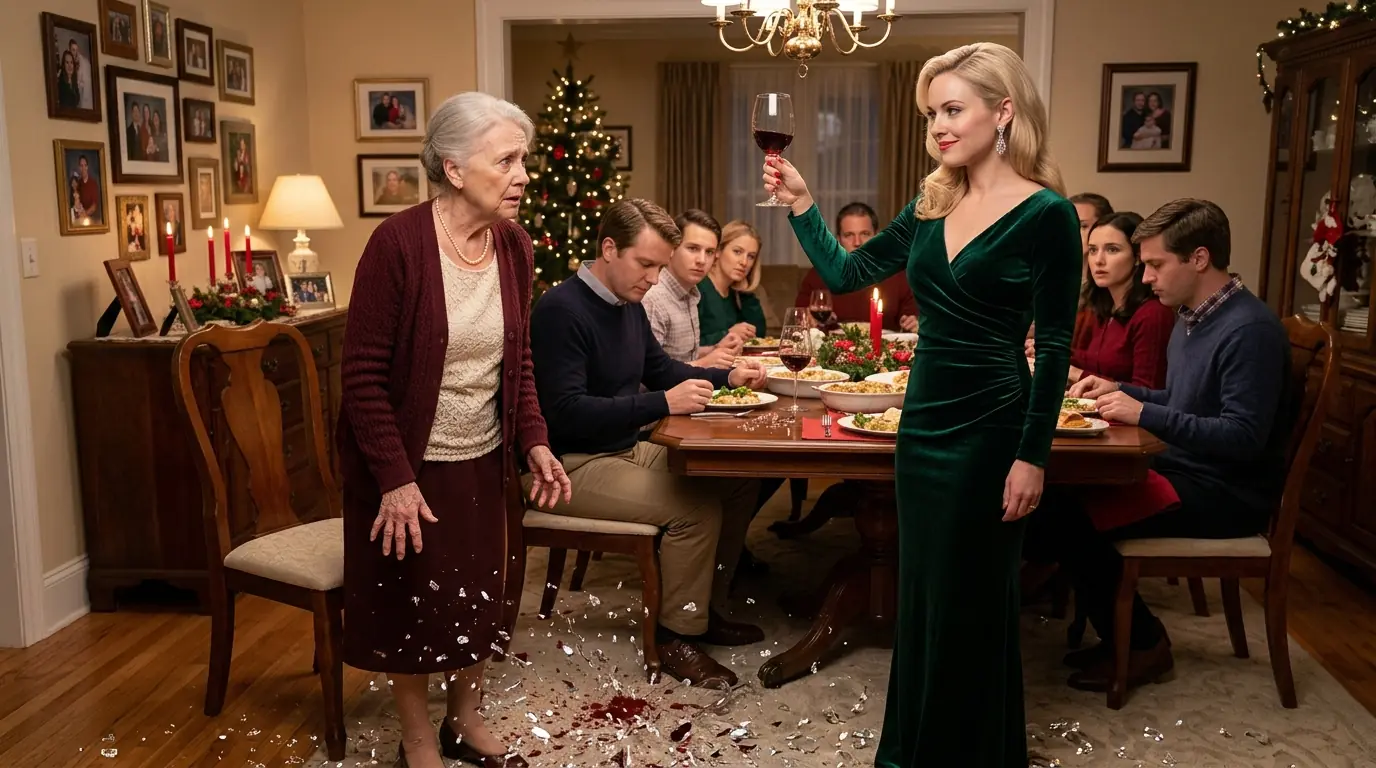
Rich Man Called the Black Maid “Too Dumb” at Dinner — Then She Spoke 7 Languages and Left Him Speechless
Put that pitcher down. You're spilling like an animal. That was Gregory Ashworth, billionaire, speaking to his maid. Filipe, you asked if she could translate your wine label? She's too dumb. She can barely pour water straight. That's all these people are good for. Lifting, carrying, smiling when told. He snapped his fingers twice. Bread? Bread. Fetch. Fetch. That's more your speed, sweetheart. Celine picked up the basket, walked to the kitchen, sweetheart. Back straight, hands steady. She didn't say a word, but in 42 minutes, the woman he just called too dumb to read a wine label would save his $68 million deal in five languages.
Let me take you back to the beginning of that evening. Gregory Ashworth's Georgetown mansion smelled like roasted lamb, rosemary, and old money. Crystal glasses clinked under candlelight. A string quartet hummed somewhere in the foyer. 12 guests sat around a mahogany table that cost more than most people's houses. Six nationalities, three ongoing business deals, and one very expensive bottle of Bordeaux breathing at the center of it all. This was the kind of room where fortunes changed hands between the salad and the steak. And moving through that room, silently, precisely, like a shadow with steady hands, was Celine Davis. She anticipated every empty glass before it hit the table. She cleared plates without making a sound. She refilled the water without being asked. Not once did anyone look her in the eye. Not once did anyone say her name. To everyone in that room, she was furniture. Furniture that breathed.
Then came the wine label moment. You already heard it. Philippe Renault's polite suggestion. Ashworth's laugh. "She's too dumb." The snapping fingers. The bread basket. The word "fetch." That was 10 minutes ago. Celine hadn't spoken a word since. She stood near the kitchen doorway holding a silver tray, face perfectly still. But something in the room had shifted. You could feel it the way you feel pressure drop before a storm. Then Ashworth's assistant leaned in and whispered something that drained the color from the billionaire's face. The professional interpreter, the one hired to handle the evening's real business, had canceled. Family emergency. Gone. The trade documents sitting on the side table were in French, German, and Portuguese. Without a translator, a multinational deal worth tens of millions was dead on arrival.
Ashworth's jaw tightened. He scanned the room. "Does anyone here speak French?" he said. "Anyone? German? Anything useful at all?" Silence. 12 powerful people. Not one answer. He glanced toward the catering staff. Then he stopped himself. He'd just told this room his maid was too dumb to read a label. He wasn't about to ask her for help now. So he didn't. But near the doorway, Celine tilted her head. Just slightly. The way someone does when they understand every word being said in every language. Gregory Ashworth didn't notice, but someone else at that table did. That someone was Ambassador Henry Callaway, retired. 31 years in the foreign service. Six countries, four languages. The kind of man who could read a room the way most people read a menu. And he'd been reading Celine Davis all night. Not because she was doing anything wrong, because she was doing everything right. He noticed the way she moved. Quiet, efficient, always one step ahead of every empty glass. He noticed the way she set down plates without a sound. The way she refilled wine from the right side without being taught. That wasn't training. That was instinct. But what really caught his attention happened the moment Ashworth said those words. "She's too dumb." Every server in that room flinched. Every single one. Except Celine. Her jaw tightened. Just barely. But her hands her hands stayed perfectly still. The pitcher didn't move. The water didn't ripple. Callaway had spent three decades sitting across from diplomats, generals, and heads of state. He knew what composure looked like. And that woman holding the water pitcher had more of it than half the people at this table. Then he noticed something else. When Philippe Renault spoke French to the table earlier, rapid, idiomatic, casual, Selena's lips moved. Faintly. Almost invisibly. Like she was translating in her head without meaning to. When Klaus Breitner shuffled through the German trade documents on the side table, her eyes tracked every page. Calloway set down his napkin. "Selena," he said. The room barely noticed. But Celine turned. Because Henry Calloway had just done something no one else at that table had bothered to do all evening. He used her name. "Would you mind bringing me the wine list? I believe it's on the credenza, next to the documents." He paused. Then added, casually, almost offhandedly, the last two words in French. "Les documents." It was a test. A gentle one. The kind only someone who suspected the truth would think to give. Celine didn't hesitate, didn't blink, didn't look around for permission. She answered in French. Flawless, unhurried, Parisian French. "Of course, sir. The trade agreement documents or the wine list?" The room went dead silent. A fork stopped midway to a mouth. Ice stopped shifting in glasses. Vivian Ashworth's champagne flute hovered an inch from her lips. Philippe Renault's jaw dropped. Literally dropped. Like a man who just heard his own language spoken better than he speaks it. Gregory Ashworth stared. He blinked. Once. Twice. Then he forced a laugh. A tight one. The kind that doesn't reach the eyes. "Well," he said, "the help speaks a little French. How charming. Probably picked it up from a phrase book." Callaway didn't smile. He turned to Klaus Breitner and asked him a question in German. Something technical. Something about a pharmaceutical regulation clause in the trade documents. Breitner answered. Also in German. Fast. Detailed. Then Callaway looked at Celine. What did Herr Breitner just say? Celine answered in German first, then in English. Word perfect. And she added a detail that Breitner himself had forgotten to mention. A regulatory subclause that changed the interpretation of the entire paragraph. Breitner's eyebrows went up. He leaned back in his chair and looked at Celine the way you look at someone you just underestimated by a thousand miles. The room was shifting now. You could feel it. Chairs creaking. Glances exchanged. The energy at that table had changed direction. Like a river hitting a rock and splitting. Philippe Renault stood up. He spoke directly to Celine. In French. Fast. Complex. Full of idioms that don't appear in any textbook. She responded. Fluently. Without a pause. He switched to Portuguese. She followed. Mid-sentence. Without blinking. Three languages. 90 seconds. From a woman holding a serving tray. The room didn't laugh this time. Ashworth's hand trembled as he set down his fork. It was small. Almost invisible. But it was there. Celine's voice hadn't changed once. Calm. Unhurried. Precise. The same tone she'd used to ask about the bread basket. Philippe Renault slowly sat back down. He didn't say a word. He just stared at Celine. The way you stare at something extraordinary that you almost missed because it was standing in the wrong uniform, but Celine Davis wasn't finished. Not even close. And what she did next would make a billionaire turn the color of the wine in his glass.
To understand what happened next, you need to know where Celine Davis came from. She grew up in Southeast DC. The part of the city that tourists never see. No embassies. No marble. No string quartets. Just cracked sidewalks, chain-link fences, and a grandmother named Odessa who smelled like lemon floor cleaner and spoke two languages. Swahili and just enough English to get by. Odessa had come from Tanzania in the 1960s. Alone. No money. No education past the eighth grade. She found work the only way she knew how. She cleaned houses. But not just any houses. Embassy houses. Diplomat houses. The kind of homes where French was spoken at breakfast, German was spoken at dinner, and Portuguese drifted through the hallways like music. And every single day, little Celine went with her. While Odessa scrubbed tile on her hands and knees, Celine sat in hallways. Cross-legged on cold marble floors listening. She listened to diplomats' children argue in French. She listened to phone calls in German through closed doors. She heard Portuguese lullabies from a Brazilian nanny two rooms away. She picked up words the way other children pick up stones, one by one, without effort, just because they were there. By the time she was eight, she could understand three languages she'd never been taught. By 12, she was walking to the public library after school, checking out grammar textbooks for languages she could already hear, but couldn't yet read. She taught herself verb conjugation from books with broken spines that nobody else had touched in years. By 16, she was fluent in five languages. By 25, seven. English, French, German, Portuguese, Spanish, Swahili, and Mandarin. Because one summer, a Chinese diplomat's family moved in next door, and Celine spent 3 months listening through the wall. But here's the part that breaks your heart. No college degree, no certifications, no connections. She applied to translation firms. They wanted credentials she couldn't afford. She applied to embassy positions. They wanted diplomas she didn't have. Every door had a lock, and every lock required a key that cost more money than she'd ever seen. So, Celine Davis, a woman who could speak seven languages, poured water for people couldn't speak two. And every shift, in the front pocket of her apron, she carried a small leather notebook, cracked, soft from years of handling, filled with words in six languages, written in pencil by a woman who could barely write in one. Grandma Odessa's notebook. On the first page, in shaky handwriting, Odessa had written a single phrase in Swahili. It translated to three words. Language is freedom. Celine carried those words against her chest every night she worked. Including tonight.
Back at the dinner table, the air had changed. 12 guests who had spent the evening talking over Celine were now looking at her. Actually looking. Some with curiosity. Some with disbelief. One, Gregory Ashworth, with something closer to irritation. Philippe Renault was the first to act. He reached for the stack of trade documents sitting on the side table. 12 pages. Dense legal terminology in French and German. The kind of paperwork that takes a certified interpreter 2 hours and a pot of coffee to get through. He slid it across the table toward Celine. "Our interpreter canceled," he said. "Would you mind taking a look? Even a general summary would help." Before Celine could respond, Ashworth's hand came down flat on the table. "Absolutely not." His voice was sharp, controlled. The kind of tone a man uses when he feels the ground shifting under him and refuses to admit it. "She's here to serve dinner, not play translator. Let's not get carried away because she knows a few phrases." He looked at Celine the same way he'd looked at her when he told her to fetch bread. "Go refill the bread basket." The room held its breath. Celine stood between two choices. The bread basket sat on the counter behind her. The trade document sat on the table in front of her. One was what they expected. The other was what she was. She looked at the bread basket. She looked at the document. Then she glanced, just for a half second, at Ambassador Calloway sitting at the far end of the table. He gave her the smallest nod, so slight that if you blinked, you'd miss it. Celine picked up the document. The room didn't breathe. She read the first page in silence. Her eyes moved steadily. No hesitation. No squinting. No flipping back to check a word. She read it the way a surgeon reads an x-ray, with total, practiced certainty. Then she began to translate aloud, paragraph by paragraph, French to English. Precise, clean, professional-grade. Halfway through page three, she stopped. "There's an error here," she said. Her voice was calm, almost casual. "This clause references a licensing exemption that expired 18 months ago. If your team signs based on this language, you'll be liable for the full amount, roughly $300,000." Renault's face went white. He pulled out his phone, called his office in Paris, and put them on speaker. He spoke in rapid French, telling his legal team that someone had just caught a catastrophic error in the trade document. Celine listened. Then she leaned in slightly. "It's closer to 350,000, Monsieur Renault. The VAT clause on page eight changes the calculation." Renault stared at her. His legal team went silent on the other end of the line. For a moment, nobody spoke. Then Klaus Breitner, the German pharmaceutical executive who had barely said a word all evening cleared his throat. "For what it's worth," he said quietly, "her German pronunciation is better than my interpreters in Berlin, and I pay that man 90,000 a year." The room turned to Ashworth. A flush was creeping up from his collar, slow, dark, like ink spreading through fabric. His jaw was clamped so tight you could see the muscles twitching beneath the skin. His right hand gripped his steak knife, not to cut, just to hold something. But he didn't back down. "Anyone can read a document," he said. "That doesn't make her qualified for anything. Let's move on." He said it firmly, loudly, the way a man speaks when he knows the room has already stopped listening to him. Gregory Ashworth had spent 30 years reading rooms. He'd built an empire on knowing which way the wind blew before anyone else felt the breeze. And for the first time in his life, he couldn't read this one. Ashworth didn't go back to his steak. He pushed his chair back, dropped his napkin on the table, and walked toward the kitchen hallway. Vivian saw him leave. She set down her champagne and followed. The hallway was narrow, dim, lit by a single wall sconce that threw long shadows on the wallpaper. The sounds of the dinner party, clinking glasses, low murmuring, felt far away, like a television playing in another room. Ashworth turned to his wife. His voice was low, controlled, but his neck was flushed, and the vein on the side of his temple was visible. "She's making us look ridiculous." Vivian opened her mouth. "Don't," he said. "Don't defend her. Don't tell me what you saw. I know what I saw. A maid who got lucky with a few words and now thinks she belongs at my table." He straightened his cufflinks. A habit. Something he did when he was making a decision he wouldn't revisit. "Get her out of here. Pay her double. I don't care. Just make it gone before she embarrasses us further." Vivian hesitated. She'd watched Celine translate three languages in 90 seconds. She'd watched Philippe Renault, a man who negotiated international trade deals for a living, sit down in silence after hearing this woman speak. She'd seen Klaus Breitner compare Celine to his $90,000 interpreter, but Vivian Ashworth had been married to Gregory for 22 years. She knew the math. She knew what defiance cost in this house. She nodded. Five minutes later, Vivian walked into the service kitchen. Celine was rinsing a tray. Teresa Collins, her colleague, the only other server on shift, was re-stacking dessert plates near the sink. The fluorescent light buzzed overhead. The kitchen smelled like dish soap and leftover lamb. Vivian held out a white envelope. Thick. Crisp. The kind you put cash in when you want someone to disappear politely. "Celine, I want to thank you for your excellent work tonight," she said. Her voice was smooth. Practiced. "We've decided your services are no longer needed for the rest of the evening. This should more than cover your time." It was twice Celine's fee. Maybe more. Teresa froze by the sink. She didn't turn around, but her hands stopped moving. Celine looked at the envelope. She didn't reach for it. "They're paying you to leave because you're too smart." Teresa whispered. She still hadn't turned around. "You understand that, right?" Celine understood. She understood it the way she understood everything. Quietly, completely, in a language nobody taught her. The envelope sat on the counter between them. White against stainless steel. The smart move was obvious. Take the money, go home. Rent was due in 5 days. The transmission on her car was grinding every time she shifted into second. She needed that money more than she needed a point to prove. Her hand moved to her apron pocket. Not to the envelope. To the notebook. Grandma Odessa's notebook. Small, cracked leather, warm from body heat. The pages were soft and faded from decades of handling. Filled with words in six languages, written in pencil by a woman who never finished high school. On the first page, in shaky, careful handwriting, three words. Language is freedom. Celine's fingers rested on those words through the fabric. Just for a second. The way you touch something holy without needing to see it. Then she looked at Vivian Ashworth. "I appreciate the offer, Mrs. Ashworth." She said. "But I think I'll finish my shift." She didn't say it with anger. She didn't say it with defiance. She said it the way someone speaks when they've made peace with a decision that might cost them everything. Vivian stared at her, then picked up the envelope and walked out without another word. Teresa let out a breath she'd been holding for 30 seconds, and then the doorbell rang, and everything changed. The front door opened and chaos walked in. Three people stood on the steps of Ashworth's Georgetown mansion. Two men in wrinkled suits, one woman in a navy blazer with a Brazilian flag pin on her lapel. They were carrying briefcases, speaking fast, and looking confused. The Brazilian cultural delegation. Three hours early for tomorrow morning's meeting. Jet-lagged, disoriented, and speaking nothing but Portuguese. Ashworth's assistant, a 26-year-old in a headset who had been managing seating charts all night, froze at the door. She didn't speak Portuguese. She didn't speak Spanish. She barely spoke loud enough to be heard over the string quartet. Um, she said, "Welcome. Do you English?" Adriana Montero, the Brazilian envoy, the senior member of the delegation, stared at her. Then looked past her into the house full of wealthy, powerful people, not one of whom had com...
Tags:
News in the same category
Her Own Son Let Her Be Called the Family ATM - Then His Mother Locked the Door on Every Free Ride
The Daughter-in-Law Wore the Widow’s Robe - Then the Deed Exposed Whose House It Was

“One Punch for $10K!” the Champion Laughs — But His Trainer Panics When the Black Grandma Steps Forward
Cops Bully The New Black Officer—Unaware She's Their New Captain
Neighbor Calls Cops on Black Family BBQ — Then the Officers Salute and Say One Word
HOA Karen Called Cops on a Man After Her Son Demands His Mustang — Then Froze When They Arrived
The Cops Tried To Arrest A Black Woman On Her Own Porch — Then Learned She Was The U.S. Attorney

The Officer Shoved Him Down on Live TV — Then the Studio Went Silent
CHAPTER 2: WHEN JUSTICE ANSWERED ON LIVE TELEVISION
The Black Belt Shoved the Old Janitor Down — Then the Room Fell Silent
CHAPTER 2: THE MAN BEHIND THE GRAY COVERALLS
Cops Destroy Her Store for Refusing to Pay—Then a Military Helicopter Arrives
Cops Target Black Family At Diner, Unaware The Father Is a Navy SEAL
A Cocky MMA Fighter Offered an Old Farmer $500 to Take Free Punches — Biggest Mistake of His Life
The Officer Smashed His Window — But the Quiet Driver Never Fought Back
CHAPTER 2: WHEN THE FBI ENDED THE COVER-UP
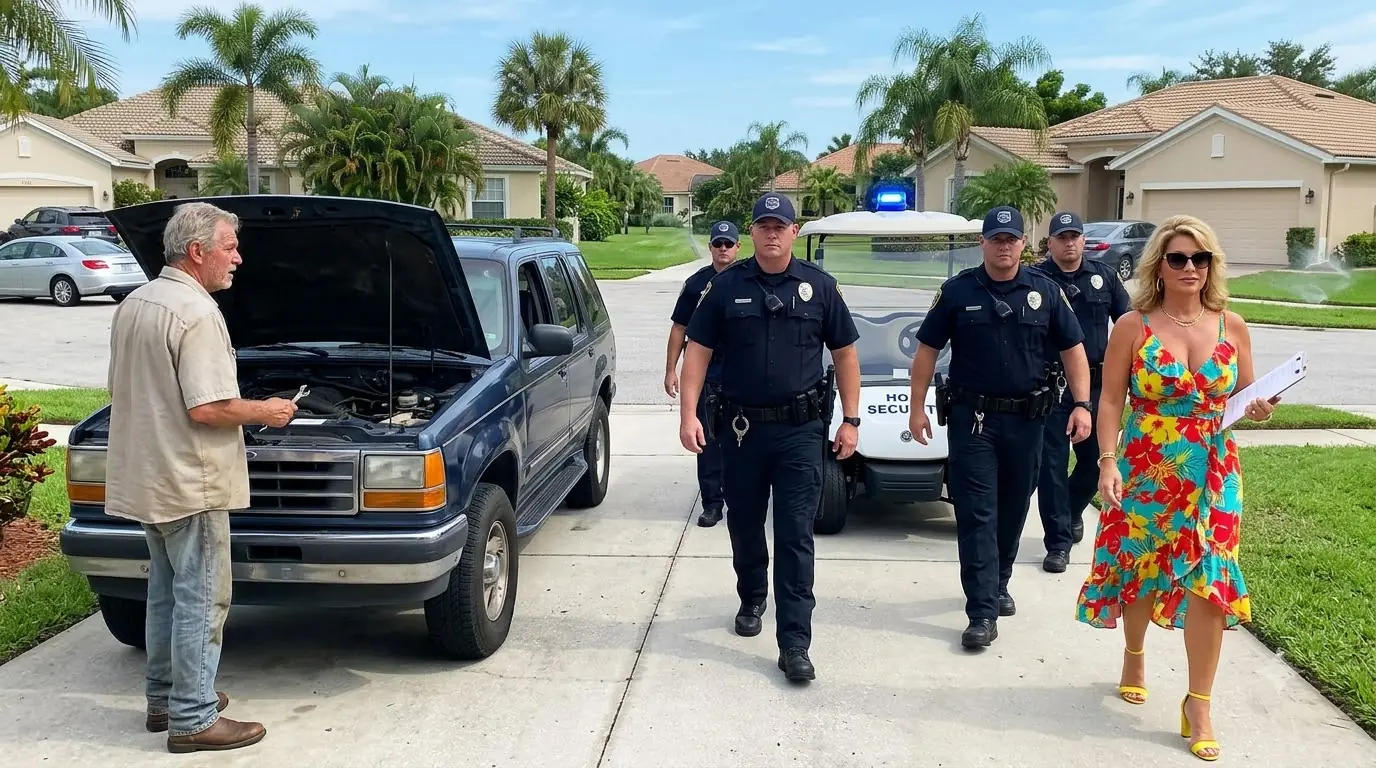
The HOA President Sent Fake Officers to Arrest Him — Then She Made One Fatal Demand
CHAPTER 2: THE NINETY-TWO-SECOND TRAP
News Post
My Daughter-in-Law Shamed Me at Christmas Dinner — Then I Gave Her Until January to Leave My House
Her Own Son Let Her Be Called the Family ATM - Then His Mother Locked the Door on Every Free Ride
The Daughter-in-Law Wore the Widow’s Robe - Then the Deed Exposed Whose House It Was
“One Punch for $10K!” the Champion Laughs — But His Trainer Panics When the Black Grandma Steps Forward
Cops Bully The New Black Officer—Unaware She's Their New Captain
Neighbor Calls Cops on Black Family BBQ — Then the Officers Salute and Say One Word
HOA Karen Called Cops on a Man After Her Son Demands His Mustang — Then Froze When They Arrived
The Cops Tried To Arrest A Black Woman On Her Own Porch — Then Learned She Was The U.S. Attorney
The Officer Shoved Him Down on Live TV — Then the Studio Went Silent
CHAPTER 2: WHEN JUSTICE ANSWERED ON LIVE TELEVISION

🚨 BREAKING: Wild Coyote Found With Plastic Container Trapped Over Its Head — Dramatic Rescue Highlights the Growing Cost of Human Waste
The Black Belt Shoved the Old Janitor Down — Then the Room Fell Silent
CHAPTER 2: THE MAN BEHIND THE GRAY COVERALLS
Cops Destroy Her Store for Refusing to Pay—Then a Military Helicopter Arrives
Cops Target Black Family At Diner, Unaware The Father Is a Navy SEAL
A Cocky MMA Fighter Offered an Old Farmer $500 to Take Free Punches — Biggest Mistake of His Life
The Officer Smashed His Window — But the Quiet Driver Never Fought Back
CHAPTER 2: WHEN THE FBI ENDED THE COVER-UP