“Hey, buddy. Why are you sitting alone in an empty restaurant?” Marcus Lawson looked up slowly from his phone.
The young police officer standing just inside the front door had one hand resting near his belt and an expression that tried very hard to look certain.
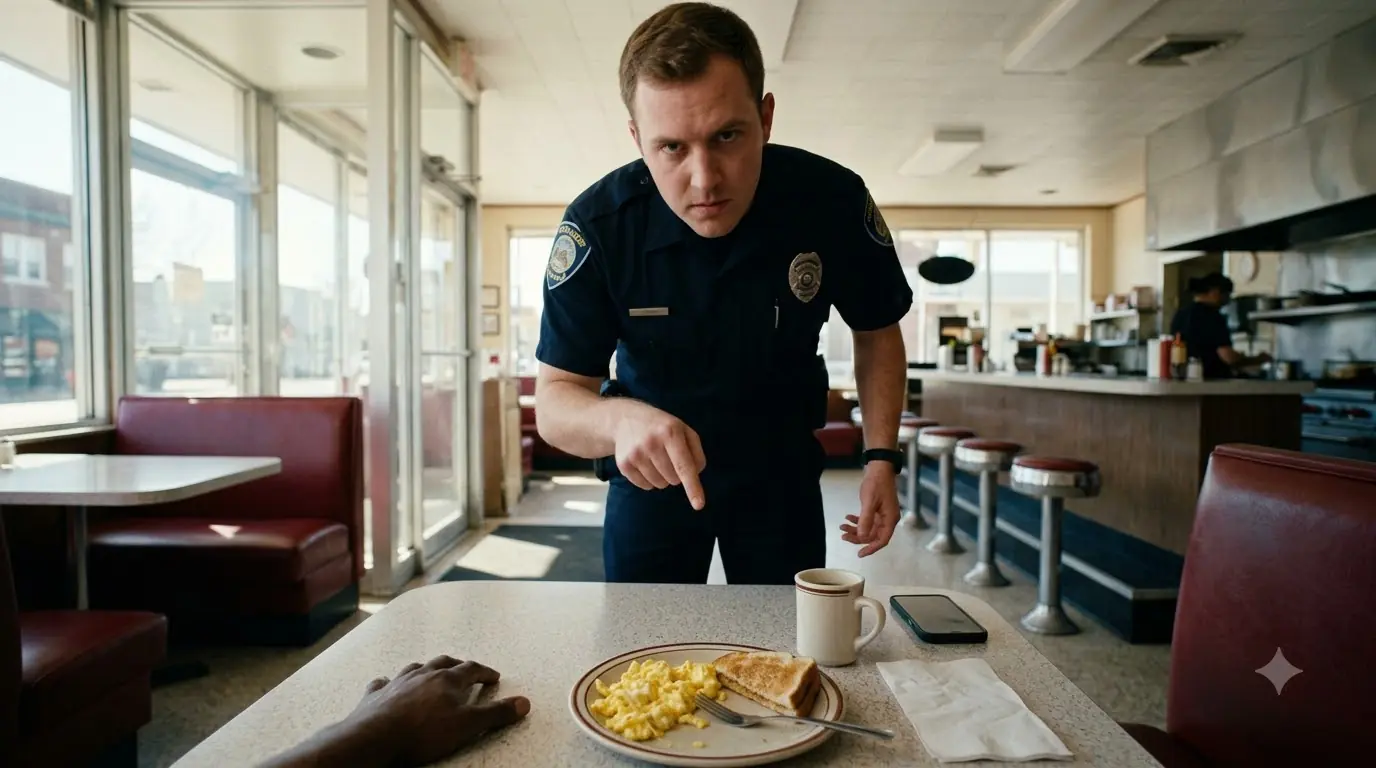
Marcus glanced around his own diner.
Morning light came through the front windows in wide golden stripes. A coffee pot hissed behind the counter. From the kitchen, he could hear the clatter of a sheet pan being set on a prep table. The smell of onions, butter, coffee, and smoked sausage still hung in the room from breakfast service.
Nothing about the place was empty in the way the officer meant.
It was simply quiet.
Marcus set his phone beside his coffee cup.
“Just having my coffee,” he said. “Why?”
The officer took another step inside.
“I passed by a few times. You’ve been here a while.”
Marcus frowned slightly.
“Yes.”
“Looks like you’re casing the place.”
For a moment Marcus thought he had misheard him.
“Casing the place?”
“Yeah.”
“No. I’m just enjoying my drink.”
The officer’s eyes moved across the dining room and back to Marcus.
“I know the owner,” he said, “and he doesn’t trust people like you hanging around here.”
Marcus stopped moving.
There are sentences that are insulting because of the words in them.
Then there are sentences that are insulting because of everything the speaker assumes before saying them.
People like you.
Marcus had heard variations of that phrase since childhood.
At stores.
At offices.
At apartment showings.
At hotels.
Even once at a bank where he had been depositing the restaurant’s payroll.
He leaned back against the vinyl booth.
“You know the owner?”
“That’s what I said.”
“Interesting.”
The officer’s jaw tightened slightly.
“Let me see your ID.”
Marcus’s voice stayed calm.
“I don’t have to give you identification without cause.”
The officer shifted his weight.
“I’m not playing around.”
“Neither am I.”
“Then stand up.”
Marcus studied him.
Young.
Late twenties, maybe.
Clean uniform.
Freshly polished shoes.
Still enough academy stiffness in his posture that Marcus suspected he had not been on the street long.
Marcus had dealt with police officers before.
Most entered the diner for breakfast.
Some came during night shifts.
A few knew him by name.
One detective ordered the same catfish-and-eggs plate every Friday morning and had done so for six years.
This officer was unfamiliar.
“Officer,” Marcus said, “before this goes any further, I think you should probably know something.”
“What?”
Marcus picked up his coffee and took one small sip.
“I’m the owner of this place.”
The officer stared at him.
Marcus added:
“Lou’s Diner. That’s me.”
The officer’s expression did not soften.
It hardened.
And that was the moment a misunderstanding became something much more serious.
Officer Trevor Holloway had been with the St. Louis Metropolitan Police Department for exactly nine months.
Nine months since graduating from the academy with average marks.
Nine months since receiving an evaluation that described him as enthusiastic, punctual, physically capable, and eager to take initiative.
The same evaluation also included a sentence that would later become important.
“Officer Holloway demonstrates a tendency to reach conclusions before gathering sufficient contextual information.”
His field training officer had written a similar note three months later.
Then again five weeks after that.
Neither warning had resulted in formal discipline.
Holloway had no civilian complaints.
No use-of-force history.
No sustained misconduct findings.
That sounded reassuring until someone remembered that he had barely been in uniform long enough to develop a history.
The department was understaffed.
Retirements had increased.
Recruitment had slowed.
Experienced officers were stretched across shifts.
Supervisors were under pressure to get probationary officers cleared for independent patrol.
Holloway completed the minimum field training requirements.
He technically passed.
So he was placed on solo duty.
Three weeks before meeting Marcus Lawson, Holloway had been assigned to patrol around the Delmar Loop.
He knew the city.
He did not know the neighborhood.