Ruby Wouldn’t Rest Until All Five Puppies Were Safe
Reader Theme:
Font Size:
24px
The Cry Behind the Building
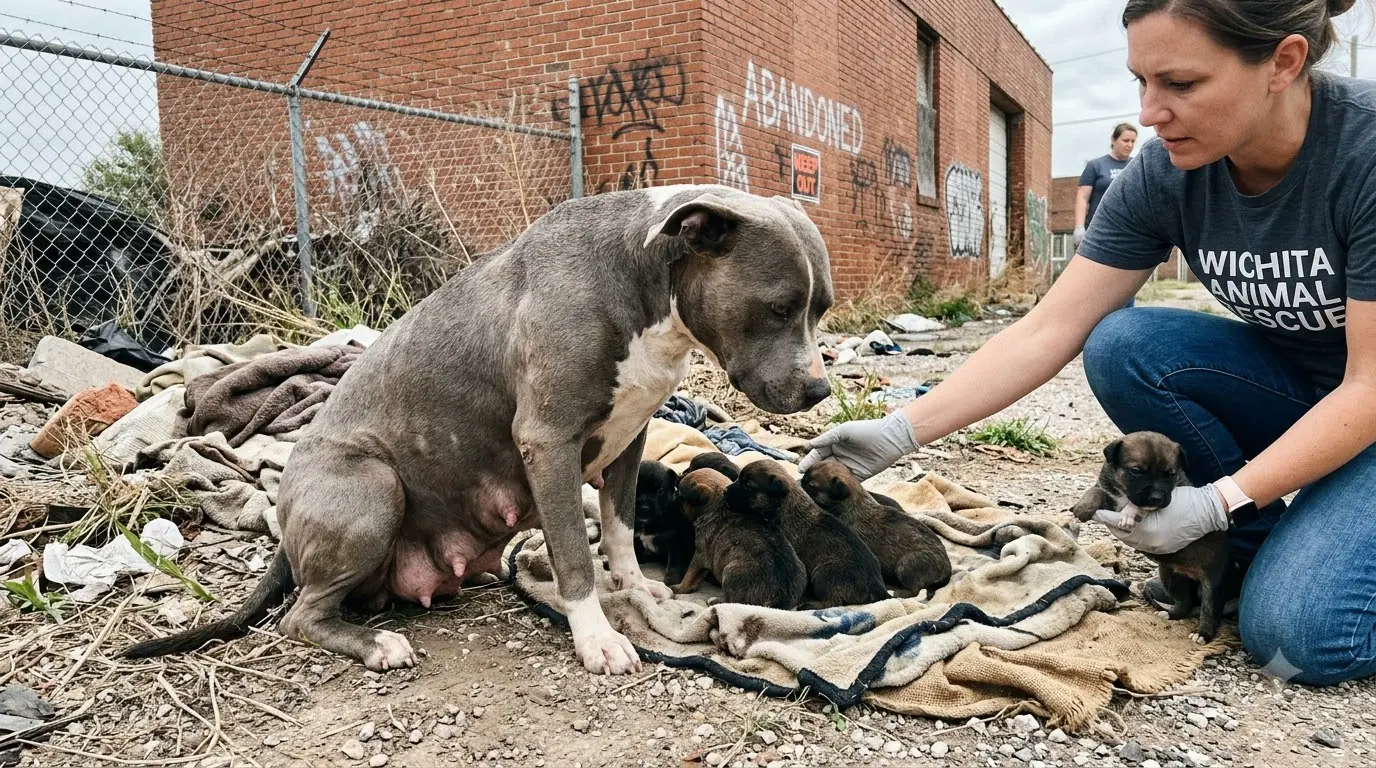
Ruby and her puppies were found because someone stopped long enough to listen.
A maintenance worker checking the area behind an abandoned commercial building heard what sounded like repeated high-pitched cries coming from behind a pile of discarded material near the rear wall.
At first, the sound was difficult to place.
Then he noticed movement.
A medium-sized dog was lying low beside a collection of old fabric, flattened cardboard, and dry debris that had formed a makeshift nest.
The dog would later be named Ruby.
She was a 4-year-old Pit Bull mix, visibly thin and tired, with five very young puppies pressed close against her body.
The maintenance worker did not try to pull the puppies away or approach Ruby directly.
Instead, he contacted a local rescue and stayed far enough back to avoid increasing her stress.
That decision mattered.
A nursing mother can be frightened, physically depleted, protective, or all three at once. Even a dog who appears calm may feel trapped if people crowd her babies.
When our rescue team arrived, Ruby watched every movement.
She did not charge.
She did not run.
She remained beside the litter.
Her entire focus appeared to be on the puppies.
Five Tiny Puppies
The puppies were small enough that the rescue team immediately became concerned about their age and ability to regulate body temperature.
They appeared to be approximately two to three weeks old.
At that age, puppies are still heavily dependent on their mother for warmth, nutrition, stimulation, and protection.
All five were alive.
That was the first encouraging sign.
But they did not all look equally strong.
Four were moving actively when touched and vocalizing appropriately.
The fifth was noticeably smaller.
That puppy remained tucked against Ruby's abdomen but did not push toward her as strongly as the others.
The team knew that getting the family somewhere warm was the priority.
Ruby needed to come too.
Separating a stable nursing mother from her litter would have created additional problems.
Moving the Puppies First
The rescuers decided to move the puppies one at a time.
They approached slowly.
Ruby's head lifted.
Her body remained tense.
Nobody reached over her.
The rescuer closest to the litter used calm movements and gently picked up the first puppy.
Ruby stood.
She watched.
The puppy was carried directly to the rescue vehicle and placed into a warm, padded container prepared for the litter.
Then the rescuer returned.
Ruby was still waiting.
The second puppy was moved.
Then the third.
Then the fourth.
Ruby followed behind the team, maintaining visual contact as much as possible.
When the smallest puppy was lifted, she stepped closer.
Nobody tried to restrain her unnecessarily.
The rescuer carried the tiny puppy directly to the vehicle.
Ruby followed.
Once she climbed inside and could see and smell all five puppies again, her posture changed.
She lowered herself onto the blanket.
The puppies were placed against her.
Only then did Ruby lie down fully.
The Ride to the Clinic
During the drive, the rescue team kept the compartment warm and quiet.
The puppies were kept close to Ruby.
The smallest one was monitored carefully.
Ruby was exhausted enough that she did not attempt to pace or investigate the vehicle.
She stayed curled around the litter.
The puppies rooted toward her.
Several latched and began nursing.
The smallest puppy tried but had difficulty maintaining a strong latch.
That detail immediately became important.
In very young puppies, a weak suckle can signal low body temperature, dehydration, low blood sugar, illness, congenital problems, or simply weakness from inadequate intake.
The team did not assume the cause.
They simply documented the behavior and alerted the veterinary clinic.
Ruby’s Initial Examination
At intake, Ruby was quiet and visibly depleted.
She weighed less than expected for her frame.
Her ribs were easy to feel, and muscle loss was noticeable around her hips and shoulders.
She was dehydrated but not in shock.
Her gums were pink.
Her heart and lungs sounded appropriate on examination.
Her temperature was monitored closely because nursing mothers can develop several postpartum complications, including uterine infection and calcium imbalance.
Ruby did not show immediate signs of either condition during the initial exam.
Her mammary glands were checked carefully.
Several were full with milk, but none showed the heat, severe firmness, or abnormal discharge that would strongly suggest mastitis at that moment.
Ruby tolerated the examination as long as she could see the puppies.
When the litter was temporarily moved a short distance for weighing, she became restless.
The team adjusted.
The puppies were brought back where she could see and smell them.
Ruby settled again.
What We Could and Could Not Know
Ruby's condition suggested that caring for five puppies had placed a substantial physical demand on her body.
But that did not tell us why she was behind the building.
We could not verify whether she had been abandoned.
We could not determine whether she had been lost.
We could not know how long she had been living there.
And we would not turn her thin body into proof of a history we could not establish.
What we could say was that Ruby was underweight, nursing five young puppies, and needed nutritional and veterinary support.
That was enough to build a responsible treatment plan.
The Puppies Are Examined One by One
Each puppy was weighed separately.
For identification, the rescue team used temporary colored collars and assigned simple call names so staff could track weight, feeding, temperature, and elimination individually.
The puppies were named Milo, Daisy, Scout, Olive, and Bean.
Bean was the smallest.
Milo was the heaviest and most active.
Daisy and Scout were close in size.
Olive was slightly smaller but nursing well.
Bean weighed substantially less than the others.
The veterinarian checked each puppy's heart, lungs, mouth, abdomen, hydration, reflexes, and overall responsiveness.
At this age, even subtle differences matter.
Milo
Milo was the strongest of the litter on intake.
He vocalized loudly when handled and immediately crawled back toward Ruby when returned to the bedding.
His temperature was within an acceptable range.
His hydration was mildly reduced but not severely concerning.
He latched strongly and nursed.
No obvious congenital abnormalities were found during the initial exam.
His immediate plan was warmth, nursing, daily weight checks, and routine monitoring.
Daisy
Daisy was active but somewhat quieter than Milo.
She also nursed well.
Her abdomen was soft, and no respiratory abnormalities were detected.
She had minor flea dirt in her coat, something that needed cautious management because very young puppies cannot safely receive every product used in adult dogs.
The veterinary team selected age-appropriate parasite-control measures for both Ruby and the litter.
Daisy's primary need was the same as Milo's: steady nursing and close weight monitoring.
Scout
Scout was vocal and energetic during examination.
He crawled strongly and reacted normally to touch.
He was mildly dehydrated but remained stable.
His suckle reflex was good.
Staff noted that he occasionally pushed littermates away from the most productive nursing positions.
That was not unusual, but it meant the team needed to make sure the smaller puppies also had access.
Scout did not require separate medical treatment at intake.
Olive
Olive was smaller than Milo, Daisy, and Scout but still active.
Her temperature was slightly lower than the largest puppies but improved with warming.
She latched and nursed consistently.
Because small changes can progress quickly in neonatal puppies, Olive was weighed more frequently during the first days.
She gained slowly but steadily.
That was reassuring.
Bean, the Smallest Puppy
Bean was different.
He was noticeably colder than his littermates.
His movements were weaker.
When offered the opportunity to nurse, he rooted toward Ruby but could not maintain a strong latch for long.
His gums remained pink, and he was breathing on his own, but his energy level was concerning.
The immediate priority was not to force-feed him.
A chilled puppy should be warmed before significant feeding because low body temperature can impair digestion and increase the risk of complications.
Bean was gradually warmed using controlled external heat.
His temperature was checked repeatedly.
Once he was warm enough, the veterinary team offered supplemental nutrition in small, carefully measured amounts.
Supporting Ruby’s Milk Production
Ruby needed calories.
Producing milk for five puppies requires substantially more energy than ordinary adult maintenance.
Her feeding plan was therefore different from that of a normal non-nursing dog.
The veterinary team started her on a highly digestible, calorie-dense complete diet appropriate for lactation.
Meals were divided throughout the day.
Fresh water remained available at all times.
Ruby was initially cautious around the bowl if unfamiliar people stood nearby.
Staff began placing the food down and stepping back.
Within a day, her appetite increased dramatically.
That was good news.
She ate.
She drank.
She returned immediately to the puppies.
Monitoring for Postpartum Complications
Because Ruby's previous veterinary history was unknown, the team monitored her closely for signs of illness associated with nursing.
Her temperature remained normal.
She did not develop foul-smelling discharge or significant lethargy that would raise immediate concern for uterine infection.
Her mammary glands remained functional without signs of severe mastitis.
Her bloodwork showed changes consistent with nutritional depletion and recent physical stress, but no emergency abnormality prevented continued nursing.
Calcium levels were monitored because nursing mothers can develop dangerous calcium imbalances.
Ruby did not show tremors, severe restlessness, disorientation, or muscle spasms.
That remained reassuring.
Bean’s First Night
The first night belonged to Bean.
The smallest puppy required the most attention.
He was warmed and offered supplemental feeding in addition to supervised attempts to nurse from Ruby.
Staff checked his temperature, hydration, responsiveness, and weight.
Bean initially lost a small amount of weight.
That was concerning.
Young puppies should gain consistently, and failure to gain can become serious very quickly.
His care plan was adjusted.
He received more frequent small feedings.
When nursing from Ruby, staff positioned him at a productive mammary gland before his larger siblings were allowed to crowd around him.
The objective was not to separate Bean permanently.
It was to give him a fair opportunity to eat.
The First Small Gain
By the next day, Bean's temperature was more stable.
He remained the weakest puppy, but his suckle had improved.
Then the scale gave the team the number they wanted.
Bean had gained weight.
Not much.
But he had gained.
That single measurement did not mean the danger had passed.
Neonatal puppies can improve and decline quickly.
Still, a positive weight trend, better warmth, and stronger nursing were all encouraging.
Ruby Begins to Relax
Ruby remained attentive to every sound from the puppies.
If one cried, her head lifted immediately.
When staff weighed the litter, she watched closely.
But she no longer stood every time someone approached.
She began accepting quiet handling.
One technician discovered that Ruby liked gentle scratching beneath her chin.
At first, Ruby allowed only a few seconds.
Then she leaned forward.
A day later, she rested her head briefly against the technician's leg.
Her trust developed around one condition.
The puppies had to remain safe.
Once Ruby understood that the people around her were feeding the litter, warming Bean, and returning every puppy to her, she became increasingly comfortable with their presence.
Moving Into a Foster Nursery
The family did not need to remain in a hospital environment indefinitely.
Once Bean was stable enough and Ruby's medical condition was improving, the rescue placed them in an experienced foster home prepared for a nursing mother and young litter.
A quiet room was converted into a nursery.
The space included a clean whelping area with safe bedding, controlled temperature, easy access to food and water for Ruby, and barriers that prevented the puppies from wandering into unsafe areas as they became more mobile.
Ruby entered first.
She investigated the room.
Then the puppies were brought in.
She counted them in the way mothers often seem to—sniffing each one, checking the pile, then settling around them.
Eating, Drinking, and Bathroom Habits
Ruby's appetite continued to strengthen.
She ate multiple meals every day and drank frequently.
Her body needed that intake.
Her stools remained generally normal once she adjusted to the richer diet.
She urinated regularly during brief outdoor breaks.
At first, Ruby did not want to stay outside long.
She completed her bathroom needs and immediately turned toward the door.
Her foster caregiver did not force longer walks.
Ruby's priority was the litter.
As the puppies grew and became less completely dependent on her, Ruby gradually became more willing to spend additional minutes outside.
Weight Changes in the Puppies
Every puppy was weighed at least daily during the early foster period.
Milo continued gaining reliably.
Daisy followed a similar trajectory.
Scout remained one of the heavier puppies.
Olive gained more slowly but consistently.
Bean required the closest monitoring.
There were days when his gain was smaller than expected.
On those days, the foster caregiver increased supervised nursing opportunities and followed the veterinary feeding plan.
The team remained cautious about overfeeding.
Too much formula too quickly can create its own problems.
Slow, frequent, measured support was safer.
A Setback for Bean
During the second week of care, Bean had a morning when he seemed less energetic.
His weight gain had stalled.
He was still breathing normally, but he did not compete for a nursing position.
The foster caregiver contacted the veterinary team immediately.
Bean was examined.
His temperature was slightly low again.
There were no obvious signs of pneumonia or severe gastrointestinal disease.
The veterinarian was concerned about inadequate caloric intake combined with his small size.
Bean's supplemental feeding schedule was temporarily intensified.
His environment was kept carefully warm.
He was monitored for coughing, milk from the nose, abdominal distention, diarrhea, and other warning signs.
Fortunately, none developed.
By the following day, Bean's energy improved.
Two days later, he resumed gaining weight.
Ruby Starts Gaining Too
As the puppies stabilized, Ruby's own recovery became easier to see.
She began gaining weight.
Her ribs were still visible for a while, but less prominently.
Muscle slowly returned.
Her coat became cleaner and softer.
Her eyes appeared brighter.
The veterinary team monitored her body condition carefully because a lactating mother can lose weight even while eating large amounts.
Her portions were adjusted based on her condition and the puppies' increasing nutritional demands.
Ruby did not gain rapidly.
That was acceptable.
The goal was steady improvement while maintaining milk production.
Their Eyes Open Wider
As the puppies matured, the nursery changed.
The five small bodies that had once done little more than sleep, nurse, and crawl began interacting with the environment.
Milo was the first to attempt an awkward walk across the bedding.
Scout followed.
Daisy became fascinated by the edge of the whelping area.
Olive often stayed closer to Ruby.
Bean developed more slowly but continued progressing.
His legs became stronger.
His movements became more coordinated.
Most importantly, he no longer needed constant help to reach Ruby.
He could find her himself.
Early Socialization
At this developmental stage, the foster home became more than a place for feeding.
The puppies began experiencing gentle, age-appropriate socialization.
They heard ordinary household noises at low intensity.
They experienced different safe textures beneath their paws.
They were handled briefly and positively.
Nothing was rushed.
The goal was not to overwhelm them with stimulation.
It was to help normal development occur in a controlled environment.
Ruby was included in that process.
If she appeared uncomfortable with a new activity, the foster caregiver slowed down.
Her ability to relax remained important.
Ruby’s Protective Behavior Softens
Ruby never displayed the dramatic aggression people sometimes imagine when hearing the phrase “protective mother.”
Her behavior was more subtle.
She positioned herself between unfamiliar people and the puppies.
She watched hands.
She became alert when a puppy cried.
As trust developed, that vigilance decreased.
She began greeting familiar visitors before returning to the nursery.
She would sometimes step outside the whelping area and rest several feet away while the puppies slept.
That was a major milestone.
Ruby was beginning to believe that she did not have to personally monitor every second.
Beginning the Weaning Process
As the puppies reached the appropriate age, weaning began gradually.
They were introduced to softened puppy food prepared in a texture they could manage.
The first attempt was chaotic.
Milo stepped into the dish.
Scout licked food from Milo's paw.
Daisy found the food immediately.
Olive investigated carefully.
Bean appeared more interested in Ruby.
That was normal.
Over several days, the puppies learned.
They began consuming more solid nutrition while continuing to nurse.
This reduced some of the nutritional demand on Ruby and allowed her body to recover more efficiently.
Bean Catches Up
Bean remained the smallest.
He did not suddenly become the largest puppy, nor was that necessary.
What mattered was his individual growth curve.
His weight continued to increase.
His energy improved.
He played with littermates.
He walked with increasing coordination.
He transitioned to softened puppy food more slowly than the others but eventually ate independently.
His veterinarian remained pleased with his progress.
There was no evidence at that stage of a major congenital problem.
The initial weakness appeared most consistent with his small size, poor condition at rescue, and difficulty competing for adequate nutrition.
That conclusion remained based on his response to treatment and ongoing examinations.
Ruby Gets Time to Be a Dog
As the puppies became less dependent on constant nursing, Ruby began spending more time outside the nursery.
Her foster caregiver took her for short walks.
At first, Ruby repeatedly looked back toward the house.
The outings lasted only a few minutes.
Over time, she began sniffing.
Then she started exploring.
She discovered that she enjoyed walking slowly along the edge of the yard.
She accepted treats outdoors.
Eventually, she could spend a calm twenty minutes away from the puppies without becoming distressed.
It was the beginning of Ruby's transition from mother in crisis to individual dog.
Veterinary Follow-Ups
Ruby and the litter returned for scheduled veterinary checks.
Ruby's hydration remained normal.
Her body condition was improving.
Her mammary glands remained healthy as nursing gradually decreased.
The puppies were examined individually again.
Milo remained healthy and active.
Daisy continued developing normally.
Scout was energetic and gaining well.
Olive remained slightly smaller than the largest puppies but was healthy.
Bean remained the smallest but had built a consistent pattern of weight gain.
Their preventive-care schedule was established based on age and veterinary recommendations.
That included appropriate deworming, vaccines when old enough, and future parasite prevention.
The Puppies Develop Personalities
Once they became mobile, the differences among them became obvious.
Milo approached new toys first.
Daisy followed people around the pen.
Scout wanted whatever his siblings had.
Olive preferred observing before joining.
Bean surprised everyone by becoming persistent.
If he wanted to climb onto a low cushion and failed, he tried again.
And again.
The puppy who once struggled to stay warm now had enough energy to create problems.
Everyone considered that an excellent development.
Preparing Ruby for Life After Motherhood
Ruby's needs changed as weaning progressed.
Her food portions were gradually adjusted as milk production decreased.
This process was managed carefully rather than suddenly restricting food or water.
She continued regaining healthy body condition.
Her exercise increased gradually.
She also began receiving more individual enrichment.
Sniffing walks.
Basic training sessions.
Quiet time on a bed outside the nursery.
These activities helped the foster team understand what Ruby might need in a permanent home.
She was affectionate with familiar adults.
She learned routines quickly.
She was food motivated.
She could become concerned when unfamiliar activity occurred around her space, so introductions continued at a comfortable pace.
The Family Begins Separating Naturally
As the puppies became more independent, Ruby spent less time lying with them.
She still checked them.
She still corrected inappropriate puppy behavior with normal canine communication.
But she also began walking away when she wanted rest.
The foster caregiver made sure Ruby had a puppy-free area where she could sleep without being climbed on.
That boundary was important.
Mother dogs should not be expected to tolerate unlimited harassment from increasingly mobile puppies.
Allowing Ruby to choose distance supported her well-being and helped the puppies learn normal social limits.
Adoption Planning for Five Puppies
Each puppy would eventually need an individual home.
That process did not begin with choosing the first available applicants.
The rescue considered temperament, household environment, veterinary commitment, and realistic expectations for raising a young dog.
Puppies require significant work.
They need house-training.
Socialization.
Chewing management.
Veterinary care.
Appropriate exercise.
Training.
Patience.
Potential adopters were encouraged to think beyond the emotional appeal of Ruby's rescue story.
The puppies needed families prepared for the next fifteen years, not just the next fifteen minutes.
Bean’s Final Nursery Recheck
Bean's later recheck became one of the happiest appointments in the family's recovery.
He remained smaller than his littermates.
But his body condition was appropriate for his size.
He ate independently.
His temperature regulation was normal.
His heart and lungs sounded normal.
He moved comfortably.
He played.
His growth was consistent.
The puppy who had once required warming and supplemental feeds no longer needed special feeding support.
That did not erase the importance of his difficult beginning.
It simply meant he had reached the same basic developmental stage as the others.
Ruby’s Recovery
Ruby also reached an important milestone.
After the puppies were fully weaned, her nutritional requirements gradually returned toward those of an ordinary adult dog.
She continued gaining muscle.
Her coat improved.
Her stamina increased.
She began enjoying longer walks.
Her sleep changed too.
For weeks, Ruby had awakened at every puppy sound.
Once the litter no longer depended on her, she began sleeping deeply in her own bed.
Sometimes she stretched out completely.
Sometimes she rested on her side while the puppies played elsewhere.
For a dog who had initially watched every baby being carried from a makeshift nest, that relaxation was significant.
Planning Ruby’s Permanent Home
Ruby's adoption planning was separate from the puppies'.
Being their mother did not mean she needed to be adopted with them.
Once weaned, healthy puppies normally develop independent lives.
Ruby deserved the same opportunity.
Her future home would need to see her as more than “the mother dog.”
She was a 4-year-old adult with her own personality.
She enjoyed gentle attention.
She liked food puzzles.
She liked leisurely walks.
She became deeply relaxed around people she knew.
She still preferred strangers to approach without rushing her.
A home willing to let trust develop naturally would suit her well.
The Moment We Keep Returning To
There were many emotional moments during Ruby's recovery.
Bean's first weight gain.
The puppies learning to walk.
Ruby eating a full meal.
The first time she left the nursery without immediately returning.
But the moment that defined the beginning happened inside the rescue vehicle.
One puppy had been carried out.
Then another.
Then another.
Ruby followed.
She watched.
She did not understand where the rescuers were taking them.
She only knew her babies were moving away from the place where she had kept them together.
Then the fifth puppy was placed beside the others.
Ruby climbed in.
She sniffed the group.
All five were there.
Only then did she lie down.
That moment told us something important about what Ruby needed most.
Before she could rest, she needed to know the puppies were with her.
Ruby and the Puppies Today
Milo is healthy, active, and growing normally.
Daisy is doing the same.
Scout remains confident and energetic.
Olive has continued steady development.
Bean remains somewhat smaller than his siblings but is eating independently, playing normally, gaining weight, and no longer requires supplemental feeding.
All five continue receiving age-appropriate veterinary care.
Ruby is at a healthier body condition.
She eats and drinks normally.
Her bathroom habits are consistent.
Her milk production has ended naturally with weaning.
Her energy has returned.
Her medical examinations have remained reassuring.
Most importantly, she is no longer carrying the entire responsibility for keeping five puppies alive.
That responsibility now belongs to us and, eventually, to the families who will care for each dog.
Ruby can sleep.
She can eat without five puppies competing beneath her.
She can walk outside simply because she wants to sniff the grass.
She can choose affection.
She can choose rest.
A Family Safe Enough to Separate
At rescue intake, keeping Ruby and the puppies together was essential.
Later, success looked different.
It meant the puppies becoming strong enough not to need their mother every moment.
It meant Ruby becoming healthy enough to walk away from the nursery without anxiety.
It meant each puppy developing as an individual.
Eventually, it would mean six separate futures.
That is not the family being broken apart.
It is the natural progression of healthy weaning and responsible rescue placement.
Ruby protected those puppies through the most vulnerable stage we witnessed.
Then veterinary care, foster care, nutrition, warmth, and routine took over.
What Comes Next
Ruby will continue receiving routine veterinary care as she prepares for adoption.
Her future family will receive complete information about her rescue and medical history.
The puppies will continue their vaccination and preventive-care schedules before moving to appropriately screened homes when developmentally ready.
No recovery is guaranteed to remain perfectly simple.
Puppies require monitoring as they grow.
Ruby will require normal adult veterinary care.
Bean's adopters will be made aware that he began life smaller and required additional nutritional support, even though his current examinations are reassuring.
The goal is transparency.
Hope does not require pretending uncertainty no longer exists.
From the Nest to Safety
When Ruby was found, her world consisted of five puppies and a makeshift nest behind an abandoned building.
She was thin.
She was tired.
But when rescuers approached, she stayed.
Then the puppies began moving toward the vehicle.
Ruby followed every one.
She watched each baby carefully.
Only after the fifth puppy was returned beside her did her body finally relax.
That instinct to remain with them carried the family through the first stage of rescue.
Everything afterward required a different kind of protection.
Veterinary examinations.
Warmth.
Nutrition.
Weight charts.
Supplemental feeding.
Parasite control.
Safe foster housing.
Gradual socialization.
Weaning.
Follow-up care.
None of those things were dramatic.
They were simply what the family needed.
Today, the five puppies are no longer tiny bodies struggling to stay warm beside their mother.
They are curious young dogs learning how to eat, play, explore, and trust people.
Ruby is no longer a depleted mother whose attention never leaves the litter.
She is becoming herself again.
That may be the most hopeful part of the entire story.
Ruby's rescue did not end when the vehicle door closed.
That was where the work began.
And now, for the first time since we met her, Ruby does not have to stay awake to make sure all five puppies are still beside her.
They are safe.
So is she.