The first thing Leo Gallagher felt was the dirt trembling beneath his palms. He was on his knees beside the abandoned gas station, one cheek burning, his ribs aching, and his foster father's shadow falling across him.
A deputy stood beside a white patrol vehicle pretending not to notice the boy's bloodied lip, while Hank Dawson held a heavy wooden bat and promised that this time Leo would not escape.
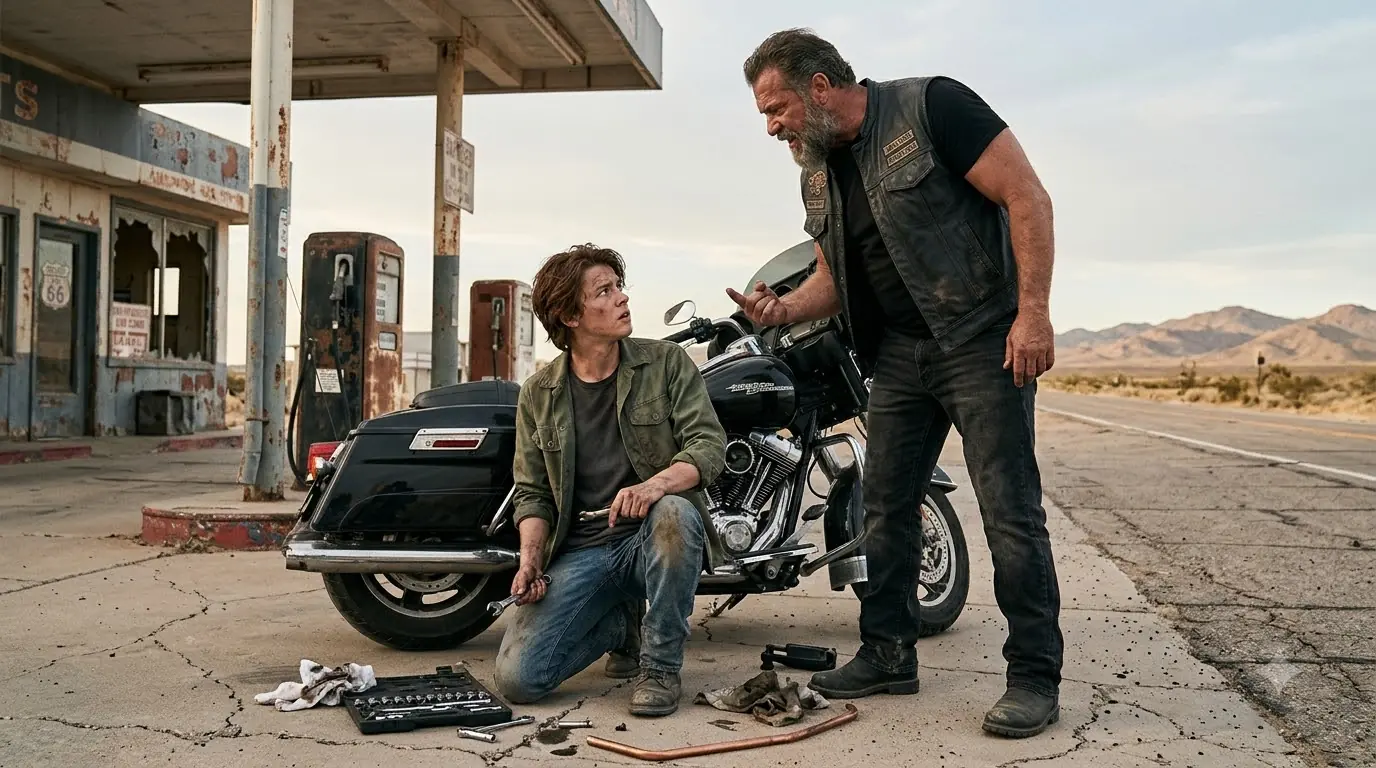
Then a sound rose out of the western horizon, so deep and steady it seemed to come from the desert itself.
At first it resembled distant thunder. Then it became the unmistakable rumble of motorcycles, dozens of them, moving together along the old highway. Hank's confident expression changed before the first headlight appeared over the rise, and Deputy Carl Higgins reached for his radio with a hand that had suddenly lost its steadiness. Leo could not know it yet, but two hundred and forty-seven riders were approaching the very place he had chosen because he believed nobody in the world would ever look for him there.
Three days earlier, Leo had saved one man's motorcycle with a handful of discarded parts and the last of his strength. He had not expected payment, and he certainly had not expected anyone to remember his name. For seventeen years, people had made decisions about him, transferred him, threatened him, and filed his life away under numbers he had never been allowed to choose. On that terrible Tuesday, the sound of arriving engines would force him to confront a possibility more frightening than running away: perhaps someone had finally come back for him.
The story had begun long before the desert, in a cramped garage outside Reno where motor oil lived permanently in the cracks of the concrete floor. Leo's father, Daniel Gallagher, repaired motorcycles for men who could afford new ones and for men who could barely afford gasoline. Daniel preferred the second group, although it meant the family sometimes ate beans for three consecutive evenings. He believed a working machine could change a person's week, and he treated every repair as if somebody's future depended on it.
When Leo was seven, Daniel made him a stool from a discarded wooden crate so he could see over the edge of the workbench. The boy learned to identify tools by touch, to recognize an engine running badly by the rhythm of its sound, and to admit when he did not know what he was looking at. Daniel never pretended that stubbornness could replace knowledge. If a part was unsafe, it stayed on the bench until he found the right answer, even when a customer argued that the bike only had to last another fifty miles.
"Listen before you touch," his father would say, leaning close enough that Leo could smell coffee on his breath. "A machine is always trying to tell you what's wrong, but you have to let it finish talking." Leo remembered the sentence more clearly than he remembered the color of the kitchen walls or the face of his second-grade teacher. After Daniel died, those words became a kind of private language, one that remained intact when almost everything else was taken away.