Scout has now been in our care for almost two years, and his physical condition is stable.
His emotional recovery is still ongoing.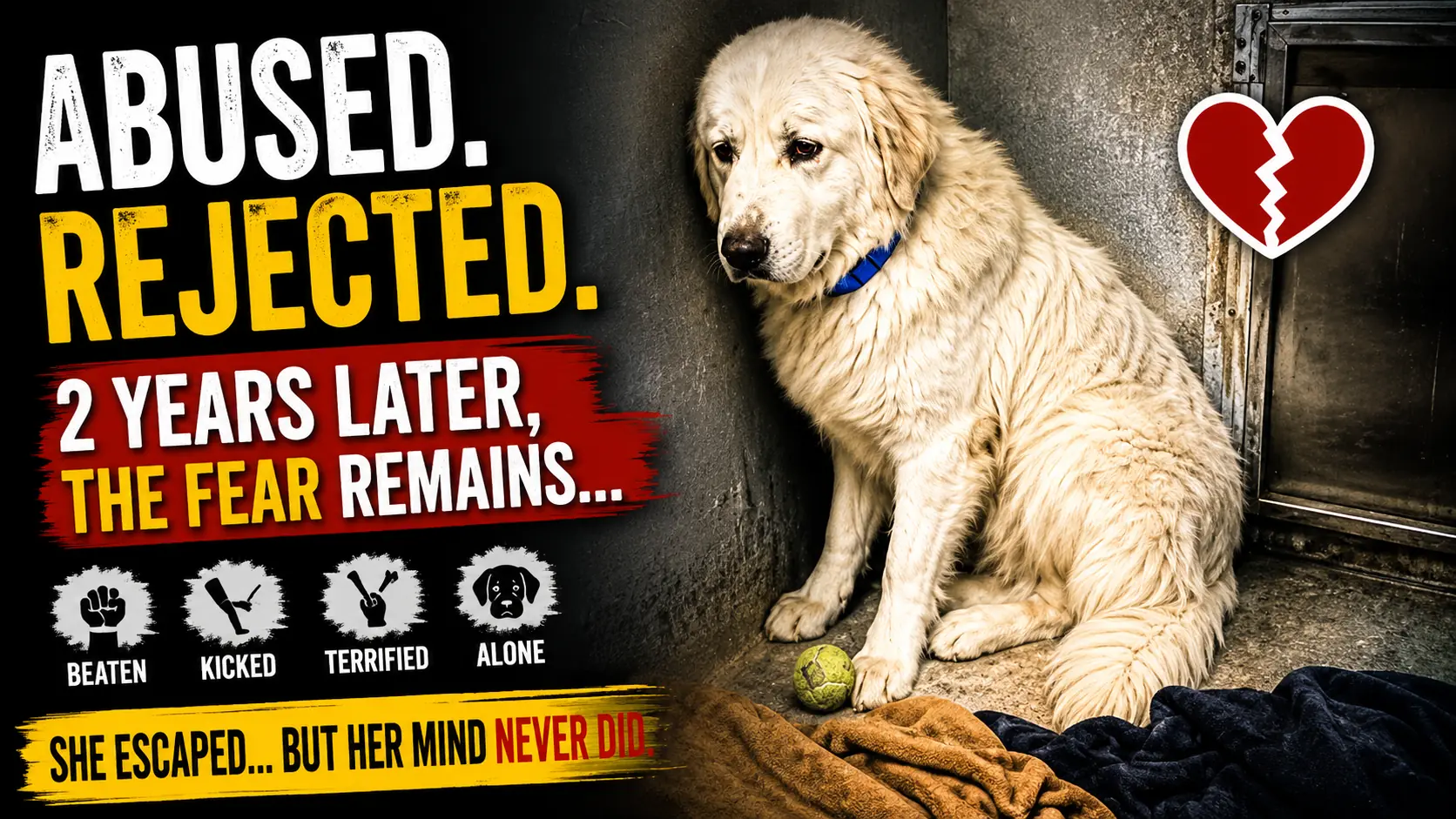
When he first arrived, nearly every interaction with people frightened him. He would retreat immediately when someone entered the kennel area. If the person continued moving toward him, Scout backed into the farthest corner and remained there, trembling.
That response did not disappear simply because the unsafe environment was gone.
For dogs who have experienced repeated mistreatment over long periods, fear can become deeply connected to ordinary human movement.
A raised hand.
Fast footsteps.
Someone leaning over.
A door closing.
A person entering a confined space.
Things that might mean nothing to another dog can trigger an immediate defensive response in a dog like Scout.
That is why our team has spent the last two years focusing on one thing above everything else:
choice.
Scout is never dragged toward a person for affection.
He is not cornered.
He is not forced to tolerate touching simply because someone believes it will help him “get used to it.”
Instead, we work at the distance where he can still think.
Sometimes that means sitting several feet away.
Sometimes it means sitting outside the kennel entirely.
The goal is not to make Scout brave on command.
The goal is to teach him that he has control over whether he approaches.
During his earliest months, Scout would not take food if a person remained nearby.
A caregiver placed treats down and walked away.
Eventually, Scout ate.
Then the caregiver remained a little closer.
He still ate.
Over time, that distance became smaller.
Today, Scout can eat while several familiar staff members sit nearby.
That may not sound dramatic.
For Scout, it is significant.
He has also learned specific voices.
There are two caregivers in particular whose arrival produces a noticeably different response.
Scout still watches carefully.
His body may remain low.
But the trembling is often less intense.
Sometimes his tail moves.
And occasionally, that little paw comes up.
One small wave.
Then another.
Nobody taught him the gesture.
We do not know whether it is a learned attention-seeking behavior, a nervous movement, or simply something Scout does when he is uncertain and interested at the same time.
But it has become part of how we recognize his willingness to engage.
The first time a volunteer saw it, she instinctively wanted to move closer.
Instead, she stayed where she was.
Scout lowered the paw.
Several seconds passed.
Then he took one step forward.
That is how we measure progress with him.
Not by how quickly we can touch him.
By how often Scout chooses to reduce the distance himself.
His physical health is monitored carefully because chronic stress can affect appetite, digestion, sleep, and overall well-being.
Fortunately, Scout has maintained a stable weight.
His appetite is generally good, especially in quieter environments.
During very busy periods, he sometimes waits until hallway activity decreases before eating.
We accommodate that rather than forcing a rigid schedule when possible.
His heart and lungs sound normal on routine examination, and there is no current major medical condition preventing adoption.
He receives preventive veterinary care and regular wellness monitoring.
His body is ready for a home.
His mind needs the right one.
Sleep has been another area where we have seen improvement.
During Scout's first months, he rarely appeared fully relaxed.
Even when lying down, his body remained tight.
Footsteps caused his head to rise immediately.
A person stopping outside his kennel could wake him from the lightest sleep.
Now, especially overnight, staff sometimes find Scout sleeping on his side.
His legs are loose.
His breathing is slow.
Sometimes he does not wake when someone quietly passes.
That is one of the most meaningful changes we have seen.
Deep sleep requires a certain level of security.
Scout is finally experiencing more of it.
He still uses the back corner of his kennel when something overwhelms him.
We have not tried to take that place away.
It is his safe zone.
There is comfortable bedding there, and staff know not to crowd him when he retreats.
Giving him somewhere to withdraw has actually made it easier for him to come forward later.
When Scout knows he can escape an interaction, he is more willing to investigate it.
That principle has shaped much of his rehabilitation.
His walks happen during quieter times.
He wears secure equipment, and the people handling him keep movements predictable.
Outside the kennel, Scout often appears somewhat more relaxed.
He enjoys sniffing.
That behavior gives him a way to gather information without direct social pressure.
At first, he walked with his body low and checked constantly behind him.
Now he sometimes becomes absorbed in a scent and forgets to monitor the person holding the leash for several seconds.
That matters.
Curiosity is beginning to exist alongside fear.
Scout also responds well to calm environments with little unexpected movement.
When brought into a quiet room with a familiar caregiver, he usually investigates the edges first.
Then he watches.
If the person sits on the floor and ignores him, Scout may eventually approach.
He rarely comes directly toward a hand.
Instead, he circles.
Sniffs nearby objects.
Moves closer.
Then away.
Sometimes the entire session ends without physical contact.
That is still successful.
We are not trying to turn every interaction into petting.
We are teaching Scout that sharing a room with a person can be safe.
Eventually, physical contact began happening on his terms.
The first touches were extremely brief.
Scout approached.
A caregiver gently touched beneath his chin.
Scout stepped away.
The person did not follow.
That was the entire session.
Later, Scout returned.
Over many repetitions, he began tolerating longer contact.
Today, there are moments when a familiar caregiver can gently scratch his chest or shoulder for several seconds before Scout chooses to leave.
On especially good days, he remains.
His body is not completely loose.
But he stays.
Those moments show us that the dog underneath the fear still wants connection.
He simply needs proof that connection is safe.
Again and again.
The hardest thing about Scout's progress is that fear sometimes returns suddenly.
A new staff member may enter.
Someone may drop an object.
A person may move too fast.
Scout can go from curious to trembling in seconds.
That does not mean the previous months of work disappeared.
Trauma recovery is not linear.
One frightened afternoon does not erase weeks of progress.
Our team treats those setbacks as information.
What happened?
How close was the person?
Was the environment too noisy?
Was Scout already tired or stressed?
Then we adjust.
His future adopter will need the same mindset.
Scout is not a dog for someone who wants immediate affection.
He may not walk into a new house and sleep on the couch that first evening.
He may choose a corner.
He may watch from another room.
He may tremble when someone reaches toward him.
He may raise that little paw and give two uncertain waves while keeping the rest of his body as far away as possible.
The right person will understand the contradiction.
Scout can be afraid and still curious.
He can want distance and still want companionship.
He can remember danger while slowly learning something new.
We hope his future home is quiet and predictable.
A household without constant traffic would likely be easier for him.
People who understand canine body language would be especially valuable.
Visitors may need careful introductions.
Children or highly active environments may be overwhelming, depending on the individual household and the recommendation of our behavior team.
What Scout needs most is consistency.
The same person putting food down each morning.
The same quiet voice.
A bed that remains where he left it.
A safe corner nobody enters without invitation.
Walks that follow a familiar pattern.
Hands that move slowly.
And a person who does not take his fear personally.
We often tell potential adopters that Scout's first major milestone in a new home may not look impressive.
He might eat while they are sitting in the same room.
He might sleep without waking when they stand up.
He might approach voluntarily.
He might sniff their hand and walk away.
Those are victories.
Eventually, perhaps the trembling will become less frequent.
Maybe the corner will be used less often.
Maybe one day someone will enter the room and Scout will simply remain on his bed.
Then perhaps the paw will come up.
One wave.
Two.
But instead of retreating afterward, he may walk forward.
That is the future we hope for.
We do not expect anyone to erase Scout's past.
That is not realistic, and it is not necessary.
A loving home cannot magically remove every association created by years of fear.
What it can do is add something new.
Hundreds of safe mornings.
Thousands of gentle interactions.
Quiet evenings.
Predictable meals.
Soft beds.
Hands that never strike.
Voices that never threaten.
Doors that open and lead back home.
Over enough time, those experiences can become part of Scout's story too.
Perhaps they will become the larger part.
That is what we mean when we say he deserves a second chance.
Not that someone will make him forget.
That someone will give him enough safety that remembering no longer controls his entire life.
For now, Scout remains with us.
When unfamiliar visitors approach, he often still backs away.
His body trembles.
His eyes stay fixed on them.
Then, sometimes, one front paw slowly lifts.
A tiny movement through the air.
Once.
Twice.
A fearful little dog still finding a way to say hello.
We hope the person who eventually adopts Scout understands what an extraordinary act of trust that really is.
He has every reason to be cautious.
And yet some part of him is still reaching toward people.
Someday, we hope one of those people reaches back in exactly the right way.
Slowly.
Patiently.
Without demanding anything.
And stays long enough for Scout to discover that this time, he is finally safe.