Officer Curtis Bole slammed the cruiser door hard enough to rattle the frame, and the sound cracked across the quiet morning like a starter's pistol. Get on the ground now. The man kneeling by the mailbox didn't move. He was 61 years old, wearing a faded gray Howard University sweatshirt with a coffee stain on the collar, and he was holding a wooden handled garden trowel that had belonged to his mother. He looked up slowly, the way a man looks up when he has been shot at before, and knows the difference between a threat and a bluff.
Officer, he said, "You are making a mistake you will not be able to take back." Boille didn't hear him. Boille never heard anyone once he'd already decided what he was looking at. Rewind 6 hours to 6:14 in the morning before any of this happened. Back when the only sound on Ridgemont Hollow Lane was a sprinkler ticking against a hedge and a morning dove complaining somewhere in a magnolia tree. This was Ashcom County, Virginia, 22 minutes outside of Washington DC by the beltway when traffic behaved itself, which it rarely did.
The houses here didn't have addresses so much as they had names. the Ellery House, the old Callaway Place, the brick Georgian at the top of the rise that had sold for $7,4 million 18 months earlier and still sat half furnished because the new owners only used it four weekends a year. Ridgemont Hollow was the kind of neighborhood where the hedges were trimmed by contract, not by hand, and where a man kneeling in the dirt at dawn was. To most eyes that didn't know better, a strange enough sight to remember. Marcus Ashworth was that man, and it was his own dirt. He had bought the house at 14 Ridgemont Hollow Lane 9 years earlier, back when he was still an assistant director running the bureau's criminal investigative division, back when his wife Denise was alive and used to stand at the kitchen window with a cup of Earl Gray watching him lose the fight against the hydrangeas every single spring.
She'd been gone 3 years now. An aneurysm on a Tuesday afternoon while she was grocery shopping. No warning, no goodbye. And the hydrangeas had become the one argument Marcus refused to lose to anybody, including the root rot that kept creeping up from the mulch bed near the mailbox. He was out there most Saturday mornings before the sun cleared the treeine in sweatpants gone gray from a hundred washes and a t-shirt with his alma mater's name cracking off the chest because for one hour a week nobody needed him to be director of the Federal Bureau of Investigation.
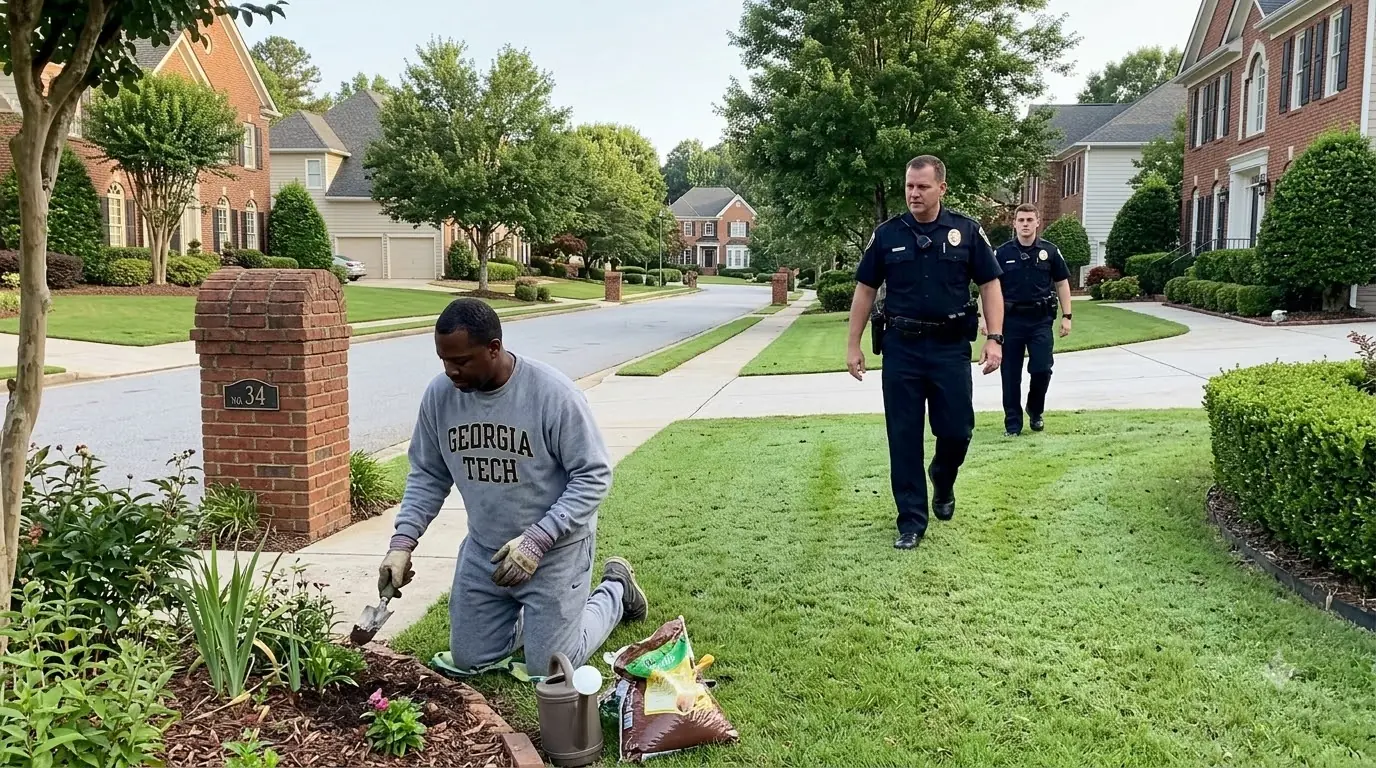
He could just be a man with dirt under his fingernails missing his wife talking softly to a row of flowers she used to love. 23 days earlier in a Senate hearing room with more cameras pointed at him than he'd faced. In 31 years of federal service, Marcus Ashworth had been confirmed as the ninth director of the FBI, sworn in with his hand on his mother's Bible, the same Bible she had carried to work every day of her life as a domestic housekeeper for families in neighborhoods exactly like this one. families who paid her in cash and never once asked her last name. He kept that Bible in a drawer of his desk in the Hoover building. Now, he kept her tel in his own garden shed, and every Saturday he pulled it out and used it, because some inheritances you're supposed to spend down to nothing, and some you're supposed to keep using until your hands remember the shape of the person who gave them to you. his security detail.
Six agents rotating in three shifts, armored suburbans, the whole choreography of protecting the most powerful law enforcement officer in the country, had been stationed at the estate's front gate that morning, 400 yd down the drive at Marcus' own explicit and repeated instruction. One hour, he'd told special agent Daniel Cross the night before. Let me have one hour where I'm just a man in his own yard. Dany, that's all I'm asking. Cross hadn't liked it.
Cross never liked it. But you did not argue twice with Marcus Ashworth once he'd made up his mind. And so at 6 that morning, the detail held its perimeter at the gate while the director of the FBI knelt 50 yards away in a sweatshirt with a hole in the cuff, utterly, deliberately, dangerously alone, two streets over in a Ashcom County patrol cruiser with 61,000 m on it and a check engine light that had been on for 3 weeks. Officer Curtis Bole was drinking gas station coffee and complaining about the commander's offensive line to a rookie who had learned in his first four months on the job to nod at roughly the right intervals. Officer Nathan Cole was 24 years old, 11 weeks removed from the academy and still believed, genuinely, stubbornly believed that the badge on his chest meant something close to what they'd told him it meant in training.
He hadn't yet learned that Curtis Bole had a private rule book that ran underneath the department's actual rule book, a set of instincts 11 years in the making about who belonged on which streets and who didn't. instincts that Bole called good police work and that his last three complaints. Two dismissed without real investigation. One still sitting open as a folder nobody wanted to touch. Called something else entirely. Porch pirates again, Bole said, turning the wheel with two fingers.
Report came in last week. Amazon boxes walking off half these driveways. Guys ride the bus in from the city. Grab and go before anybody's even had coffee. He said, "The city, the way some men say a curse word, feels pretty dead out here," Cole offered, looking at the empty, gleaming sidewalks.
"It's never dead," Bole said. "You just got to know what you're looking at." The cruiser came around the bend onto Ridgemont Hollow Lane at 6:41, and Bole's foot found the break before his brain had finished the thought. He was looking at a black man in sweatpants kneeling in the mulch near the mailbox of a house that in Curtis Bole's 11 years of pattern recognition did not belong to a black man in sweatpants. That was the entire chain of reasoning. It took him 4 seconds and every one of those seconds felt to him like certainty.
There he said already reaching for the door handle. Look at that. Cole followed his eyes. He's got a trowel, Boille. He's gardening.
He's casing it, Bole said. And something in his voice had gone flat and sure. The tone of a man who has stopped listening to the world and started listening only to himself, checking if the mails piled up, seeing if anybody's home. You think a guy who looks like that owns a house on this street? Cole didn't answer because 11 weeks into the job, he still had a conscience that hadn't yet been sanded down.
And the conscience was telling him something the training academy hadn't put into words. That the sentence his training officer had just said out loud was not a theory about a crime. It was a theory about a man's skin. They got out of the car. Marcus heard the doors. that particular heavy official slam that a man who has spent three decades around federal vehicles could identify with his eyes closed and stood.
One hand pressed to the small of his back, the trowel still loose in his other palm. He watched Bole come across the lawn first, walking with the rolling chestforward swagger of a man who has never once in his adult life had to wonder whether a room would take his authority seriously. Cole trailed two steps behind, and something about the way the younger officer held his shoulders, tight, apologetic, already bracing, told Marcus everything he needed to know about which one of these two men might eventually matter. Morning, officers, Marcus said. His voice was calm.
It was always calm. Three decades of interrogation rooms had burned the panic reflex out of him a long time ago. Can I help you? Step away from the mailbox," Boil said, stopping at the edge of the grass, one hand resting on his duddy belt in a posture that was pure theater and pure threat at once. Marcus raised an eyebrow and did not move an inch.
"Excuse me, you heard me. Drop the tool. Step back onto the sidewalk. I am tending my garden," Marcus said, setting the trowel down in the mulch with the unhurried precision of a man giving nothing away for free. Is there a problem?
Yeah, there's a problem, Bole said. And now he stepped onto the grass itself, closing the last 6 ft of distance until he was standing inside the small circle of space that in any ordinary conversation between two adults belongs to the person being spoken to. We've had thefts in this neighborhood, and I find you crouched at somebody's mailbox in a stained t-shirt on a property that plainly isn't yours. Something in Marcus' posture changed then. Not fear, nothing close to fear, but the specific ancient straightening of a man who has decided a line is about to be crossed and wants the other side to see him standing at his full height when it happens.
I assure you, officer, this property is mine, and I am not going through anyone's mail. Boil laughed. It was not a laugh that contained any real humor in it. Yours? Sure, let's see some ID.
My identification is inside the house, Marcus said, and his voice dropped, not louder, but lower into the register he used in briefings with three star generals and Senate committee chairs, a register that had made grown men reconsider their next sentence for 30 years. I'll retrieve it now. You're not going anywhere, Bole snapped, and he reached out and closed his hand around Marcus's forearm. That was the first frozen moment. For two full seconds, nothing moved.
The sprinkler two houses down kept ticking. A jogger's footsteps faded around the far corner without slowing down. Without seeing, the way most footsteps in most stories like this one keep walking. Marcus looked down at the hand on his arm the way a man looks at a stain that has just appeared on a clean shirt, not with panic, but with a kind of cold cataloging disbelief. "Remove your hand," Marcus said very quietly.
"Before you make a decision you cannot undo. You have no reasonable articulable suspicion to detain me, and none whatsoever to put your hands on me while I am standing on my own property." Boille's face went a deep modeled red, the color of a man who has just heard his own authority questioned in language too precise to argue with and hates the questioner for it more than he would have hated an insult. Oh, we got a lawyer out here. Cole, grab his other arm. Cole hesitated.
It was the kind of hesitation that lasts less than a second and changes nothing in the moment and everything in the story. Boille, maybe we let him go get his ID. Grab his arm, Boille roared, and before either Cole or Marcus could do anything else, Boille wrenched Marcus' right arm behind his back and drove him forward against the brick pillar of his own mailbox. Marcus' cheek met warm, sunbaked brick. The cuffs went on with a sound like a small machine, finishing a job it had done 10,000 times before.
That flat ratcheting click that means something has just been permanently decided. Marcus didn't struggle. He let his cheek rest against the brick, breathing evenly, and when he spoke, his voice carried no strain at all, which somehow made it worse to hear. You are making the most expensive mistake of your career, officer. Shut up, Bole said, patting him down hard enough to bruise. finding no weapon, no wallet, nothing but a phone in the sweatshirt pocket, which he yanked out and dropped into an evidence bag without looking at it twice, prowling, failure to identify, resisting, "You're going downtown, and we'll see how much of that fancy talk survives a holding cell." Two houses away, behind a curtain of raw silk, 83-year-old Eleanor Pratt, watched the whole thing from her breakfast nook with her hand pressed flat against her chest.
And then she picked up her cordless phone and dialed the one number in Ridgemont Hollow that everyone quietly understood was for emergencies of an unusual kind. The drive to the 9inth district station took 11 minutes, and it was the longest 11 minutes of Nathan Cole's short career. The plexiglass divider kept the sound thin, but not the tension. Boille talked the whole way. Loud, expansive, pleased with himself, the way men get when they've convinced themselves that cruelty was actually competence.