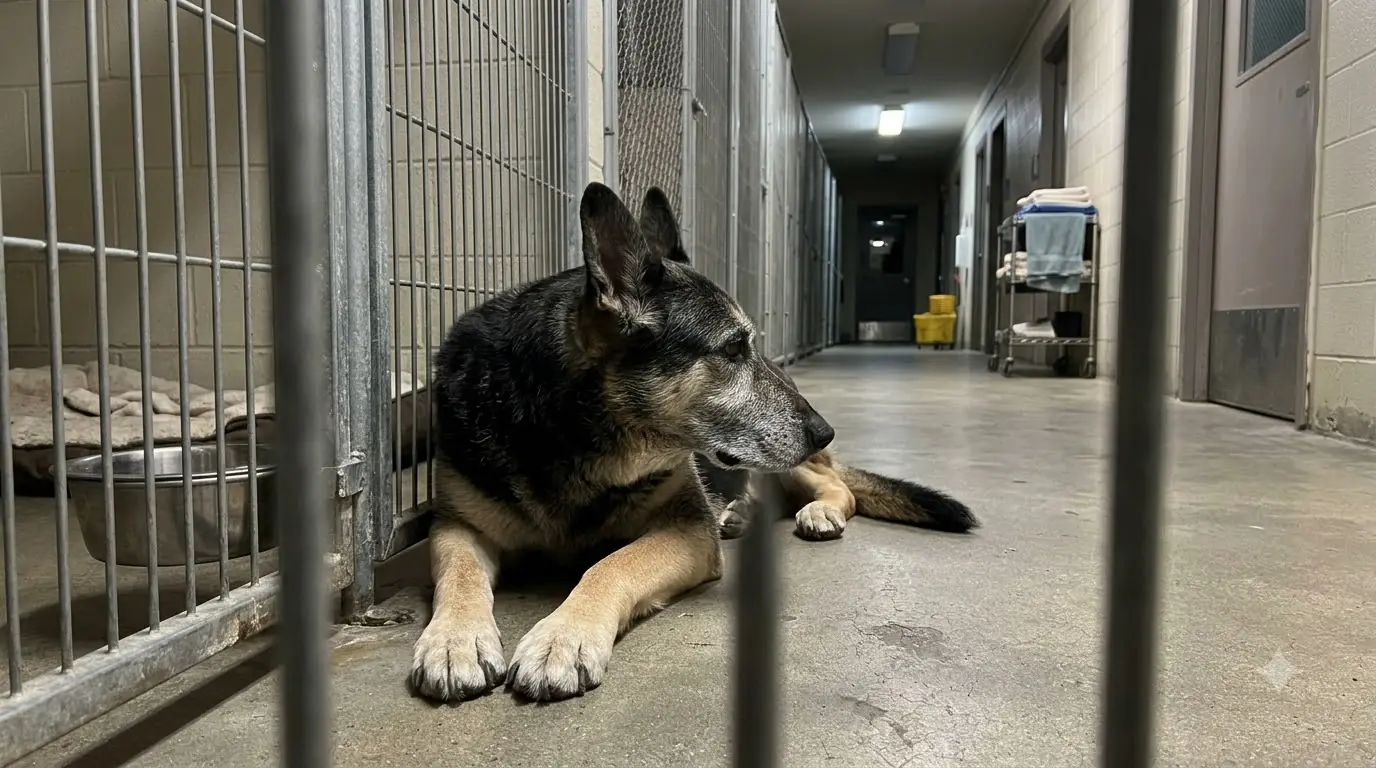
Luna was one of the quietest dogs in the kennel row.
That did not mean she was unaware of what was happening around her.
She noticed almost everything.
The 8-year-old German Shepherd mix rarely barked along with the other dogs. Even when the kennel area became loud, Luna usually remained silent.
Instead, she watched.
Most evenings, she lowered herself beside the kennel door and stretched her head forward until her nose rested close to the bars.
Sometimes she pushed her muzzle gently between them.
Not far enough to become trapped.
Just enough to smell the hallway more clearly.
Whenever another dog was taken out, Luna stood.
She followed the movement with her eyes until the dog and handler disappeared.
Then she stepped closer to the gate.
She sniffed.
For several seconds, she seemed to study the air left behind in the corridor.
Afterward, Luna returned to the floor.
At night, when the shelter finally became quieter, she settled in the same place.
Her gray muzzle rested between her paws.
Her body faced the door.
And that was where she fell asleep.
Luna’s Behavior Was Easy to Misread
People who saw Luna near the kennel gate often assumed she was waiting for someone.
That may have been possible.
But it was not something we could prove.
We did not know enough about Luna’s previous life to say whether she had once lived with another dog, whether she was accustomed to following people through doorways, or whether the hallway had simply become the most interesting part of her shelter environment.
There are many reasons a dog may position herself near an exit.
She may be monitoring movement.
She may be seeking social contact.
She may feel safer when she can see what is happening.
She may have learned that doors predict walks, food, or interaction.
She may simply prefer that location.
Our job was not to invent the reason.
Our job was to observe whether the behavior affected her welfare.
Over time, it became clear that it did.
What We Knew About Luna at Intake
Luna entered our care as an older adult with incomplete history.
Her age was estimated at approximately eight years.
Her appearance was consistent with a German Shepherd mix.
She had a dark saddle pattern, lighter markings along her legs and face, and noticeable gray around the muzzle.
We did not have reliable medical records confirming previous diagnoses or long-term medication use.
We could not verify where she had lived before coming into rescue.
We also could not confirm whether she had been intentionally abandoned, lost, surrendered, or transferred through another circumstance.
When history is incomplete, we avoid filling in the gaps with assumptions.
What we could document was her physical condition.
Luna was slightly underweight.
Her ribs were easy to feel beneath her coat.
She had moderate muscle loss over her hindquarters.
Her nails were somewhat overgrown.
She moved independently but appeared stiff after resting.
Her coat was generally intact, though somewhat dull.
She drank normally after intake and accepted food.
She did not rush through meals.
She ate steadily, occasionally pausing to look toward the kennel entrance.
Her First Veterinary Examination
Luna’s initial physical exam was thorough.
Her temperature was within an expected range.
Her heart and lungs sounded normal on routine auscultation.
Her abdomen was soft and did not produce an obvious painful response.
Her eyes showed mild age-related changes but no immediate emergency.
Her ears contained moderate debris and mild chronic inflammation.
Her mouth had visible tartar and early periodontal disease.
Several teeth required monitoring, but there was no urgent dental infection at intake.
Her skin showed no major wounds.
Her paws were intact.
Then the veterinarian evaluated her movement.
Luna walked with a shortened stride behind.
The stiffness was most noticeable when she first stood from lying down.
After several minutes of walking, her gait improved.
That pattern raised concern for chronic joint disease.
Orthopedic Findings
The veterinarian carefully palpated Luna’s hips, knees, spine, shoulders, and elbows.
She tolerated handling but became mildly tense during hip extension.
There was reduced flexibility through both hips.
Her lower back also seemed somewhat stiff.
No acute fracture was suspected.
There was no obvious neurological deficit.
Luna could place her paws normally.
She could support her own weight.
Still, the age, muscle loss, and stiffness justified imaging.
Radiographs showed degenerative changes consistent with osteoarthritis.
There were also mild chronic changes along portions of the lower spine.
Nothing suggested a recent traumatic injury.
The diagnosis was not surprising for a dog of Luna’s age and build.
But it was important.
A dog who chooses to lie near a hard kennel gate for hours may be placing herself somewhere that is not physically comfortable simply because she is strongly motivated to monitor the hallway.
That changed how we thought about her behavior.
Her Preferred Spot Was Not Her Best Spot
Luna had access to padded bedding.
She had a soft bed farther inside the kennel.
She used it sometimes.
But during busy evening periods, she consistently returned to the gate.
That meant her social or environmental motivation was strong enough to outweigh some of her physical comfort.
For an arthritic dog, that mattered.
Hard flooring can worsen stiffness.
Repeatedly standing every time another dog moved through the hallway also increased the number of transitions between lying and standing.
Those small movements may sound insignificant.
For an older dog with chronic joint discomfort, they add up.
The veterinary and behavior teams began working together on a plan.
Pain Management Came First
Luna began a veterinary-prescribed pain-management program appropriate for her age and laboratory results.
Baseline bloodwork had already been performed.
Her kidney and liver values were acceptable for the selected treatment plan.
She was monitored closely for changes in appetite, vomiting, diarrhea, unusual lethargy, increased thirst, or other possible side effects.
Medication alone was not enough.
Her bedding was upgraded.
Non-slip surfaces were used where possible.
Her daily walks became shorter but more frequent.
The goal was steady low-impact movement rather than long strenuous exercise.
As Luna’s discomfort became better controlled, staff noticed that she stood more easily.
That was encouraging.
But she still returned to the gate.
The Hallway Was Still More Important Than the Bed
Even with better pain control, Luna remained focused on movement outside her kennel.
When a dog walked past, her ears shifted forward.
She stood.
She watched.
If the dog disappeared around the corner, Luna often remained standing for several seconds.
Then came the sniffing.
She moved her nose toward the lower bars.
The hallway may have been empty to human eyes.
For Luna, it was full of information.
Dogs process the world through scent in ways people cannot.
Another dog’s passage could leave behind a complex trail of odor.
That may have been part of what kept her interested.
But again, the problem was not that Luna noticed.
The concern was how much of her day she spent monitoring.
She Was Not Sleeping Deeply Enough
Staff began documenting Luna’s sleep.
During quiet midday periods, she could sleep well.
She sometimes stretched onto her side and remained asleep for long periods.
During late afternoon and evening, things changed.
Doors opened.
Dogs moved.
Handlers passed.
Luna’s head lifted repeatedly.
She stood.
She repositioned.
She returned to the gate.
At night, she did sleep.
But she slept facing the door.
Any unusual sound could bring her head up.
The behavior team began to wonder whether Luna was experiencing a form of environmental hypervigilance.
That term does not mean we knew what caused it.
It simply described the fact that she remained unusually alert to movement and sound around her.
Shelter Stress Can Be Quiet
Luna was a good example of why shelter stress does not always look dramatic.
She was not constantly barking.
She was not destroying bedding.
She was not lunging at people.
She was not spinning in circles.
Yet she was still having difficulty disengaging from the environment.
Quiet dogs can struggle too.
Sometimes their stress is easier to miss because it is less disruptive.
Luna’s behavior required just as much attention.
Creating Predictable Outings
The behavior team adjusted her daily schedule.
Luna began receiving walks at more consistent times.
Predictability can reduce the need to respond to every passing person.
If a dog learns that certain cues reliably predict an outing, random footsteps may become less important.
Her walks were gentle.
Luna liked to sniff.
She investigated grass, fence lines, and tree trunks slowly.
She did not need a fast pace.
For her joints, slower was better.
For her brain, sniffing was valuable enrichment.
She often returned to the shelter more relaxed after these outings.
Quiet Time Away From the Kennel
Whenever staffing allowed, Luna spent time in a quieter room.
The first few sessions were revealing.
When she entered, she immediately checked the door.
Then she checked the room.
She sniffed the walls.
She walked one slow circle.
After several minutes, she lay down.
At first, she kept her head facing the entrance.
Later, she shifted.
Eventually, she slept.
That told us something important.
Luna could relax when the environment gave her fewer reasons to monitor movement.
The kennel row was likely maintaining part of the behavior.
Her Appetite Remained Stable
Throughout this period, Luna continued eating.
Her meals were measured to support gradual improvement in body condition.
Because she was slightly underweight but also arthritic, we wanted careful weight gain without allowing excess body fat.
Extra weight could worsen joint pain.
Her diet was complete and balanced.
She ate more consistently in quieter settings.
When hallway activity was intense, she sometimes paused.
Once the noise decreased, she resumed.
That pattern reinforced the idea that environmental awareness affected several parts of her routine.
Weight and Muscle Recovery
Over the next several weeks, Luna’s body condition improved modestly.
Her ribs remained easy to feel but were no longer as prominent.
Her hind-limb muscle returned slowly as regular walking and pain control allowed more comfortable movement.
This process could not be rushed.
Muscle rebuilding in an older dog takes time.
Too much exercise could worsen arthritis.
Too little could accelerate deconditioning.
The veterinary team adjusted activity based on how Luna moved during and after walks.
Her response was positive.
Dental Care Became the Next Priority
Luna’s mouth did not require emergency treatment, but the dental disease observed at intake still needed attention.
As she became medically stable, a dental procedure was planned.
Pre-anesthetic bloodwork was reviewed.
Dental radiographs identified several areas of periodontal disease below the gumline.
A small number of diseased teeth required extraction.
The remaining teeth were cleaned.
Luna recovered without a major complication.
She received appropriate pain control.
For several days, her food was softened.
Once healed, she returned to her normal diet.
Addressing dental discomfort removed another chronic source of pain.
The Gate Behavior Did Not Disappear Immediately
After her arthritis and dental discomfort were better managed, Luna still preferred the kennel door.
That was useful information.
It meant the behavior could not be explained only by pain.
There was likely a strong learned or emotional component.
Rather than trying to physically block her from the gate completely, staff worked on providing alternative resting spots that were equally interesting.
One bed was moved closer to the front while still giving her more cushioning.
A visual barrier was used selectively to reduce constant stimulation from one direction.
Enrichment was placed farther from the entrance.
These changes encouraged Luna to spend more time away from the bars without forcing her.
Rewarding Disengagement
Staff also began reinforcing moments when Luna chose to disengage from the hallway.
If she heard footsteps and remained on her bed, a caregiver might quietly deliver a treat.
If another dog passed and Luna looked away on her own, that choice was reinforced.
The goal was not to teach her that watching was “bad.”
It was to help her discover that she did not have to respond to every movement.
Progress was gradual.
At first, Luna still stood for almost every dog.
Later, some dogs passed without more than a head lift.
That was a meaningful improvement.
Social Contact Helped
Luna enjoyed calm human companionship.
She was not excessively demanding.
She liked slow petting along her chest and shoulders.
She sometimes leaned against familiar caregivers.
She did not enjoy people reaching directly over her head.
Staff respected that preference.
When someone sat beside her quietly, Luna often relaxed more than when people repeatedly called her name.
She seemed to value presence more than excitement.
That information would later be useful for placement planning.
No Evidence of Severe Separation Distress
One question was whether Luna’s doorway behavior represented severe separation anxiety.
Her behavior did not support that diagnosis clearly.
When familiar staff left a quiet room, Luna watched the door.
Sometimes she stood.
But she did not consistently panic.
She did not attempt to escape.
She did not vocalize continuously.
She often settled within several minutes.
That suggested her shelter behavior was more likely related to environmental vigilance, social monitoring, learned expectations, or a combination of factors rather than severe separation distress alone.
A Medical Setback
Several weeks into care, Luna had a more difficult morning.
She rose slowly and appeared noticeably stiffer.
Her appetite was slightly reduced.
Because older dogs with known arthritis can still develop unrelated illness, the veterinary team reassessed her.
Her temperature was normal.
Her abdomen remained soft.
She showed no neurological deficit.
Her joint discomfort was more pronounced but there was no evidence of a new acute injury.
The episode was considered an arthritis flare.
Her activity was reduced temporarily.
Her pain-management plan was reviewed.
Within several days, Luna returned closer to baseline.
The Setback Changed Her Door Routine Briefly
During the flare, Luna spent less time at the gate.
Not because her interest in the hallway disappeared.
Standing was simply less comfortable.
That made the importance of her physical condition especially clear.
Once her pain improved, the gate behavior partially returned.
But by then, the behavioral plan had already begun helping.
She spent more time on the padded bed near the front.
She stood less frequently.
She recovered faster after dogs passed.
A Foster Home Became the Next Goal
The shelter could manage Luna safely.
But a quieter home offered something the kennel could not.
Fewer dogs moving past.
Fewer sudden barks.
Fewer footsteps with unpredictable meaning.
More opportunities for deep sleep.
We began searching for a foster caregiver comfortable with an older large-breed dog and chronic arthritis.
The home needed good traction.
Limited stairs would be ideal.
Luna needed controlled exercise and predictable routines.
She also needed someone willing to let her decompress rather than filling her first week with visitors.
Eventually, the right foster placement became available.
Luna’s First Day in Foster Care
Luna entered the house slowly.
Her nose immediately went to work.
She sniffed the entryway.
The walls.
The edge of a rug.
Then she walked toward the front door.
She inspected the bottom seam.
She stood there for several seconds.
Her foster caregiver remained quiet.
A comfortable orthopedic bed had been placed nearby but not directly against the door.
Luna walked past it.
She explored the living room.
Then she came back.
She lay on the rug facing the entrance.
Old habits had traveled with her.
The First Night
That night, Luna was given several resting options.
A bed near the living room.
Another in a quieter corner.
A folded blanket near the bedroom.
She chose the living room bed.
But she positioned herself so she could see the front door.
When a car passed outside, her head came up.
When the house settled again, she lowered it.
Sometime after midnight, the foster caregiver checked on her.
Luna was asleep.
Not curled at the door.
On the bed.
Still facing the entrance.
But farther away than she had been in the shelter.
That was a start.
Home Sounds Were Easier to Understand
Over the next several days, Luna began learning the household soundscape.
The refrigerator.
The heating system.
The neighbor’s car.
A delivery truck.
The foster caregiver walking from one room to another.
Unlike the shelter, there were not dozens of dogs moving unpredictably through a corridor.
This made a difference.
Luna stopped standing for every sound.
She still noticed.
But she no longer responded physically each time.
Her sleep improved first.
She began spending longer periods on her side.
Sometimes her back faced the door.
That was new.
The Front Door Remained Important
Luna was still interested in arrivals and departures.
When the foster caregiver put on shoes, she watched.
When a leash came out, she stood.
When someone left the house, she often followed to the entryway.
But she did not remain there indefinitely.
At first, she waited several minutes.
Then she moved to her bed.
A camera confirmed that she could settle while alone.
There was no destructive behavior.
No continuous barking.
No frantic pacing.
That was reassuring.
Her Walks Became More Comfortable
With consistent pain management and better rest, Luna’s mobility improved.
She remained an arthritic senior dog.
She did not become physically young again.
But she stood more easily.
Her first steps after sleep were smoother.
She enjoyed neighborhood walks.
She moved at a moderate pace.
Her nose remained her strongest guide.
Luna could spend several minutes investigating one patch of grass.
That was perfectly acceptable.
Her foster caregiver avoided long, strenuous walks.
The goal was mobility and enjoyment, not endurance.
Bathroom Habits
Luna appeared familiar with eliminating outdoors.
She received frequent scheduled breaks during the transition.
Her urination was normal.
She did not strain.
Her stool remained well formed.
No persistent accidents occurred.
As she learned the routine, she began standing near the door when she needed to go outside.
That behavior looked different from her shelter door monitoring.
It had a clear practical context.
The foster caregiver learned to distinguish the two.
Her Weight Reached a Better Range
Luna continued gaining a small amount of weight.
Her body condition moved into a healthier range.
Her meals were then adjusted to maintain rather than increase.
For an arthritic German Shepherd mix, staying lean would remain important.
Her muscle condition also improved.
Her hindquarters looked stronger.
She could rise from the orthopedic bed with less effort.
These changes were gradual but measurable.
A New Sleeping Spot Appeared
About two weeks into foster care, Luna began using the quieter bed farther from the front door.
At first, only during the afternoon.
Then one evening.
Then overnight.
She did not abandon the entryway completely.
But she was expanding her choices.
One night, the foster caregiver walked through the living room and found Luna sleeping with her back toward the door.
Her gray muzzle rested on the edge of the bed.
She did not wake when a car passed outside.
That moment meant more to us than any dramatic display of affection.
Deep rest is a basic welfare need.
Luna was finally getting more of it.
Follow-Up Veterinary Care
At her recheck, Luna’s arthritis remained stable.
Her medication continued to provide acceptable comfort.
Repeat laboratory testing showed no significant adverse changes related to treatment.
Her weight was appropriate.
Her dental extraction sites had healed.
Her heart and lungs remained stable on examination.
No new medical problem emerged.
The focus shifted from short-term stabilization to long-term senior care.
What Luna Will Need Going Forward
Luna’s osteoarthritis will require lifelong management.
That may include veterinary-prescribed pain medication, appropriate exercise, weight control, supportive bedding, and periodic laboratory monitoring.
Her needs may change with age.
If she develops sudden weakness, severe lameness, collapse, loss of coordination, major appetite changes, or other new symptoms, those should be evaluated rather than attributed automatically to aging.
Routine dental follow-up will also remain important.
At eight years old, Luna is entering a period when regular senior wellness examinations can detect changes earlier.
Behaviorally, She Still Needs Patience
Luna is calmer in a home.
That does not mean every behavior has disappeared.
She still watches doors.
She still notices when another dog passes during walks.
She still listens to footsteps.
In a new permanent home, some of her shelter habits may temporarily return.
She may sleep facing an exit.
She may follow household members.
She may rise when someone leaves.
Those behaviors should be managed through routine and reassurance, not punishment.
Adoption Planning
Luna appears best suited to a household that appreciates an older dog’s pace.
She enjoys walks but does not need extreme exercise.
She likes people but does not require constant interaction.
She benefits from quiet resting areas.
Good traction and limited unnecessary stairs would help her joints.
Any resident dogs would need appropriate introductions.
Luna’s interest in other dogs in the shelter hallway did not automatically mean she would enjoy every dog in a home.
Compatibility must always be assessed individually.
What We Cannot Say About the Hallway
We may never know what Luna thought when she watched dogs disappear.
We cannot say she believed they were being adopted.
We cannot say she wondered when it would be her turn.
We cannot know whether the scent of each departing dog reminded her of someone from her past.
Those would be human stories placed onto canine behavior.
What we can say is that Luna noticed every departure.
She often stood.
She watched.
She sniffed the hallway afterward.
And then she returned to the kennel gate.
That pattern was real.
The Pattern Is Different Now
In foster care, Luna still hears doors.
But they mean different things.
The front door opens for walks.
It opens for deliveries.
It opens when the foster caregiver leaves.
Then, later, it opens again.
Someone returns.
Luna has learned that departures do not always mean permanent disappearance.
Whether she understands that concept in human terms does not matter.
Her behavior has changed.
She no longer spends every evening lying against an exit.
She no longer stands for every movement.
She rests.
Luna Today
Luna remains a senior German Shepherd mix with chronic osteoarthritis.
Her gray muzzle is still there.
Her slower first steps are still there.
Her quiet personality is still there.
The goal was never to change those things.
The goal was to improve comfort and reduce the amount of time she spent unable to disengage from her surroundings.
That progress is happening.
Luna is eating well.
Her body condition is healthier.
Her dental disease has been addressed.
Her pain is being managed.
She enjoys slow walks and long sniffing sessions.
She sleeps more deeply.
She approaches familiar people for calm affection.
She can remain on her bed while someone walks through the room.
And sometimes, when the front door opens, Luna does not even stand.
She lifts her head.
She listens.
Her nose moves once.
Then she lowers her gray muzzle back onto her paws.
The door closes.
The house becomes quiet.
And Luna goes back to sleep.
At the shelter, she spent night after night facing a hallway where dogs came and went.
Today, there is still a door in front of her.
But it is no longer the only place she knows how to rest.
More often now, Luna chooses the soft bed farther inside the room.
She turns once.
Lowers herself carefully.
Sometimes she faces the door.
Sometimes she does not.
And that simple freedom to stop watching has become one of the clearest signs that she finally feels safe enough to rest.