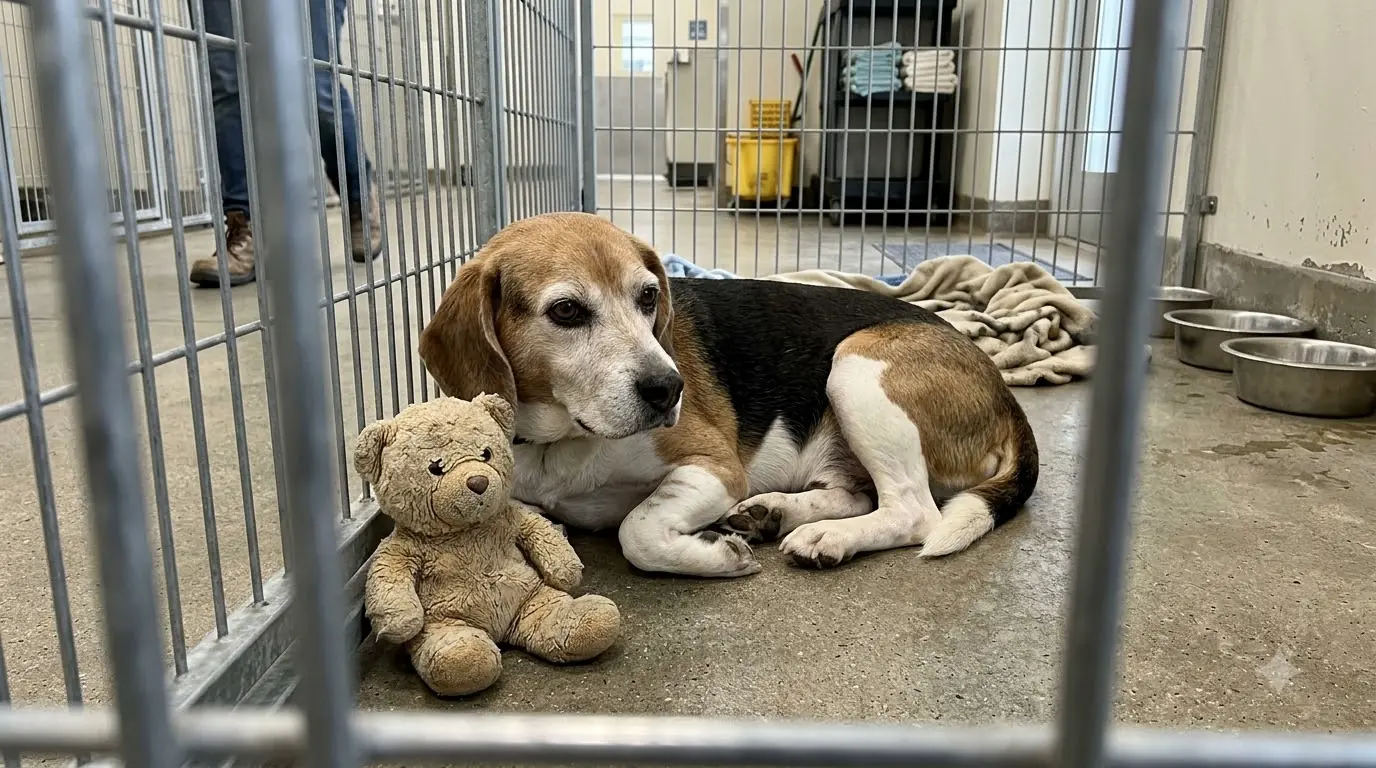
Teddy’s stuffed bear was old enough that no one could remember exactly when it had first entered his kennel.
The fabric had faded.
One ear was slightly flattened.
The stuffing had shifted inside the body after months of being carried, dropped, slept beside, and picked up again.
But Teddy treated it differently from every other toy.
The 10-year-old Beagle mix carried the bear to his food bowl.
He placed it beside his blanket before lying down.
If a caregiver entered, Teddy often picked it up before approaching.
And whenever visitors appeared at the front of the kennel, the bear came with him.
Teddy would grab the toy gently by the middle.
He walked to the gate.
His tail wagged.
Then he stood there with the stuffed bear in his mouth, watching.
Some people stopped.
Some continued to the next kennel.
When they passed, Teddy remained at the gate for several seconds.
Eventually, he turned around and carried the bear back to his bed.
It became such a predictable part of his routine that staff began checking for the toy almost as automatically as they checked his water bowl.
One evening, however, Teddy did something slightly different.
After the last visitors had left and the shelter had become quiet, he carried the bear to the kennel door.
He lowered it carefully onto the floor near the gate.
Then Teddy turned in a small circle directly behind it.
He curled up.
His nose rested close to the toy.
When staff arrived the following morning, Teddy was still there.
So was the bear.
Teddy Arrived With an Incomplete History
Teddy came into our care as a senior dog with limited reliable background information.
We knew his approximate age.
We knew he was a Beagle mix.
Beyond that, many details were uncertain.
We did not have a complete record of where he had spent the previous decade.
We could not verify whether the stuffed bear came from a previous home or had been given to him after arriving in rescue.
We did not know how long he had been experiencing physical discomfort.
And we could not responsibly say that Teddy carried the toy because it reminded him of a specific person.
That kind of interpretation may sound emotionally satisfying.
It would also go beyond the evidence available to us.
What we could observe was simple.
Teddy repeatedly chose the bear.
It appeared to be a familiar object he was comfortable carrying.
And when the environment became socially active, the toy was often with him.
His Physical Condition Needed Attention
At intake, Teddy was alert but tired.
He walked independently.
His nose was active, and he investigated the floor, the room, staff shoes, and every food container that entered his space.
That behavior was unmistakably Beagle-like.
But he moved slowly.
His body condition was below ideal.
His ribs were easy to feel, and there was visible loss of muscle over his hindquarters.
He was not critically emaciated.
Still, for a 10-year-old dog, maintaining healthy muscle is especially important.
His coat was generally intact but lacked some of the shine expected in a dog receiving consistent nutrition.
His nails were moderately long.
There were no major wounds.
Teddy drank water normally after settling.
Food interested him immediately.
But the way he ate suggested something was wrong.
Eating Took Teddy Longer Than Expected
Teddy approached his bowl eagerly.
He sniffed.
He began eating.
Then he stopped after several bites.
He chewed carefully on one side of his mouth.
A piece of dry food fell out.
Teddy picked it up, tried again, and continued.
The pattern repeated.
His appetite was present.
Chewing appeared uncomfortable.
That distinction mattered.
A dog can be hungry and still avoid eating efficiently because of oral pain.
Staff documented the behavior and softened his next meal.
Teddy ate more comfortably that way.
His stuffed bear remained beside the bowl the entire time.
His First Veterinary Examination
Teddy received a complete senior veterinary examination.
His temperature was within the expected range.
His heart and lungs sounded stable on routine auscultation.
His abdomen was soft and did not produce an obvious painful response.
His eyes showed mild age-related changes but no urgent abnormality.
His ears contained debris and mild inflammation.
Then the veterinarian examined his mouth.
Dental disease was immediately apparent.
Teddy had heavy tartar, gingival inflammation, and several teeth that appeared severely compromised.
Some were loose.
Others showed gum recession.
The odor from his mouth was stronger than expected.
These findings made dental pain a likely contributor to his slow eating.
But his mouth was not the only concern.
Teddy Was Stiff Behind
When Teddy stood after resting, his first few steps were short.
He sometimes paused before bringing his hindquarters fully upright.
Once he had been walking for several minutes, his gait became smoother.
The veterinarian examined his hips, knees, spine, paws, and lower back.
There was mild discomfort during hip extension.
His knees remained stable.
No acute fracture was suspected.
The reduced muscle over his hindquarters suggested that chronic discomfort, reduced activity, age-related deconditioning, or a combination of factors could be involved.
Radiographs were recommended.
Senior Bloodwork Came First
Before anesthesia or long-term medication was considered, Teddy needed baseline laboratory testing.
A complete blood count was performed.
He was mildly anemic, though not at a level requiring emergency intervention.
His white blood cell count did not suggest a severe systemic infection.
A serum chemistry panel assessed kidney and liver function, proteins, glucose, and electrolytes.
His kidney values were mildly higher than those expected in a younger dog but not severe enough to diagnose advanced kidney failure from one test alone.
His liver values were not significantly abnormal.
His protein levels were slightly low.
Those findings could be influenced by age, nutritional status, hydration, chronic inflammation, or other factors.
Urinalysis was therefore added.
Kidney Function Required Monitoring, Not Panic
Teddy’s urine remained reasonably concentrated.
There was no heavy protein loss.
There was no obvious urinary tract infection.
The overall picture suggested early age-related kidney changes might be present, but not severe clinical kidney disease.
That distinction mattered.
We did not label Teddy with a major diagnosis that the evidence did not support.
Instead, his veterinary team documented the findings and planned repeat testing.
Senior dogs often benefit from periodic laboratory monitoring because trends over time can reveal more than a single snapshot.
For now, the values did not prevent treatment.
They did influence how carefully medications would be selected and monitored.
Parasite Screening
Because Teddy’s previous preventive history was incomplete, fecal testing was performed.
A low-level intestinal parasite infection was identified.
It was medically manageable and not considered the only cause of his low body condition.
Teddy received an appropriate deworming protocol.
Follow-up testing was planned.
Parasites can contribute to poor stool quality, reduced nutrient absorption, and weight loss.
But in Teddy’s case, dental pain and reduced intake were also likely factors.
Recovery would require addressing more than one problem.
Imaging Confirmed Arthritis
Radiographs of Teddy’s hips and lower spine showed degenerative changes consistent with osteoarthritis.
There was no recent fracture.
There was no obvious destructive bone lesion.
The findings matched his clinical stiffness.
At 10 years old, osteoarthritis was not unexpected.
But “expected” does not mean “unimportant.”
Chronic joint pain affects sleep, mobility, muscle maintenance, bathroom habits, willingness to exercise, and overall quality of life.
Teddy began a veterinary-directed arthritis management plan tailored to his kidney values and general health.
The plan included pain control, weight management, supportive bedding, good traction, and controlled activity.
Dental Treatment Had to Be Planned Carefully
Teddy’s mouth was likely one of the most painful parts of his body.
Dental radiographs were recommended because visible tartar tells only part of the story.
But anesthesia in a 10-year-old dog requires preparation.
Age alone is not a reason to deny necessary dental care.
It does mean the veterinary team should understand the patient’s overall health.
Teddy’s bloodwork, physical examination, and cardiovascular status were reviewed carefully.
His mild kidney changes were considered.
A tailored anesthetic plan was created.
The goal was not to avoid treatment because Teddy was old.
The goal was to treat him safely.
His Bear Stayed Nearby During Preparation
While Teddy was undergoing medical evaluation, the stuffed bear remained in his kennel.
He carried it less during the busiest treatment days, possibly because he was tired.
But whenever he returned from an examination room, he almost always checked for it.
He sniffed the blanket.
Then the bear.
Sometimes he picked it up and repositioned it.
That repeated behavior told us the toy was part of his routine.
So we kept it available as long as it remained safe.
Staff inspected the bear regularly.
Loose stitching or exposed stuffing would have required removing or replacing it.
Fortunately, Teddy handled it gently.
His Dental Procedure Explained More Than We Could See
Once medically cleared, Teddy underwent dental treatment.
Dental radiographs showed advanced periodontal disease affecting multiple teeth.
Several required extraction.
Others could be cleaned and preserved.
The procedure was completed under appropriate monitoring.
Teddy’s heart rate, blood pressure, oxygenation, ventilation, and temperature were observed closely throughout anesthesia.
He received pain control before, during, and after the procedure.
The recovery period was uneventful.
He was drowsy for several hours.
That evening, he ate only a small amount of softened food.
The next morning, his appetite was better.
Eating Slowly Began to Mean Something Different
Teddy remained a slow eater after dental treatment.
But the pattern changed.
Before the procedure, he dropped food.
He chewed cautiously.
He sometimes stopped after only several bites.
After healing, Teddy ate steadily.
He still took his time.
But the hesitation appeared reduced.
His meals became more consistent.
That mattered for weight recovery.
His daily food intake was measured.
Staff did not simply fill the bowl and hope.
Every meal contributed information about how Teddy was doing.
Weight Gain Was Intentionally Gradual
Because Teddy was underweight, people naturally wanted to feed him more.
The veterinary team resisted the temptation to overcorrect.
Senior dogs need adequate nutrition, but rapid weight gain is not necessarily healthy.
Extra body fat would also worsen pressure on arthritic joints.
Teddy received a complete, balanced diet in measured portions.
His calories were adjusted gradually.
Treats were included in the daily total.
He remained enthusiastic about food.
His Beagle nose made sure of that.
Over several weeks, Teddy gained a modest amount of weight.
His ribs became less prominent.
His muscles improved more slowly.
That was expected.
Muscle recovery requires both nutrition and movement.
Walking Became Part of His Rehabilitation
Teddy did not need long hikes.
He needed consistency.
Short walks were offered several times a day.
The first few minutes remained slow.
Teddy stopped frequently to sniff.
Grass.
Fence posts.
Leaves.
Doorways.
Anything with a scent trail deserved investigation.
This was useful.
Sniffing allowed Teddy to move at a gentle pace while still engaging mentally with the environment.
His arthritis was monitored through the entire process.
Staff watched how he moved after returning to the kennel.
If he became significantly stiffer later, activity would need adjustment.
Instead, over time, his tolerance improved.
He Still Slept Near the Gate
Medical progress did not immediately change Teddy’s preferred sleeping position.
He continued taking the bear toward the kennel door.
Some nights he left it there and returned to his bed.
Other nights he curled directly behind it.
The gate remained important.
Visitors made it more important.
Whenever people entered the kennel area, Teddy stood.
He grabbed the bear.
His tail moved rapidly.
Then he walked to the front.
This was consistent enough that even volunteers who had never handled Teddy learned to recognize him.
“He’s the dog with the bear.”
That became an easy way to describe him.
But his care team watched the behavior for another reason.
We wanted to know whether Teddy was spending too much time monitoring the entrance.
Senior Dogs Need Deep Rest
At Teddy’s age, rest was important.
Arthritis makes repeated transitions between lying and standing more physically demanding.
If Teddy rose every time someone passed, that could worsen fatigue and stiffness.
The behavior team began tracking how often he stood during busy periods.
The answer was: frequently.
Teddy was not barking.
He was not spinning.
He was not throwing himself against the gate.
Still, he was highly attentive to social movement.
That could be stressful even if it looked quiet.
We adjusted his routine.
Predictability Helped
Teddy began receiving walks at more consistent times.
Meals followed a regular schedule.
Quiet periods were protected.
He spent time in lower-traffic areas when possible.
The goal was to reduce the need to respond to every footstep.
If Teddy learned that specific routines predicted attention, random hallway movement might become less important.
This took time.
At first, Teddy still picked up the bear whenever anyone approached.
Later, there were moments when he only lifted his head.
Those moments mattered.
The Bear Became Part of Enrichment
Because the toy seemed meaningful to Teddy, staff incorporated it into low-stress activities.
Sometimes the bear was placed on his bed after cleaning.
Other times, Teddy was allowed to carry it into a quiet interaction room.
He did not guard it aggressively.
If the toy needed to be moved, staff traded gently rather than pulling it from his mouth.
Teddy accepted that routine easily.
He seemed to enjoy having the bear nearby more than actively playing with it.
He rarely shook it.
He did not tear it.
He carried it.
Placed it.
Slept near it.
That was enough.
One Day the Bear Did Not Come to the Gate
Several weeks after dental treatment, Teddy was sleeping deeply when visitors entered the hallway.
His head lifted.
He looked toward the door.
The bear was beside his bed.
Usually, Teddy would stand and grab it.
That afternoon, he did not.
He watched for several seconds.
Then he lowered his head again.
It was a small change.
But it suggested Teddy was beginning to feel less compelled to respond to every person.
No one tried to force that behavior.
It happened because the environment had become more predictable and his physical comfort had improved.
A Temporary Arthritis Flare
Progress was not perfectly linear.
One cool morning, Teddy was noticeably stiffer.
He stood slowly.
His hind legs trembled briefly.
He took several guarded steps.
Because Teddy had known arthritis, it would have been easy to assume the cause.
The veterinary team still reexamined him.
There was no new injury.
No neurological deficit was identified.
He could bear weight.
His temperature was normal.
His appetite remained good.
The episode was considered consistent with an osteoarthritis flare.
His activity was reduced temporarily.
His pain-management plan was reviewed.
Within several days, Teddy returned closer to baseline.
The Bear Moved Closer During the Flare
During those stiffer days, Teddy stopped carrying the toy to the gate as often.
Instead, he kept it beside his bed.
He slept with one paw touching it.
Again, we could not say why.
He may simply have been less willing to move.
But the behavior helped staff recognize how much his physical state affected his routines.
When Teddy felt better, he began carrying it again.
Follow-Up Bloodwork
Because Teddy was receiving ongoing arthritis treatment and had mild age-related kidney changes, repeat laboratory testing was performed.
His kidney values remained stable.
There was no significant deterioration.
His liver values were acceptable.
His mild anemia had improved as nutrition and overall health improved.
His protein levels also moved closer to normal.
That allowed the medical plan to continue.
Ongoing monitoring would still be important.
At 10 years old, Teddy’s health could change over time.
His Stool and Urination Stayed Stable
Teddy’s bowel movements became consistently formed after parasite treatment and diet stabilization.
Follow-up fecal testing supported successful management of the infection.
He urinated normally.
There was no persistent straining.
No major increase in frequency.
No urinary accidents suggesting a new medical problem.
Staff continued tracking these details.
In senior dogs, changes in bathroom habits can be important early signs of illness.
Foster Care Became the Next Step
Once Teddy was medically stable, our team began looking for foster placement.
A kennel had kept him safe.
But a quieter home could provide more rest and help us better understand his behavior around doors, visitors, and the stuffed bear.
The foster caregiver chosen for Teddy had experience with senior dogs.
The home had minimal stairs.
Rugs covered the slippery floors.
An orthopedic bed was prepared in the living room.
Another bed was placed in a quieter room.
Teddy’s food, medications, medical records, and stuffed bear went with him.
Teddy’s First Minutes in the House
Teddy walked inside slowly.
His nose dropped immediately.
He investigated the entryway.
Then the rug.
Then the base of a chair.
Then the kitchen.
He found the water bowl.
He found the first bed.
Then he noticed the bear.
The foster caregiver had placed it beside the bed.
Teddy picked it up.
For a moment, everyone expected him to carry it toward the front door.
Instead, Teddy walked into the living room.
He placed the bear near the couch.
Then he continued exploring.
That was the first hint that the toy’s location might change when the environment changed.
The First Night
Teddy ate a full dinner.
His food remained softened slightly out of habit, though his mouth had healed well enough for normal eating.
Afterward, he drank.
Then he walked to the living room.
The bear was still near the couch.
Teddy picked it up.
He moved it beside the orthopedic bed.
Then he circled twice and lay down.
For the first hour, he watched the front door.
When a car passed outside, his head came up.
Then he settled again.
Sometime after midnight, the foster caregiver checked on him.
Teddy was asleep.
His body was stretched partly onto one side.
The bear rested against his chest.
Morning Brought a Familiar Routine
When the foster caregiver walked into the room, Teddy woke.
His tail started moving.
He looked at the bear.
He picked it up.
Then he followed into the kitchen.
The toy sat beside his food bowl while he ate.
That behavior had not changed at all.
After breakfast, Teddy carried it back to the living room.
He left it near the bed.
Then he went outside for a short walk.
The foster caregiver did not try to discourage the routine.
It was harmless.
More importantly, Teddy seemed relaxed.
Visitors Were Different in a Home
The first visitor arrived several days later.
Teddy heard the door.
He stood.
His ears shifted forward.
He found the bear.
Then he walked toward the entryway.
His tail wagged.
The visitor was asked to ignore him initially.
No reaching.
No leaning over.
No immediate petting.
Teddy approached with the bear.
He sniffed.
Then he moved away.
Several minutes later, he returned without the toy.
He accepted gentle chest scratches.
That was useful information.
Teddy enjoyed social contact, but he did not need strangers to overwhelm him with attention.
His Door-Watching Behavior Decreased
Over the next several weeks, Teddy spent less time near the front door.
He still noticed departures.
He sometimes followed the foster caregiver into the entryway.
But after the person left, Teddy usually returned to the living room within several minutes.
A camera confirmed that he could settle when alone.
He did not bark continuously.
He did not pace for long periods.
He did not scratch the door.
Most importantly, he did not spend the entire absence waiting at the entrance.
The bear usually stayed near his bed.
The Bear’s Role Changed Slowly
At the shelter, Teddy often carried the toy toward people.
In foster care, the bear became more of a household object.
He still took it to meals.
He still slept beside it.
Sometimes he carried it when the foster caregiver returned home.
But he no longer grabbed it every time someone walked past.
That change suggested the object itself was not the problem.
The shelter environment had amplified the routine.
Once Teddy had more predictable access to people, he seemed less compelled to present the bear at every opportunity.
His Arthritis Improved With Routine
Teddy’s mobility remained stable.
He still had stiffness after long naps.
That did not disappear.
But consistent low-impact walking, pain management, good traction, and a supportive bed helped.
His foster caregiver learned to let Teddy warm up slowly.
He was never rushed down stairs.
Long walks were unnecessary.
Teddy preferred sniffing anyway.
A 15-minute outing could become 25 minutes if an interesting scent crossed the sidewalk.
For Teddy, that was part of the experience.
Weight and Muscle Continued Improving
Teddy’s weight increased slightly, then stabilized at a healthier level.
His ribs remained easy to feel without being prominent.
His hindquarters gained modest muscle.
The foster caregiver measured his food carefully.
Beagle mixes can gain excess weight quickly when food is abundant.
For a dog with arthritis, obesity would create a new problem.
His goal was lean senior fitness, not maximum size.
Follow-Up Dental Care
At Teddy’s dental recheck, his extraction sites had healed appropriately.
There was no evidence of a major postoperative complication.
His breath was improved.
His chewing was more comfortable.
The remaining teeth would still require routine care.
Future dental disease was possible.
Senior dogs benefit from regular oral examinations even after a major cleaning.
The foster caregiver received clear instructions about signs of oral pain.
Dropping food.
Chewing on one side.
Pawing at the mouth.
Reduced appetite.
Excessive drooling.
If those returned, Teddy would need reassessment.
His Kidney Values Remained a Long-Term Consideration
Teddy’s mild kidney changes did not progress during the early foster period.
He remained well hydrated.
His urine output was normal.
His appetite was good.
He did not develop persistent vomiting.
Repeat testing would continue according to veterinary recommendations.
The foster caregiver was also advised to watch for increased thirst, increased urination, weight loss, nausea, or reduced appetite.
These signs can have many causes but deserve attention in an older dog.
A Second Setback
One morning, Teddy refused breakfast.
That was highly unusual.
He sniffed the bowl.
The bear was beside it.
But he walked away.
Given his age and medical history, the foster caregiver contacted the shelter.
Teddy was examined the same day.
His temperature was normal.
He was mildly nauseated.
His abdomen remained soft.
Bloodwork did not show an acute major change in kidney or liver values.
He had no vomiting.
The episode was managed supportively.
By evening, Teddy ate a small meal.
The next morning, his appetite returned.
The event did not become a major illness.
But it reinforced an important rule.
Senior dogs do not receive the benefit of being dismissed as “just old.”
Sudden changes deserve attention.
Teddy Returned to His Bear
The morning after his appetite returned, Teddy carried the stuffed bear into the kitchen.
He placed it beside the bowl.
Then he ate.
The foster caregiver described the moment as one of the clearest signs that Teddy felt like himself again.
From a medical perspective, the important thing was that his appetite and energy had normalized.
From a behavioral perspective, the return of his familiar routine was equally reassuring.
Adoption Planning Began
Once Teddy had demonstrated stable health and predictable behavior in foster care, adoption planning became more active.
His future family would need to understand that he was a senior dog.
He had chronic osteoarthritis.
He had a history of significant dental disease.
He had mild age-related kidney changes requiring monitoring.
He would need routine bloodwork.
He would benefit from a lean body condition.
He needed controlled exercise.
He needed good bedding.
And he might need adjustments to his care plan as he aged.
These were not reasons to avoid adoption.
They were reasons to choose an adopter prepared for senior-dog care.
Teddy Did Not Need a Busy Home
Teddy enjoyed people.
He liked visitors.
He enjoyed greeting them with his bear.
But he did not require constant activity.
In fact, too much noise and movement could interfere with his rest.
A calmer household appeared to suit him best.
He liked predictable meals.
Short walks.
Long naps.
Gentle affection.
He also liked having places where he could choose to rest without being disturbed.
Any resident animals would require appropriate introductions.
His friendly behavior toward people did not automatically predict compatibility with every dog or cat.
Placement decisions would be individualized.
What We Could Not Say About the Bear
People often asked whether Teddy’s stuffed bear came from his previous home.
We did not know.
They asked whether he thought visitors would adopt both of them.
We could not know that either.
They asked whether he used the toy as emotional support.
That phrase may be useful conversationally, but Teddy cannot explain what the object means to him.
The most responsible description is also the simplest.
Teddy repeatedly chooses the bear.
He carries it.
He sleeps beside it.
He sometimes brings it to people.
The toy appears to be part of a familiar and comforting routine.
Anything beyond that would be speculation.
One Evening Looked Different
Several weeks into foster care, Teddy’s caregiver noticed something at bedtime.
The bear was near the front door.
Teddy had carried it there after the evening walk.
At the shelter, that would usually have meant Teddy sleeping behind it.
This time, he did not.
He walked away.
He entered the living room.
He climbed onto his orthopedic bed.
He circled twice.
Then he lay down.
The bear remained near the door.
Teddy looked toward it once.
Then he rested his gray muzzle on the edge of the bed and closed his eyes.
He slept there until morning.
Teddy Today
Teddy is still 10 years old.
He is still arthritic.
He still needs senior veterinary care.
His kidneys still require monitoring.
His dental history remains relevant.
Those things have not disappeared.
What has changed is how comfortable he appears in daily life.
He eats well.
His weight is healthier.
His muscle condition has improved.
His walks are steady.
His bathroom habits are normal.
His dental pain has been addressed.
His arthritis is being managed.
He sleeps deeply.
He enjoys people without spending every minute monitoring a doorway.
And the stuffed bear is still part of his life.
Some mornings, Teddy carries it into the kitchen.
He places it near the food bowl.
After eating, he picks it up again.
Sometimes he takes it to his bed.
Sometimes he leaves it in the hallway.
When a visitor arrives, Teddy may still appear with the bear in his mouth and his tail wagging.
But if the visitor leaves, Teddy no longer always follows the sound to the door.
Sometimes he watches.
Then he turns around.
He walks back to his bed.
The bear comes with him.
Other times, it stays behind.
At the shelter, Teddy once placed the toy near the kennel gate and curled up directly behind it after everyone had gone home.
By morning, both were still there.
Today, Teddy still likes to know where the door is.
He still notices footsteps.
He still knows exactly where his bear has been left.
But the door is no longer the center of every evening.
There is a warm bed farther inside the room.
There is food at predictable times.
There are short walks suited to aging joints.
There are veterinary appointments when something changes.
There is someone who comes back.
And when Teddy curls up at night, the stuffed bear is often beside him.
Not at the gate.
Not waiting in front of the kennel bars.
Just resting near an old Beagle mix who finally has somewhere else he feels comfortable enough to sleep.