A wealthy woman called the police on an elderly black man for stealing a Ferrari seconds before discovering he was the father of the billionaire who owned it. A luxury shopping plaza in Naples, Florida. A bright red Ferrari. A crowd of strangers. And one accusation that would change multiple lives forever.
When Victoria Sterling pointed at an elderly black man and called the police, she was certain she knew exactly who he was. To her, Samuel Carter looked like someone who didn't belong near a car worth hundreds of thousands of dollars. But what Victoria didn't know was that the quiet man holding a paper bag full of food for the needy wasn't a thief, wasn't a criminal, and wasn't afraid. Because hidden behind his humble appearance was a truth so powerful that it would bring a billionaire across the country, expose years of painful prejudice, and remind an entire nation that a person's value can never be measured by the clothes they wear, the car they drive, or the assumptions others make about them. Sir, step away from that Ferrari right now.
The voice cut through the warm Florida afternoon like a knife through glass. Heads turned. Conversations stopped. The sound of shopping bags rustling faded into silence. Outside the upscale waterside plaza in Naples, Florida, a crowd began gathering near the front entrance.
Luxury stores lined both sides of the palm tree-covered promenade. Sunlight reflected off polished windows. A fountain sparkled in the center courtyard. Everything looked peaceful. Until Victoria Sterling started shouting.
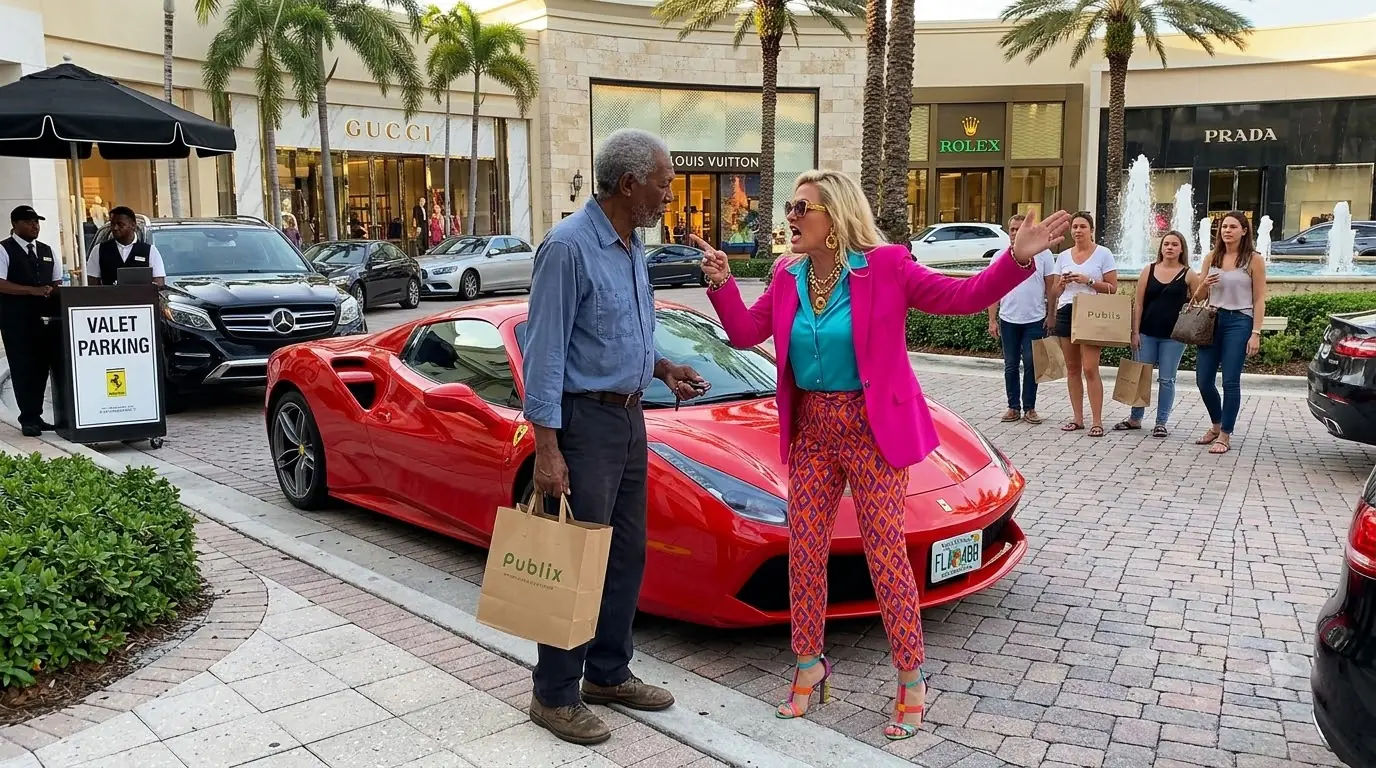
She stood near the curb in a cream-colored designer suit. One manicured hand pointing across the parking area. At the center of her accusations stood an elderly black man, Samuel Carter, 72 years old, gray hair, weathered hands, a faded blue button-down shirt, worn brown shoes, and in one hand a simple paper bag carrying meals from a community kitchen. The image didn't fit the setting. Not to Victoria.
Not to many of the people watching. And certainly not to the story already forming inside their heads. "Someone call security!" Victoria shouted. "That man is trying to steal that car!" Several people immediately turned toward the vehicle. A bright red Ferrari sat parked near the entrance.
Its paint gleamed beneath the afternoon sun. Its value was probably more than most houses in the neighborhood Samuel lived in. A few shoppers pulled out their phones. Others stepped closer. The crowd always moved toward drama.
Samuel simply looked at Victoria. His expression never changed. No anger. No panic. No fear.
Just quiet patience. "Ma'am," he said gently, "there seems to be some misunderstanding." "A misunderstanding?" Victoria laughed sharply. The sound carried across the courtyard. "You expect anyone here to believe that Ferrari belongs to you?" A few people exchanged glances. Nobody answered.
Nobody defended him. The silence said enough. Samuel lowered his eyes briefly toward the paper bag in his hand. Inside were sandwiches left over from the community kitchen. He had planned to deliver them to a shelter on his way home.
Now he stood surrounded by strangers staring at him like he had done something wrong. The old feeling returned. The one he thought he'd learned to live with years ago. The feeling of being judged before speaking, of being measured before being known. Victoria stepped closer.
You should leave before security gets here. Samuel looked at the Ferrari, then back at her. I don't think that will be necessary. The confidence in his voice seemed to irritate her even more. Her face tightened.
You're actually staying? I am. Unbelievable. She immediately pulled out her phone. Fine.
Let's let the police sort it out. Several people in the crowd nodded. Some looked uncomfortable. Most simply watched. Nobody knew Samuel.
Nobody knew where he had come from. Nobody knew that he had spent the morning serving meals to strangers. Nobody knew that he often skipped buying things for himself so others could eat. Nobody knew that kindness had become a habit so natural to him that he rarely thought about it anymore. All they saw was an old black man standing next to a Ferrari.
And for many of them, that was enough. Victoria dialed 911. Her voice changed instantly. It became softer, more urgent, more frightened. The performance was impressive.
Yes, I'd like to report suspicious activity, she said. Samuel listened quietly. There is an elderly man attempting to access a Ferrari outside Waterside Plaza. She paused dramatically. I don't feel safe.
The crowd grew larger. Someone whispered. Someone else started recording video. A teenager near the fountain pointed his phone directly at Samuel. Samuel noticed.
He didn't look away. He simply stood there beneath the bright Florida sun while strangers documented one of the most humiliating moments of his life. Yet somehow, he remained calm. That calmness puzzled people. Most expected arguments.
Most expected shouting. Most expected excuses. Instead, Samuel waited. Almost as if he knew something they didn't. A security guard finally approached.
Young. Nervous. Trying to appear confident. Sir. He said politely.
Can I ask what you're doing here? Waiting. For what? Samuel smiled faintly. I suppose we'll find out soon enough.
The guard looked confused. Victoria rolled her eyes. "I don't care what he thinks. He's stalling." Just bring the car around. The security guard glanced at the Ferrari.
Then at Samuel. Then back at Victoria. Nobody seemed certain what was actually happening. The only thing everyone agreed on was that something unusual was unfolding. A warm breeze drifted through the courtyard.
Palm leaves swayed overhead. Water splashed softly from the fountain. For a strange moment. The world seemed suspended between two different versions of the truth. One version belonged to Victoria.
The other belonged to Samuel. And only one of them could survive. Minutes later, distant sirens echoed across the boulevard. The crowd reacted immediately. Phones rose higher.
Whispers spread faster. Victoria crossed her arms with visible satisfaction. There. She said. Now we'll see.
Samuel looked toward the road where flashing lights approached. Not a trace of worry appeared on his face. No trembling hands, no attempt to leave, no desperation, just quiet acceptance. That calmness unsettled Victoria far more than any argument could have because guilty people usually ran. Guilty people usually panicked.
Samuel did neither. The police cars turned into the plaza. Blue lights flashed across storefront windows. The crowd parted. The moment had arrived.
Yet, the most important part of the story hadn't even begun because nobody standing in that courtyard knew who Samuel Carter really was. Nobody knew why he wasn't afraid. Nobody knew why a man dressed so simply could stand beside a Ferrari with such quiet confidence. And nobody, not Victoria Sterling, not the crowd, not even the officers stepping out of their patrol cars, could imagine that within the next few hours everything they believed about this old man would be turned completely upside down. Because Samuel Carter wasn't waiting for someone to save him.
He was waiting for the truth to arrive. And when it did, nothing in that parking lot would ever look the same again. But long before the flashing police lights, long before the Ferrari, long before Victoria Sterling pointed her finger and decided who he was, Samuel Carter had already lived through enough judgment to last several lifetimes. That morning had begun like most Saturday mornings in Tampa. The sun hadn't fully risen yet.
A pale orange glow stretched across the sky beyond rows of aging duplexes and modest single-story homes. Sprinklers clicked lazily across small front yards. Somewhere in the distance, a train horn echoed through the humid Florida air. Samuel was already awake. He always was.
At 72, his body no longer needed an alarm clock. He sat quietly at a small kitchen table scarred by decades of use. A chipped ceramic mug rested beside him. Steam curled upward from fresh coffee. The house wasn't much.
Two bedrooms, one bathroom, old wooden floors that creaked whenever he crossed them, a roof that occasionally leaked during heavy storms, but it was home. And after everything life had taken from him, home was enough. On one wall hung a faded photograph of a younger Samuel standing beside his late wife, Diane. She had been gone for 11 years. Cancer.
Fast. Cruel. The kind of loss that never really leaves. Samuel glanced at the picture every morning. Not because he enjoyed remembering the pain, because he never wanted to forget the love.
"Morning, sweetheart." He said softly. The habit remained even after all these years. He finished his coffee, washed the cup, put on his worn blue shirt, and headed out. Outside, the neighborhood was waking up. An elderly man swept his porch.
Two children waited for a school bus. A woman carried groceries into a small apartment building. Samuel waved to everyone. Everyone waved back. Most people knew him.
Not because he was important, because he was kind. There was a difference. 20 minutes later, he arrived at New Hope Community Kitchen. The building sat between an old church and a discount grocery store. The paint was peeling.
The sign was faded. But every weekend, hundreds of people passed its doors. Some came because they were hungry. Some came because they were lonely. Some came because they simply needed someone to look them in the eye and remind them they mattered.
Samuel understood all three. Inside volunteers moved between folding tables. The smell of soup filled the room. Fresh bread cooled on metal racks. Coffee brewed in giant silver containers.
"Morning, Sam." called Linda Watkins, the kitchen director. She was 65, sharp-witted, and ran the place with military precision. "Morning, Linda. You got here before me again." Samuel smiled. "Barely.
You ever think about retiring from volunteering?" "No." "Why not?" He shrugged. "What would I do all day?" Linda laughed. The answer never changed. Samuel spent the next several hours serving meals. He greeted every person exactly the same.
The homeless veteran, the struggling single mother, the retired factory worker, the teenager living out of a motel room. No special treatment. No judgment. No pity. Just dignity.
Around noon, a young volunteer named Brian approached him. Brian couldn't have been older than 20. "Mr. Carter?" "Yeah?" "Can I ask you something?" Samuel handed a tray to an elderly woman before turning back. "Sure." "Why do you do this every week?" Samuel looked around the room. People eating.
People talking. People laughing. People surviving. Then he smiled. "Because somebody once did it for me." Brian frowned.
"You were homeless?" "For a little while. The young man's eyes widened. Samuel rarely talked about his past. But today, for some reason, he continued. When I was 23, I lost everything.
Brian listened. My job, my apartment, nearly my hope. What happened? Samuel looked out a nearby window. For a moment, he seemed far away.
Life happened. The answer carried more weight than details ever could. Brian nodded quietly. Samuel placed a hand on his shoulder. The trick is simple.
What's that? When somebody helps you stand up, he paused, you spend the rest of your life helping somebody else. Brian never forgot those words. Neither would the audience watching Samuel's story unfold. By mid-afternoon, the crowd began thinning.
Volunteers stacked chairs. Tables were wiped clean. Floors were swept. As always, Samuel stayed behind. As always, he worked until everything was finished.
And as always, he refused every attempt to thank him. Linda noticed. She always noticed. "You know," she said while carrying supplies toward storage, "most people your age would be relaxing somewhere." Samuel chuckled. "Sounds boring." "I'm serious." "So am I." She shook her head.
"You spend more money on other people than yourself. Money comes and goes. And yet you keep giving." Samuel looked around the empty room. Sunlight streamed through dusty windows. The place suddenly felt peaceful, almost sacred.
My mother used to say something. What? If your hands are full of blessings, they should never stay closed. Linda smiled. Smart woman.
The smartest. A few minutes later, Samuel carried several leftover meal bags toward his truck. The old pickup had nearly 200,000 miles on it. The paint was faded. The air conditioner only worked when it felt like it, but it still ran.
And that was enough. He placed the bags carefully in the passenger seat. Several would go to a nearby shelter. A few would go to people he knew sleeping under bridges. Nothing would be wasted.
As he climbed behind the wheel, a familiar feeling settled over him. Contentment. Not happiness. Not excitement. Something deeper.
The quiet satisfaction that came from being useful. Many people spend their lives chasing significance. Samuel had found something better. Purpose. The engine rumbled to life.
The afternoon sun hung high above the Florida sky. Traffic moved steadily along the boulevard. Palm trees swayed in the warm breeze. He pulled onto the road and began driving toward Naples. He had no idea that before the day ended, his life would collide with someone determined to judge him before knowing him.
He had no idea that strangers would question his character. That cameras would follow his every move. That police officers would stand around him. That millions of people would eventually learn his name. At that moment, he was simply an old man delivering food.
Nothing more. Nothing less. Several miles later, as he approached a quieter stretch of highway, something caught his attention. A silver sedan sat on the shoulder. Its hood was raised.
A young woman stood beside it. A little boy sat on the curb nearby. Even from a distance, Samuel could see the worry on her face. And the moment he saw it, he eased his truck onto the shoulder. Because that was who Samuel Carter was.
Someone else's problem had a way of becoming his concern. He parked behind the disabled car and turned off the engine. The little boy looked up. The woman wiped tears from her eyes. And neither of them realized that the stranger stepping out of the pickup truck was about to change their lives.
Just as they were about to become part of a story far bigger than any of them could imagine. The heat shimmered above the asphalt. Cars rushed past on the highway without slowing down. Most drivers never even glanced toward the stranded silver sedan sitting on the shoulder. But Samuel Carter had always been the kind of man who noticed people, especially the ones everyone else overlooked.
He stepped out of his truck and closed the door gently behind him. The young woman looked up immediately. Relief flickered across her face, then embarrassment, then uncertainty. The little boy sitting on the curb tightened his grip around a worn stuffed dinosaur. Samuel offered a warm smile.
Afternoon. Hi. The woman replied softly. You having car trouble? She laughed nervously.
That obvious? Samuel glanced at the raised hood. A little. The boy finally looked up. His cheeks were red from the heat.
Samuel crouched slightly so he wouldn't seem intimidating. Hey there. The boy nodded. What's your name? Tyler.
Well, Tyler, I think your mom and I are going to see if we can figure this thing out. Tyler looked toward the broken car. Can you fix it? Samuel smiled. I don't know yet.
It wasn't a promise, it was honesty. And children usually trusted honesty more than promises. The young woman introduced herself. My name's Emily. Samuel.
She looked exhausted. Dark circles sat beneath her eyes. Stress seemed woven into every movement. Samuel had seen that look before. Life had given it to him years ago.
How long have you been stuck here? He asked. You seem troubled. Almost an hour. You call somebody?
Emily looked away. Not really. Samuel understood immediately. Calling for help cost money. Tow trucks cost money.
Repairs cost money. And sometimes people simply didn't have any left. The silence told him everything. Samuel rolled up his sleeves and leaned over the engine. Years ago, before life took him down a hundred unexpected roads, he'd worked maintenance jobs, construction, repairs, mechanical work, enough to learn a few things.
He checked the battery. A loose connection. Nothing dramatic. Nothing expensive. Just enough to stop the car.
Mind if I try something? Emily blinked. Please. Samuel walked back to his truck. A few moments later, he returned carrying a small toolbox and jumper cables.
Tyler watched him with wide eyes. You keep all that in your truck? Samuel chuckled. At my age, you learn to be prepared. 10 minutes later, sweat covered his forehead.
The Florida sun showed no mercy. But eventually, the connection tightened into place. Samuel nodded toward the driver's seat. Try it now. Emily climbed in, turned the key.
The engine sputtered, then roared to life. For a moment, she simply stared, as though she couldn't believe it. Then tears filled her eyes. Oh my God. Tyler jumped to his feet.
Mom, it works. His voice echoed across the roadside. Pure joy. The kind adults often forget how to feel. Emily stepped out of the car.
I don't know how to thank you. Samuel wiped his hands on a rag. You don't have to. No, seriously. It's okay.
She shook her head. You saved me today. Samuel smiled. No. Your car just needed a little help.
But Emily knew it was more than that. She had spent the entire morning trying not to panic. Rent was due. Bills were waiting. Her second job started in less than two hours.
The breakdown felt like one more thing she couldn't survive. Then a stranger stopped. A stranger who didn't know her, didn't owe her anything, didn't ask for anything. And somehow that mattered more than the repair itself. Samuel walked back toward his truck.
Then he paused. Has Tyler eaten? Emily hesitated. A second too long. Samuel noticed.
Parents rarely lied well when it came to their children. We had breakfast. That's not what I asked. Emily looked embarrassed. No.
Samuel nodded slowly. Without another word, he opened the passenger door of his truck. The paper bags from the community kitchen still sat inside. He carried two over. Turkey sandwiches.
Emily immediately shook her head. Oh, no, I couldn't. You can. I don't want to take food from somebody else. Samuel looked at her.
That's exactly who it's for. Tyler's eyes never left the sandwiches. Samuel handed one directly to him. The boy accepted it carefully. Like someone handing him treasure.
Thank you, sir. You're welcome. For a few minutes, they sat beneath the shade of a nearby tree eating lunch. Traffic rushed past. Palm trees swayed.
The world kept moving. Yet somehow the moment felt still. Peaceful. Samuel listened while Emily talked. Not because he was curious, but because nobody else seemed to listen.
She told him about working two jobs. About raising Tyler alone. About trying to stay ahead of bills that always seemed faster than she was. She didn't complain. She simply sounded tired.