The livestock dealer came through Meade County on the second Tuesday of March in 1935, three weeks earlier than anyone expected a traveling dealer to venture across that stretch of western Kansas.
The wind that morning had carried dust since before sunrise, and the co-op yard wore a thin brown coating that settled over feed sacks, wagon wheels, and the shoulders of men who stood talking about another year of uncertain rain.
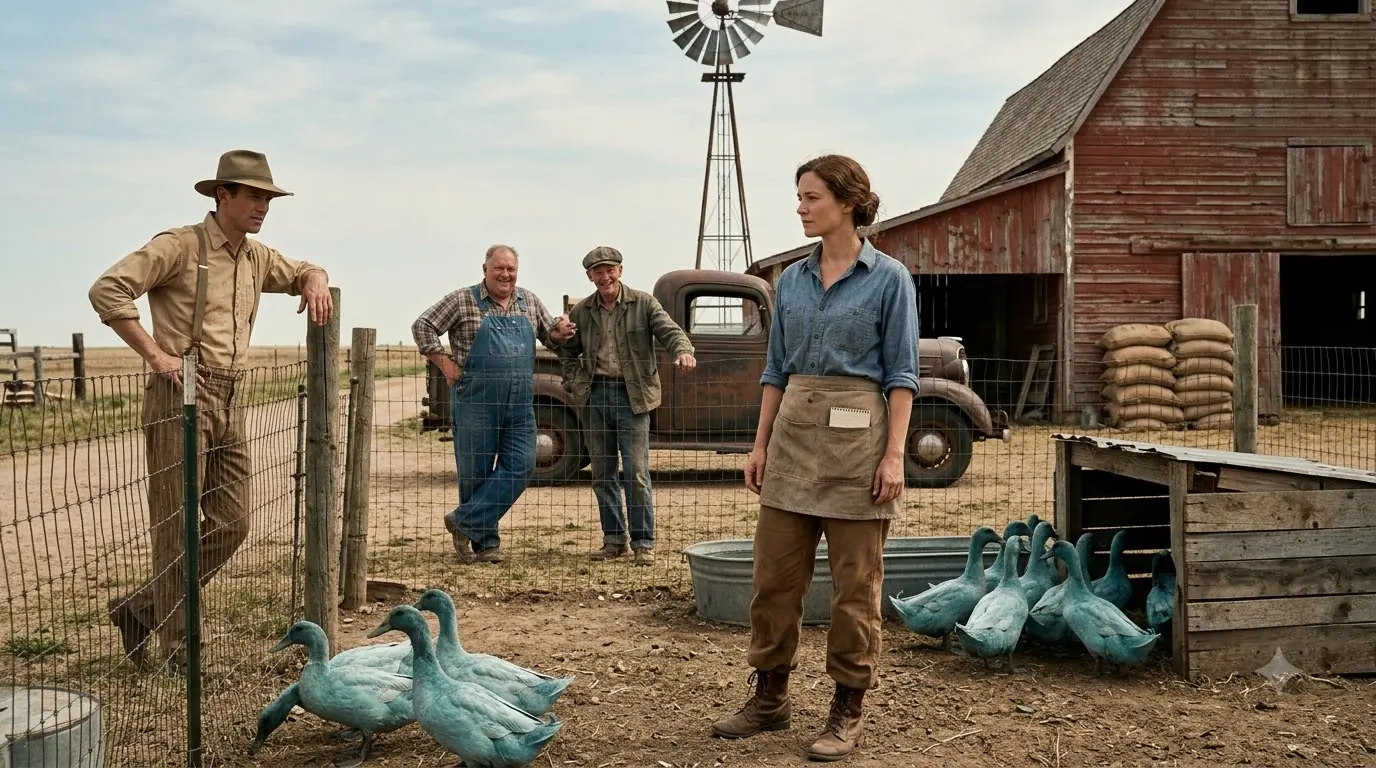
Vera Aldren was at the counter with a pencil behind one ear, adding the price of two sacks of laying mash for the third time although the numbers had not changed since the first. She had fourteen dollars in her household account, and she had come to price feed, not to buy it.
Fourteen dollars was not the money she had earned that week or the money she expected to receive when the wheat came in. It was everything available to spend without borrowing against land that was already carrying more worry than she liked to admit. Seven dollars had been set aside for spring planting, four for feed, and three for whatever broke at the worst possible moment. Her father had once told her that a farm could absorb almost any disaster except a farmer who forgot to leave something for the unexpected. Vera had taken that lesson seriously, especially since the winter morning, two years earlier, when she had buried him beside her mother in the little cemetery beyond the county road.
She was twenty-eight, though the last two years had made her feel older in ways that had nothing to do with the calendar. There were lines beside her mouth that had not been there when she was twenty-five, and her hands had grown rough from carrying work her father once divided between both of them. She wore his old brown coat over a faded blue dress, with work boots that had been resoled twice and still admitted water at one heel. A stranger might have mistaken the stillness of her expression for an absence of feeling, but people who knew Vera understood it was usually evidence of the opposite. She felt things deeply enough that she had learned not to let every feeling interrupt the work.
The Aldren place lay several miles outside town, where wheat fields met a shelterbelt of old cottonwoods and a barn leaned slightly toward the south because a windstorm in 1929 had shifted its frame. Her father, Thomas Aldren, had farmed that land through better years and worse ones, through prices that made a man hopeful and prices that made him ashamed to bring his own grain to market. He had taught Vera to mend harness, read weather in the color of distant clouds, count seed by weight, and judge an animal with her eyes before listening to the seller's opinion. He had also taught her to keep a notebook, because memory grew generous when hope was involved, and generous memory was a poor substitute for records.