I've made my decision. This is my house. That's his school bag. I want you both out within the hour. Go inside and get what you need.
My drawings were in there. An hour. I know, buddy. I know. I smelled the smoke before I heard Ezra call my name.
By the time I got to the backyard, his school bag was already burning. So were the books inside it. So was the sketch he'd made of his mother's face from an old photograph, the one he'd kept on his wall for 8 years without anyone telling him to put it away. My wife stood next to the fire with her arms crossed. She gave us an hour to leave.
What she forgot, standing there in the yard she believed was hers, was that her name wasn't the only one on the deed. The smoke was the first thing, not the sound of Ezra's voice, not the creak of the back door, just the smell reaching me through the kitchen window while I was washing a coffee mug. The kind of smell that the body recognizes before the mind has caught up. I set the mug down and walked outside and what I saw in the backyard I have replayed many times since, not because I want to, but because certain things embed themselves without asking permission. Natasha was standing beside a metal trash bin with flames coming out of the top.
She was facing away from me, arms crossed, watching the fire the way someone watches a problem being solved. Ezra stood about 3 ft to her left, close enough to feel the heat. He was not crying. He had clearly already done that. I understood what was burning before I got close enough to see clearly.
The shape of the bag. The color of one strap that hadn't caught yet, that specific shade of blue that I had watched Ezra pick out in the store in August. His school bag. And what was inside it, the books, the sketch pad he'd been carrying everywhere for the last 6 months. The drawing he had made of his mother's face from a photograph he kept on his wall, the one he'd asked me to take down from the wall and put in his bag last week so he could look at it during lunch.
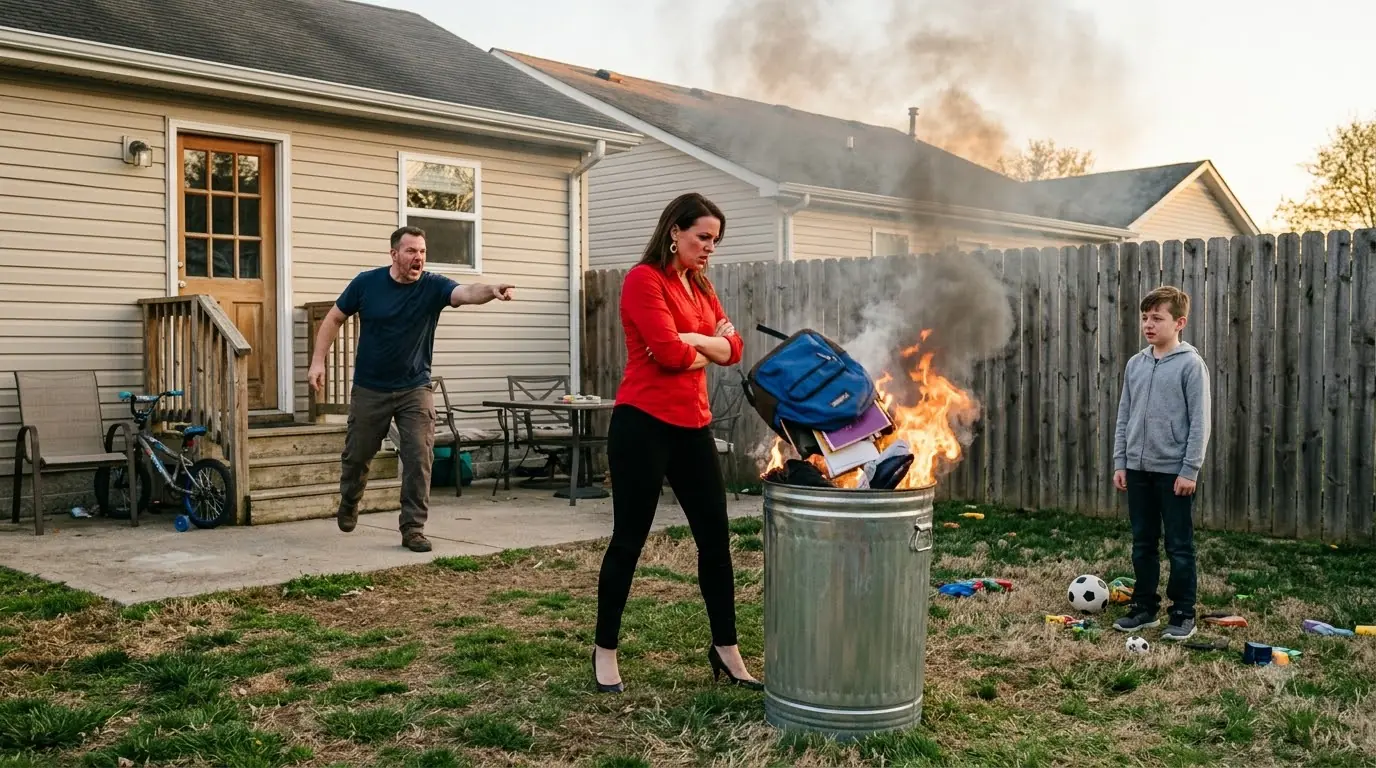
Natasha said she had made her decision. She said it without turning around. She said the house was hers. She said she wanted us out within the hour. I looked at Ezra.
He looked at me and the expression on his face was not the expression of a child who needed someone to fix something. It was the expression of a child who had already understood that this was not fixable and was simply waiting to see what came next. He was 11 years old. He had learned to read rooms before most people his age had learned to read books. I told him to go inside and get what he needed.
He asked about his drawings. I told him to take whatever was still there. I went inside without arguing, which was more composure than I had at that moment. Let me tell you about who Natasha had been before she became the person standing next to that fire. I don't mean this as softness or as a way of excusing what she did.
I mean it because the story is not honest if I leave out the version of her that I married, the version that made the subsequent years make sense. When I met Natasha, she was quick and warm and she noticed things about people that most people missed. She noticed on our third date that I ordered for Ezra before I ordered for myself, and she mentioned it not as an observation but as something she found worth saying. I had been a single father for 4 years by then, and no one outside my immediate family had ever seemed to register that specific ordering of priorities as meaningful. There was a night not long after we started spending real time together when Ezra came down with a fever.
I had called to cancel plans and Natasha had offered to come over anyway, not to be with me, but to help. She sat with him on the couch with a damp cloth and a television remote while I went to find the thermometer and when I came back he had fallen asleep against her shoulder. She didn't move for nearly an hour. She looked up at me when I came back in and said nothing. Just a look that communicated something about choosing to be present rather than performing the act of being present.
That distinction had always mattered to me. I had spent four years learning to tell the difference. A few months in Ezra stopped calling her Miss Natasha and started calling her Tasha. He did it once without thinking and then looked up to see if she minded. She smiled at the floor and said nothing about it which was exactly the right response because anything she'd said would have turned it into a moment and it didn't need to be a moment.
It just needed to be true. That was the person I married. The change that came later did not erase who she had been. It just settled on top of it and eventually I couldn't find the original anymore. The shift happened over the course of about two years and I could tell you the approximate month it began, but not a single specific day because it was the kind of change that operates through accumulation.