Ben Carter swiped the credential through the reader at the front desk of the Asheford Police Department at 8:41 on a gray Tuesday morning.
The scanner chirped once.
A green bar appeared across his monitor.
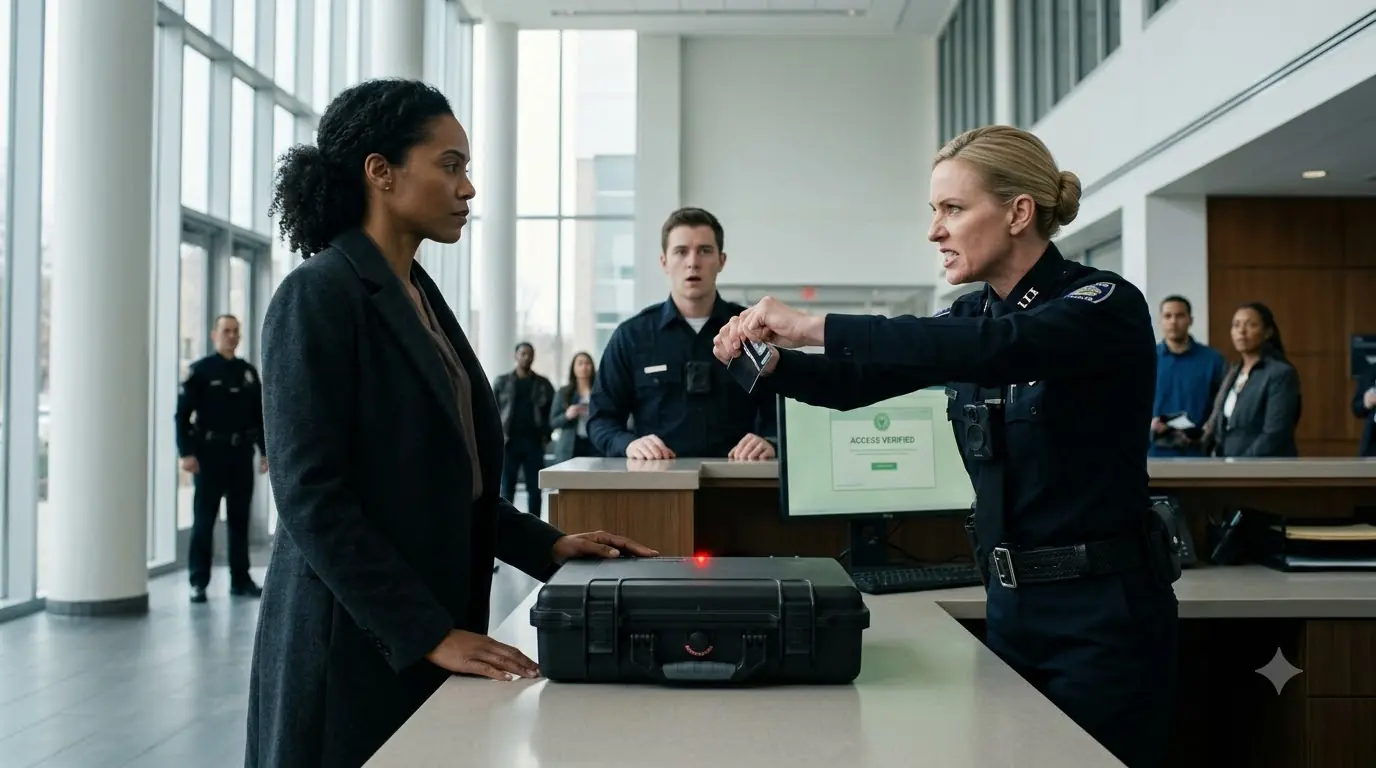
FEDERAL AUTHORITY VERIFIED.
SPECIAL ACCESS ACTIVE.
Ben stared at the message longer than necessary.
He had been with Asheford Police for only nine months, and although he had already learned the difference between the department’s ordinary visitor badges, municipal contractor cards, county credentials, and court-issued access passes, he had never seen that message before.
Across the counter stood a Black woman in her early forties wearing a dark wool coat over a charcoal business suit. She carried no visible badge, no sidearm Ben could see, and no briefcase that looked remotely ordinary.
Instead, she had placed a matte-black security case on the counter beside her.
The case was the size of a small legal file box, with reinforced corners, two electronic latches, and a narrow indicator strip glowing green along the handle.
Outside, visible through the wide front windows, an older dark-blue Ford sedan sat in the visitor parking lot.
Nothing about the woman matched Ben’s idea of a federal inspection team.
That bothered him less than it probably should have.
The computer had verified her.
“Ma’am,” he said, trying to sound more experienced than he felt, “the credential came back active.”
“I know.”
Her voice was calm.
Not cold.
Not friendly.
Simply controlled.
“What access are you requesting?”
“Digital evidence archive, administrative access records, sealed property logs, and the technology procurement files associated with the federal modernization grant.”
Ben glanced at the screen.
The credential’s access category did not name an agency, but the authorization field clearly covered protected evidence review.
“Do you have an appointment?”
“No.”
That answer caught his attention.
Before he could ask another question, footsteps approached from the hallway.
Lieutenant Rebecca Sloan appeared from behind the records office.
She was forty-six, tall, disciplined, and known throughout the building for remembering details people wished she would forget. Her dark blond hair was pulled tightly behind her head, and she moved with the clipped confidence of someone who had spent fourteen years working her way from patrol to command.
“What’s the delay?” Rebecca asked.
Ben moved slightly aside.
“Federal access credential.”
Rebecca looked at the monitor.
Her eyes stayed on the green confirmation for several seconds.
Then she looked at the woman.
“Name?”
“Maya Williams.”
“What agency?”
“The credential gives you the authority level required for the access procedure.”
Rebecca’s expression changed.
“That wasn’t my question.”
“I know.”
Ben felt the temperature at the desk drop even though neither woman raised her voice.
Rebecca pointed toward the monitor.
“This says federal authority. It doesn’t tell me whether you’re FBI, DEA, Inspector General, Homeland Security, or somebody from a contractor who knows how to manufacture a convincing plastic card.”
Maya looked at her.
“You’re permitted to verify the credential.”
“We did.”
“You completed the first-level check.”
Rebecca folded her arms.
“And now I’m asking you directly.”
“The credential instructions provide a validation number for secondary confirmation.”
“I’m aware of how credential verification works.”
“Then we shouldn’t have a problem.”
Rebecca’s eyes moved to the black case.
“What’s in that?”
“Protected federal material.”
“What kind?”
“Preservation equipment and legal authorization packets.”
“Open it.”
“No.”
Ben looked from one woman to the other.
Rebecca leaned slightly toward the counter.
“You entered a police facility carrying an unidentified locked electronic case, without an appointment, asking for access to restricted evidence, and now you refuse to identify your agency or show me what you brought inside.”
“That is not what happened.”
Rebecca’s eyes narrowed.
Maya continued.
“I presented an authorized credential. Officer Carter verified it. Your system returned a valid federal access event. The credential provides a secondary validation procedure. You have not used it.”
Rebecca looked at Ben.
“What exactly did the screen say?”
Ben hesitated only because he could feel the direction of the conversation shifting.
“Federal authority verified. Special access active.”
“And nothing else?”
“There’s a coded authorization reference.”
“Does it identify her agency?”
“No, ma’am.”
Rebecca looked back at Maya.
“Then I need more than a green message.”
“You’re allowed to verify the credential.”
“I’m verifying you now.”
“No. You’re disregarding the verification because the result is inconvenient.”
For the first time, Rebecca’s composure cracked slightly.
“You don’t tell me how security works inside my building.”
Maya did not react.
“I’m not asking to control your building.”
“Then identify your agency.”