She Gave Our Apartment Savings to Her Ex-Boyfriend… and Expected Me to Understand
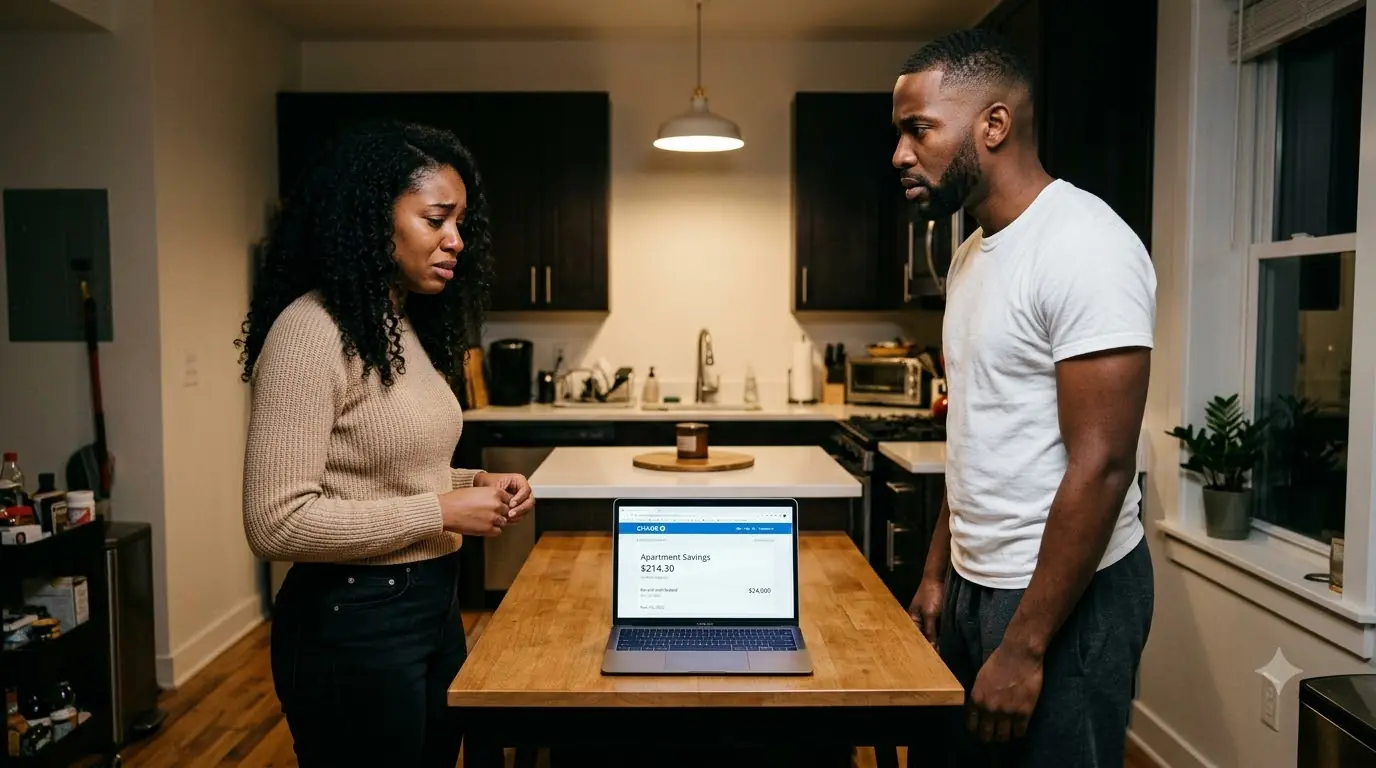
PART 1
“You gave him how much?”
Megan didn’t answer.
She was sitting across from me at our tiny kitchen table, both hands wrapped around a glass of water she hadn’t touched.
I stared at her.
“Say the number.”
Her eyes filled.
“Eight thousand.”
For a few seconds, I honestly thought I had heard her wrong.
“Eight thousand dollars?”
She nodded.
I looked toward the hallway.
Then back at her.
“The apartment money?”
Another nod.
I laughed once.
Not because anything was funny.
Because my brain had run out of normal reactions.
“Megan.”
“I was going to put it back.”
“How?”
“I don’t know yet.”
“You don’t know.”
“I know this looks bad.”
“Looks bad?”
I pushed my chair back.
“That was our savings.”
“I know.”
“Two years.”
“I know.”
“Two years of overtime. Two years of saying no to trips. Two years of cooking at home because we were trying to get out of this place.”
“I know.”
“Then why did you give eight thousand dollars to your ex-boyfriend?”
She flinched at the word ex.
Good.
I wanted her to.
Megan and I had been together for four years.
We had lived in the same one-bedroom rental in Columbus for nearly three.
The apartment was small, cheap, and slowly falling apart.
The upstairs neighbor played music at midnight.
The bathroom ceiling had leaked twice.
Our kitchen had exactly two usable outlets.
We complained constantly.
But we stayed because we had a plan.
Save enough for first month, last month, security deposit, moving costs, furniture, and an emergency cushion.
Then get something better.
Not luxurious.
Just ours.
A two-bedroom place with enough space for Megan to work from home and enough quiet for me to sleep when I came off late shifts.
I worked as an operations supervisor for a distribution company.
Megan worked in payroll for a medical billing firm.
We weren’t rich.
Every thousand dollars meant something.
That was why we had a shared high-yield savings account.
The balance had reached just over nineteen thousand.
Or at least, that was what I believed.
Until that afternoon.
I had logged in because I wanted to see whether our tax refund had cleared.
The balance read $11,246.
I thought it was a mistake.
Then I saw the transfer.
$8,000.
Three weeks earlier.
Sent to an external account.
I called Megan immediately.
“What is this?”
She went quiet.
I knew before she said anything that whatever answer was coming would be bad.
“I can explain.”
Those are four words nobody wants to hear when money is missing.
“Explain what?”
“Can we talk when I get home?”
“No. Tell me now.”
She refused.
So I spent three hours at work imagining every possibility.
Credit card debt.
A family emergency.
Gambling.
A secret purchase.
I even wondered whether she had found another apartment without me.
What I did not expect was Evan.
Her ex.
The man she dated before me.
They had been together from twenty-three to twenty-seven.
Almost four years.
He cheated.
More than once, according to Megan.
The breakup had been ugly.
When we first met, she told me Evan was the reason she had trouble trusting people.
I had hated him without ever meeting him.
Not because I was jealous.
Because I had watched the aftermath.
The way Megan sometimes went quiet if I stayed out later than expected.
The way she asked whether everything was okay if I answered a text too briefly.
The way she once admitted, “He made me feel stupid for trusting him.”
And now she had secretly sent him eight thousand dollars.
I stood by the counter.
“Why?”
Megan wiped her eyes.
“He was in trouble.”
“What kind of trouble?”
“He lost his apartment.”
I stared at her.
“What?”
“He got laid off a few months ago.”
“And?”
“He fell behind.”
“And that became our problem?”
“No.”
“Then why is our money in his bank account?”
She looked down.
“He called me.”
That sentence hit hard.
“He called you.”
“Yes.”
“How does he even have your number?”
“I’ve had the same number for years.”
“That’s not what I mean.”
“Jason—”
“You two were talking?”
“No.”
“Then why did he think he could call you for eight thousand dollars?”
“He didn't ask for eight thousand at first.”
I went still.
“At first?”
She realized too late.
“How long have you been talking to him?”
“Not long.”
“That is not a number.”
“About two months.”
My stomach dropped.
Two months.
Not one desperate call.
Not one emergency.
Two months of communication.
Behind my back.
“What were you talking about?”
“Mostly what was happening with him.”
“Mostly?”
She closed her eyes.
“I checked on him after he called.”
I laughed bitterly.
“Of course you did.”
“It wasn't like that.”
“Then tell me what it was like.”
“He said he didn't have anyone.”
“And you felt sorry for him.”
“Yes.”
“The man who cheated on you.”
“Yes.”
“The man you told me destroyed your ability to trust.”
Her voice got sharper.
“I know who he is.”
“Apparently not.”
She looked up.
“That’s not fair.”
“No?”
I stepped closer.
“You gave him money we saved for our future.”
“I wasn't trying to betray you.”
“Intent does not change the bank balance.”
“I know.”
“No. You keep saying you know, but you did it anyway.”
She stood.
“I thought he was going to be homeless.”
“So?”
She looked shocked.
“What do you mean, so?”
“I mean he has family.”
“His mom moved to Florida.”
“He has friends.”
“Not really.”
“He has a car.”
“That’s not the point.”
“It absolutely is.”
I pointed toward the laptop.
“You acted like you were the only person standing between Evan and the street.”
“He was desperate.”
“So you became his emergency contact?”
Silence.
That hurt more than I expected.
“You did.”
Megan sat back down.
“I felt responsible.”
“For what?”
She didn’t answer.
“Megan.”
Her voice came out quietly.
“For leaving him when he was at his worst.”
I stared at her.
“He cheated on you.”
“I know.”
“You left because he cheated on you.”
“I know.”
“Then what are you talking about?”
She looked miserable.
“When we broke up, he was drinking a lot. His dad had just died. He was falling apart.”
“And sleeping with other women.”
“Yes.”
“Stop turning yourself into the villain in his story.”
“I’m not.”
“You are.”
I could hear my voice rising.
“He hurt you, and somehow years later you still feel guilty because there were consequences.”
Her eyes filled.
“It’s complicated.”
“No.”
I shook my head.
“What’s complicated is why you thought his crisis mattered more than the promise you made to me.”
That landed.
She looked away.
I continued.
“You know what I did last month?”
She stayed quiet.
“I picked up six extra shifts.”
“Jason.”
“You know why?”
“For the apartment.”
“For us.”
My voice broke.
“I was exhausted. I missed my sister’s birthday dinner. I skipped a weekend trip with my friends.”
“I told you not to work that much.”
“That is not the point.”
I stared at her.
“The point is I was making sacrifices for a future you were secretly funding someone else out of.”
“I was going to replace it.”
“With what money?”
She didn’t answer.
I laughed bitterly.
“Exactly.”
For a long moment, neither of us spoke.
Then I asked the question I was afraid to ask.
“Do you still love him?”
Her head snapped up.
“No.”
“Don’t answer quickly.”
“I don't.”
“Then why him?”
“Because I knew what it felt like to see him broken.”
“That is not love?”
“No.”
“Then what?”
“Guilt.”
I stared at her.
She continued.
“And history.”
I looked away.
That word hurt.
History.
History was dangerous because it could make terrible choices feel meaningful.
“You chose your history over our future.”
“No.”
“That is literally what happened.”
She stood again.
“I didn't choose him.”
“You transferred eight thousand dollars.”
“I was helping someone.”
“Someone you hid from me.”
“Because I knew you’d say no.”
Everything went still.
There it was.
The sentence that changed the argument.
Not:
I forgot to tell you.
Not:
I panicked.
She knew.
She knew exactly what my answer would be.
And instead of asking, she made sure I couldn't stop her.
“You knew I’d say no.”
“Yes.”
“And you did it anyway.”
She started crying.
“I thought I was doing the compassionate thing.”
“No.”
My voice went quiet.
“You thought asking forgiveness would be easier than asking permission.”
Her face crumpled.
I hated that part of me still wanted to comfort her.
I didn’t.
Not then.
“Did Evan know the money was ours?”
She hesitated.
My stomach dropped again.
“Megan.”
“Yes.”
I closed my eyes.
“He knew.”
“Yes.”
“He knew you were taking money you saved with your boyfriend.”
“Yes.”
“And accepted it.”
“He said he'd pay it back.”
I laughed.
“Of course he did.”
“He will.”
“You believe that?”
She didn’t answer.
“What else have you given him?”
“Nothing.”
“Money?”
“No.”
“That’s not what I asked.”
She went quiet.
“What else?”
“I met him once.”
I felt cold.
“When?”
“Two weeks ago.”
“Where?”
“A coffee shop.”
“Why?”
“He wanted to thank me.”
“You needed to meet him so he could thank you for stealing eight thousand dollars from our future?”
“It wasn’t stealing.”
I stared at her.
Her expression changed.
“I mean—”
“No.”
I nodded slowly.
“You’re right.”
She looked confused.
“It wasn't stealing from the account.”
My voice hardened.
“Your name was on it.”
I looked directly at her.
“But you stole my ability to choose what happened to money I helped earn.”
She started crying harder.
“I’m sorry.”
“What happened at the coffee shop?”
“Nothing.”
“How long?”
“About an hour.”
“Did you touch him?”
“No.”
“Did he?”
“No.”
“Did you talk about us?”
She hesitated.
My heart sank.
“What did you say?”
“He asked if you knew.”
“And?”
“I said no.”
I swallowed.
“And what did he say?”
“He said you’d probably hate him.”
“Smart man.”
“Jason.”
“What else?”
She looked down.
“He said I always was the person who rescued everyone.”
I stared at her.
“And you liked hearing that.”
Her eyes lifted.
I knew immediately.
Not romantically.
Something more complicated.
Evan knew an old version of Megan.
The woman who carried everyone.
The woman who stayed too long.
The woman who believed love meant saving people from themselves.
And he had reached exactly that part of her.
“You liked being needed.”
She started to answer.
Then stopped.
“Yes.”
That honesty hurt.
But it mattered.
“So this wasn’t just money.”
“No.”
“It was emotional.”
She nodded.
I stepped away.
“I need you to leave tonight.”
Her face changed.
“What?”
“I need space.”
“Jason, please.”
“Not forever.”
I wasn’t even sure why I added that.
Maybe because four years still meant something.
Maybe because love does not disappear at the exact speed trust does.
“Where am I supposed to go?”
“Your sister’s.”
“Can’t we talk?”
“We are talking.”
“No, you're ending the conversation.”
“I’m ending tonight.”
She wiped her face.
“What do you want me to do?”
I looked at her.
“The money comes back.”
“I know.”
“No.”
I shook my head.
“You’re still saying that like you control whether it happens.”
I took a breath.
“I want you to tell Evan he needs to repay it.”
“I will.”
“And no more secret contact.”
She nodded immediately.
“Yes.”
“But that’s not enough.”
Her face fell.
“I need to figure out whether I can build a future with someone who knew I would say no and decided my opinion didn’t matter.”
She cried quietly.
“I love you.”
That hurt.
I believed her.
That was what made the situation so difficult.
“I love you too.”
She looked hopeful for half a second.
Then I said, “But love wasn’t the thing missing from our account.”
Her face fell again.
“Trust was.”
She packed a bag.
Before leaving, she turned at the door.
“I’ll fix this.”
I said nothing.
Because I had learned something in the past hour.
Some things can be repaid in dollars.
Other things cannot.
The next morning, I received a text from a number I didn’t know.
Jason, this is Evan. I think you and I should talk.
I almost deleted it.
Then another message appeared.
Megan didn’t tell you the whole reason I asked her for help.
My stomach tightened.
I stared at the screen.
Then:
And before you blame her for everything, you should know she wasn’t the first person in your relationship to keep a financial secret.
I read the message twice.
Then a third time.
My hands went cold.
I typed one word.
Explain.
His response came almost immediately.
Ask Megan what she found in your desk three months ago.
I stopped breathing.
Because there was something in my desk.
Something I had never told Megan about.
And suddenly the betrayal in our relationship was no longer as one-sided as I wanted it to be.
PART 2 — FINAL
I didn’t reply to Evan.
I called Megan.
She answered on the first ring.
“Jason?”
“What did you find in my desk?”
Silence.
That was all the confirmation I needed.
“What did you find?”
She exhaled.
“Can we talk in person?”
“No.”
“Please.”
“No more delayed explanations.”
I paced the living room.
“Tell me.”
She stayed quiet for several seconds.
Then said, “The credit card statements.”
I closed my eyes.
There it was.
My turn.
Eight months earlier, my mother had needed dental work her insurance barely covered.
She was sixty-four, working part-time, and embarrassed about money.
She refused to ask my sister.
So I paid.
Almost six thousand dollars.
On a credit card Megan didn’t know I still had.
I told myself it was my debt.
My problem.
Not related to our apartment savings.
I made the minimum payments, then increased them whenever I had extra cash.
I had planned to pay it off before we moved.
I had never told Megan.
Not because I thought she would leave.
Because I knew she would be angry that I was taking extra shifts to cover debt while we were saving.
I sat down.
“You found those?”
“Yes.”
“When?”
“Three months ago.”
“Why didn’t you ask me?”
She gave a quiet, broken laugh.
“Do you hear yourself?”
That hurt.
I said nothing.
She continued.
“I found almost six thousand dollars of debt you had never mentioned.”
“I was paying it.”
“And I was supposed to trust that?”
“It was for my mom.”
“I know.”
I frowned.
“How?”
“I called her.”
My head snapped up.
“You called my mother?”
“I needed to know whether what I was looking at was real.”
“What did she say?”
“That you paid for her dental work.”
I rubbed my forehead.
“Why didn’t you confront me?”
“Because I understood why you did it.”
“That doesn’t make the secrecy okay.”
“No.”
She paused.
“It doesn’t.”
For the first time, I realized she wasn’t using my mistake to erase hers.
That mattered.
But I was still angry.
“So you found out I helped my mother secretly and decided that meant you could give eight thousand dollars to Evan?”
“No.”
“Then why is Evan bringing it up?”
“Because I told him.”
I froze.
“You told him about my debt?”
Her silence returned.
That felt like another betrayal.
“Megan.”
“I was trying to explain why I felt like I couldn't talk to you.”
“You told your ex-boyfriend about my private finances.”
“I know.”
“That is not your story to tell.”
“I know.”
I laughed bitterly.
“You really had an answer for everything with him.”
“That’s not fair.”
“Maybe not.”
I stood.
“But right now I’m wondering how much of our relationship he knows.”
“Too much.”
At least she admitted it.
I asked, “Did my credit card influence your decision?”
“Yes.”
That surprised me.
“How?”
“You kept telling me we were doing everything together.”
Her voice shook.
“But then I found out you were making financial decisions without me too.”
I stared at the wall.
“So you were angry.”
“Yes.”
“And instead of talking to me, you did something worse.”
“Yes.”
That answer stopped me.
No excuse.
No attempt to make the amounts equivalent.
She continued.
“I think part of me told myself I wasn’t crossing a new line.”
My throat tightened.
“Because I already had.”
“Yes.”
I sat down again.
There it was.
Not justification.
A pattern.
Two people quietly making financial decisions and calling them personal because asking would have created conflict.
Mine had been for my mother.
Hers had been for an ex.
Those circumstances were not equal.
But the secrecy came from the same place.
We did not trust the relationship enough to tolerate disagreement.
“What else did Evan say?” Megan asked.
“That you didn't tell me everything.”
“He would say that.”
“What am I missing?”
She went quiet.
“Megan.”
“Evan didn’t originally call because he was about to be homeless.”
My stomach tightened.
“What?”
“He called because he needed money for a lawyer.”
“A lawyer for what?”
“Custody.”
I frowned.
“Evan has a kid?”
“Yes.”
I stared at nothing.
“You never told me that.”
“I didn't think it mattered.”
“It apparently mattered eight thousand dollars.”
She sighed.
“His daughter is four.”
“Who’s the mother?”
“A woman he dated after me.”
“And the custody issue?”
“He’d been missing support payments after losing his job.”
I rubbed my forehead.
“So he needed money to fight for custody while not paying support.”
“It’s more complicated than that.”
“Of course it is.”
“He was behind because he lost his income. He was trying to get a temporary adjustment.”
“And the apartment?”
“He was behind there too.”
I laughed bitterly.
“So the emergency kept expanding.”
“Yes.”
“How much did he ask for?”
“Three thousand.”
I went still.
“Then why did you send eight?”
Megan didn’t answer.
“Megan.”
“He showed me everything he owed.”
I felt sick.
“And you decided to solve it.”
“Yes.”
There it was again.
The rescuer.
“You weren’t helping him survive.”
“No.”
“You were trying to reset his life.”
Her voice broke.
“Yes.”
I closed my eyes.
That was worse in a way.
Not because she wanted Evan romantically.
Because she had taken responsibility for a grown man’s consequences.
And funded that rescue with a future she was supposed to be building with me.
“Do you understand how serious that is?”
“Yes.”
“No.”
I shook my head.
“I need you to understand something.”
I stood and walked toward the window.
“If you had come to me and said, ‘Evan called. He has a daughter. He’s in trouble. I want to help somehow,’ I still probably would have said no to giving him our apartment money.”
“I know.”
“But we could have talked.”
“Yes.”
“We could have found another option.”
“Yes.”
“A smaller amount from your personal money.”
“Yes.”
“Resources. Legal aid. Family.”
“I know.”
“But you didn’t want an alternative.”
She cried quietly.
“You wanted to save him.”
“Yes.”
That was the real betrayal.
Not generosity.
Control.
She needed to be the person who fixed it.
Even if fixing Evan meant breaking something with me.
I asked her to stay at her sister’s another week.
She agreed.
During that week, something unexpected happened.
Evan called me.
I almost didn’t answer.
Then I did.
“What do you want?”
“To repay you.”
I laughed.
“With what?”
“I sold my car.”
That surprised me.
“You sold your car.”
“Yes.”
“How much?”
“Five thousand after paying what I owed on it.”
“And the rest?”
“I can do five hundred a month.”
I stayed quiet.
He continued.
“I know you hate me.”
“I don’t know you well enough to hate you.”
“Fair.”
“Why are you suddenly doing this?”
“Because Megan told me what happened.”
I stared at the wall.
“What did she tell you?”
“That she might lose you.”
I hated the way that sentence affected me.
Evan continued.
“And because I shouldn’t have accepted the money.”
“Correct.”
“I was desperate.”
“So was she.”
He went quiet.
Then said, “You know she doesn't love me, right?”
My jaw tightened.
“I didn't ask.”
“I’m telling you because I know what this looks like.”
“You know nothing about what this looks like from where I’m standing.”
“You're right.”
He paused.
“But she wasn't trying to get me back.”
“Then why did you accept it?”
“Because I knew she'd help.”
That answer was brutally honest.
“You knew how to reach her.”
“Yes.”
“You used her guilt.”
Silence.
Then:
“Yes.”
I hated him a little then.
Not because he had magical power over Megan.
Because he knew exactly which emotional button to press.
But Megan had still chosen to respond.
Both things could be true.
“Don't contact her again,” I said.
“I won't.”
“Repay the money.”
“I will.”
“And don't turn repayment into a reason to stay connected.”
“I understand.”
When the call ended, I sat there for a long time.
Anger feels cleaner when one person is entirely wrong.
Our situation wasn't clean.
Evan manipulated an old wound.
Megan made a terrible choice.
I had my own financial secrecy.
And underneath all of it was the same weakness:
We were making major decisions alone because we were afraid the other person might disagree.
That was not partnership.
Megan came home the following Sunday.
Not to move back in.
To talk.
She sat across from me at the same kitchen table.
“I transferred five thousand back.”
I frowned.
“How?”
“Evan repaid part of it.”
“I know.”
She looked surprised.
“He called me.”
Her expression changed.
“I told him not to contact you again.”
“He said you already told him the same.”
“Good.”
“And the other three?”
“I pulled it from my individual savings.”
“You only had about twenty-five hundred.”
“I sold some jewelry.”
I stared at her.
“What jewelry?”
“The bracelet my grandmother left me.”
My stomach tightened.
“No.”
She looked confused.
“No what?”
“You shouldn't have sold that.”
“I needed to replace the money.”
“Yes, but not like that.”
“Jason, I made the mistake.”
“And punishing yourself dramatically doesn't rebuild trust.”
She went quiet.
“I already sold it.”
I sighed.
This was exactly the problem.
Megan still thought repair meant sacrifice.
Lose something.
Suffer enough.
Prove remorse.
But I did not want suffering.
I wanted judgment.
Transparency.
Consistency.
“I’m paying off the rest of my credit card this month,” I said.
Her eyebrows rose.
“How?”
“I’m using my personal emergency fund.”
“That’ll leave you almost nothing.”
“I know.”
“Then don't.”
I looked at her.
“Why?”
“Because this is what we do.”
Her voice shook.
“We make painful financial decisions alone and announce them afterward.”
That stopped me.
She was right.
I had almost done it again.
Even while criticizing her.
I sat back.
“So what do you suggest?”
“We put everything on the table.”
“Everything?”
“Every account. Every debt. Every recurring payment.”
I nodded slowly.
“And we rebuild the plan together.”
That became the beginning.
Not forgiveness.
Not reconciliation.
The beginning.
We made a complete financial inventory.
My credit card balance.
Her personal savings.
Our shared account.
Retirement accounts.
Bills.
Nothing hidden.
Then we went to couples counseling.
I resisted at first.
“It was money,” I said.
The therapist looked at me.
“No. Money was where the betrayal happened.”
She was right.
The actual issue was loyalty.
Boundaries.
Conflict avoidance.
Megan’s need to rescue.
My need to solve family problems without burdening anyone.
During one session, the therapist asked Megan:
“What did giving Evan the money allow you to feel?”
Megan cried before answering.
“Useful.”
I looked at her.
She continued.
“When he cheated on me, I felt stupid.”
Her hands shook.
“I spent years telling myself I should have seen it coming.”
The therapist waited.
“When he called me desperate, I wasn't the stupid girl anymore.”
Her voice cracked.
“I was the person he needed.”
That hurt.
Not because she wanted him.
Because I finally understood how the old wound worked.
Helping Evan gave her control over a story where she once had none.
The therapist asked, “And what did it cost you?”
Megan looked at me.
“Someone who never asked me to prove my value that way.”
That sentence stayed with me.
My turn came later.
“Why didn't you tell Megan about your mother’s dental debt?”
I answered easily.
“Because it was my responsibility.”
The therapist asked, “Why?”
“She’s my mom.”
“And Megan is?”
“My partner.”
“Then why wasn't your partner allowed to know that your financial reality had changed?”
I hated the question.
Because I had no good answer.
Eventually I admitted the truth.
“I didn't want her telling me no.”
Megan looked at me.
There it was.
Same sentence.
Different decision.
I didn't want her telling me no.
Megan hadn't wanted me telling her no.
We had both confused independence with permission to exclude each other.
The difference was scale, context, and boundary.
But the relationship problem underneath was shared.
We made new rules.
Any transaction over five hundred dollars from shared funds required both of us to agree.
Personal money remained personal, but debt affecting our joint plans had to be disclosed.
No loans to ex-partners.
No secret financial rescue missions.
If family needed help, we discussed what we could actually afford before emotion decided for us.
And most importantly, no hiding information just because we thought we knew what the other person would say.
Megan moved back in after two months.
Not because I fully trusted her again.
Because trust had started becoming measurable.
She was transparent.
Consistent.
She did not contact Evan.
When his monthly repayment arrived, she showed me immediately.
No secret conversations.
No checking on him.
No emotional closure meetings.
Nothing.
It took Evan seven months to repay everything.
Every transfer went directly into the apartment fund.
By then, our savings had grown again.
But something surprising happened.
When we finally had enough to move, I didn’t feel excited.
Neither did Megan.
One night she said, “Maybe we shouldn't sign a new lease yet.”
I looked at her.
“You don't want to move?”
“I do.”
“Then why?”
“Because I don't want a nicer apartment to become proof that everything is fixed.”
That was wise.
So we waited.
Three more months.
We rebuilt first.
Then we moved.
The new apartment had two bedrooms.
Big windows.
A dishwasher that actually worked.
Megan got her office.
I got quiet.
On our first night there, we ate takeout on the floor because our furniture hadn't arrived.
She looked around.
“We finally did it.”
I smiled.
“Yeah.”
Then she became quiet.
“What?”
“I keep thinking about what I almost did.”
“Almost?”
“Lost this.”
I looked at her.
“You did lose part of it.”
Her face fell slightly.
I continued.
“Trust.”
She nodded.
“But you helped rebuild it.”
Her eyes filled.
“I’m still sorry.”
“I know.”
“And I know sorry doesn't make it disappear.”
“No.”
We sat quietly.
Then I said something I had learned the hard way.
“You know what hurt most?”
“The money?”
“No.”
She looked at me.
“It was knowing that if Evan needed something and I disagreed, you were willing to remove me from the decision.”
Her eyes dropped.
“That made me feel like I wasn't actually your partner.”
“I understand.”
“And my debt did something similar to you.”
She nodded.
“Yes.”
I reached for her hand.
“That’s the part we can’t do again.”
“We won’t.”
I squeezed her fingers.
“Don't promise.”
She looked up.
“Show me.”
She smiled sadly.
“Fair.”
Our relationship survived.
Not because what Megan did was small.
It wasn't.
Giving eight thousand dollars of shared savings to an ex without telling me was a serious betrayal.
And if I had ended the relationship over it, that would have been reasonable.
Forgiveness is not an obligation just because someone regrets what they did.
But I stayed because remorse became action.
Because she stopped defending the choice.
Because she understood why it happened.
Because I also faced the secrecy I had normalized in myself.
And because neither of us tried to pretend our mistakes were identical just to make reconciliation easier.
They weren't identical.
Context matters.
Boundaries matter.
Giving money to a parent for medical care is not the same as secretly giving joint savings to an ex.
But both choices taught us something about partnership.
You cannot ask someone to build a future with you while making major decisions as though you are still alone.
Shared money is not just money.
It represents hours.
Sacrifice.
Delayed plans.
Trust.
Promises.
Sometimes it represents the apartment you haven't lived in yet.
The trip you haven't taken.
The emergency you hope never happens.
The future both people believe they are funding together.
That was why I couldn't simply look at the account and see eight thousand missing.
I saw every extra shift.
Every cheap dinner.
Every time we said, “Not now. We're saving.”
And knowing that those sacrifices had quietly become someone else's rescue plan made me feel replaced by a man who wasn't even in our relationship.
Megan eventually understood that.
She had not chosen Evan romantically.
But in that moment, she had chosen his crisis over our agreement.
And betrayal is often less about who someone claims to love than whose needs they protect when two loyalties collide.
A year after we moved, Megan and I started talking about buying a home.
Slowly.
Carefully.
One Saturday, we sat at the kitchen table reviewing our savings.
She looked at me.
“You trust me with this again?”
I thought before answering.
“Yes.”
Her eyes filled.
“Completely?”
“No.”
She looked surprised.
I smiled slightly.
“I don't think trust has to mean believing someone is incapable of making a terrible decision.”
I took her hand.
“I think it means believing they'll bring the decision to you before they make it.”
She nodded.
“That’s fair.”
And that was where we ended up.
Not perfect.
Not innocent.
Not pretending the past didn't happen.
Just more honest than before.
Because she once gave our apartment savings to her ex-boyfriend.
And I thought the missing money was the whole betrayal.
It wasn't.
The real betrayal was that she knew exactly what I would say and decided my voice didn't deserve a place in the decision.
The money eventually came back.
My trust took longer.
And that was the part neither of us could afford to lose again.