She grabbed him by the collar in front of 400 people and said, "Prove it." Not a whisper, not a suggestion, a demand sharp as a blade, loud enough to silence the entire ballroom. Victoria Hayes had never lost a fight in her life. Fifth degree black belt, self-made billionaire, a woman who had crushed boardrooms and opponents with equal precision. And the quiet man she just grabbed by the collar, he didn't flinch. didn't step back, didn't say a single word.
He just looked at her and smiled. The kind of smile that made her stomach drop. She had no idea what she had just started. The night it happened, Daniel Carter was running late.
Not because he overslept, not because he forgot. He was late because Emma had asked him three times in that stubborn way she had inherited entirely from him whether her hair looked right for the school play. And Daniel, who had once disarmed the live explosive device in 47 seconds, spent 12 full minutes standing in front of his daughter, telling her she looked perfect. Because she did.
Because she always did. Because no matter how many years had passed since the world used to call him something else, something harder, something louder. The only title that mattered to Daniel Carter now was dad. He arrived at the Meridian Tower event hall at 7:43, 17 minutes after the doors had opened for the annual Hartfield Industries charity gala.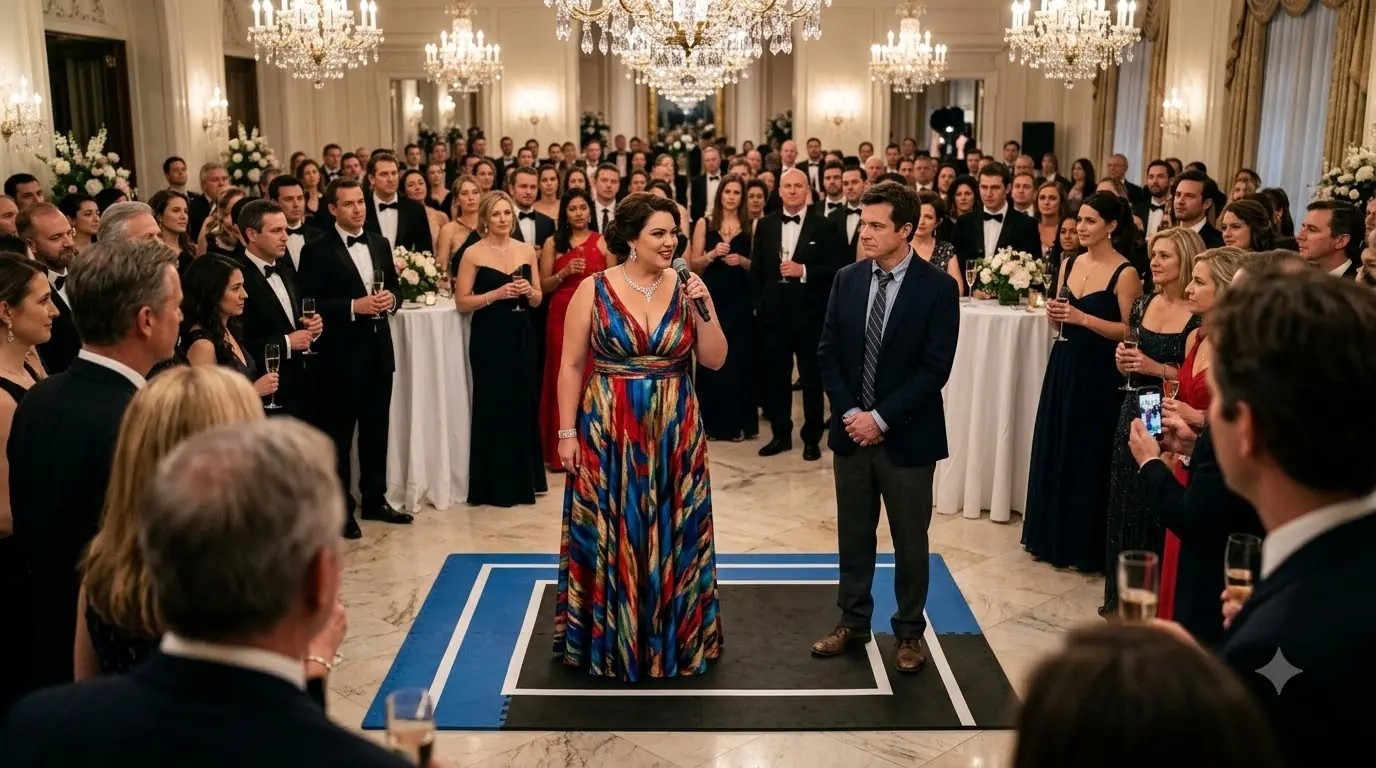
He was wearing a navy blue sport coat he'd bought at a discount store 3 years ago, and dress shoes that were clean but not new. His tie, Emma, had picked it out that morning, green with small geometric squares, was slightly crooked. He didn't fix it. He never bothered with things like that.
Daniel moved through the crowd the way he moved through every crowd quietly, efficiently, leaving almost no trace that he had passed through at all. He nodded to the security team at the door. Two men he recognized from the building rotation and accepted a glass of sparkling water from a server who was barely old enough to drive. The Hartfield Gala happened every year in October.
It raised money for veterans, families, and children's hospitals. two causes close enough to Daniel's chest that he always cleared his schedule, always bought a table, always showed up. He had been coming for 4 years. He knew most of the staff. He knew which caterer they used and which corners of the building had dead spots in the security camera coverage because it was his job to know those things.
He was, after all, the maintenance and facilities supervisor for Hartfield Industries Eastern Division buildings. It was not a glamorous title. He had not chosen it for glamour. He had chosen it because it kept him present.
It kept him local. It meant that when Emma got sick at school, which happened twice in third grade and once already this fall, he was never more than 20 minutes away. That was the entire calculation. The room was beautiful in that specific way.
Expensive charity events always are dim lighting round tables dressed in white linen, a small stage at the front with a podium and a live jazz quartet playing something that nobody was quite listening to. The kind of evening where people with serious money dressed in serious clothes and told themselves they were doing something meaningful while drinking $400 bottles of wine. Daniel didn't judge it. He had attended enough of these to understand they did genuine good, even wrapped in all that polish and performance.
He found his seat at table 14 near the back close to the exit with a clear sighteline to the main stage and both side doors. Old habits. The man next to him was a regional director named Phil Baitman, in his 50s, good-natured, who spent the first 10 minutes telling Daniel about a fishing trip he'd taken in Montana. Daniel listened.
He asked two questions, both genuine. Phil was the kind of man who just needed someone to pay attention and Daniel had always found it easy to give people that. It was 20 minutes into the entree course when everything shifted. Daniel heard her before he saw her, not because she was loud.
Victoria Hayes was never loud in the cheap sense of the word. She had a voice that carried controlled precise, designed to reach the back of a room without ever sounding like it was trying. It was a voice that expected to be obeyed. Which is why I want the Eastern Division restructuring complete before December.
I don't care what the facilities team says about timeline. Timeline is a preference. December is a requirement. Daniel looked up.
She was standing three tables away in conversation with two men who both had the posture of people who were technically her equals, but had already decided they weren't. She was dressed in deep charcoal, not quite black, not quite gray, and wore her dark hair pulled back with the kind of effortless severity that usually took an hour to achieve. She had sharp features and sharper eyes, and the kind of stillness in her body that told anyone who knew what to look for that she was trained, significantly trained. Daniel looked back at his plate.
He had heard about Victoria Hayes. Everyone in the Hartfield organization had heard about her. 6 weeks ago, Hayes Capital had completed an acquisition of Hartfield Industries, a move that the financial press called bold and that the employees called terrifying. Victoria had spent the first four weeks conducting what she called structural assessments and what everyone else called figuring out who to fire.
Daniel's department had passed. Barely by some accounts, though Daniel himself had never been called into a meeting, had never been formally reviewed, had never once been asked to justify his position. He suspected that was because his division's numbers were excellent, and because he had spent the last 3 years quietly fixing things that nobody else noticed were broken. He wasn't complaining, but he had watched in those six weeks as Victoria Hayes moved through the organization like a very elegant, very precise demolition crew.
She restructured the marketing division. She consolidated three regional accounting teams into one. She let go of a VP of operations who had been with Hartfield for 19 years and replaced him with a 29-year-old data analyst who Daniel had to admit actually seemed excellent at the job. She was good at what she did.
He just didn't particularly want to be noticed by her. You're Daniel Carter. He looked up. Victoria Hayes was standing at his table, not passing through, standing, looking directly at him with those sharp assessing eyes, holding a champagne glass she hadn't touched.
Phil Baitman next to him made a sound like a man who had suddenly forgotten how his lungs worked. "Yes, ma'am," Daniel said. He didn't stand immediately, not out of disrespect, but because he was still processing how she had moved across the room that quickly and that quietly. She had training in stealth as well as force.
Interesting. He stood. Eastern Division facilities supervisor, she said. It wasn't a question.
That's right. She studied him for a moment. Not rudely, more the way a person studies a piece of equipment they're trying to figure out methodically without sentiment. You filed a security protocol amendment 3 weeks ago.
She said a recommendation to change the overnight patrol rotation schedule and install secondary sensor coverage in the loading corridors. I did. Nobody asked you to. No.
Daniel agreed. But the existing coverage had a 12-minute gap window on the northeast corridor between 2 and 4:00 a.m. 3 weeks earlier, we had an equipment theft during that exact window. I thought the pattern was worth addressing. Victoria tilted her head slightly.
The security director said the theft was random. The security director's assessment was based on the inventory report. Daniel said the inventory report didn't account for the secondary access point on the service level. I walked the corridor myself.
A pause. You walked it at 2:00 in the morning at 2:15. Yes. Another pause.
Longer this time. Why? Daniel considered the question. It seemed straightforward to him, but he had learned slowly over years that things that seemed straightforward to him were not always obvious to other people because that's what the job requires," he said.
Victoria looked at him for three more seconds. Then she nodded a single decisive motion and moved back toward the front of the room without another word. Phil Baitman exhaled audibly beside him. man," he said quietly. "How are you so calm?" Daniel looked at him.
"What do you mean? That's Victoria Hayes. She just came over here and interrogated you, and you talked to her like she was asking for directions." Daniel picked up his fork. She wasn't interrogating me.
She was curious. "There's a difference." "Yes," Daniel said. "A big one." The martial arts demonstration came after dinner. It was a regular feature of the Hartfield Gala had been for years long before Victoria took over.
Local martial arts schools, a couple of professional instructors, some light sparring between volunteers from the audience. It was meant to be entertaining, celebratory. The proceeds from a live auction afterward went directly to the veterans fund. Daniel watched from his seat.
He watched the way he always watched things, not casually, not with detachment, but with the kind of complete attention that most people never noticed because it didn't look like attention. He looked relaxed. He looked like a man watching a pleasant after-dinner performance. He was cataloging every movement on that mat.
The first two demonstrations were good. A local taekwondo instructor and one of her senior students ran through a crisp, well-rehearsed pattern that drew genuine applause. Then a Brazilian jiu-jitsu practitioner from a downtown gym demonstrated a series of ground techniques on a willing volunteer. Then Victoria Hayes stepped onto the mat.
The room changed. Not dramatically, not suddenly, but something shifted the way the air in a room shifts when someone walks in who changes the gravity of the space simply by being present. People sat up slightly. Conversations softened.
A few phones appeared angled toward the stage. She had changed into training clothes, dark-fitted professional. She moved to the center of the mat with the kind of economy that told Daniel everything he needed to know. This wasn't performance.
This was real. Her sparring partner was a third-degree black belt from a local dojo. A man in his late 30s who was clearly capable and clearly already treating her with careful respect. They bowed.
They began. She was extraordinary. Daniel watched without expression. She had speed that most people her size never developed. not muscle-driven speed, but the sharper, more dangerous kind that came from genuine understanding of how to minimize distance between intention and action.
Her footwork was quiet. Her transitions were seamless. She read her partner's body language two moves ahead and adjusted so smoothly, it looked effortless. Fifth degree black belt, the program said.
The program was underselling her. When the demonstration ended, the room gave her a standing ovation. Victoria bowed once properly with genuine respect for her partner and then did something Daniel didn't expect. She looked out at the audience and her eyes found him.
Mr. Carter. Her voice carried perfectly without the microphone. Every head in the room turned. Daniel felt the shift of attention like a physical thing.
400 pairs of eyes swinging toward table 14, toward the man in the slightly crooked green patterned tie. He didn't react, he just waited. I've been told, Victoria said, and her voice had an edge to it that was almost playful, but not quite. That you have some experience in high pressure situations.
Daniel said nothing. I've also been told, she continued stepping to the edge of the mat, that you have opinions about how things should be run, about protocol, about what people in leadership positions might be missing. She paused. I find that interesting.
In my experience, the people who are quickest to identify what others are doing wrong are often the least prepared to step up themselves. The room was very quiet. Phil Baitman to Daniel's left had stopped breathing entirely. You telling me, Victoria said.
And now the edge was sharper. Now it was directed that you know how to handle pressure, that you understand what it takes to make real decisions under real stakes. She tilted her head. Then prove it.
The silence that followed was the kind that has weight to it, the kind that presses against the skin. At the back of the room near the service entrance, Daniel could see a small cluster of children from one of the charity programs that the gala supported. eight- and nine-year-olds dressed in their best clothes brought in for a special presentation that was scheduled for the end of the evening. One of them was a girl with dark braids and a serious expression who had been watching the martial arts demonstration with enormous focused eyes. She reminded him of Emma.
He thought about Emma, about the promise he had made a long time ago. Not to avoid the fight, but to understand it. To know the difference between strength and performance. to know when the mat was the right answer and when it was simply the loudest one. He stood up.
Not quickly, not dramatically. He just stood. The room registered at a subtle collective inhale. The particular silence of 400 people recalibrating their expectations.
Daniel walked to the edge of the mat. He looked at Victoria. Hayes really looked at her in the way he had learned to look at people. Pass the performance and the posture and the precision down to the thing underneath.
A question she didn't know she was asking. I'll step on the mat, Daniel said. His voice was quiet. Calm.
The kind of calm that doesn't announce itself. But I want to say something first. Victoria raised an eyebrow. By all means.
I don't fight to prove I'm strong, Daniel said. And I don't step up when someone challenges my pride. He paused. I only fight when someone needs protecting.
He let that land. In the back of the room, he heard one of the children laugh softly at something. He didn't look away from Victoria. Those are very pretty words, she said.
I know, Daniel said. I've had a long time to figure out which words are true. She studied him. For a moment, just a moment, something crossed her face that was not quite certainty.
Then it was gone. Step on the mat, Mr. Carter. He did. What happened in the next 40 seconds would be described in the weeks that followed in at least a dozen different ways by people who were present.
Some would remember it as brutal. Some would remember it as elegant. Some would remember the speed of it and some would remember the quiet. What they would all agree on, all 400 of them, regardless of where they were sitting, regardless of how they remembered the details, was this.
The most extraordinary thing was not how it ended. The most extraordinary thing was what Daniel Carter did the moment after. But that part of the story requires understanding something about Daniel Carter that nobody in that room knew. Not Victoria Hayes, not Phil Baitman, not the retired Navy officer sitting near the stage who had been watching Daniel from the moment he walked in, growing quieter and quieter with a particular kind of recognition in his eyes.
Not the girl with the dark braids near the service entrance, who looked exactly like someone's daughter. Nobody knew the weight that man carried into the room with him. Nobody knew the name the world used to call him. And nobody not yet understood why a man who could dismantle a trained fighter in 40 seconds chose to spend his evenings fixing broken things in empty buildings at 2:00 in the morning.
To understand that you have to go back not 6 weeks, not 6 months, you have to go back 8 years to a hospital room to a promise to the moment Daniel Carter made the decision that changed everything about who he was going to be. Eight years earlier, Daniel Carter had a different life. He does not talk about it. He will not talk about it if you ask him directly.
And almost nobody who knows him now would think to ask because nothing about the way he carries himself suggests there is anything to ask about. He will answer you politely, briefly, and in a way that closes the door without slamming it. He will tell you he served. He will tell you it was a long time ago.
He will tell you he's grateful and then he will ask you something about yourself because Daniel Carter has always been better at listening than most people will ever be at anything. What he will not tell you, what he has told almost no one since leaving the Navy is that for 11 years Daniel was assigned to SEAL Team 8. That he ran 41 missions across six countries. that he was responsible at the height of his career for the training and operational command of a 12-man element that operated in conditions where the margin for error was measured not in percentages but in heartbeats. He was not the loudest man in any room he entered.
He was never the loudest man, but he was consistently the last man standing. In the Navy, they had a term for what Daniel was not the official designation, not the formal title, but the thing the other operators called him when they were being honest about what they saw. They called him the quiet, not because he was passive, not because he was soft, but because Daniel Carter had a quality that very few people in any profession ever develop. He was dangerous in the specific way that silence is dangerous in the way that still water is dangerous because you can't see the depth until you're already in it.
He left the Navy 8 years ago. Not because he was forced to, not because he failed. Because his wife was dying. Rachel Carter, née Rachel Bloom from Columbus, Ohio. a third grade teacher who could make any child feel like the most important person in the world and who had the specific profound courage of someone who faced enormous things without ever making a production of it was diagnosed with a rare neurological condition 18 months after their daughter Emma was born.
The diagnosis came on a Tuesday. Daniel was in the middle of a pre-deployment briefing in Virginia Beach when his phone vibrated. He stepped out of the briefing. He read the message.
He stepped back in. He did not tell anyone for three days. Because Daniel Carter dealt with crisis the way he dealt with everything by first going completely still, by understanding precisely what was in front of him by refusing to act until he understood what action would actually accomplish something. On the fourth day, he walked into his commanding officer's office and began the paperwork.
18 months later, he was out. He spent six years at Rachel's side working maintenance jobs flexible enough to build around her treatment schedule, around Emma's school schedule, around the particular geography of loving someone who is leaving you slowly and who is still right up until the end more worried about the people she's leaving than about herself. Rachel died on a Wednesday morning in March 2 years ago. Emma was six.
She had known in the way children know things that adults try to protect them from that her mother was very sick. She had not known, could not have known the specific weight of what came after. The particular silence of a house that used to have a certain sound and then didn't. The night after Rachel's funeral, when Emma was asleep, Daniel sat at the kitchen table for 4 hours.
He did not cry. He had already done that in the hospital in the parking lot in the specific private way of a man who does not perform his grief for anyone. He sat at the table and he thought about what came next. He thought about Rachel's last real conversation, not the last words which had been soft and brief and between just the two of them, but the last real conversation 3 weeks before the end when she had held his hand and looked at him with those serious loving eyes and said, "Dany, promise me something.
Anything. Don't let the Navy take you back. Don't let any of it take you back. Emma needs a father who's present.
Not a legend, not a warrior, just a dad. He had promised. He had meant it. And sitting at that kitchen table two years ago, he understood that the promise was not about hiding.
It was not about pretending. It was about choosing actively daily in every small moment to put his daughter ahead of everything that used to define him. He got a job managing maintenance for Hartfield Industries Eastern Division. He enrolled Emma in the school three blocks from their apartment.
He went to every school play, every soccer game, every parent teacher conference. He learned how to braid hair badly at first, then adequately, then with genuine competence because Daniel Carter did not stay bad at things he decided to be good at. He lived quietly. He chose it deliberately, and for 2 years it worked until the night Victoria Hayes stepped onto a mat and said, "Prove it." And Daniel Carter, who had spent two years carefully, deliberately, lovingly becoming the most ordinary man he could manage to be, felt something old and very deep in his chest shift slightly.
Not anger, not pride, something quieter than both. Something that had been waiting patient as stone for the moment when the line between retreat and surrender finally became visible. He walked to the mat. He said what he said.
And then he waited to see what kind of man he was still capable of being. Because here is the thing about Daniel Carter that nobody in that room understood. He wasn't afraid of Victoria Hayes. He wasn't afraid of the crowd.
He wasn't even afraid of losing. He had lost things so much larger than a charity sparring match that the concept barely registered. What Daniel Carter was afraid of. The only thing he had been afraid of for 8 years was becoming someone his daughter couldn't recognize.
And standing on that mat looking at a woman who had decided he was lesser without knowing the first true thing about him. Daniel Carter made a decision not to fight, to be seen. Just once, just enough. He didn't know yet what that would cost him.
He didn't know yet that the retired officer near the stage had already pulled out his phone. He didn't know yet that by the time the night was over, the name he had spent 2 years burying would be standing in the middle of that room in front of 400 strangers. He didn't know any of it. He just stepped onto the mat, and the room held its breath.
The room did not breathe. That was the only way to describe it afterward. 400 people, champagne glasses, half-raised forks, set down mid-sentence conversations left hanging in the air like smoke, and not a single one of them making a sound. The jazz quartet had stopped playing somewhere in the last 2 minutes.
Nobody had asked them to. They just stopped because even musicians understand when the room has moved on to something more interesting than anything they could offer. Daniel Carter stood at the edge of the mat. Victoria Hayes stood at the center of it.
And between them was something that had no name yet. Not a fight, not a confrontation exactly, but a kind of charged specific silence that happens when two people who are both in their different ways, exceptionally dangerous, finally occupy the same space and have to decide what to do about it. Victoria rolled her shoulders once. A small movement practiced automatic. the kind of movement a person makes 10,000 times before it stops being something they think about and becomes simply the thing their body does when it is preparing.
Daniel noticed it. He noticed everything. You don't have to do this, Victoria said. And her voice was quieter now.
Not softer, not kinder, just quieter the way a person's voice gets when they've shifted from performance to something more real. If you're uncomfortable, I understand. We can call it a friendly conversation. She was giving him an exit.
He understood that. He even respected it in a narrow technical way. Victoria Hayes was not cruel. She was precise and precision sometimes looks like cruelty from the outside.
But the thing underneath it was actually a kind of discipline. She had given him a challenge and now she was giving him a door. Most men would have taken it. I'm not uncomfortable, Daniel said.
No, no. She studied him for another second. you've done this before. It wasn't a question. She was reading him the way he had been reading her, looking past the surface, cataloging the details that didn't match the story she'd already written.
The way he stood, the way his weight was distributed, the way his eyes were quiet and his hands were still. I've done something like it, Daniel said. Phil Baitman, still at table 14 later, told his wife that those four words were the moment he understood that something very strange was happening. Because the way Daniel said them, not boastful, not evasive, just precise, was the way a person talks about something enormous that they have decided to minimize.
Something like it, Victoria repeated. One corner of her mouth moved. All right, then. She came forward, not slowly.
Victoria Hayes did nothing slowly. She moved the way she had moved through the entire demonstration with the specific compressed efficiency of someone who had trained their body to eliminate every unnecessary motion, who had spent years burning away the waste until what remained was pure intent translated directly into action. She was fast. She was genuinely impressively fast.
And Daniel moved, not the way most people move when they are trying to avoid something. He didn't scramble. He didn't lean away. He shifted a half step, a rotation of the hips, a redirection so subtle that half the room wasn't sure they'd seen it at all.
And Victoria's strike went past him by 4 in. She reset immediately. No hesitation, no surprise registered on her face. Just immediate recalibration.
She came again lower this time, changing the angle, and Daniel moved again and again. Her strike landed on air. The crowd made a sound, not applause, something between a gasp and a murmur, the specific sound of people revising their expectations in real time. Victoria stopped.
She looked at him. "You've been trained," she said. "Not accusatory, just a statement of fact, the way someone says the sky is blue." "Yes," Daniel said formally. "Yes, not just some weekend self-defense class." "No," she tilted her head slightly.
Her eyes had changed. Still sharp, still precise. But there was something in them now that hadn't been there a minute ago. Something that looked a lot like genuine curiosity and a little like the particular alertness of a person who has walked into a room they thought they knew and discovered it was larger than they expected.
Who trained you? She asked. The United States government, Daniel said. He said it the way he said most things, simply without drama, without any apparent awareness that the words themselves were a depth charge.
The room registered it differently than he did. The murmur that moved through 400 people was the sound of 400 different mental calculations updating simultaneously of people glancing at each other and then back at the quiet man in the slightly crooked tie who had just said with the calm of someone describing their college major that he had been trained to fight by the federal government. Victoria did not look at the crowd. She kept her eyes on Daniel.
Military, she said. Yes. Which branch? Daniel hesitated just for a half second.
So small that most people in the room missed it entirely. But Victoria Hayes did not miss it. and the retired officer near the stage, a heavyset man in his late 60s named Robert Hale, who had spent three decades in the Navy and had been getting progressively more still for the last 15 minutes. He did not miss it either. Navy, Daniel said, and then he said nothing else.
Victoria looked at him for three full seconds. The calculation on her face was visible rare for a woman who usually kept her expressions on an extremely tight leash. She was doing the math, the stillness, the awareness, the movement, the specific quality of a man who had been trained not just to fight, but to survive, to operate, to function under conditions that would dismantle most human beings entirely. "Step on the mat," she said.
But the edge was different now, less sharp, more intent, and Daniel stepped on. What happened next took 42 seconds. Later, different people would remember different details. the way witnesses to significant events always do. A woman at table 7 remembered the sound, or rather the lack of it.
The way the room got quieter and quieter until the 42 seconds were over. A man near the front remembered the expression on Victoria's face. Not when she went down, but when she looked up the specific quality of that expression that he could not quite name, but would spend a week trying to describe to anyone who would listen. Phil Baitman remembered Daniel's hands. how still they had been, how absolute the control, like watching someone handle something powerful with the complete certainty that came from having handled it 10,000 times before.
Victoria came at him hard this time. No more testing, no more reading. She had decided that the only way to understand what she was dealing with was to find the edges of it. And Victoria Hayes found edges by pushing against them with everything she had.
She was exceptional. In any other context against any other person in that room, she would have ended the exchange in the first 15 seconds. She was faster than most men, more technically precise than almost everyone, and she fought with the particular ferocity of someone who had decided long ago that hesitation was the enemy of winning. Against Daniel, it simply wasn't enough.
He was not fighting her. That was the thing nobody fully understood until later. Daniel Carter was not fighting Victoria Hayes. He was containing her the way you contain something dangerous.
Not by destroying it, but by understanding it so completely that you can stay one step ahead of every decision it makes before it makes them. He read her body like a language he had learned before he learned to read words. The shift in her left shoulder that preceded her favored combination. The way her weight moved to her back foot before she changed direction. the specific rhythm of her breathing, which most fighters don't control, and which tells an attentive opponent things they would very much prefer not to share.
He stayed 3 in outside every strike. Not dramatically, not with any visible effort, just outside. And then at 38 seconds, he moved forward. It was the first time he had moved forward.
For 38 seconds, he had been still, had been patient, had been the thing that could not be hit. And then he moved forward, and the shift in the energy of the room was immediate and complete. It took 4 seconds, three precise movements, not violent, not brutal, just absolutely correct. The way mathematical proofs are correct, the way a surgeon's cut is correct.
And Victoria Hayes was on the mat, not hurt, not humiliated in any way that was gratuitous or cruel, just down. And then Daniel stepped back. He extended his hand. Victoria looked up at him from the mat and every single person in that room saw her face in that moment and understood that something had happened that was much larger than a sparring match, that some kind of reckoning was occurring between two people who were still in the very early stages of understanding what it meant.
She took his hand. He pulled her up. The room erupted. Not politely, not in the careful, orchestrated way that charity events usually generate applause.
This was real. The specific applause of people who have witnessed something they didn't expect and are responding to it with their actual selves rather than their event selves. Victoria was breathing, controlled, but real breathing. the breathing of someone who has genuinely exerted herself. She looked at Daniel and he looked back at her and neither of them said anything for a moment.
Then she said quietly enough that only he could hear her, "Who are you?" And Daniel said, "Someone who learned a long time ago that winning isn't the same as being right." It was the most he'd said that was true in months. He didn't know know yet that it was the beginning of the thing coming undone. Robert Hale had been moving through the crowd while Daniel and Victoria were still on the mat. He moved the way old military men move in civilian spaces with a particular unhurried purposefulness, parting the crowd without drama, his eyes fixed on his mat.
He was 67 years old and carried a moderate amount of extra weight around the middle and used a cane on his right side because of an old injury that had never healed completely. And none of those things made him any less absolutely certain of where he was going or what he was about to do. He reached the edge of the mat as Daniel stepped off it. He stopped.
He looked at Daniel for five full seconds. The way a man looks at something he thinks might be a mirage. The specific squinting attention of someone whose eyes are telling him something his brain is having trouble processing. Daniel Carter," he said.
His voice was not loud, but it was the kind of voice that had spent decades learning to cut through noise, and the room had been moving back toward conversation, but it wasn't there yet. And so his voice carried to more people than he intended it to. Daniel turned. He looked at Robert Hale, and something in his face for just one moment, one fraction of a second changed.
Not much. A small tightening around the eyes. A slight shift in the quality of his stillness. The specific expression of a man who has been living under a name without a history and has just heard someone say the name and the history at the same time.
Captain Hail, Daniel said. Quiet, even like a man absorbing a blow without letting anyone see it land. Robert Hale took two more steps forward. His cane clicked against the hardwood at the edge of the mat.
SEAL Team 8. He said he was not trying to announce it. He said it the way you say the name of a place you and another person both know as a shared reference, as an anchor, as a way of confirming that what you are seeing is what you think you are seeing. But 400 people heard it.
And in the specific quiet that had settled over the room in the aftermath of what had just happened on the mat, 400 people understood all at once the thing that the quiet man in the crooked tie had not told anyone. The murmur was different this time. Slower, deeper, the sound of people revising not just their expectations, but their entire understanding of who they had been looking at for the last hour. Phil Baitman said, "Oh my god, very quietly, and nobody around him disagreed." Victoria Hayes had gone very still.
She was standing at the edge of the mat, her training jacket in her hand. And she was looking at Daniel with an expression that was not embarrassment and was not guilt and was not anger, but was something much more complicated than any of those things. Something that looked like the beginning of a person realizing that they have been wrong in a way that goes much deeper than the specific thing they got wrong. Former SEAL team 8, Robert Hale said, and now he was speaking to the room in the tone of a man who understands that the context is necessary.
Element commander, 11 years, 41 operations. He paused. He looked at Daniel and in his eyes was a respect so deep and particular that it had its own weight. The Joint Chief's commendation, the classified operations I can't name, and the training program he built that is still being used today.
Another pause. This man saved my son's life in 2019 in a situation I am not permitted to discuss and I have been looking for a way to say thank you to his face for 5 years. The room was completely silent. Daniel Carter stood in the middle of it and did not look at the ceiling and did not look at his shoes and did not perform any of the things that a person performs when they are the subject of an unexpected revelation in front of hundreds of strangers.
He just stood there absorbing it the way he absorbed everything completely without visible reaction. The way deep water absorbs things without changing its surface. But his jaw was tight and his eyes. If you were close enough to see them, if you were paying the kind of attention that most people in that room were paying all of it.
Now every last scrap of it directed at one man. His eyes had something in them that was not pride and was not discomfort. It was the look of a man who had built a very specific, very deliberate life and who could feel it shifting under his feet. He thought about Emma.
He thought about Rachel. He thought about the kitchen table at 2 in the morning and the promise he had made and the way he had understood that promise not as eraser, not as shame, but as choice, as protection, as love made practical. He had not wanted this. He had not engineered it or allowed it or done anything except show up tonight because the charity supported veterans families and he bought a table every year because it was the right thing to do.
And now 400 people were looking at him with a specific kind of attention that he recognized from a different life. The specific attention that people give to someone they have just decided is extraordinary. And Daniel Carter felt in the very center of his chest a complicated grief for the ordinary life he had spent two years carefully building. And that was in this moment cracking along seams he hadn't known were there.
Victoria Hayes walked across the room toward him. She didn't hurry. She moved the way she had moved all evening with precision, with intention. But something in her posture was different.
The specific efficiency was still there, but it had shifted slightly. the way a very rigid thing shifts when it encounters something that challenges its assumption of its own strength. She stopped in front of him. She was close enough that the conversation was private or as private as anything can be when 400 people are watching your face and trying to read your lips. You should have told me, she said.
Daniel looked at her. Told you what? Who you are? I did tell you, he said.
You just decided you already knew. She took that. She didn't flinch away from it, which he noticed and which elevated her slightly in his estimation because the people who could take a direct accurate observation without deflecting it were rarer than most people understood. That's fair, she said.
It's not an accusation, Daniel said. It's just what happened. She was quiet for a moment. People around them were talking again.
The room had found its voice in the aftermath of the revelation. the specific excited murmur of a crowd that has witnessed something they will be discussing for weeks. But between Daniel and Victoria, there was still a particular stillness. Why are you running maintenance operations for my company? She said when you could be running, she paused.
Most things. Daniel looked at her for a long moment. The question was genuine. He could hear that.
Victoria Hayes was not performing curiosity. she was experiencing it which was rarer and more valuable and also meant the answer mattered because my daughter's school is three blocks from the building he said because my hours are flexible because when Emma was sick in September I was there in 20 minutes he paused I'm not running away from something I'm running towards something Victoria Hayes CEO fifth-degree black belt woman who had dismantled and rebuilt a billion-dollar company woman who had never once in her professional life been at a loss for what to do next. Did not say anything for several seconds. She's lucky, Victoria finally said. Your daughter, she's eight, Daniel said.
She doesn't know she's lucky yet. She just knows she has a dad who shows up. A brief pause. That's enough for now.
Robert Hale had reached them. He put his hand out to Daniel and Daniel took it and the handshake lasted the specific length of time that a handshake lasts between men who share things they cannot explain to anyone who wasn't there. You look good, Robert said. You're lying, Daniel said.
And something in his face eased just slightly, just for a second. The face of a man who has been managing enormous solemnity, finding a brief real opening for something lighter. Robert laughed. a genuine deep old man laugh that was entirely out of scale with the gravity of the preceding minutes and completely appropriate for exactly that reason. I'm not lying about the important part.
I know, Daniel said. And for just a moment, just a breath, he looked like the man he used to be. Not the maintenance supervisor, not the single father, not the quiet man at table 14 with the crooked tie. He looked like the person Robert Hale had been looking at from across the room all evening.
The person underneath the deliberate ordinary life. The person who had spent 11 years in the hardest service his country offered and had come out the other side of it with his character intact and his soul inconveniently whole. Then the moment passed and Daniel Carter was standing in a ballroom with 400 strangers who now knew his name and his history. thinking about a girl at home who was probably reading past her bedtime and who had no idea that her carefully constructed ordinary life had just developed a very significant crack. His phone buzzed in his pocket.
He looked at it. Emma, a text, a small cartoon of a sleeping girl with the words still awake underneath it, which was Emma's reliable method of communicating that she was absolutely still awake and also wanted him to know it. He looked at that image for 3 seconds. He typed back, "Go to sleep." 3 seconds later, a cartoon of an eye wide open staring directly at the screen.
Daniel Carter, who had not smiled all evening with anything approaching real warmth, smiled. And Victoria Hayes, who had been watching his face with that same precise cataloging attention she brought to everything, saw it happen. She saw the smile arrive and she saw what caused it and she registered something in that transaction. The phone, the small message, the private warmth that crossed a very controlled face that changed something in the way she understood the evening.
She really is lucky, Victoria said quieter this time. Daniel pocketed his phone. He looked at Victoria. His face had returned to its usual measured calm, but the warmth was still there underneath it, faint as heat rising off pavement, visible if you were paying close enough attention.
"I made a promise," he said simply. He did not explain what promise. He did not explain to whom he had made it or what it cost him or what it had required of him night by night, day by day, in the specific ordinary heroism of showing up without fanfare for the smallest and most important things. But Victoria Hayes had built a company from nothing.
She had read a thousand people across a thousand conference tables. She had learned through long practice to hear the things that were said between the words. She heard them now. She heard the promise in the way he said the word.
She heard the person it was made to. She heard two years of very deliberate, very loving choice layered under 5 seconds of simple explanation. and something in Victoria Hayes in the precise, efficient, relentlessly capable woman who believed that every problem could be solved through strength and that strength was best proven by demonstration. Something in her went quiet, not defeated, not humbled in any cheap or temporary sense, just quiet. The way a person goes quiet when they have encountered something that requires them to enlarge their understanding of what strength actually looks like.
Phil Baitman found Daniel 20 minutes later near the exit collecting his coat. "You could have said something," Phil said, not accusing. Just the natural bewilderment of a man who had spent the evening eating dinner next to a person he completely failed to understand. Daniel looked at him.
Said what? I don't know anything. Hey, by the way, I'm basically a superhero. I'm not a superhero, Phil.
You literally just I'm a maintenance supervisor, Daniel said. and the specific quality of his voice was not a correction or a dismissal. It was a statement of genuine identity, the thing he had chosen, the thing he was, the thing that mattered to him regardless of everything else the world had decided to make of this evening. I'm also Emma's dad. Those are the things I am.
Phil stared at him for a long moment. Okay, Phil said finally, but I'm putting you down as a reference. Daniel laughed short. Reel the laugh of a man who doesn't do it often enough.
And for a moment, the ballroom, the revelation. Victoria Hayes and Robert Hale, and 41 operations in six countries. All of it receded slightly, and it was just two men standing near a coat check. One of them confused and endearing about it, and Daniel felt something that was neither the weight of his past, nor the brightness of tonight's unexpected exposure, but something simpler and older and more reliable.
He felt like himself, all of himself, maybe for the first time in a while. He didn't know yet what that would require of him. He didn't know yet that Victoria Hayes would spend the next 6 hours unable to sleep, sitting in her office with a glass of untouched scotch, turning the evening over in her mind, with the specific restless focus of a person who has encountered an idea they cannot resolve. He didn't know yet that Robert Hale would make three phone calls before midnight to three people who would each make their own calls and that by morning a version of tonight's story, imprecise, incomplete, but structurally accurate, would be moving through a network of people who had served, who had known Daniel Carter in his other life, who had wondered for years what had become of him.
He didn't know yet that Emma at home had not gone to sleep. Had in fact spent the last 40 minutes sitting at the kitchen table in the specific worried but not saying so way of eight-year-olds who sense when something in their world is changing, looking at the front door and waiting for the sound of his key in the lock. Daniel Carter walked out of the Meridian Tower into the October air. He breathed once, twice.
He thought about Rachel. He thought about the promise. He thought about whether he had broken it tonight, whether stepping onto that mat and letting 42 seconds of his real self be visible to 400 strangers was a betrayal of the life he had chosen, of the deliberate ordinary peace he had built for Emma's sake. He thought about it for a long time, standing on the sidewalk with his coat over his arm and the sounds of the city moving around him.
Then he decided he didn't know yet. He didn't know if tonight was a mistake or something else. He didn't know if the crack in the ordinary life was damage or a door. He didn't know what Victoria Hayes was going to do with what she'd seen or what Robert Hale's phone calls would put in motion or what Emma was going to ask him in the morning when she looked at his face and read him the way she always did with the ruthless loving accuracy of a child who has never known her father to be less than entirely honest with her about the things that mattered.
He only knew one thing with complete certainty. Standing there in the October dark, he had to get home. Emma was waiting. He started walking.
Emma was still awake. Daniel knew it before he opened the door. He knew it the way he knew most things. Not from evidence exactly, but from the particular quality of the silence inside the apartment.
The specific weight of a silence that has a person in it versus the silence of an empty space. Eight years of living alone with a child teaches you the difference. He turned the key quietly, stepped inside, set his coat on the hook by the door. She was at the kitchen table sitting in her pajamas, the ones with the small yellow stars that she had insisted on buying 3 months ago, and that were already slightly too short at the ankles.
She had a book open in front of her. She was not reading it. She was looking at the front door with the expression she used when she was trying to appear casual and was doing it badly. Hi, Emma said.
Hi, Daniel said. I was reading. I see that. The book is really good.
What's it about? A pause. She looked down at the cover as if she was checking horses, she said. Daniel pulled out the chair across from her and sat down.
He loosened the green tie, the one she had picked, the one that was still slightly crooked, and set it on the table between them. He looked at his daughter for a moment. She looked back at him with those serious dark eyes that were Rachel's eyes that had always been Rachel's eyes that would be Rachel's eyes when Emma was 40 and 60 and old. Something happened tonight, Emma said.
It was not a question. What makes you say that? You're doing the face. What face? the face where everything is normal, but it isn't.
Daniel considered this. He had spent 11 years training himself to have no readable face, to give nothing away in his expression, to be a wall of pleasant, appropriate blankness when the situation required it. Against Emma Carter, all of that training was apparently entirely useless. "Some people found out about the Navy tonight," he said.
He kept it simple. With Emma, Simple was always right. She was eight, but she had never been a child who needed things dressed up. She inherited her mother's preference for the actual truth delivered directly without performance.
Emma went very still, not frightened, just processing. He watched her do it. The particular internal machinery of his daughter working through information, reorganizing things. The seal stuff, she said.
Yes. How? An old officer recognized me. Captain Hail, I've mentioned him before.
Emma thought about it. The one whose son you. Yes. Another silence.
She was looking at the tie on the table between them. Then she looked up. Are you okay? She asked.
And Daniel Carter, who had been asked that question many times in many circumstances by many people who asked it as a formality, heard it asked by his 8-year-old daughter in the way she meant it with complete uncomplicated sincerity, with the full weight of her attention, with the specific love of a child who has one parent left and watches him the way you watch something you cannot afford to lose, and felt something in his chest that was very large and did not have a clean name. I'm okay, he said. I'm figuring some things out. About what?
He looked at her. About what I'm supposed to do with the parts of me that I put away. Emma considered this with the gravity she brought to everything she considered. Seriously.
Mom always said you can't put things in boxes forever, she said. She said eventually the box gets full and you have to deal with what's in it. Daniel was quiet for a moment. She said that she said it to Aunt Carla.
I was listening from the hallway. Emma paused. I wasn't supposed to be listening. No.
Daniel agreed. But you were right to remember it. Emma looked at him. Are you going to change things?
I don't know yet. But maybe, maybe, he said. He reached across the table and straightened the edge of her book, a gesture that meant nothing except that his hands needed something small to do. "Is that okay with you?" Emma thought about it with the seriousness it deserved.
8 years old, with her mother's eyes and her father's stillness, sitting in star pajamas at 11:00 at night, making a real decision about something real. "Yeah," she said. "I think so." then with the directness that had been hers since birth. Will you still be home when I'm sick?
Always, Daniel said. That part doesn't change. Nothing changes that part. She nodded once.
Decisive the way he was decisive. Then she picked up her book. Okay, she said. I'm going to sleep now.
Horses are that interesting. Very," she said, and the faintest smile crossed her face, the one she used when she was making a joke and pretending she wasn't. He watched her go down the hall. He heard her door close.
He sat at the kitchen table in the silence of the apartment, and he thought about Rachel, and he thought about boxes, and he thought about 42 seconds on a mat in front of 400 strangers. And he thought about the fact that Victoria Hayes had looked at him the way nobody had looked at him in two years, like someone who was trying to understand something they didn't yet have the language for. And he sat there until well past midnight, thinking all of it through. He did not come to any conclusions.
But for the first time in 2 years, he didn't need to. The phone rang at 7:45 the next morning. Daniel was at the stove making eggs. Emma sitting at the counter with cereal.
She wasn't eating because she was reading the actual horse book, the one she apparently had genuinely been reading and had simply used as a prop the night before. The number on the phone was unfamiliar. A city prefix downtown. He answered it, "Mr. Carter." Victoria Hayes's voice.
Clean, direct, no preamble. I'd like to meet this morning if you're available. Daniel looked at Emma. Emma looked at her cereal.
She was pretending not to listen. She was absolutely listening. What time? Daniel said.
Nine. My office. A pause which from Victoria was notable because Victoria Hayes did not do pauses. Please.
He noticed the please. He suspected she didn't use it often. I'll be there, he said. He hung up.
Emma looked up from her cereal with an expression that was carefully neutral and completely transparent. the CEO, she said. Yes, the one from last night. I didn't tell you about last night. Phil Baitman's wife texted Aunt Carla this morning.
Emma said, "Aunt Carla called at 7:15. I answered because you were in the shower." Daniel stared at his daughter. "What exactly did Carla tell you?" Emma tilted her head with the particular angle that meant she was deciding how much to share. that you put some lady on the floor in front of a lot of people and she's a black belt. Another pause.
She seemed pretty excited about it. Daniel turned back to the eggs. Eat your cereal, he said. Was it cool, Emma?
I'm just asking. Cereal. She ate the cereal. But he could see from the corner of his eye that she was smiling.
Victoria Hayes's office was on the 43rd floor of a building that she owned or that her company owned, which in practical terms was the same thing. Daniel arrived at 8:58. He told the receptionist his name. The receptionist's eyes registered something a slight widening quickly controlled the particular expression of someone who has been briefed and said she would let Ms. Hayes know.
He waited 4 minutes. Then a young assistant appeared and led him down a corridor and through a set of glass doors into an office that was large and ordered and revealed in its specifics the character of the person who inhabited it. No decorations for decoration's sake. Every object had a function.
Two whiteboards covered in what appeared to be organizational diagrams. A bookshelf with actual book spines worn margins presumably marked. A desk that was clear except for a laptop. a coffee cup and a single folder. Victoria was standing at the window when he came in.
She turned when she heard the door. She looked different, not less professional, not less composed. But the specific calibration of her composure was different, less armored somehow, like a person who had spent a long night making adjustments. "Thank you for coming," she said.
"Of course," Daniel said. She gestured to the chairs in front of the desk. He sat. She didn't.
She moved to the edge of the desk instead, which put her slightly above him and which was probably a habit so ingrained she wasn't aware of it. He didn't mention it. I owe you an apology, she said directly. No wind up, no softening.
You don't, Daniel said. I do. She picked up the coffee cup, then set it down without drinking. I made a public assumption about who you were based on a surface reading and I compounded it by challenging you in front of a room full of people to prove yourself when you had given me no reason to question your competence to begin with.
She paused. That was arrogant and it was wrong. Daniel looked at her. I'm not angry.
I know that's actually part of what I'm trying to address. She crossed her arms, not defensively. The posture of a person organizing their thoughts. Most people would be most people would be sitting in that chair right now enjoying the reversal.
You're not because it wasn't a reversal, Daniel said. I wasn't trying to embarrass you. I know that, too. She looked at him steadily.
What were you trying to do? The question landed simply without aggression, and Daniel recognized it as genuine. Not a trap, not a test, but a real question from a person who had been trying to understand something since the previous evening and was still not quite there. "I was trying not to shrink," he said.
"There's a difference between avoiding a fight and disappearing when someone decides you're not worth taking seriously." "Victoria was quiet. I've been disappearing for 2 years," he said. "For good reasons. But last night, someone made a decision about who I was in front of 400 people. and I made a decision that that particular audience deserved better than a man who walks away from something that isn't right.
Victoria was still. Then she said, "Because of Emma." Daniel looked at her. "Because of me," he said. "Emma already knows who I am.
She's known since she was six. She doesn't need me to be the man from last night. She just needs me to be honest." He paused. Last night was honest.
Victoria sat down finally in the chair behind the desk. The practiced movement of someone returning to the posture where they think most clearly. I spoke to Robert Hale this morning, she said. Daniel waited.
He told me about Operation Kestrel, she said. The name moved through Daniel like a current. Not painful exactly, but real. The specific weight of something that had been stored at a distance for a long time being brought close.
That's a classified operation, he said. He told me what he's permitted to tell me, Victoria said. Which is enough. She looked at him directly.
You carried a wounded man 4 miles through hostile territory with a fractured radius, didn't you? Because your extraction team was 2 minutes out and you were not going to leave him. Daniel said nothing. The wounded man was Robert Hale's son.
Victoria said, "Yes, and you never told anyone, never filed for the additional commendation, never disclosed the injury until 3 weeks later when a combat medic noticed the way you were favoring the arm." Daniel said nothing. "Why?" It was the same question she had been asking since last night, just dressed in different clothes. "Why are you hiding? Why are you quiet?
Why are you this?" Daniel looked at the middle distance for a moment. Then he looked back at her. Because Marcus Hale got to go home to his family, he said. That was the point.
The point was never me. Victoria Hayes woman who had built a company on the conviction that achievement should be visible, that strength should be demonstrated, that capability should be announced, sat with that for a long real moment. Then her phone buzzed on the desk. She glanced at it.
Something crossed her face. It's a rapid internal adjustment. Something that looked like frustration being controlled. I have to take this, she said.
But I need you to know something first. She stood. She looked at him with the directness that was Daniel had come to understand the most honest thing about her. The thing under the precision and the performance, the quality that was actually real.
I want to offer you a position, she said. not facilities management, a senior role, safety and operations companywide with actual authority and resources because the thing you identified in the loading corridor, our security director with 15 years of experience missed it. Our executive team missed it. You caught it on a walkthrough you did at 2 in the morning because you thought it mattered. She paused.
That kind of judgment doesn't belong in a maintenance office. Daniel looked at her. Think about it, she said. She picked up her phone.
Take whatever time you need. She answered the call and moved to the window. And Daniel stood. And as he walked out, he carried with him the strange new weight of being offered plainly and without theater.
The acknowledgement of something he had spent spent two years pretending he didn't need. He didn't give her an answer that morning, but walking back through the lobby, riding the elevator down, stepping out into the street, he understood that the answer was already somewhere inside him. had probably been there since last night, was just waiting for him to stop moving long enough to hear it. Three days passed. They were ordinary days, the kind Daniel had spent 2 years building Emma's school, the work schedule, the broken HVAC unit in building C that required two days of creative problem solving, and a part that had to be special ordered from a supplier in Cleveland.
He fixed the HVAC unit. He picked Emma up from school. He made dinner. He watched 30 minutes of something forgettable on television and went to bed.
On the surface, nothing had changed. Underneath everything was rearranging itself very quietly in the way things do when a person has encountered an idea they can't put back. On the third day, his phone buzzed with a text from a number he didn't have saved. It took him 3 seconds to recognize the writing style.
It was from Victoria Hayes. The text said, "I was wrong about something else. You told me who you were. I told the room who you were.
Those aren't the same thing. I'm sorry for that specifically. Daniel stared at it for a long time. He typed back accepted.
3 minutes later, still thinking about the offer. He typed yes. Her response came in 4 seconds. Good.
He almost smiled. He put the phone in his pocket and went back to the HVAC unit. The call from Robert Hale came that same evening at 7:15 after Emma was in bed. "Daniel was on the couch doing nothing, which was a thing he did rarely and poorly, but was making an effort to do more of.
I want to apologize," Robert said without any opening formality. "For what I said at the gala, it wasn't my call to make. Your history is yours." "It's all right," Daniel said. "It isn't.
I saw a chance to say something I'd been wanting to say for 5 years, and I didn't think about the cost to you. A pause. Robert Hale had the specific cadence of a man who had spent his life in command and who understood the weight of being accountable for decisions. Marcus called me this morning.
He heard through the network. He wants to reach out. I told him I'd ask you first. Daniel was quiet.
Marcus Hale, 29 years old now, had finished his MBA last year, had a daughter of his own, Robert had mentioned once in passing at a previous gala before Daniel had made himself invisible from those conversations. Had a life he was living because one night in a situation, Daniel was not permitted to discuss. Daniel had done the math and decided that the only acceptable outcome was both of them coming home. Tell him yes, Daniel said.
You sure? I'm sure. Robert exhaled. You're a good man, Daniel.
I'm a dad, Daniel said. Most days that's the same thing. Robert laughed the same deep laugh from the gala. The laugh that was entirely out of proportion and entirely correct.
They talked for another 20 minutes. Not about operations, not about the past, but about the specific ordinary things that fill the lives of men who have come through large experiences and are doing their best with the ordinary days that follow. Robert's bad knee, his granddaughter, who had apparently decided that the only acceptable career was marine biology and was approaching that ambition with a focus that Robert found both admirable and slightly alarming. The fishing trip he kept planning and never taking.
When they hung up, Daniel sat for a moment in the quiet apartment. He thought about what Victoria had said. He thought about what Robert had said. He thought about the text and the apology and the offer and Emma at the kitchen table at 11:00 in pajamas with the horse book she actually was reading.
He thought about Rachel. He thought about the promise and he understood. sitting there in the quiet. Something he should have understood a year ago, maybe two years ago. Maybe the morning he drove away from the Navy for the last time that Rachel's promise was not about hiding.
That his wife, who had been one of the most honest people he had ever known, would not have asked him to disappear, would not have equated presence with eraser, would not have looked at the man she loved and asked him to become less than himself in order to be a father. She had asked him not to let the war take him back. She had not asked him to pretend the war hadn't made him. Those were different things.
He had spent two years confusing them. He picked up his phone. He opened the contact for Victoria Hayes. He typed, "I've been thinking about the offer." He stopped.
He deleted it. He typed instead, "I'll take the meeting." Sent it before he could reconsider. Her response again was almost immediate. Monday, 9:00 a.m. Bring your actual opinion about the security protocol. all of it.
He set the phone face down on the couch. He sat in the quiet for another minute. Then he went to check on Emma. Her light was off.
The door was cracked the way she liked it. Enough air, enough light from the hallway, enough of a connection to the rest of the apartment to feel safe. She was asleep on her side, the horse book on the nightstand, her dark hair loose across the pillow. He stood in the doorway for a moment.
He thought about the person he had been at her age and at 18 and at 25 and at the specific moment 11 years ago when he first understood that he had been given a rare and particular kind of capability and that it came with a responsibility he could not outsource to anyone. He thought about the person he was now. He thought for the first time in a long time that they might not be as separate as he had been treating them. How was a Navy SEAL?
Past tense technically. But the things it had made of him, the awareness, the judgment, the specific kind of calm that functions under conditions where calm is the most difficult thing to maintain. Those were not past tense. Those were present.
Those were his. And Emma's school being three blocks away and being able to be there in 20 minutes when she was sick. None of that required him to be less than he was. It only required him to be deliberate about what he gave and where.
He had been so afraid of becoming absent of being swallowed back into the world that used to own him that he had overcorrected into a different kind of absence. Rachel would have told him that if she'd had time. Emma was trying to tell him in the patient, stubborn 8-year-old way of someone who knew him well enough to know that he worked things out at his own speed and simply needed to be nearby while he did it. He pulled the door to its cracked position.
He went back to the kitchen. He made himself coffee. he probably didn't need and sat at the table and spent the next hour doing something he had not done in a very long time making plans. Not maintenance schedules, not emergency protocols, not the small practical geometries of keeping everything running and nobody in danger. Real plans.
The kind that assumed he had something to offer. The kind that started from the premise that the last two years had been one chapter and not the whole book. The kind that a man makes when he has decided quietly and without announcement that the life in front of him deserves the same quality of effort he used to bring to the hardest things. He was still at the table when his phone buzzed again.
He expected Victoria. He expected Robert Hale. It was a number he didn't recognize. A city code he didn't know.
He answered Mr. Carter. A young man's voice careful slightly nervous trying to be steady about it. This is Marcus. Marcus Hale.
Daniel felt something move through him. Something that was not grief and was not joy, but was somewhere in the narrow specific territory between them. The feeling of something long deferred arriving at its proper time. Marcus, he said.
Yeah, I've been waiting for this one. A pause. You have not consciously, Daniel said. But yeah.
Marcus Hale, 29 years old, alive with his MBA and his daughter and his whole full improbable life, let out a long breath that had probably been in his chest for 5 years. I didn't know how to find you, he said. I tried after I got back, but you were you'd already. I know, Daniel said.
That was me. I wasn't ready. Are you now? Daniel thought about Emma asleep down the hall.
He thought about Victoria's offer. He thought about the kitchen table and the plans he'd been making and the crack in the ordinary life that was looking more and more in the small hours of this particular morning like a door. "Yeah," he said. "I think I am." Marcus was quiet for a moment.
When he spoke again, his voice had changed less careful, more direct, the voice of someone who has decided to just say the thing. "I have a daughter," he said. "She's three. Her name is Rachel." Daniel stopped.
He sat very still at the kitchen table with his cooling coffee and his plans in the apartment where his 8-year-old daughter was asleep with the horse book on the nightstand. "My wife picked it," Marcus said. "But I didn't argue. I didn't argue because he stopped, studied himself.
Because I was there. I know what it cost and I wanted to remember. I didn't want it to just be something that happened to me and that I got over." Daniel did not speak for several seconds. That's a good name, he said finally.
Yeah, Marcus said, "It is." They talked for an hour. Not about the mission, not about the four miles or the fractured radius or the dark or the weight or any of the things that made up the story as other people had since tried to tell it. They talked about daughters. They talked about what it was like to be responsible for something you loved that much about the specific calibrating terror of it.
And also the specific joy, the specific ordinary daily joy that didn't get talked about enough because it wasn't dramatic and people seemed to think that only dramatic things were worth describing. When they finally hung up, it was past midnight. Daniel stayed at the kitchen table a little longer. outside the city was doing what the city always did, indifferent and continuous and very much alive. He had lived in it for two years years as a man with his head down and it had let him because cities are good at that at accommodating the people who need to move through them quietly.
He had a feeling, not certain, not definitive, but solid in the way that feelings are solid when they're actually true, that the head down part was coming to an end. Not because he'd been found out. Not because Victoria Hayes had challenged him onto a mat. Not because Robert Hale had said his name and his former designation in front of 400 people and cracked the shell of the ordinary life he'd built, but because Emma had said at 11:00 in star pajamas with complete and uncomplicated certainty.
I think so. Yeah. Because his daughter, who had her mother's eyes and his stillness and her own enormous, honest particular self, had looked at the possibility of change and said yes before he could. Because Rachel Carter had once said to her sister in a hallway where a small child was listening from the shadows, "You can't put things in boxes forever.
Eventually, the box gets full and you have to deal with what's in it." Daniel Carter sat at his kitchen table at past midnight in the city that had let him be quiet for 2 years and decided it was time to deal with what was in the box. He didn't know yet what that would look like. I didn't know what Monday's meeting would bring, or what Victoria Hayes was building toward with her offer and her apologies, and her precise evolving understanding of the man she had so efficiently and thoroughly misjudged. He didn't know what Marcus Hale's little girl named Rachel would mean to him over time, or what the reconnection with a world he'd stepped away from would cost or give back.
He didn't know any of it. But for the first time in a long time, not knowing felt less like danger and more like space. He finished his coffee. He washed the cup.
He turned off the kitchen light and walked down the hall and stood for a moment outside Emma's door. "Good night," he said quietly to the dark. From inside, after a pause, a small voice said, "You thought I was asleep." "I knew you weren't." Another pause. Dad.
Yeah. I'm glad you went tonight to the thing. He stood in the dark for a moment. Me too, Bug.
He said, "Go to sleep." She did. And Daniel Carter, maintenance supervisor, single father, former Navy SEALman with a box to deal with and a Monday meeting. And a daughter with her mother's eyes went to his room and lay in the dark and for the first time in 2 years did not have to think himself to sleep. He was already there.
He was at the building by 8:40. Not because the meeting was early, not because he was anxious. Daniel Carter arrived early to things the way he did everything that mattered deliberately without theater. Because being present before the pressure arrived was the only way to be genuinely ready for it when it did.
He took the elevator to the 43rd floor. The same receptionist from Thursday. The same slight widening of the eyes better controlled this time. She said Ms. Hayes was expecting him and offered coffee that he accepted and that arrived in a real cup, not a paper one, which told him something about the register of this particular morning.
He sat in the chair outside Victoria's office and drank the coffee and thought about nothing specific, which was a skill that had taken him years to develop, and that most people who knew him now would have found unremarkable because they had no frame of reference for what it had replaced. At 8:59, the door opened. Victoria Hayes was already behind her desk when he came in. And there were two other people in the room.
A woman in her mid-40s whom Daniel did not recognize sitting to the left of the desk with a leather portfolio and the precise prepared bearing of someone who had been briefed. and a man of about 60, heavyset with reading glasses pushed up on his forehead, who Daniel recognized immediately as Gerald Fitch Hartfield's former VP of security, who had technically retired 8 months ago, but who was apparently in this room at 9:00 on a Monday morning. Daniel noted all of this without changing his expression. He sat in the chair in front of the desk. Daniel Victoria said, "Thank you for being here.
I want to introduce Dr. Sarah Okafor, our head of organizational development. And I think you know Gerald Fitch. We've met, Daniel said. Gerald Fitch looked at him with an expression that was difficult to read.
Part professional courtesy, part something else. Something that had the shape of a man who has heard a story about himself that he needed time to sit with. Briefly, Gerald said, "Through the corridor report." Through the corridor report, Daniel agreed. Victoria put both hands flat on the desk.
It was a gesture Daniel had come to recognize as her version of calling a room to order. Not aggressive, just definitive, the physical equivalent of a gavel. "Here is where we are," she said. "I've spent the last 72 hours doing a complete review of our security and operations infrastructure across all 12 Hartfield divisions." "Gerald was our previous lead on this, and I want to be clear that the gaps we found are not a reflection of Gerald's competence.
They're a reflection of a structure that has not kept pace with the growth of the organization. She looked at Gerald steadily. Gerald was working with the tools and framework he was given. The framework was insufficient.
Gerald Fitch said nothing, but something in his posture eased fractionally. What we found, Victoria continued, is that the corridor issue Daniel identified was not an isolated anomaly. It was a symptom. Across the 12 divisions, we have seven similar coverage gaps, three access protocol vulnerabilities, and an incident reporting system that runs on software that was outdated 6 years ago.
She paused. In the last 14 months, we have had four theft incidents, two of which resulted in insurance claims and one contractor injury that we settled quietly and that should never have happened at all. Every single one of these incidents occurred in a gap that a thorough operational walkthrough would have found. The room was quiet.
Daniel looked at the numbers, felt them settle. He had known about building C. He had not known about the other 11 divisions because he had not been given authority over the other 11 divisions. He had not pushed for it because he was a maintenance supervisor who was trying to be unremarkable and unremarkable people did not push for expanded authority.
What is it you're proposing specifically? He asked. Victoria looked at him directly. A new position, vice president of safety and operations, authority across all 12 divisions, budget for infrastructure upgrades, a team of your choosing, reporting directly to me.
Dr. Sarah Okafor spoke for the first time. Her voice was measured warm in the specific professional way of someone whose job required her to be both precise and human simultaneously. The organizational structure we're proposing would give you genuine decision-making authority, Mr. Carter, not a consultative role, not a liaison position. You'd be responsible for the standard and accountable for the outcome.
Daniel looked at her, then back at Victoria and Gerald. Victoria said, "Gerald has agreed to serve as a senior adviser during the transition for as long as that's useful to you." Daniel looked at Gerald Fitch. Gerald looked back at him. He was 62 years old and had spent 30 years in corporate security.
And he was being asked to advise a man who two weeks ago was fixing air conditioning units in the basement. And his face showed the specific complicated texture of a person navigating genuine respect mixed with genuine professional adjustment. You caught something I missed, Gerald said simply without performance. That's not something I take lightly, and it's not something I'd want happening again because I let my ego get in the way of fixing it.
Daniel held his gaze for a moment. That's honest, Daniel said. I'm 62, Gerald said. I don't have time to be anything else.
Something in Daniel's chest moved. Not warmth. Exactly. Recognition.
The particular connection between people who have both decided that the truth is more valuable than the face- saving version of events. He looked back at Victoria. I have conditions, he said. Victoria didn't blink.
Tell me. My hours are flexible. If Emma is sick or has a school event or needs me, I leave. No questions, no meetings that can't be rescheduled.
Done. Victoria said, "I choose my own team. No political appointments, no legacy hires I inherit because they've been here a long time." Done. And I need Gerald on the walkthroughs for the first 3 months.
Not because I need the help, because the people who report to him need to see the transition happen with respect, not replacement. Gerald Fitch made a sound that was not quite speech. It was the sound of a man who has been treated better than he expected to be and was recalibrating accordingly. Victoria looked at him with something new on her face.
That's more generous than you needed to be. It's practical, Daniel said. If the people on the ground don't trust the transition, the transition fails regardless of how good the plan is. Victoria smiled.
It was not a performance. It was small, genuine, and entirely different from every other expression Daniel had seen on her face. "All right," she said. "Those conditions are accepted, all three." Daniel nodded.
"When do you want me to start?" "How is Wednesday?" Wednesday works," he said. Sarah Okafor was already writing something in her portfolio. Gerald Fitch leaned back in his chair and exhaled slowly. He looked at Daniel with that complicated expression, the respect and the adjustment still present, but something else arriving underneath them.
Something that looked a lot like relief. Can I ask you something? Gerald said. Yes.
The corridor issue. Building C northeast quadrant. The 12-minute gap window. You walked it yourself at 2:00 in the morning?
Yes. Why that night specifically? Daniel thought about it. The theft report crossed my desk and something in it bothered me.
The inventory numbers didn't match the access log times. It was a small discrepancy, the kind of thing that gets filed as data entry error. But in my experience, small discrepancies that repeat aren't errors, they're patterns. Gerald stared at him.
We have an analytics team that reviews those reports. I know they missed it. Yes. Gerald was quiet.
What else have you seen? Daniel looked at him steadily. How much time do you have? Gerald Fitch pulled out his own notepad.
As much as you need. They talked for 90 minutes. Victoria sat at her desk and did not leave and did not interrupt. She listened.
And what she heard over the course of those 90 minutes was Daniel Carter quietly and methodically describing from memory seven operational vulnerabilities across four buildings with the specific precision of a man who had spent 2 years doing a job that nobody thought required this level of attention and who had given it that attention anyway because it was the right thing to do. At the end of it, Gerald Fitch sat down his pen. He looked at the notes he'd taken. He looked at Daniel.
You've been carrying all of this, he said. It's not carrying, Daniel said. It's just paying attention. Most people don't pay attention like that.
Most people haven't been trained to, Daniel said. That's not a criticism. It's a gap. It's the gap we're going to fix.
Victoria finally spoke. This is why I need you in this role, she said. Not the gala, not the sparring. this. She gestured at the notepad in Gerald's hand.
This is what I saw 6 weeks ago when you filed that corridor amendment. And this is what I failed to act on immediately because I was too focused on the org chart to see the person inside it. She paused. I'm not making that mistake again.
Daniel looked at her. He believed her. Not naively. He understood that Victoria Hayes was also a CEO making a decision that served her company and that believing in his value and acting on it were not entirely altruistic acts but they were genuine ones and genuine was enough.
Wednesday he said Wednesday she confirmed he stood he shook hands with Sarah Okafor he shook hands with Gerald Fitch and the handshake lasted slightly longer than the professional minimum. the grip of two people agreeing on something unspoken. He shook hands with Victoria last. She held it for a moment, looked at him. One more thing, she said, "Yes, the sparring at the gala." She met his eyes.
I want a rematch. Something moved through Daniel that might in a different man have been a laugh. In Daniel Carter, it presented as a very specific relaxation around the eyes and a slight upward movement at one corner of his mouth. "When you're ready," he said.
"I'm always ready," she said. "No," he said gently, but directly. "You weren't ready the first time. That's what the first time was for." She looked at him for two full seconds.
"Fair," she said. He left. He was in the elevator when his phone buzzed. Emma, a voice message this time which she reserved for things that felt important.
He played it. Dad, Mrs. Patterson says we're doing a family heritage project and we have to bring in something that represents our family. I want to bring something from when you were in the Navy, but I don't know what's okay and what's private. Can we talk about it tonight?
Also, I left my math homework on the counter. Can you not touch it? I know where everything is. He listened to it twice.
The second time he noticed the way she said something from when you were in the Navy. Not from your secret life. Not from when you used to be a different person. Just when you were in the Navy with the same casual factual ease that she said when you worked at the hardware store or when we lived in the apartment on Clemen Street.
To Emma, it was all the same continuous person. It had always been the same continuous person. She had never made the distinction he had spent two years making. He texted back.
Tonight we'll figure it out together and I'm not touching the homework. 3 seconds. Thank you. Also, I already know about the job.
He stared at that. He typed how her response, Aunt Carla. He put the phone in his pocket. He thought about what it said about the network of women in his life.
That information traveled through it faster than any intelligence system he had ever operated. He walked out into the street. It was midmorning, a Tuesday, that had the feeling of October turning toward November. That particular quality of light that is both sharp and diminishing.
That tells you summer is genuinely finally over and that something colder and more honest is coming. He stood on the sidewalk outside the building for a moment, letting the city move around him. Wednesday, he would start a new job. In 3 weeks, Emma would present a family heritage project that included something from a life her father had spent two years trying to separate from himself.
In an hour, he had a meeting with the contractor about the HVAC unit in building C that was not yet fully resolved, and that was still technically his responsibility until Wednesday. He went to the HVAC meeting because that was also the job. Because nothing about accepting something new required abandoning the thing he'd already committed to doing correctly. Because Daniel Carter did not do things halfway, had never done things halfway, and was not about to start.
The contractor was a man named Doug, who had the specific energy of someone who'd been working trades for 30 years and had stopped being impressed by most things. Doug was impressed by Daniel in the particular way that competent people are impressed by other competent people practically without sentiment expressed primarily through willingness to show up when called and do the work without drama. They fixed the HVAC unit. It took 4 hours and a part that had to be hand modified because the replacement model was slightly different from the original and the housing didn't quite fit.
Daniel made the modification with the specific focused patience of someone for whom the problem in front of them is the entire world for the duration of the problem. When it was done, Doug looked at the finished work. He nodded. "Good fix," he said.
"Good enough," Daniel said. "You really taking that VP job?" Doug asked. He had heard through the building network, which was its own form of intelligence infrastructure. "Wednesday." Daniel said.
Doug nodded slowly. "Building's going to miss you." "The building's going to be fine," Daniel said. "I'm recommending they hire a guy named Tony Ferrara from the second shift team. He's better at HVAC than I am, and he actually enjoys it." Doug laughed.
"You don't enjoy it?" Daniel considered the question honestly. "I enjoy solving it. I don't enjoy the knees." Doug laughed again. the laugh of a man who understood in his own knees exactly what that meant. They packed up.
Doug left. Daniel did a final walkthrough of building C not because it was required, but because it was his still for two more days, and he did not leave things unfinished. He walked the northeast corridor. He stood in the spot where the 12-minute gap had been.
It was covered now, had been covered for 3 weeks since the day he filed the amendment, and it was for once acted upon immediately. The new sensor array was clean, properly angled with no dead zones. He stood there for a moment. He thought about the fact that this building, these corridors, these systems, this particular patch of unremarkable industrial infrastructure had been where he spent 2 years trying to disappear, and that he had not in the end disappeared.
That something about him was apparently too constitutionally opposed to leaving things broken to sustain a truly anonymous life. that he had walked a corridor at 2 in the morning because the discrepancy bothered him and that one walk had led in a chain of improbable connections to a Monday morning meeting on the 43rd floor and a Wednesday start date and Emma already knowing about the job because Aunt Carla had apparently been informed by some mechanism Daniel could not identify. He almost smiled. He turned off the corridor light and walked out. That evening, Daniel and Emma sat at the kitchen table with a shoe box he had retrieved from the top shelf of his closet.
The place he put things he needed to keep and did not need to look at regularly. Emma sat across from him with the particular focused attention she brought to things she understood were significant. She did not bounce or fidget. She had her hands flat on the table watching him open the box.
He opened it. He took out items one at a time and set them on the table between them. A unit patch small worn at the edges from years in the box. Emma reached out and touched it carefully the way you touch something old.
A photograph. Four men in operational gear faces obscured by the angle of the shot standing in front of nothing identifiable. Daniel was on the left. He was younger in the photograph in a way that was not primarily about age.
It was about the particular quality of a person who has not yet become fully themselves. who is still in the process of being shaped by the things that will define them. Emma looked at it for a long time. Which one is you? She said left side.
She studied it. You look serious. It was a serious job. Are you still friends with them?
Daniel thought about that. Some of them in the way you stay friends with people you've been through something big with. It's not the same as regular friendship. It's more like you always know they're there.
Even when you don't talk. Emma considered this with the weight it deserved. Like how I feel about Josie, even though she moved to Oregon. A lot like that, Daniel said.
She nodded satisfied. She reached into the box and took out a small folded piece of paper. Looked at it. Looked at it.
Looked at Daniel. Can I open this? He looked at what she was holding. His breath shifted slightly.
It was a letter. He recognized it by the fold, by the particular weight of the paper, by the way. It had been in the box for 2 years, and he had not opened the box in 18 months, and he had completely forgotten that the letter was in there with everything else. Rachel's handwriting on the outside.
His name in the handwriting he would know until the day he died. "Yeah," he said. "You can open it." Emma opened it carefully. She read it silently.
Her face did the thing it did when she was feeling something large. She went very still and her eyes got a specific quality that was not sadness and was not happiness, but was the complete and open experience of something real. She finished reading. She set it down on the table between them.
Daniel looked at it. He had not read it. She had been the one to open it. He was going to have to decide right now whether to read it here in front of his daughter or ask to read it privately.
And the decision felt in the particular gravity of this kitchen table moment like a larger decision than it sounded. He reached out. He picked up the letter. He read it.
It was three paragraphs in Rachel's clear, deliberate handwriting. The first paragraph was about Emma. Specific things. The way Rachel knew specific things about people.
The particular details of their daughter that Rachel had been cataloging with the attention of someone who knew she would not have enough time. the things Emma would need, the things she already had, the ways she was her father's daughter, and the ways she was entirely herself. The second paragraph was about Daniel. It was the kind of paragraph that a woman writes when she loves a man with the cleareyed completeness of someone who has known him long enough to see all of him. Not just the version he offers publicly, but the version he is at 2 in the morning when he thinks no one is watching.
It said things that were true. It said them without sentiment, without performance with Rachel's characteristic precision and the love underneath that precision that never needed to announce itself. The third paragraph was short. It said, "Danny, I need you to understand something.
I asked you not to let the war take you back. I didn't ask you to lock yourself in a box. There's a difference. I need you to know the difference.
Emma needs a father who is present. But present doesn't mean small. Don't become small for her. Become whole.
She doesn't need less of you. She needs all of you. She can hold it. She's ours.
She can hold anything. Daniel sat at the kitchen table for a long time after he finished reading. Emma was watching him. What does it say?
She asked quietly, not demanding, just asking the way she always asked things, directly with the assumption that he would tell her the truth. He looked at his daughter. He folded the letter along its original lines and set it in the middle of the table. She says you can hold anything, he said.
Emma looked at the letter. Then at him, she was right. Emma said simply, not arrogantly, just as a statement of fact in the voice of a child who has been holding a great deal for a long time and has never once dropped any of it. Something in Daniel Carter's chest broke open. not broke apart, broke open like a door that has been closed a long time, finally swinging outward on its hinges, not damaged, not destroyed, but releasing something into the air that had been pressing against it.
He reached across the table. He put his hand over Emma's hand. She turned her palm up and held his hand the way she had held it since she was three, with the complete uncomplicated grip of someone who has never had reason to doubt that the hand would be there. They sat like that for a while.
The kitchen was quiet. The city was outside. The box was between them on the table with the unit patch and the photograph and the letter. And two years of careful distance that had just in the space of one kitchen evening become something else.
Can I bring the photo? Emma asked. For the project. Yeah, Daniel said.
You can bring the photo. And the patch. And the patch. Emma studied the photograph again.
I'm going to tell them you were a Navy SEAL, she said. Is that okay? Daniel thought about it. Two weeks ago, the answer would have been complicated.
It would have involved calculations about exposure and privacy and the specific geography of the ordinary life he was trying to protect. Tonight, it was simple. Yeah, he said. That's okay.
Emma nodded satisfied. She began to carefully return the items to the box with the particular care she took with things she understood were important, placing each one as if the arrangement mattered, which she seemed to have decided it did. Daniel watched her. He thought about Wednesday, about Victoria's offer and Gerald Fitch's notepad full of seven vulnerabilities and Sarah Okafor's portfolio.
He thought about Marcus Hale's daughter named Rachel, 3 years old, probably asleep right now in some city. Daniel didn't know growing up in the particular sunlight of being alive when she might not have been. He thought about Robert Hale saying, "You're a good man." and himself saying, "I'm a dad." And the way he'd believed those were the same thing. He was starting to understand they were not the same thing.
They were both true. That was different from being the same. Emma closed the box. She looked at him.
"Dad," she said. Yeah, I'm proud of you, she said directly without preamble. The way his daughter said everything that mattered. I know I'm a kid and you're the parent and you're supposed to say that to me, but I wanted to say it.
Daniel Carter looked at his 8-year-old daughter. He thought about 41 operations in six countries. He thought about the things he'd done and survived and carried and then deliberately set aside. He thought about 400 people in a ballroom.
He thought about a letter in Rachel's handwriting that had been waiting in a box on a high shelf for 2 years, patient as stone, for the right moment to be found. He thought about Emma at the kitchen table at 11:00 in star pajamas, saying, "Yeah, I think so." Before he could, he thought about becoming whole. Thank you, he said. Emma nodded.
She stood, picked up the box, and handed it to him. You should keep this somewhere you can see it, she said. Not on the high shelf. He took the box.
I'll find a better spot, he said. Somewhere in the living room, she said. So when people come over, they can ask about it. People don't come over that often, Daniel said.
Emma gave him the look, the specific Emma Carter look. That meant she was about to say something that would require him to adjust his understanding of a situation. They will," she said. She went to bed.
Daniel sat with the box in his lap for a long time. Then he went to the living room. He looked at the shelf above the television, the one with the three books he was currently reading, and Emma's second place soccer trophy and a small framed photograph of the three of them from before the last family photo they had taken. The one where Rachel is laughing at something Daniel said right before the shutter clicked.
And Emma is looking at her mother with the particular adoration of a four-year-old who thinks their mother hung the stars. He set the box on the shelf next to the photograph. He stepped back. He looked at it for a moment.
Then he went to bed. He slept without thinking himself there and did not dream about corridors or darkness or the weight of things carried over impossible distances. He dreamed about nothing at all, which for Daniel Carter was the most peaceful thing in the world. Wednesday arrived the way significant days usually do without fanfare, without any external signal that this particular morning was different from the ones before it.
The alarm went off at 6:15. Daniel made coffee. He made Emma's lunch turkey on wheat, the crusts on, because she had recently and without explanation decided crusts were acceptable, which he had noted and adapted to without comment because that was how Daniel Carter operated. He walked her to school.
He watched her go through the door. He turned and walked back to the street and stood for a moment in the October air. Then he went to work, not to building C, not to the maintenance office on the second floor, where he had spent 2 years among work orders and replacement parts, and the specific organized quiet of a job that asked nothing of him that he was not prepared to give. He went to the 43rd floor.
He went to the office that Sarah Okafor had shown him on Monday afternoon, smaller than Victoria's, with a window that faced north and a desk that was entirely empty because nobody had occupied it before him, and he would be the one to decide what it needed. He set his coffee on the desk. He looked at the empty surface for a moment. Then he sat down and opened his laptop and started working because that was what you did on the first day of something you started.
By 9:00, he had reviewed the security incident reports for all 12 divisions going back 14 months. By 10:30, he had built a prioritized list of the seven vulnerabilities he had described to Gerald Fitch, organized by risk level estimated remediation timeline and cost. By 11, he had requested access to the vendor contracts for the current monitoring systems because three of the seven vulnerabilities were not structural. They were contractual.
The monitoring company they used had specific response time guarantees in their agreement that were not being met and those gaps were being covered by nothing at all. Gerald Fitch appeared in his doorway at 11:15. He looked at the whiteboard Daniel had already filled. He was quiet for a long moment.
"You did all of that this morning," he said. "I had the data from the walkthroughs," Daniel said. I just needed access to the contracts to confirm what I suspected about the vendor issue. Gerald stepped into the office.
He looked at the whiteboard more closely. He pointed at one of the seven items a notation about building 7's loading dock. I flagged this 18 months ago. He said the request went to the facilities committee.
They tabled it pending budget review. I saw that in the record. Daniel said the budget review was completed 8 months ago. The item was never reinstated.
Gerald looked at him. Nobody followed up. Nobody was responsible for following up. Daniel said, "That's a structural problem, not a personnel problem.
When nobody owns an item, it dies. We need a closed loop accountability system. Every flagged issue has a named owner and a resolution deadline, and the deadline follows the issue regardless of which department or committee it passes through." Gerald was quiet. He was doing the specific thing that people do when they hear an idea that is both obviously correct and implicitly critical of the way things have been done, absorbing it without defensiveness, which was the only productive option and which spoke well of him.
If we'd had that system 18 months ago, Gerald said the building 7 issue would have been resolved 14 months ago, Daniel said. and the contractor injury last spring, which happened in building 7's loading dock, probably doesn't happen. Gerald sat down in the chair on the other side of the desk. He put his reading glasses on. He looked at the whiteboard.
Show me the closed loop system, he said. They worked until 1:00. Victoria appeared at 12:45, which Daniel suspected was not accidental. She had a schedule. awareness that bordered on the architectural and showing up 15 minutes before lunch on the first day of a new VP's tenure was a deliberate choice, a check-in framed as a passing visit, which he found both transparent and appropriate.
She looked at the whiteboard. She looked at Gerald, who was still in the chair across the desk, glasses on pen moving. "This is either very good or very alarming," she said. "Both," Gerald said without looking up.
"Mostly good, some alarming." Victoria picked up the vendor contract from the edge of the desk, the one Daniel had flagged with three yellow sticky notes. She read the relevant sections. Her expression moved through several states in about 8 seconds. Recognition followed by something that looked like contained fury followed by the specific compression of a person deciding to be productive instead of angry.
They're not meeting the response window, she said. by a median of 11 minutes, Daniel said, across 417 incidents in 14 months. Three of the four theft events happened during that 11-minute gap. Victoria set the contract down. I want this in a formal report by Friday, she said.
I'm meeting with their account executive on Monday, and I want every number documented. You'll have it Thursday, Daniel said. She looked at him. I said, Friday.
I know, he said. You'll have it Thursday. Something moved across Victoria Hayes's face that was not quite amusement and not quite the kind of satisfaction a person feels when they have made a decision that is working out correctly. It was somewhere between those two things.
And it had a quality that Daniel was starting to recognize the specific expression of a woman who was unaccustomed to being anticipated and was finding it despite herself somewhat of a relief. Thursday, she said. Thursday, he confirmed. She left.
Gerald Fitch looked up from his notes. He looked at the door. He looked at Daniel. That's the first time I've seen her accept a change to her timeline without arguing it.
He said, "She wasn't arguing her timeline." Daniel said, "She was testing mine." Gerald considered this. And you responded by moving it up. I responded by being accurate. Daniel said, "I can have it done by Thursday." Saying, "Friday would have been conservative.
I don't do conservative when accurate is available." Gerald looked at him for a moment. "Can I tell you something?" Gerald said, "Yes. When I heard about the gala, the sparring, the whole thing, my first reaction was defensive. I want to be honest about that.
I thought, here's some guy from the basement who got lucky and now he's getting a title I spent 30 years building toward." He paused. I want you to know that reaction lasted about 45 minutes. Then He thought about it more carefully and He thought about the corridor report and He thought about building 7. Another pause.
I was wrong to be defensive. Daniel looked at him steadily. You weren't wrong to have the reaction. He said you were right to reconsider it.
That's the part that matters. Gerald nodded slowly. You're going to be good at this job. He said, "I'm going to do the job." Daniel said, "That's different." Not as different as you think, Gerald said.
That afternoon, Daniel called his team meeting. There were six people on the initial operations team that Sarah Okafor had assembled. Four of them existing Hartfield employees who had been identified through internal review. Two of them external hires who were starting the following week.
They gathered in the conference room at 2:00 and Daniel looked at them across the table. He knew from years of reading rooms that this was a test of a different kind. Not the kind Victoria had given him on a mat. Not the kind that involved physical capability or tactical precision.
This was the test that had always mattered most to him. The one where you had to look at six people who were wondering whether you were actually going to be what they needed you to be. and you had to decide in real time how much of yourself to give them in order to make that true. He decided to give them the actual thing. I want to start by telling you the truth about this job.
He said, "What I found in the last 3 days is a pattern of issues that have been accumulating for years because the structure we're working in didn't have the right system for catching them. That is not about blame. It is about what we do from here. Our job, your job and mine is to build a system that doesn't let things fall through and to maintain it with enough discipline that when the next issue comes and it will come, we know about it before it becomes a problem instead of after.
He paused. The room was quiet. He had learned to read this particular kind of quiet. It was the quiet of people deciding whether to trust.
I'll tell you what I expect from you, he said. I expect honesty. If you see something, I need you to say it regardless of who it might inconvenience, including me. I expect follow-through.
If you take ownership of an item, you own it until it is resolved. Not until it is handed off. Not until the committee reviews it until it is resolved. Another pause.
In return, I'll tell you what you can expect from me. I will listen. I will act on what I hear. I will not waste your time with bureaucracy when directness works. and I will tell you when I'm wrong because I will be wrong sometimes and pretending otherwise wastes everyone's time.
He looked around the table. Questions? He said a young woman named Priya second from the left early 30s with the focused expression of someone who had been underutilized for a long time and was cautiously deciding whether this was different raised her hand. What happened with the building seven flag?
She said 18 months ago. Why did it die? Nobody owned it. Daniel said, "We're building a closed loop system that prevents that from happening.
I want you to help design it." Priya looked at him. Something in her expression shifted the specific shift of a person who has been handed a real task rather than a symbolic one. "Okay," she said. "I have some thoughts about that already." "I expected you would," Daniel said.
"My office tomorrow morning, 8:00." She wrote something in her notebook. A man named Carl to Daniel's right, 20 years in facilities operations. The particular steadiness of someone who had seen management trends come and go and was reserving judgment. The vendor contract issue.
Are we renegotiating or replacing? Renegotiating first. Daniel said, "If they can't meet the corrected terms, replacing I want the renegotiation to be genuine, not theater. If they can fix their response window, they're a known system and transition cost is real, but the fix has to be real, not a promise.
Carl nodded. The specific nod of a man who had been given a practical answer to a practical question and found it satisfactory. The meeting lasted 1 hour. When it ended, Daniel watched the six people leave the room and noticed something in the way they moved.
A slight difference from the way they had entered a fractional change in posture in pace. He had seen that before. It was the specific change that happened in a group when the people in it had shifted from waiting to see if they were being led somewhere worth going to, having quietly decided that they were. It was a small thing.
It was the only thing that actually mattered. He went back to his office. He worked until 5:30. He picked up Emma from her after school program at 5:55.
She got in the car, looked at him, and said, "How was it?" "Good," he said. Like actually good or politely good? Actually good. She considered this.
Did you fix anything? Started to. Did you eat lunch? He thought about it.
He had not in fact eaten lunch. He had worked through it without noticing which was something that had happened regularly in his previous life and had not happened once in 2 years as a maintenance supervisor because that job had a rhythm that included lunch. "No," he said. Emma shook her head with the patient disappointment of someone who had expected this answer.
"We're getting tacos," she said. "Okay," Daniel said. "They got tacos." They sat across from each other in a booth, and Emma told him about the heritage project, which she had apparently been planning in significant detail, and which was going to involve not only the photograph and the unit patch, but also a written component that she had already started called simply my dad. She had decided she told him that the most important fact about him was not that he was a Navy SEAL.
The most important fact was that he showed up. Showed up for what? Daniel said. Everything.
Emma said that's the point. He looked at his daughter across the taco booth. He thought about 41 operations. He thought about a whiteboard full of seven vulnerabilities and a vendor contract with 11-minute gaps and a team of six people who had left a conference room walking slightly differently than they had walked in.
He thought about Wednesday, which had turned out to be a significant day after all, though not in any of the dramatic ways that significant days usually announce themselves. "You're a good writer," he said. "I know," Emma said. "I got it from mom." You did, he agreed.
She ate her taco. He ate his. The restaurant was loud in the comfortable way of places that are full because they're good. And the noise moved around them without touching the particular quiet of their booth.
The weeks that followed had a different quality from the two years before them. Not louder, not more dramatic, just fuller. The way a room feels different when you move the furniture away from the walls. The same space, the same dimensions, but somehow more of it available.
The vendor renegotiation happened on a Monday. Daniel sat across from the account executive, a man named Steven Park, who arrived in an expensive suit and opened with compliments about Hartfield's long relationship with his company. And Daniel let him finish and then opened his laptop and showed him the data. 417 incidents, median gap of 11 minutes, three theft events, one contractor injury.
All of it documented, sourced, timestamped. Steven Park looked at the screen for a long moment. These numbers are, he started, accurate, Daniel said. I was going to say concerning.
Also accurate, Park looked at him. What are you looking for from us? A response window of four minutes guaranteed in the contract with financial penalties for non-compliance. A dedicated account manager who reports to me directly and a retroactive review of the four incident claims to determine whether our insurance was billed correctly given your non-performance.
The last one landed hard. Park's expression went through several adjustments. That last item is non-negotiable, Daniel said. Park was quiet for a moment.
I need to bring this back to my team, he said. You have 48 hours, Daniel said. After that, we begin the transition to an alternate vendor. Park looked at Victoria, who was sitting to Daniel's left and who had not said a single word during the entire meeting, which was Daniel had come to understand one of the things Victoria Hayes did when she was communicating maximum support for someone else's position.
She became still deliberate, presidentially present without intervening. Park looked back at Daniel. 48 hours. He said they had a revised contract in 36.
Gerald Fitch, reviewing the new terms in Daniel's office, looked up over his reading glasses. 4-minute window. He said, "That's aggressive. Their current infrastructure supports it." Daniel said, "I reviewed their technical specifications.
They've been running on a comfortable margin because nobody pushed. The margin is real. Gerald set the contract down. He looked at Daniel with that specific expression, the one that had been evolving over 3 weeks from professional adjustment to something much closer to genuine regard.
"Can I ask you something personal?" he said. "Yes. Do you miss at the Navy?" Daniel thought about the question with the honesty it deserved. "I miss some of what it made me feel," he said.
The clarity when the job is that direct, the mission is X, the obstacle is Y. Everything else is noise. There's a simplicity to it that civilian work doesn't have. He paused.
But I don't miss being away. I don't miss the cost of it. And I don't think I was wrong to leave. Gerald nodded.
You just brought the clarity with you. I tried to. Daniel said. I buried it for a while.
That was a mistake. Why did you? Daniel was quiet for a moment. then because I was afraid of what it would cost Emma to be the daughter of that person instead of just the daughter of her dad. He paused.
Turns out they're the same person. Emma figured that out before I did. Gerald smiled. A small real old man smile.
Kids usually do, he said. Emma's heritage presentation was on a Friday morning. Daniel took the morning off. He told no one in advance.
He simply was not there on Friday morning because Friday morning was the thing that had already been decided and everything else was noise. He sat in a plastic chair in the back of a fourth grade classroom with 23 other children and their assorted parents and grandparents. And he watched his daughter stand up in front of the room with the photograph, the unit patch, and three pages of her own writing. She was not nervous.
She was Emma. She talked about him for 6 minutes. She described the Navy with the particular accuracy of a child who had done actual research, which she had. He had found three library books on her nightstand and had not said anything because the research was clearly for a purpose.
And Emma did her research seriously. She talked about the missions she couldn't describe because they were classified, which she said with the complete uncomplicated authority of a fourth grader who had absorbed the concept of classified and found it entirely legitimate. She talked about him leaving the Navy when her mother got sick and taking a job that let him be home. And she described this not as sacrifice but as choice with the moral clarity of a child who understood the difference between those two things.
Then she held up the photograph. This is my dad. She said he's on the left. He looks serious because it was a serious job.
But the most important thing my dad ever did wasn't in the Navy. The most important thing he does is show up. He shows up for everything. when I'm sick, when I have a school play, when I need someone to tell me my hair looks okay, even when he takes 12 minutes to say it. She paused, small smile.
That's the most important part. Not the seal stuff, just that he shows up. The room was quiet. In the back, in the plastic chair, Daniel Carter sat completely still.
He had his hands flat on his knees, and his face was the face he wore when he was managing something very large with the tools of a person who had spent years learning to manage large things quietly. His jaw was tight. His eyes were clear. He was present in the way he was always present, completely without reservation, in the specific way that cost him nothing and everything simultaneously.
Emma's teacher was a woman in her 50s named Mrs. Patterson, who had seen a great number of family heritage presentations in her career, and who later told the assistant principal that she had never seen one quite like that for reasons she found difficult to articulate precisely. After school, Emma found him waiting at the pickup door. She looked at him. "Did you cry?" she said.
"No," he said. She studied his face with the accuracy she brought to everything. "Almost," she said. Almost, he admitted.
She took his hand. They walked to the car. I like the part about the 12 minutes, he said. I thought you would, she said.
3 months after the gala, Victoria Hayes appeared in Daniel's office doorway at 6:45 in the evening. The building was mostly empty. Daniel was still at his desk, not because the work required it, but because he had sent Emma to Aunt Carla's for the evening, a planned arrangement dinner and a movie, and the office in the early evening had a quality of quiet that he found productive. "You're still here," Victoria said.
"You're still here," he returned. She came in. She sat in the chair across the desk. She looked at the whiteboard which had been completely replaced twice since his first day and currently held the architecture of the closed loop accountability system that Priya had designed and that was now operational across all 12 divisions.
The building 7 contractor called me today. Victoria said the one who was injured last spring. Daniel waited. He'd heard about the changes about the system about the vendor contract renegotiation.
She paused. He wanted to say thank you. Daniel looked at the whiteboard. I told him the changes were already in motion when I arrived.
He said Gerald had flagged the issue. Priya had the data. The pieces were there. Don't do that.
Victoria said. He looked at her. Don't minimize it. She said the pieces were there for 14 months.
Nothing happened. You arrived and in 3 weeks the contract was renegotiated and the system was operational and the building 7 item was resolved. She held his gaze. That's not nothing.
Don't make it nothing. Daniel was quiet for a moment. All right, he said. Good.
She crossed her arms. I have something to tell you. He waited. I've been thinking about the gala, about what I did.
She said it directly the way she always said things. But there was something underneath the directness that he had not heard from her before. A quality of real accounting of a person not explaining but examining. I've been going back over it.
The challenge the way I framed it in front of 400 people and I want to be honest with you about what that was. You don't have to. Daniel said I know. She said I want to.
She looked at the window. I grew up believing that the only way to be taken seriously was to be the most capable person in every room. And the way you prove that the way I learned to prove that is by identifying the people who might challenge that position and dealing with them before they can preemptively. She paused.
That's what the challenge was. I saw something in you that I didn't have a category for, and I didn't have patience for things I couldn't categorize. So, I turned it into a competition where I controlled the terms. She looked back at him.
What I didn't understand, she said, is that you weren't a challenge to my position. You weren't competing with me for anything. You were just what you are. And what you are made me feel something I'm not very comfortable with.
What's that? Daniel said, like I'd been doing it wrong, she said. Not the business, not the martial arts, but the thing underneath it, the reason for it. She paused.
You do what you do because it's right, because people are safer when you pay attention. Because Emma needs you home. There's no performance in any of it. And I have spent my entire career performing.
She said it without self-pity as a clean, accurate observation. The gala was a performance. Challenging you was a performance. and you just didn't perform back and it made me realize I didn't know what that looked like. Daniel looked at her for a long moment.
You're performing a little right now, he said. She stopped. He was not unkind about it. He said it the way he said most things directly without malice with the specific quality of honesty that a person can only offer when they genuinely do not want anything from the person they are honest with.
Victoria Hayes sat with that for three full seconds. Then she laughed. It was the first time he had heard her actually laugh. Not the controlled professional near laugh she produced in meetings when something was mildly amusing but a real laugh surprised out of her slightly undignified entirely genuine.
You're right. She said I'm still doing it. It takes time. Daniel said the habit of performing is deeper than most people realize because it works.
It gets you things. The problem is eventually you can't turn it off and then you can't tell the difference between what you actually think and what you've performed so many times it feels like what you actually think. Victoria looked at him. How do you tell the difference, Emma?
He said simply, "She can't be performed to. She sees straight through it every time. So I stopped." He paused. Or I try to stop.
I'm better at it than I was. Victoria was quiet. "I want to start sparring again," she said. "Not as a rematch, not to prove anything.
I want to train. Actually train. I've been training for competition for 20 years, and I want to know what it feels like to train for understanding instead." Daniel looked at her. "Saturday mornings," he said.
"7:00. There's a gym on Calendar Street. I have a standing arrangement with the owner." She nodded. "I'll be there.
Bring comfortable expectations, he said, not competitive ones. That Victoria said, is going to be the hardest part. I know, he said. That's why it's worth doing.
She left at 7. Daniel sat in the empty office for a few minutes afterward in the specific quality of quiet that follows a real conversation, not the absence of noise, but the presence of something that has been said and cannot be unsaid, and that has changed in some small and permanent way. the shape of the air between two people. Then he packed up. He turned off the whiteboard light.
He picked up his jacket from the back of the chair. He went to pick up Emma from Aunt Carla's. She was asleep when he arrived. Carla met him at the door, a woman in her early 40s with Rachel's cheekbones and her own specific energy, brisk and warm.
Simultaneously, the way certain people are who have learned that efficiency and love are not contradictions. She lasted through dinner, Carla said quietly. Crashed during the movie. I carried her to the guest room.
I'll get her, Daniel said. He went to the guest room. Emma was asleep on her side in the same position she always slept. Dark hair, loose face, entirely unguarded in the specific way that sleeping children are unguarded, without performance, without management, just completely themselves.
He picked her up carefully. She stirred. Dad," she said, not quite awake. "Yeah," he said.
"I got you." She settled against his shoulder with the absolute boneless trust of someone who has never once been dropped. He carried her to the car. He buckled her in. He drove home through the quiet city streets, the city he had lived in for 2 years as a man with his head down, and was now living in differently.
Not loudly, not dramatically, but with the specific quality of presence that was different from hiding the way that light is different from the absence of darkness, even when the room looks similar. He carried her up to the apartment. He put her to bed. He pulled the blanket up.
He stood in the doorway for a moment. On the nightstand next to the horse book was a folded piece of paper. Her heritage project printed out and brought home. He could see his name in her handwriting at the top.
My dad. He did not pick it up. He did not need to. He had already heard it.
He went to the living room. The box was on the shelf where Emma had told him to put it visible, accessible, next to the photograph of the three of them, next to the second place soccer trophy in the specific ordinary arrangement of a life that was being lived rather than managed. He looked at it for a moment. He thought about Rachel's letter, about becoming whole, about Emma saying she can hold anything and being right.
He thought about Saturday mornings at 7:00 on Calendar Street and Gerald Fitch's notepad and Marcus Hale's daughter named Rachel, who was 3 years old and growing up in the sunlight of being alive. He thought about Priya's closed loop system and Carl's practical questions and six people walking out of a conference room slightly differently than they had walked in. He thought about 42 seconds on a mat. He thought about a crooked green tie that he had washed and rehung and which was now slightly less crooked because Emma had adjusted it for him one morning while he was making her lunch with the focused attention of someone correcting something that had been wrong for too long.
He thought about the thing he had said on the mat, the thing that had been true before he said it and was more true now in the accumulated weight of everything that had happened since. He did not fight to prove he was strong. He fought only when someone needed protecting. And he understood now in a way he had not understood the night he said it.
That protecting was larger than he had been treating it. That protecting Emma didn't mean becoming small. That protecting the people in his buildings didn't mean hiding in the corridors. That protecting the man Rachel loved didn't mean erasing him.
Protecting meant showing up whole with everything. The crooked tie and the clearance level. the school plays and the 41 operations, the maintenance supervisor and the element commander and the father and the man who had learned the hard way and then the slow way and then finally the right way. That all of those things were the same person had always been the same person and that the person was enough, more than enough. Daniel Carter turned off the living room light.
He went to bed. He did not think himself to sleep. He was already home. And for a man who had spent years carrying the weight of everything he had survived and everything he had lost and everything he had chosen to set aside in the name of love and protection and the particular courage of ordinary life for that man being home was not a small thing.
It was the whole thing. It was the only thing that had ever mattered. And he had it. He had always had it.
He just needed a fifth degree black belt and a charity gala. and his eight-year-old daughter in star pajamas at 11:00 at night to remind him that the man he had been trying to protect Emma from was the same man she had been counting on all along. He closed his eyes outside the city kept moving indifferent and continuous and very much alive the way cities are, the way life is without pause, without ceremony, without any acknowledgement of the particular moment when a man who had been hiding finally stops. But Daniel Carter knew, Emma knew, and somewhere in the specific certainty of a mother who had written three paragraphs on a piece of paper and trusted the right moment to deliver them, Rachel Carter had known, too. The box was on the shelf, the tie was less crooked, the work was real, and the job was his, and the girl down the hall was asleep and safe, and wholly completely entirely his daughter.
That was strength. Not the ability to put someone on the ground in 42 seconds, though he could do that. Not the ability to walk a corridor at 2 in the morning and catch what everyone else missed, though he would keep doing that. Not the commendations or the operations or the name that Robert Hale had said in a ballroom, and that would follow him now probably into every room he entered for the rest of his professional life.
Strength was this, knowing what you are capable of. Choosing every single day what to do with it. Choosing the people who need you over the audience that admires you. Choosing presence over performance.
Choosing whole over safe. Daniel Carter had been one of the most dangerous men in any room he entered for 11 years. And he had come home from it and chosen to be a father. And in choosing that, he had not become less dangerous.
He had become the rarest kind of dangerous. The kind that has no ego attached to it. The kind that exists purely in service of the things that matter. That kind of man does not need anyone to know what he is capable of.
He just needs his daughter to sleep well at night. She did. He did too. And that every ordinary, unwitnessed, unheroic, entirely heroic night of it was exactly.
END