The morning Raymond Holt shut off the water to his own ranch, he was not thinking about homeowners associations.
He was not thinking about subdivision bylaws, community boards, neighborhood politics, or whether anyone living beyond his eastern fence might have an opinion about what he was doing.
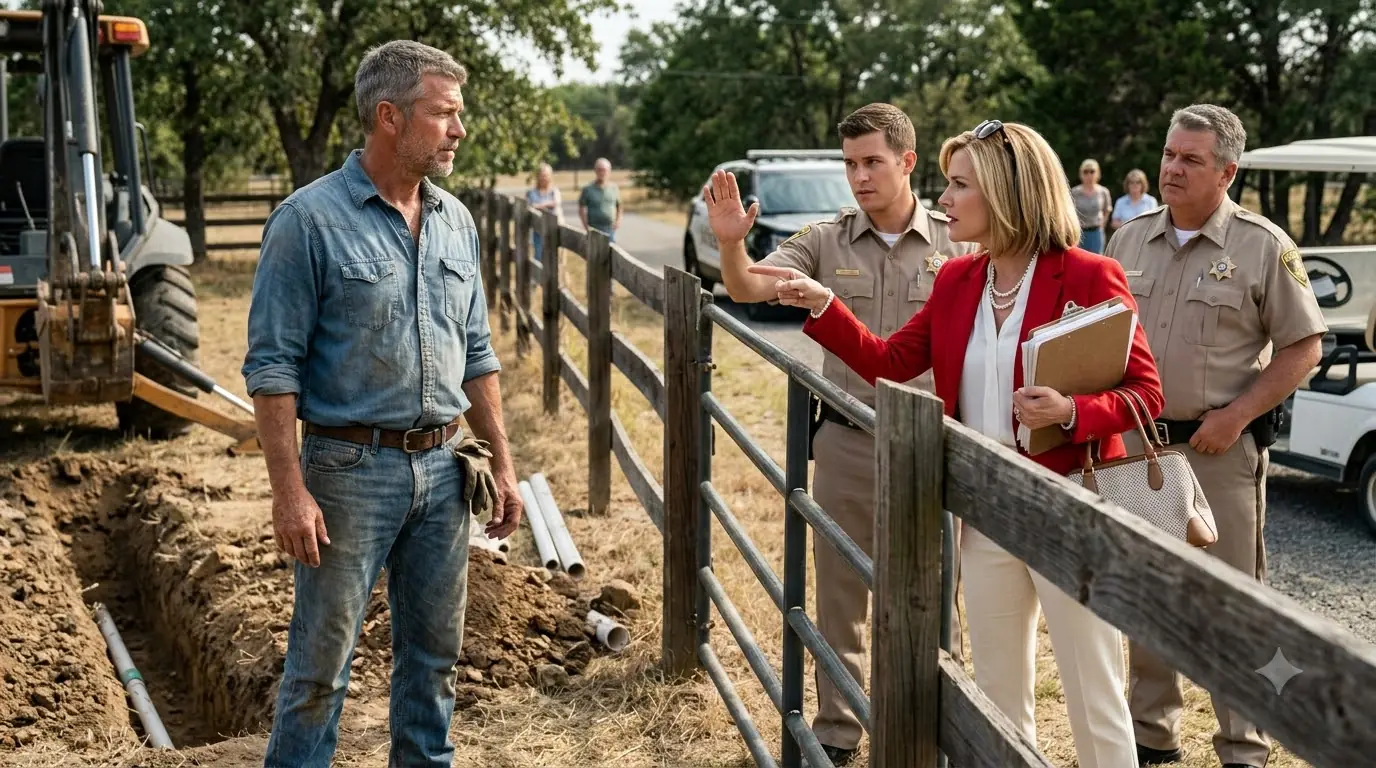
He was thinking about a leak.
For three weeks, the pressure gauge inside the pump house had been dropping half a pound here, a pound there, never enough to shut the system down but enough to tell him something was wrong.
At first, Raymond suspected the pressure tank.
Then the pump.
Then a check valve.
He tested all three.
Nothing.
The well itself was producing normally.
The pump amperage looked right.
The tank held pressure.
The loss was somewhere underground.
On the previous Friday, Raymond had walked the supply line from the pump house toward the western cattle troughs and noticed a patch of soil along the fence line that looked darker than everything around it.
That caught his attention immediately.
It had not rained in almost three weeks.
The surrounding pasture had gone pale under the summer heat.
The only reason dirt that dry should have been soft was if water was reaching it from below.
Raymond pushed the heel of his boot into the soil.
It sank.
He crouched.
Pressed his fingers into the earth.
Wet.
“Found you,” he muttered.
He marked the spot with an orange survey flag, called Pete Hollis, who owned a small excavation company, and arranged for a backhoe Tuesday morning.
The pipe was almost certainly cracked.
Not unusual.
The main line had been installed decades ago.
Sections had been replaced over the years, but the stretch along the western fence was still original.
Raymond knew its history because he had been there when part of it went into the ground.
He had been twenty-three.
His father, Harold Holt, had been forty-eight.
Back then, the ranch house still had aluminum windows.
The old barn had not burned.
The eastern pasture stretched uninterrupted all the way to the ridge where the subdivision now stood.
Raymond remembered his father standing in the trench holding a length of pipe and telling him:
“Bury things right the first time, because the ground charges interest on shortcuts.”
Raymond had laughed.
Thirty-eight years later, standing above a leak in the same line, he understood exactly what Harold meant.
The Holt Ranch had belonged to the family for fifty-three years.
Harold had bought the original parcel after leaving the Army, starting with cattle, a used tractor, two borrowed implements, and a house that had needed almost as much work as the land.
Raymond grew up repairing fences, hauling feed, chasing calves, and learning that nearly every piece of equipment on a ranch eventually failed at the least convenient moment possible.
The well came later.
The first few years, the family relied on a shallow older well near the house and a seasonal pond.
Then two dry summers nearly emptied both.
Harold borrowed equipment and hired a driller from the next county.
They went deep.
Deeper than expected.
When water finally came, it came hard and clean.
The new well transformed the property.
They added holding tanks.
Ran underground supply lines.
Built troughs.
Extended irrigation to a small hay field.
Years later, when Raymond inherited the ranch, that same well was still producing.
He had replaced the pump twice.
Rebuilt the control panel.
Changed pressure tanks.
Repaired freeze damage after a brutal winter.
But the basic system remained the heart of the property.
That was why a leak mattered.
A small leak left alone became a bigger leak.
A bigger leak became a washed-out trench, a burned pump, a dry tank, or a problem at the exact moment livestock needed water most.
Raymond did not postpone water problems.
At 6:02 Tuesday morning, Pete’s backhoe rattled through the gate.
By 6:40, Raymond had already walked him to the flagged area.
They discussed the pipe depth.
The old utility markings.
Where to place spoil.
At 7:27, Raymond entered the pump house.
It smelled the way it always did.
Cool concrete.
Metal.
Dust.
Mineral-heavy water.
The pressure gauge rested just under sixty pounds.
Raymond placed one hand on the primary shutoff.
Turned it.
The pump cycled down.
The needle fell.
Fifty.
Forty.
Twenty.
Zero.
He shut off power to the affected line and placed a maintenance tag on the valve.
Then he stepped outside.
“Good to go,” he told Pete.
Pete lowered the backhoe bucket.
The first scoop of earth came up dark.
The second came up wetter.
By the fourth, water began collecting in the trench.
Raymond nodded.
“Right there.”
Normal maintenance.
Ordinary problem.
Private land.
Private equipment.
Private well.