Benjamin Howard extended his hand across the polished mahogany table.
Across from him, Victoria Caldwell looked at his palm as though he had offered her something contaminated.
The room went quiet.
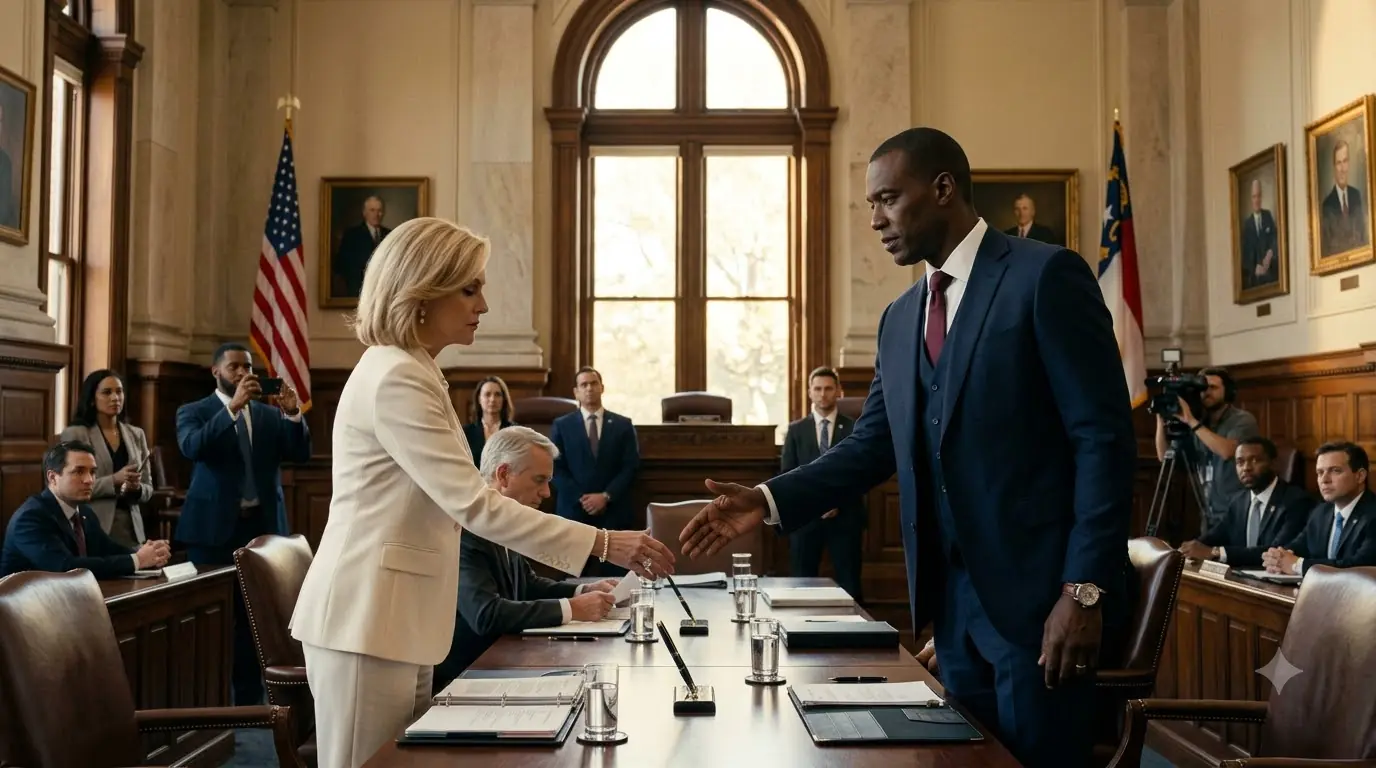
Five hundred people were watching the city’s live stream. Several reporters stood along the rear wall with phones already raised. Mayor Charles Bennett sat less than six feet away. Two city attorneys had their pens resting over open folders. Staff members, council aides, finance officials, and invited business leaders surrounded the table.
Nobody could pretend they had missed what happened next.
Victoria did not lower her voice.
“I don’t shake Black hands.”
Benjamin’s hand remained extended.
One second.
Two.
The mayor’s eyes dropped toward the documents in front of him.
No one interrupted her.
Victoria’s mouth curved into a small, contemptuous smile.
“Three generations of Caldwells helped build this city,” she said. “And you think your money buys you a seat at our table?”
A phone rose in the gallery.
Then another.
Benjamin still did not move.
Victoria laughed softly.
“You can put on a three-thousand-dollar suit. You can walk in here waving billions of dollars around. But money doesn’t change where people come from.”
Her eyes moved over him slowly.
“And some things always show.”
She reached past his still-extended hand and picked up the ceremonial pen.
That was the moment the room failed.
Not only Victoria.
The room.
The mayor did not object.
The city attorney did not stop the ceremony.
No council member stood.
No one told Victoria Caldwell that the man across from her had just been publicly humiliated in a building funded by taxpayers while negotiating one of the largest private infrastructure commitments in Charlotte’s history.
Benjamin lowered his hand.
His face did not change.
That frightened Eleanor Howard later when she watched the footage.
She knew her husband’s anger.
Benjamin angry was not loud.
It was still.
The more furious he became, the quieter he looked.
He returned to his chair and signed the final ceremonial acknowledgment placed before him.
Victoria signed hers.
Photographers captured the moment.
The mayor gave closing remarks about partnership.
People applauded weakly.
And while nearly everyone in Council Chamber B believed the worst thing that had happened that evening was an ugly racist spectacle on a city livestream, Benjamin Howard was already thinking about Clause 17.4 of the financing framework sitting inside his leather briefcase.
The $2.4 billion had not yet been funded.
Howard Capital Partners had committed the money subject to final governance certification, compliance approval, and Monday’s capital authorization.
The city had celebrated the agreement as finished.
Legally, one final gate remained.
And Victoria Caldwell had just handed Benjamin a reason to close it.
By sunrise, every undisbursed dollar Howard Capital controlled under that framework would be gone.
Not transferred to Charlotte.
Not frozen pending an apology.
Gone.
Redirected.
Victoria Caldwell would wake believing she had embarrassed a Black billionaire.
She would discover instead that she had detonated a $2.4 billion investment, exposed a political machine her family had protected for decades, and reopened a wound first inflicted on Benjamin’s father almost forty years earlier.
But none of that began in Council Chamber B.
It began in Greenville, South Carolina, in a small house with a leaking roof.
Benjamin Howard grew up in a neighborhood where people fixed things because replacing them was rarely an option.
The Howard house had two bedrooms when Benjamin was born and three after his father, William, added a room himself using materials left over from a construction job. The roof leaked every spring near the back hallway. William patched it every year until he could afford to replace the entire section.
Benjamin remembered buckets.
He remembered his mother moving towels.
He remembered his father climbing a ladder in the rain even when everyone told him to wait until morning.
William Howard had spent thirty years in construction.
He started as a laborer.
Brick.
Concrete.
Framing.
Demolition.
Whatever paid.
He worked beneath Carolina heat that soaked shirts through by ten in the morning and winter winds that turned metal tools painful to touch.
He learned to read plans.
Then estimates.
Then contracts.
By the time Benjamin was eight, William had saved enough to start his own company.
William Howard Construction LLC.
Three trucks.
Twelve employees at its peak.
A secretary who worked four days a week.
One rented office with brown carpet and fluorescent lights.
Business cards William designed himself.
The cards were simple.
WILLIAM HOWARD CONSTRUCTION LLC.
COMMERCIAL. MUNICIPAL. RESIDENTIAL.
LICENSED. BONDED. RELIABLE.
Benjamin kept one for the rest of his life.
William was never rich.
Some years he did well.
Other years he spent January trying to recover from December.
But the company fed families.
It paid mortgages.
It put Benjamin through school before scholarships took over.
And it taught him his earliest lessons about how money and opportunity actually moved.
William taught his son two rules.
The first was practical.
“You work twice as hard until nobody can honestly say you didn’t deserve to be there.”
Benjamin once asked why twice as hard should be necessary.
William looked at him.
“It shouldn’t.”
“Then why do it?”