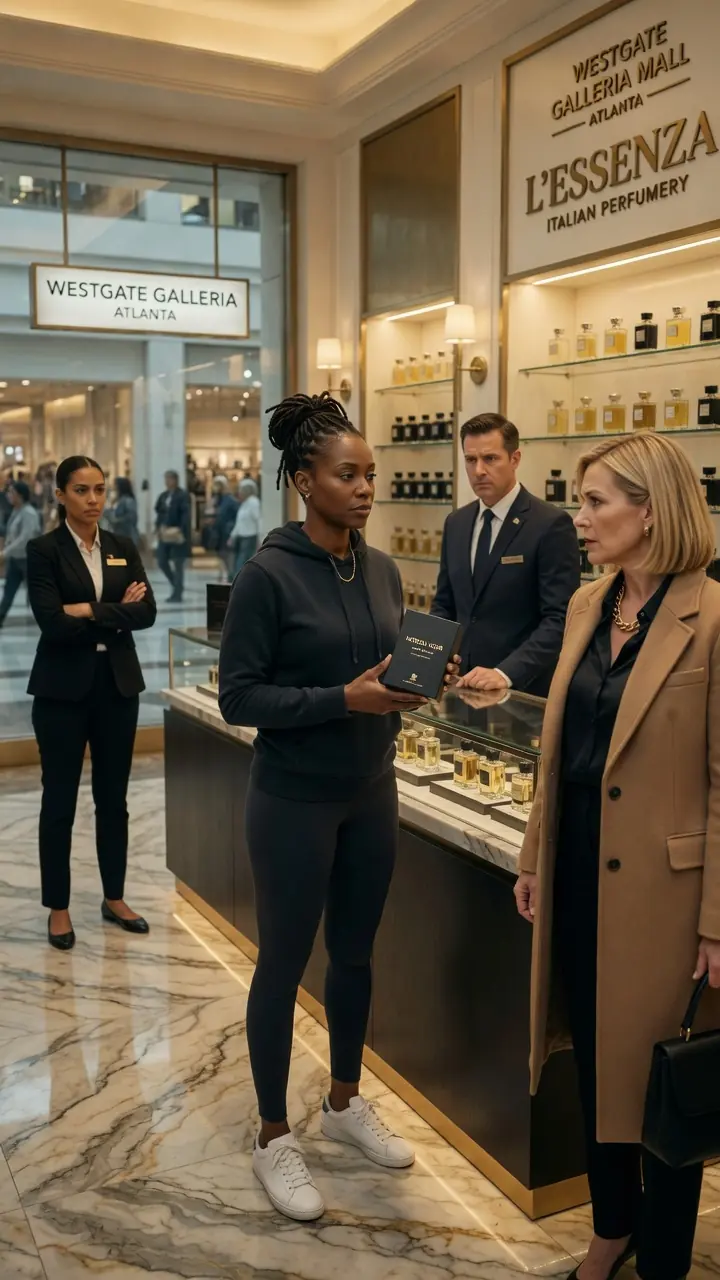
The woman in the $3,000 blazer pointed straight at the Black woman near the entrance of the luxury perfume shop. “She’s a thief. Someone stop her. I saw her. She’s stuffing something in her bag.”
The Black woman turned around. “I have the receipt. Open the bag. Right now.”
“No. You’re not allowed to touch my property.”
“Are you afraid I’ll see something dirty in your tattered bag?”
“I said no.”
The white woman lunged forward, snatched the bag with both hands, and ripped open the zipper. Everything fell to the floor. Nothing was stolen. Nothing was hidden. But that white woman in the blazer had no idea who she had just put her hands on. And by the time she found out, it was already too late.
Brea Blake pulled her SUV into the parking deck of Westgate Galleria. Nothing fancy. A five-year-old Honda Pilot with a car seat in the back and a faded air freshener hanging from the mirror. She’d been up since six that morning and had spent four hours at a Boys & Girls Club event on the south side of Atlanta handing out backpacks and reading certificates to kids whose school tuition her foundation had covered. Her hoodie still had the speaker badge clipped to it. Her sneakers had grass stains from the parking lot outside the community center. She wasn’t dressed for a luxury mall. She wasn’t trying to be. All she needed was one thing: a bottle of perfume for her little sister’s birthday. Thirty minutes in and out. That was the plan.
The Westgate Galleria was not a regular mall. Italian marble floors, soft jazz through hidden speakers, chandeliers that cost more than most people’s cars. Every storefront looked like it belonged in Paris. What none of the staff knew, what none of them had ever bothered to learn, was that every square foot of this building belonged to one man: Brea’s husband, Damon Blake, CEO of Blake Holdings, owner of Westgate Galleria and nine other commercial properties across the Southeast. But Brea never introduced herself that way.
She pushed through the glass doors of Lumiere Paris, a high-end perfume boutique on the ground floor. Soft lighting, mirrored shelves, the air thick with jasmine and sandalwood. A small bell chimed. Hayley Brooks, mid-twenties, blonde, perfectly pressed blouse, looked up from behind the counter. Her eyes started at Brea’s sneakers, moved up to the hoodie, the messy bun, no jewelry. Her smile disappeared.
Brea walked to the fragrance wall, picked up a tester, sprayed it on a paper strip, and closed her eyes. Too floral. She moved to the next shelf. Warm vanilla and amber. Her sister would love that. She checked the label. Chanel, limited edition, $480.
“Excuse me, could I see this one in the box?”
Hayley glanced over and didn’t move. “That one’s four hundred eighty.”
“I know. I just read the label. I’m just making sure.”
“We get a lot of people who browse.”
Brea looked at her for a second. Let it go. “The box, please.”
Hayley pulled it from the case slowly, set it on the counter, and stepped back like she was doing Brea a favor.
That’s when the bell chimed again. Caroline Whitmore walked in like she owned the place. White blazer, pearl earrings, Hermes bag tucked under her arm. The energy shifted immediately.
“This is Mrs. Whitmore. So lovely to see you.” Tyler Morgan, the store manager, appeared from the back room. Mid-thirties, slicked hair, a smile that turned on and off like a light switch. “Your special order just came in. Can I get you a glass of champagne while I wrap it?”
Caroline smiled. “Sparkling, not still. Of course.”
Hayley practically ran to the back. Tyler pulled out the champagne himself. Crystal glass, chilled, handed to Caroline on a small silver tray. Caroline took a sip and looked around. Her eyes landed on Brea. She stared. Not a quick glance. A long, slow, deliberate stare. The kind that starts at the shoes and ends with a conclusion.
She leaned toward Hayley, who had just returned. “Who is that?”
“I don’t know. She just walked in.”
“In that outfit? Here?”
Hayley said nothing, but she didn’t disagree.
Caroline lowered her voice, but not enough. “You’d think they’d have someone at the door.”
Tyler overheard, adjusted his tie, walked over to Hayley, and whispered, “Keep an eye on her.”
Hayley nodded.
Caroline took another sip. Her eyes never left Brea. “Honestly, Tyler, I don’t understand how just anyone can walk into a place like this.”
Tyler gave a tight smile. “We’re handling it, Mrs. Whitmore.”
“I hope so. Last time I was at Neiman’s, a woman walked out with a Dior in her purse. Broad daylight. You can’t be too careful.”
Three people, three small decisions, none of them illegal, none of them violent, but every single one pointed in the same direction. And Brea, standing at the fragrance wall holding a bottle of perfume she was about to buy with her own money, had no idea what was already being set in motion behind her back.
Brea carried the box to the register, set it down gently, and pulled out her wallet. Hayley stood behind the counter but didn’t move right away. She glanced over at Caroline like she was checking for permission. Caroline gave a tiny nod, almost invisible, but it was there.
“Card.”
Brea slid a black titanium card across the counter. Hayley picked it up, turned it over, turned it again, and held it up to the light like she was checking for a watermark on a counterfeit bill.
“I’ll need to see your ID.”
Brea pulled out her driver’s license and set it next to the card. Hayley looked at the ID, looked at Brea, looked at the ID again, and squinted like the photo didn’t match even though it clearly did.
“The names match,” Brea said quietly.
“I know. It’s just store policy.”
“You didn’t ask Mrs. Whitmore for her ID.”
Hayley’s cheeks flushed. She swiped the card. The machine beeped, “Approved.” But she didn’t hand the receipt over. Instead, she turned to Tyler. “Tyler, could you come verify this for a second?”
Tyler walked over, took the card, studied it front and back, and flipped it one more time. Then he picked up the phone behind the counter.
“What are you doing?” Brea asked.
“Just calling the bank to verify. Standard procedure for high-value purchases.”
“Standard procedure? I’ve never seen anyone call the bank for a four-hundred-dollar perfume.”
“It’s store policy, ma’am.”
“You keep saying that. Is there a different policy for different customers or just for me?”
Tyler didn’t respond. He held the phone to his ear, waited, spoke quietly, nodded a few times, then hung up. “It cleared.”
“I know it cleared.”
He handed Brea the receipt with two fingers like the paper might be contaminated. “Have a nice day.”
Brea took the receipt, folded it, placed it inside the perfume box, put the box in her crossbody bag, and zipped it shut. She turned toward the door.
And that’s when Caroline stepped in. Not physically, not yet. She didn’t block the door. She just drifted toward it casually, like she happened to be walking in that direction. But the timing was too perfect to be an accident.
“Sweetheart.”
Brea stopped. “I’m sorry. Are you talking to me?”
“I just want to help.” Caroline tilted her head, that fake concern look. “That perfume you bought, it’s a very exclusive piece, limited edition. Are you sure you meant to pick that one?”
“I’m sure.”
“Because there’s a lovely drugstore about two blocks from here. They have some very nice options, very affordable.”
The words hung in the air like smoke. Brea looked at Caroline for a long moment. Her jaw tightened. But her voice stayed level. “I appreciate the suggestion, but I already paid. So if you’ll excuse me.”
She took a step toward the door.
“Wait.” Caroline’s voice changed. The fake sweetness was gone. “Tyler, I want to see her receipt.”
Tyler looked up. “Ma’am?”
“The receipt. I want to see what she actually bought. Because I’ve been watching her this whole time, and something doesn’t add up.”
Brea stopped walking and turned around slowly. “You’ve been watching me?”
“Someone has to.”
“And what exactly doesn’t add up?”
Caroline crossed her arms. “You walk in here dressed like that, you go straight for the most expensive bottle on the shelf, and you just happen to have a black card? Please.”
“Please what?”
“Please, let’s not pretend.”
“Pretend what exactly?”
Caroline smiled, not a warm smile, the kind of smile people use when they think they’ve already won. “I’ve been shopping at this store for twelve years. Twelve years. I know every face that walks through that door. I know the clientele, and I know when someone doesn’t belong.”
“Doesn’t belong?” Brea repeated softly.
“You heard me.”
Brea felt her chest tighten. That old familiar heat. The one she’d learned to swallow since she was fifteen years old. Since the first time a security guard followed her through a department store for no reason. Since the first time a saleswoman pulled a dress away from her and said, “This one’s not on sale.” She’d learned to swallow it every single time.
“I don’t owe you an explanation,” Brea said. “I don’t owe you anything.”
“Then show the receipt. If you’ve got nothing to hide, why won’t you show it?”
“Because you’re not the manager. You’re not security. You’re a customer, just like me.”
“Just like me?” Caroline almost laughed. “Honey, we are nothing alike.”
The room got very quiet. Hayley stood frozen behind the counter, her hand still resting on the register. Tyler was pretending to organize something on a shelf, but his hands weren’t moving. Two other customers near the window had stopped browsing entirely. A woman with a stroller near the door pulled her child closer to her side. Everyone was watching now.
Brea felt it. The way the air shifts when a room decides whose side it’s on before anyone says another word. She knew this feeling. She’d felt it in classrooms, in job interviews, in hospitals, in her own neighborhood. The moment where being calm stops being a strategy and starts being a survival skill.
She took a breath. “I’m going to leave now. I’ve paid for my purchase. I have my receipt. This conversation is over.”
She turned toward the door one more time, and Caroline said the words that changed everything.
“Tyler, call security. She’s not leaving this store until someone checks that bag.”
Tyler hesitated just for a second. His eyes flicked to Brea, to the receipt in the box, to the register that still showed the approved transaction. He knew. He absolutely knew. But he picked up the phone anyway.
“Security to Lumiere Paris, please.”
Brea turned back around. Her voice was steady, but her eyes had changed. “You just called security on me for a purchase I already made with a receipt in my hand.”
“Ma’am, please don’t make this difficult.”
“I’m not making anything difficult. You are.”
Caroline jumped in. “Tyler, tell her she can’t leave.”
“Mrs. Whitmore, maybe we should just—”
Tyler swallowed hard and looked at Brea. “Ma’am, I’m going to have to ask you to wait here until security arrives.”
“And if I don’t?”
“Then I’ll have to report that you left the store while under investigation.”
“Investigation?” Brea repeated the word like it tasted rotten. “Investigation for what? Buying perfume while Black?”
Tyler opened his mouth, closed it, opened it again. Nothing came out.
Caroline filled the silence. “Oh, don’t pull that card. This has nothing to do with race.”
“It has everything to do with race, and you know it.”
“If you’ve done nothing wrong, this will only take a minute.”
“That’s what they always say.”
The walkie-talkie crackled from somewhere in the corridor. Heavy footsteps on marble, getting closer. Officer Greg Wilson appeared in the doorway. Mall security, mid-forties, buzz cut, chest puffed out, hand resting on the radio clipped to his belt. He didn’t look at Brea first. He looked at Tyler.
“What’s the situation?”
“Possible shoplifting. This customer may have concealed unpurchased merchandise in her bag.”
“That’s a lie,” Brea said firmly. “I paid for one item. I have the receipt. Your register confirms it.”
Wilson didn’t acknowledge her. He was still looking at Tyler. “Did you verify the transaction?”
“Yes, but the other customer,” Tyler nodded toward Caroline, “observed suspicious behavior.”
“Suspicious behavior,” Brea repeated. “Buying perfume. That’s the suspicious behavior.”
Wilson finally looked at her, up and down. The same scan Hayley had done twenty minutes ago. The same scan Caroline had done five minutes after that. Three people, three identical looks, like they were all reading from the same playbook.
“Ma’am, I’m going to need you to step back inside the store.”
“I am inside the store.”
“Step away from the door, ma’am.”
“Am I being detained?”
Wilson paused. The question clearly caught him off guard, but he recovered fast. “I’m asking you to cooperate.”
“I’ve been cooperating. I showed my ID. I waited while they called my bank. I answered every question. What else do you need from me?”
“I need to see inside the bag.”
“No.”
“Ma’am—”
“I said no. I have a receipt for every single item in this bag. You have no legal right to search my personal property without my consent. If you believe a crime has been committed, call the police. Real police. Not mall security with a walkie-talkie.”
Wilson’s jaw clenched. He took a step closer, close enough that Brea could smell the coffee on his breath. Close enough that she had to tilt her head up to look him in the eye.
“You can either open the bag voluntarily, or I can detain you right here until Atlanta PD arrives. Your choice.”
Caroline, from behind him, loud enough for everyone to hear: “Just open the bag. Innocent people don’t refuse.”
Brea looked at her and held her gaze for three full seconds. “Innocent people shouldn’t have to prove it.”
Nobody moved for about five seconds. Five seconds doesn’t sound like a lot, but in a silent room full of strangers staring at you, five seconds feels like five minutes. Brea stood still, bag on her shoulder, hands at her sides. She wasn’t going to open it. She wasn’t going to run. She was just going to stand there and wait for someone in this room to do the right thing.
Nobody did.
Caroline broke the silence first. “This is ridiculous. If she won’t open it, I will.”
“Ma’am, please let security handle this,” Tyler started, but Caroline was already moving.
She crossed the floor in three quick steps, reached for Brea’s bag, and grabbed the strap. Brea pulled back.
“Don’t touch me.”
“Then open it.”
“Get your hands off my bag.”
“What are you hiding?”
“Nothing. I have a receipt.”
“Then prove it.”
Caroline yanked the strap hard. Brea stumbled forward. Her hip hit the edge of the glass counter. A tester bottle wobbled and fell. Glass shattered on the marble. The sharp smell of bergamot exploded into the air.
She grabbed the bag with both hands and pulled it back. “I said, don’t touch me.”
“Let go.”
Tyler stepped forward. “Ladies, please.”
Neither of them heard him. And then it happened.
Caroline gripped the top of the bag with both hands and ripped the zipper open with a single violent pull. The fabric tore at the seam. The zipper split apart, and everything inside tumbled out onto the cold marble floor. The perfume box hit the ground with a dull thud. The receipt was still taped to the top. Her wallet fell open. Credit cards scattered across the tile. Her phone cracked against the marble, a spider web of broken glass from the corner. A stack of brochures from her literacy foundation fanned out across the floor. A speaker badge from the Boys & Girls Club event that morning. The lanyard snapped on impact.
And one more thing. A handwritten letter folded in half. Lined paper. The kind kids use in school. It slid across the marble and came to rest near Caroline’s right foot.
The room went dead silent. Caroline looked down. Her chest was still heaving. Her fingers still curled like claws. There was nothing stolen. Nothing hidden. Nothing that wasn’t hers. Everyone knew it. Hayley, Tyler, Wilson by the door, the crowd, everyone. But nobody said a word.
Caroline’s face twitched. She was scanning the floor, trying to find something, anything that would prove her right. “She could have dropped it before I got to her. She could have hidden something somewhere else.”
“Before you what?” Brea’s voice was barely above a whisper. “Before you ripped my bag apart in front of all these people?”
“I was protecting this store.”
“From what? From me buying perfume?”
“From people who come in here and take things that don’t belong to them.”
“I paid for it. The receipt is right there. On the floor, where you threw it.”
“Well, I didn’t know that, did I? You didn’t ask. You didn’t check. You didn’t even look.”
Caroline’s jaw tightened. “I shouldn’t have to. I can tell just by—”
She stopped herself, but not fast enough.
“By what?” Brea said quietly. “Finish that sentence.”
Caroline pressed her lips together and didn’t finish. But she didn’t need to. Everyone in the room heard the words she swallowed.
Brea looked down at the floor. The letter, face down on the marble, one corner pinned under Caroline’s stiletto heel. A dusty footprint smeared across the back.
That letter was from a girl named Keisha, eight years old, third grade. Brea’s foundation had paid her tuition for two years. Keisha had written it in pencil, in big wobbly letters, and mailed it to the foundation office with a drawing of a butterfly on the envelope. It said, “Dear Miss Brea, thank you for paying for my school. My mama said you are an angel. I want to be like you when I grow up.”
And now it was on the floor, under a stranger’s shoe, in a store where Brea had done nothing wrong.
Something broke inside her. Not loudly, not dramatically. The kind of breaking that happens when you’ve been holding something together for too long and your hands just can’t grip anymore. Her shoulders trembled, just barely. Her fingers curled into fists, so tight her knuckles went pale. And then the tears came. Not sobbing, not wailing. Just tears. The kind that rise up from somewhere deep and hot and old. The kind you get when you’ve swallowed it down a hundred times and this time there’s just no room left.
One tear rolled down her left cheek, then another down her right. She didn’t wipe them. She bent down slowly, hands shaking. She picked up the letter and brushed off the footprint with her thumb. Gently, like it was the most valuable thing in the room.
Her voice cracked, but the words came out clear. “This letter is from an eight-year-old girl. Her name is Keisha. I paid for her school. She wrote this because nobody ever told her she could be something, and you just stepped on it.”
She held the letter against her chest. “I came in here to buy perfume. I had the money. I had the receipt. I didn’t steal anything. I didn’t hide anything. I didn’t do anything wrong.”
Her voice broke on the last word. She pressed her lips together, swallowed hard, and tried again. “I didn’t do anything wrong.”
Each word came out separately, like stones dropping into still water. The store was so quiet you could hear the jazz still playing softly from the ceiling speakers. Smooth saxophone over a woman’s breaking heart. So out of place. So absurd.
Caroline took a step back. For the first time she had nothing to say. Hayley was crying behind the counter. Silently, hand over her mouth. She didn’t move to help. She wanted to. You could see it in the way her body leaned forward and then pulled back. But she didn’t.
The woman with the stroller by the door turned her child away. An older man near the window shook his head slowly. Wilson stood by the door, arms crossed, face like stone.
Wilson uncrossed his arms and stepped forward. Not to help. Not to comfort. To grab her.
“Ma’am, you’re going to need to come with me to the back office.”
Brea looked up at him, eyes red, tears still on her cheeks. “For what?”
“Until we sort this out.”
“Sort what out? Everything I own is on the floor.”
“Ma’am, I don’t make the rules.”
“What rule says you can drag an innocent woman to a back office?”
“I’m not going to ask again.”
He reached out and grabbed her upper arm. Not gently. His fingers dug into her hoodie, hard enough that her shoulder jerked, hard enough to leave a bruise by morning.
Brea flinched. She didn’t pull away. She didn’t scream. She just stood there, holding a child’s letter in one hand with a grown man’s grip on her arm in a store where she had paid for everything she’d touched.
“Take your hand off me.”
He didn’t let go.
“Please. Take your hand off me.”
He squeezed tighter.
Caroline, from behind: “Just go with him. Stop making a scene.”
“I’m making a scene?” Brea’s voice was raw now. “She ripped my bag open. You’re grabbing my arm, and I’m the one making a scene?”
Nobody answered.
Brea closed her eyes for one breath, then opened them. “I want to make a phone call.”
Tyler smirked. “Go ahead. Call whoever you want. Won’t change anything.”
Caroline added, “Tell them to bring bail money.”
Brea reached into her hoodie pocket with her free hand. Pulled out her phone. Screen spiderwebbed from hitting the marble. Pressed one contact.
It rang once. A man’s voice picked up. Warm. Calm.
“Hey, baby.”
Brea’s voice was almost steady. Almost. But he could hear the cracks underneath. The wetness. The weight.
“Damon, they ripped my bag open.”
A pause. Two seconds. Maybe three. On the other end, she could hear a chair pushing back. Footsteps.
“Where are you?”
“Lumiere Paris. Inside the mall.”
Another pause. And when he spoke again, his voice had changed. The warmth was still there, but underneath, something cold. Something dangerous.
“I’m on the third floor. Don’t move. Don’t say another word.”
The line went dead.
Brea lowered the phone, looked straight ahead, and said nothing.
Tyler leaned toward Hayley. “Five bucks says she called her boyfriend.”
Caroline set her empty champagne glass on the counter. “Can we speed this up? I have a dinner reservation at seven.”
Brea didn’t respond. She just stood there, still, quiet, holding that letter against her chest. She knew what was coming. They didn’t.
Three minutes passed. In a movie, three minutes is nothing. In that boutique, with Brea standing still, Wilson’s hand on her arm, Caroline checking her watch, and Tyler leaning against the counter, three minutes felt like an hour. Nobody spoke. The jazz kept playing. The bergamot from the broken tester bottle still hung in the air.
Then the bell chimed. The door was held open by a man in a dark suit. Another man in a dark suit stepped through. Both scanned the room the way people scan a room when they’re paid to notice everything.
And then he walked in. Damon Blake. Navy suit, no tie. He didn’t rush. He didn’t raise his voice. He walked in the way a man walks into a building he owns. Not with arrogance, but with the kind of calm that comes from knowing exactly where he stands.
Tyler looked up. His face went through three expressions in two seconds. Confusion, recognition, and then the blood draining from his face entirely. He’d seen that face before, a month ago, on a screen, during the quarterly all-hands meeting for every tenant in Westgate Galleria. The man on the screen had welcomed them, talked about lease renewals, and reminded them of the mall’s non-discrimination policy. That man was now standing six feet away.
From behind Damon, footsteps, fast, almost running. Gregory Anderson, the general manager of Westgate Galleria, appeared in the doorway. Tie crooked, breathing hard, looking like a man who’d just been told his house was on fire.
“Mr. Blake, sir, we weren’t expecting you today.”
Damon didn’t look at him. He walked right past him. Anderson stopped mid-sentence. Then he looked around the boutique, saw the items on the floor, saw Wilson’s hand on Brea’s arm, saw the torn bag. His face turned the color of old paper. He whispered into his radio, “All available staff to Lumiere Paris, now.”
Damon crossed the floor. His shoes were the only sound. He walked straight to Brea. Not to Tyler. Not to Caroline. Not to Wilson. To his wife. He stopped in front of her, looked at her face, the red eyes, the dried tears, the letter still pressed against her chest. His jaw tightened. His hand curled into a fist at his side, then slowly uncurled. He took a breath, a long one, through his nose. The kind of breath a man takes when he’s deciding who he’s going to be in the next sixty seconds.
He reached out. With his thumb, he wiped the last tear from her cheek. A small gesture. A private gesture. In front of a room full of strangers.
Brea looked at him. Her lips trembled, but she didn’t cry again. She just nodded once, like she was saying, “I’m okay. I held on.”
Then he turned around. His eyes landed on Wilson’s hand, still on Brea’s arm.
“Take your hand off my wife.”
Four words. Quiet. Not shouted. But every person in that room heard them like thunder.
Wilson let go so fast his hand flew back like he’d touched a hot stove. He took two steps backward and bumped into a display shelf.
Tyler’s mouth opened. No sound came out. Hayley stepped backward into the shelf behind her. A bottle rattled.
Caroline looked confused. Genuinely confused. Her eyes moved from Damon to Brea, from the suit to the hoodie, back to the suit. She couldn’t make the connection.
“Your wife?”
Damon didn’t answer. He turned to Anderson.
“Mr. Anderson, tell me what happened in this store.”
“Sir, I—I just got here. I didn’t—”
“You’re the general manager. This happened in your building. You don’t know what happened?”
“I’m trying to find out, sir.”
Damon turned to Tyler. “You’re the store manager.”
“Yes, sir.”
“My wife came in. She selected a product. She paid for it. Your register confirmed the transaction, correct?”
“Yes, sir.”
“And after that, after you verified her card, after you called her bank, you still called security, correct?”
Tyler said nothing.
“And then this woman,” he turned to Caroline, “physically assaulted my wife, ripped open her bag, threw her belongings on the floor, and you stood there and watched.”
Tyler’s chin dropped to his chest.
Damon looked at Caroline. She was standing very still. Face white. The pearl earring on her left ear was trembling.
“What’s your name?”
“Caroline. Caroline Whitmore.”
“Mrs. Whitmore, you tore open my wife’s bag. You called her a thief in front of a room full of people. You put your hands on her property. You did this to a woman who had a receipt in her hand, a charity badge on her chest, and a child’s letter in her bag.” He paused. “You did all of that because of how she was dressed. And because of the color of her skin.”
Caroline’s mouth moved. Nothing came out. Her hands were shaking. “I—I didn’t. If I had known—”
“Known what? That she was my wife? That I own this building?”
Damon shook his head slowly. “That’s the problem, Mrs. Whitmore. You think it should matter who she’s married to. It shouldn’t. She’s a human being. That should have been enough.”
The room was so still that the jazz from the ceiling sounded like it was playing in another universe.
Caroline looked at Brea, then at Damon, then at the floor. She had nothing left to say.
Damon turned away from Caroline. He looked down at the floor, at Brea’s belongings still scattered across the marble. He didn’t ask anyone to pick them up. He didn’t wave over an employee. He knelt down himself. In his navy suit, on the cold marble floor, Damon Blake got on one knee and started picking up his wife’s things.
The wallet first. He gathered the credit cards one by one, then the brochures from her foundation, then the cracked phone. He turned it over, looked at the shattered screen, and placed it on the counter. Then the speaker badge, the snapped lanyard, and finally, Keisha’s letter. He picked it up and read it. His fingers weren’t quite steady. He folded it carefully along the original crease and handed it to Brea without a word. She took it, pressed it against her chest, and nodded.
He stood up, brushed off his knee, and turned to face the room.
Caroline rushed forward. The authority was gone. The entitlement was gone. What was left sounded thin and desperate.
“Mrs. Blake, I am so sorry. I had no idea. If I had known who you were, I never would have—”
Brea cut her off, quietly, clearly. “That’s exactly the problem, Mrs. Whitmore. You shouldn’t have needed to know.”
“I just—I made a mistake. People make mistakes.”
“A mistake is grabbing the wrong size. A mistake is forgetting your wallet. You ripped open a stranger’s bag because you looked at her skin and decided she was a criminal. That’s not a mistake. That’s a choice.”
Caroline had no answer.
Two Atlanta PD officers walked through the door. Not mall security. Real police. One of Damon’s associates had called them from the parking lot the moment they’d arrived. The officers surveyed the room, the torn bag, the scattered items, the crowd of silent witnesses. Several customers stepped forward immediately, offering their accounts.
The taller officer approached Caroline. “Ma’am, I’m going to need you to come with us.”
“What? No, this is a misunderstanding. I was trying to help.”
“Multiple witnesses described you physically grabbing and destroying another customer’s property. You’re being detained.”
“You can’t do this. My husband is David Whitmore. He’s a senior partner at—”
“Ma’am, please turn around.”
The handcuffs clicked shut in the same boutique where she’d been sipping champagne fifteen minutes ago. The sound echoed off the marble. She started crying. Loudly. Messily. The kind of crying she probably hadn’t done in public in her entire life. Nobody felt sorry for her.
Damon turned to Anderson, calm, professional, final. “Mr. Anderson, administrative leave effective immediately. HR will contact you Monday. Hand your key card to Andre at the security desk.”
Anderson didn’t argue. He turned and walked out. His footsteps faded down the corridor.
Damon turned to Tyler. “Mr. Morgan, Lumiere Paris is in immediate breach of the non-discrimination clause in your lease, section twelve, paragraph four. Blake Holdings legal team will contact your corporate office within twenty-four hours.”
Tyler’s face was gray. “Sir, if you’ll just let me explain—”
“You called the bank on a verified transaction. You called security on a paying customer. You blocked my wife from leaving and told her she was under investigation. There’s nothing to explain.”
Tyler closed his mouth.
Damon turned to Wilson. “Your contract is with Pinnacle Security Group. Pinnacle holds a service agreement with Blake Holdings. Your assignment at Westgate Galleria is terminated. These officers will escort you out.”
Wilson didn’t move. For a second, it looked like he might argue. Then one of the Atlanta PD officers put a hand on his shoulder. “Let’s go.”
Wilson unclipped his radio, set it on the counter, and walked out without a word.
The boutique was quiet. Someone in the back had finally turned off the jazz.
Brea stood by the counter, torn bag in one hand, Keisha’s letter in the other. Hayley was still behind the register, still crying. She opened her mouth, maybe to apologize, maybe to explain. Nothing came out. She just lowered her head.
Brea looked at her for a long moment. Not with anger. Not with forgiveness, either. Just recognition. The look of a woman who understood exactly what Hayley’s silence had cost, and knew that Hayley was beginning to understand it, too.
Then Brea turned to Damon. He offered his arm. She took it. And they walked out together.
The story didn’t stay inside that boutique. By Sunday morning, it was everywhere. It started with the witnesses. Over a dozen customers had been inside or near Lumiere Paris when it happened. Several of them gave statements to Atlanta PD that night. Others told their families, their co-workers, their friends. By Monday, two local news stations had picked it up. By Tuesday, it was national. CNN ran a segment. NBC followed. The Atlanta Journal-Constitution published a front-page story with the headline “Mall owner’s wife accused of shoplifting in store he owns.”
The story spread not because of who Brea was married to. It spread because every Black woman who read it recognized the feeling. The scan. The suspicion. The assumption. The way a room can turn against you before you’ve done a single thing wrong. Thousands of people shared the story with one line: “This has happened to me.”
And then came the legal system.
Caroline Whitmore was formally charged three weeks later. Four counts. Simple assault for grabbing Brea and physically ripping her bag open. Destruction of property for the torn bag, the broken phone, and the snapped lanyard. Filing a false police report for telling mall security that Brea had stolen merchandise when she had not. And the fourth charge was the one that made national news: a hate crime enhancement under Georgia state law. The prosecution argued, and the evidence supported, that Caroline’s actions were motivated by racial bias. Her own words in the store, confirmed by multiple witnesses, made the case almost airtight. “I can tell just by—” The sentence she never finished. The one everybody heard anyway.
Caroline’s attorney pushed hard for a plea deal. The DA’s office agreed, but the terms were not gentle. Eighteen months of probation. Two hundred forty hours of community service to be completed at a civil rights organization, not a country club charity event. Fifty thousand dollars in restitution to Brea. Mandatory completion of a bias awareness and de-escalation program. And one final requirement that Caroline fought harder than any other: a public written apology read aloud in open court and entered into the official record.
The day she read it, the courtroom was packed. Reporters lined the back wall. Caroline stood behind a microphone in a gray suit. No pearls this time. No Hermes bag. No champagne glass in hand. Just a woman standing alone with a piece of paper. Her voice cracked on the second sentence and didn’t recover. She read every word. It took four minutes. She cried through most of it. Her hand shook so badly the paper rattled against the microphone. When she finished, she stepped back and stared at the floor. Nobody applauded. Nobody comforted her. The same woman who had demanded Brea open her bag was now the one being forced to open herself in front of cameras, in front of strangers, in front of a judge who didn’t care about her husband’s name.
Her husband, David Whitmore, did not attend the hearing. Two days later, he released a public statement distancing himself from his wife’s actions and donated two hundred fifty thousand dollars to the Dignity Initiative, the organization Brea would go on to create. Their marriage became a private matter after that.
The civil case moved faster than anyone expected. Brea’s legal team filed suit against Caroline personally, Lumiere Paris’s parent company, and Pinnacle Security Group, the contractor that employed Officer Wilson. The details of the settlement were sealed, but court filings indicated a high eight-figure amount across all defendants. Brea did not keep a single dollar for herself.
Lumiere Paris lost three retail locations in Blake Holdings’ portfolio: Westgate Galleria and two other malls in Georgia. The parent company issued a formal apology and was required to implement a company-wide bias training program independently monitored for three years. The brand that had once prided itself on exclusivity was now a case study in what exclusivity really meant and who it really excluded. The Westgate Galleria location was shut down permanently. The storefront went dark for two months.
Then a new sign went up. A Black-owned fragrance boutique called Maison Elise moved in. Blake Holdings offered them a reduced first-year lease to help them get started.
Tyler Morgan was terminated the day after the incident. He applied to fourteen luxury retail positions over the following six months. None of them called him back. His name had become a cautionary tale in the industry. The manager who checked a Black woman’s card three times and still called security. Last anyone heard, he was working in a different field entirely.
Officer Greg Wilson’s security license was revoked by the state of Georgia following a formal review of his conduct. The review found that he had used excessive force on a person who was not suspected of any crime by law enforcement and that he had failed to independently verify the claims made against Brea before physically detaining her. He did not appeal.
Gregory Anderson was terminated for cause. He tried to sue Blake Holdings for wrongful dismissal. He lost.
And then there was Hayley Brooks. Three weeks after the incident, Hayley walked into the office of Brea’s attorney. She wasn’t subpoenaed. She wasn’t offered anything. She came on her own. She sat in a conference room, hands folded on the table, and gave a sworn statement.
“I saw the receipt. I scanned it myself. I knew she had paid for everything and I still called Tyler over. I still let it happen. I didn’t say anything because I was afraid of losing my job. I was afraid of Mrs. Whitmore. I was a coward.”
Her voice broke on that last word, but she kept going. Her testimony became one of the most important pieces of evidence in the civil case. It proved that the store staff had knowingly participated in the harassment of a customer they had already confirmed was innocent.
Hayley lost her job. She expected that. What she didn’t expect was the phone call she received four months later from the Dignity Initiative. They were launching a pilot program to train retail employees on recognizing and interrupting racial bias in real time. They wanted Hayley to be part of the first class. She said yes without hesitation.
Brea funded the Dignity Initiative with the full amount of her civil settlement. The organization’s mission was simple: provide legal aid for victims of racial profiling in retail, fund bias training programs across the country, and offer therapy for people who had been publicly humiliated because of the color of their skin. In its first year, the foundation handled thirty cases. Twenty-two resulted in formal action: settlements, policy changes, or terminations. It wasn’t enough. Brea knew that. But it was a start.
Six months later. Saturday afternoon. Westgate Galleria.
Brea Blake walked through the same automatic doors she’d walked through that day. Same hoodie, the gray one with the Literacy Foundation logo. Same white sneakers. Same messy bun. The parking deck still smelled like warm concrete. The chandeliers still hung from the ceiling like frozen fireworks. The marble floors still echoed under every footstep.
But something was different.
There was a new general manager, a woman named Tara Collins, handpicked by Damon from a national search. First thing she did when she started: she put the Dignity Initiative’s bias training program in every break room, every back office, every employee handbook in the building. She held a mandatory all-staff meeting in the first week, stood in front of two hundred employees, and said one sentence that stuck.
“If you can’t treat every person who walks through those doors with basic dignity, you don’t work here.”
And where Lumiere Paris used to be, the gold lettering, the velvet curtains, the glass cases, there was now a new sign. Warm wood. Clean font. A small lavender sprig etched into the corner. Maison Elise. A Black-owned fragrance boutique founded by a woman named Elise Turner who had spent fifteen years making custom perfumes out of her apartment in East Atlanta before she got the call from Blake Holdings offering her a storefront at a reduced lease.
Brea walked in. The bell chimed. A woman behind the counter looked up and smiled. Not because she recognized Brea. Not because she knew who her husband was. She smiled because a customer walked in and that’s what you do.
“Welcome in. Let me know if you need help with anything.”
“Thank you. I’m looking for something warm. Vanilla maybe. It’s a gift.”
“I’ve got just the thing. Let me grab a tester.”
The woman brought out a small amber bottle. Brea sprayed it on a paper strip, closed her eyes, and smiled. Warm vanilla and amber, just like the one she’d bought that day, but this time from a different shelf in a different store in a different world.
“This is perfect.”
“That one’s fifty-five. Want me to wrap it?”
“Please.”
Brea paid. The woman handed her the bag with a smile. No ID check. No bank call. No suspicious glances. No champagne for the white customers and silence for the Black ones. The whole thing took ninety seconds.
Brea walked out, bag in hand. Nobody stopped her. Nobody followed her. Nobody called security.
That was it. That was the whole scene. And that was the point.
Three months after that, the Dignity Initiative held its first annual gala in a ballroom in downtown Atlanta. Four hundred guests. Community leaders. Civil rights attorneys. Educators. Survivors. Women who had walked into stores and been followed. Women who had been asked to open their bags. Women who had been told in a thousand different ways that they didn’t belong.
Damon stood at the podium. He wore the same navy suit. No tie. He looked out at the room for a long moment before he spoke.
“Nine months ago, my wife walked into a store in a mall that I own. She was wearing a hoodie. She was carrying a bag with a child’s letter inside it, and a woman she had never met looked at her and saw a thief.”
He paused.
“That woman didn’t know Brea was my wife. She didn’t know I owned the building. And here’s what keeps me up at night. If she had known, none of it would have happened. She would have smiled. She would have stepped aside. She might have even offered to help.”
Another pause, longer this time.
“That’s the problem. My wife shouldn’t need me to be treated like a human being. No woman should. The lesson of this past year is not that we won. The lesson is that millions of women who look like my wife walk into stores every single day, and they don’t have a Damon Blake to call. And until that stops being the deciding factor, the work is not done.”
The room was silent for a moment. Then the applause came. It started slowly and built until the entire ballroom was on its feet. It lasted a long time.
Brea sat in the front row. She didn’t stand. She didn’t wave. She just held Keisha’s letter in her lap. The same letter, now framed, that she carried with her to every event, and smiled quietly to herself.