“You always forgive me, Ethan,” Lauren said it with a smile.
Not a nervous smile. Not the crooked little expression she wore when she knew she had hurt me and did not know how to apologize. This was different.
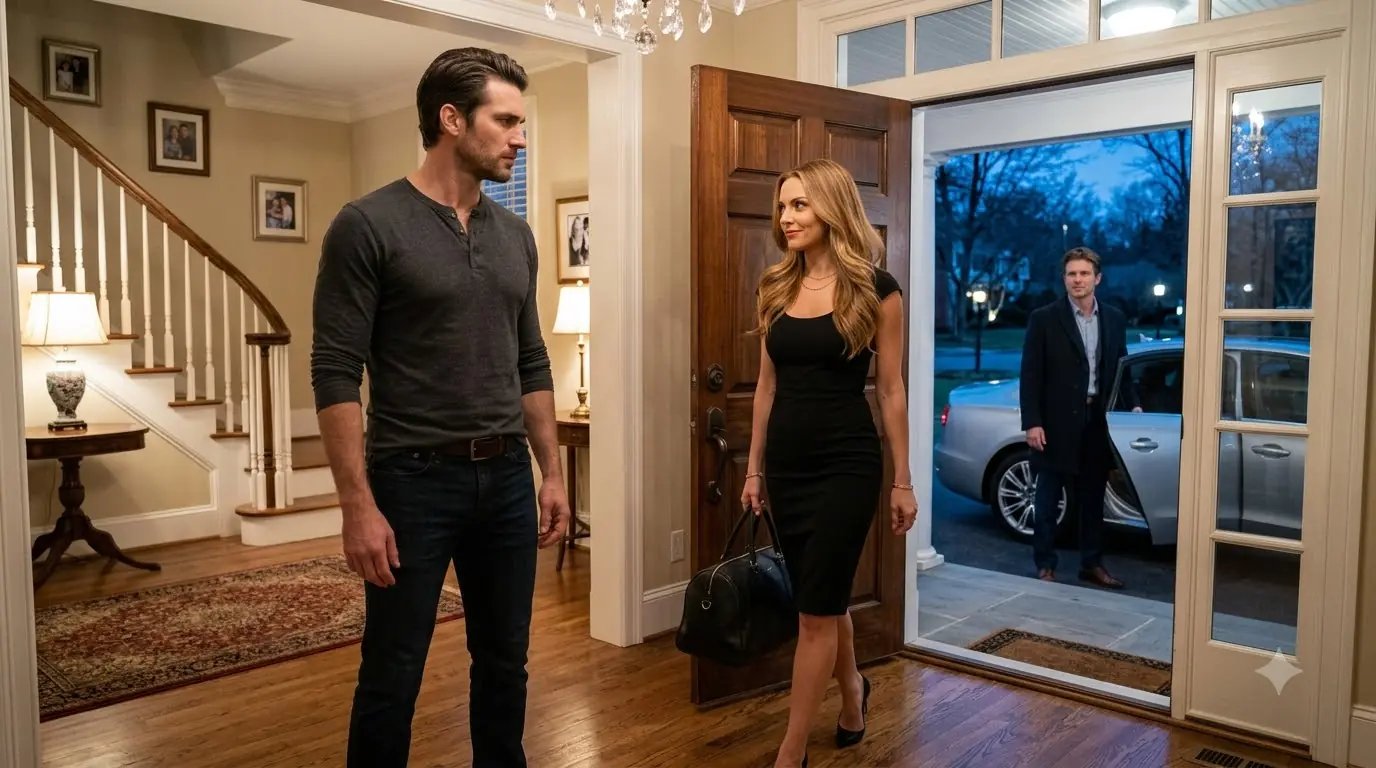
Confident.
Almost affectionate.
As though forgiveness were not something I chose to give, but something she had already factored into the evening.
Then my wife picked up an overnight bag, walked past me, and left our house to spend the night with another man.
Seven days later, she came home expecting me to prove her right.
Instead, she found forty-three cardboard boxes lined neatly beneath the covered front porch of our colonial on Mercer Street.
Every dress.
Every coat.
Every pair of shoes.
Her books.
Her framed photographs.
The expensive espresso machine her mother had given her.
The ridiculous collection of hotel candles she kept bringing home because every new scent was supposedly “the one.”
Everything that belonged unquestionably to Lauren was labeled, sealed, and waiting.
On top of the largest box sat one package wrapped in silver paper.
That was the package that made her smile.
She thought it was an apology.
She thought it meant I had finally calmed down.
She thought Ethan Caldwell had done what Ethan Caldwell always did.
Forgiven her.
But to understand why I put that package there, you have to understand exactly how a marriage can die long before either person is willing to say the word.
My name is Ethan Caldwell.
I was thirty-six years old when my marriage ended, although the divorce decree would not arrive until months later.
I worked as a financial systems consultant for midsized companies throughout central New Jersey, usually helping businesses migrate old accounting platforms into newer ERP systems without destroying payroll, inventory, or everyone's sanity in the process.
It was the kind of job that rewarded the part of my brain that wanted everything to have a cause.
If numbers did not reconcile, there was a reason.
If a system failed, something had been configured incorrectly.
If a process produced bad results, you traced the process backward until you found the break.
I liked that.
People were harder.
Lauren used to tell me that was my biggest problem.
“You think feelings are software bugs.”
She said it jokingly at first.
Later, she stopped joking.
Lauren was thirty-three.
She worked in event management for an upscale hotel group with properties in Princeton, Philadelphia, and Manhattan. She was excellent at her job because she could walk into a ballroom three hours before a major corporate event, see six problems nobody else noticed, and somehow solve all six without making the client feel that anything had ever been wrong.
She knew flowers.
Lighting.
Menus.
Guest lists.
She knew which executives needed to be seated apart, which bride was going to cry before the ceremony, and which wealthy donor would feel insulted if his name appeared second instead of first on a sponsor board.
Lauren understood social temperature the way I understood spreadsheets.
When we met, that difference was what I loved most.
It was October, five years before the night she left.
A pharmaceutical company had hired my firm to help integrate a billing platform after an acquisition. Their leadership retreat was held at one of Lauren's hotels in Princeton.
The event was a disaster before the first presentation began.
The audiovisual system failed.
A shipment of conference materials was delivered to the wrong hotel.
Two executives who were in the middle of a lawsuit were accidentally assigned rooms across the hall from each other.
I was standing near registration arguing with an IT vendor when Lauren appeared beside me.
“Your microphone problem is fixed.”
I looked at her.
“I wasn't talking to you.”
“No.”
She smiled.
“You were talking loudly enough that everyone was participating.”
I should have been offended.
Instead, I laughed.
She was wearing a navy dress and a headset, holding three phones and somehow answering questions from four different people.
I watched her work that entire day.
By dinner, I wanted to know her.
By midnight, we were sitting at the hotel bar after everyone else had gone upstairs.
Lauren drank a gin and tonic.
I drank bourbon.
She told me I looked like somebody who alphabetized his refrigerator.
I told her she looked like somebody who deliberately lost her keys because finding them made life interesting.
She laughed so loudly the bartender turned around.
We dated for eighteen months.
For most of that time, we were good.
Not perfect.
But good.
Lauren pulled me out of routines.
I gave her stability.
She convinced me to book last-minute weekends in Montreal.
I taught her how to make a monthly budget she ignored almost immediately.
She filled my quiet house with music.
I remembered to renew her car registration before she received tickets.
She made my birthdays feel like events.
I made sure she never had to wonder whether I would show up.
When I proposed, she cried before I finished.
We married in a small vineyard outside Lambertville.
My father gave a speech about how I had always been dependable.
Lauren's maid of honor, Camille, joked that Lauren had finally found someone who could survive her chaos.
Everybody laughed.
So did I.
Dependable sounded like love then.
Three years later, Lauren used almost the same word differently.
“Predictable.”
We lived in a renovated colonial on Mercer Street in Princeton, about fifteen minutes from the center of town.
I had purchased the house two years before meeting Lauren after the previous owner died and his children sold it quickly.
It needed work.