She Stormed Into the Hotel Demanding the Vault Keys — Then Her “Court Order” Hit the Table
Reader Theme:
Font Size:
24px
The condemned hotel had been empty for 32 years when Everett Hale bought it for less than the price of a suburban house. Everyone called him reckless until demolition crews uncovered a sealed steel vault beneath the ballroom floor. Before Everett could open it, HOA President Marjorie Voss arrived with lawyers, security guards, and a forged emergency order demanding every key. She claimed the vault belonged to the community. Everett knew the hotel had never joined her HOA.
What Marjorie did not know was that the vault contained records capable of destroying her, exposing stolen land, and stripping away the power she had spent 11 years building on lies. Everett Hale stood at the back of a county auction hall on a gray autumn morning watching bidders lose interest one property at a time. He was 46 years old, a former historic restoration engineer who understood blueprints, load-bearing walls, and property records better than most lawyers understood contracts. The last listing of the day was the Blackthorn Grand Hotel, a sprawling structure that had once hosted governors and touring orchestras, now boarded up and rotting on top of a hill overlooking a neighborhood called Silver Ridge Estates. 84 rooms, a grand ballroom, an old dining hall, a garden gone wild, an underground parking structure, and nearly 11 acres of land came with the sale.
But the building wore a condemnation notice, like a scar across its front doors. The roof leaked in a dozen places. The electrical system was beyond salvage, and inspectors had flagged three walls as structurally unstable. No serious investor wanted to touch it, which was exactly why Everett raised his paddle when the price dropped low enough to matter, and walked out that afternoon owning the hotel for $412,000, a fraction of what the land alone was worth. The county records clerk had warned Everett, half-joking, that nobody in their right mind bought a condemned building on a hill above an established neighborhood without expecting trouble.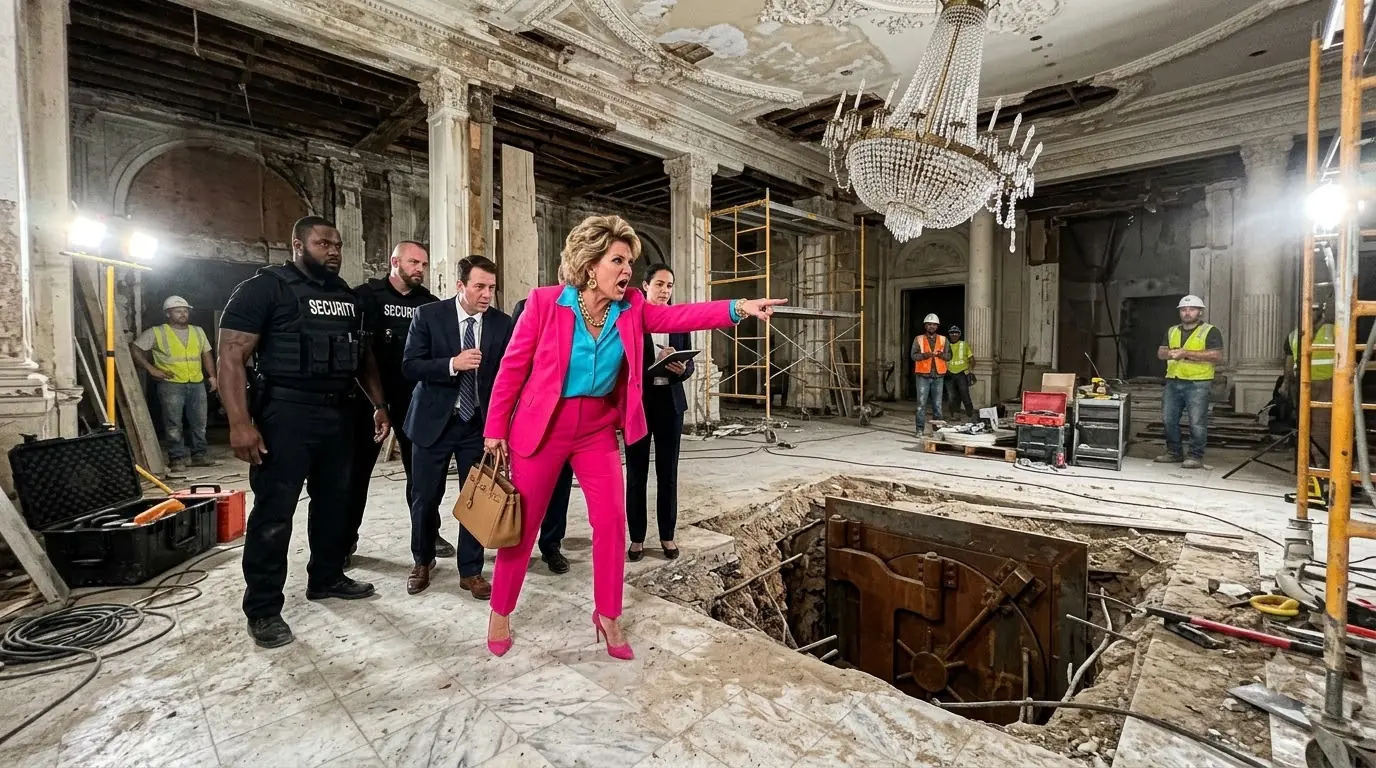
And Everett had smiled and said trouble was easier to manage than debt. He had spent nearly two decades restoring courthouses, opera houses, and old rail depots for cities that could no longer afford to lose their history. And something about the Blackthorn Grand Hotel reminded him of buildings he had saved before structures written off as hopeless, right up until the day someone finally looked past the rot and saw what was still standing underneath it. He walked the grounds alone the evening after the auction, closed flashlight in hand, tracing water stains across the ceiling of the old lobby and running his fingers along a marble staircase rail that had somehow survived three decades of neglect without a single crack. It was, he thought, the kind of building that deserved a second chance rather than a wrecking ball, and he had no idea yet that the very ground beneath his feet held a secret capable of upending an entire neighborhood.
Within a week, a certified letter arrived from the Silver Ridge Estates Homeowners Association, signed by its president, Marjorie Voss. The letter claimed the hotel sat inside the association's architectural influence zone, that Everett needed board approval before any renovation work began, and that the property owed 32 years of unpaid dues totaling $184,000. It further insisted that every driveway and parking area on the hotel grounds had to remain open for use by association residents. Everett pulled the original deed and found no mention of any homeowners association, no covenant, no signature page, tying the hotel to Silver Ridge in any legal sense. Two days later, Marjorie showed up in person with two board members trailing behind her, stepping over caution tape as though she already owned the building, and demanded that Everett halt construction immediately, hand over a duplicate key, grant the board unrestricted inspection rights, open the garden and parking lot to residents, and tear down the hotel's original historic sign.
Everett refused politely, and Marjorie's expression hardened into something colder. She told him he might have purchased a building, but he had not purchased the right to defy her community. And Everett answered that he was not defying anyone, only declining to surrender property to a woman with no legal claim to it. Marjorie left without another word, but on her way to the car, she stopped and stared for a long moment toward the ballroom wing, a look that had nothing to do with driveways or dues. Everett noticed it and filed the memory away.
That night, walking the perimeter with a flashlight before locking up, he found the basement door lock scratched and pried at the edges, fresh marks in metal that had been undisturbed for decades. And he understood that whatever Marjorie wanted from the Blackthorn Grand Hotel, it was something specific, something hidden, and something she had been thinking about long before he ever bid on the property. Marjorie had run the Silver Ridge Estates homeowners association for 11 years, and in that time she had built a reputation as the kind of woman who treated every fence height and mailbox color as a moral failing to be corrected. Longtime residents joked quietly, and only among themselves that Marjorie seemed to know the contents of every garage in the neighborhood better than she knew her own, and that crossing her meant a letter in the mailbox within 48 hours. Nobody had ever seriously challenged her because nobody had ever needed to.
And the sight of Everett Hale calmly refusing her demands on his own front steps was according to one neighbor who witnessed it. The first time anyone in Silver Ridge had watched Marjorie Voss get told no and simply walk away. That neighbor mentioned it to another who mentioned it to a third, and within days, a quiet undercurrent of curiosity was already moving through the development, long before anyone knew what truly lay beneath the ballroom floor. The following week brought a flood of citations. The association fined him for overgrown grass for construction trucks, parked in view of the road, for running a generator without board approved noise permits for warning signs painted the wrong color, and for failing to submit renovation blueprints to a board that had no jurisdiction over his land.
The fines climbed past $38,000 within days, and Everett forwarded every notice straight to his attorney, Celeste Rowan, a sharp real estate lawyer who had spent two decades untangling land disputes across the county. Celeste dug into the hotel's history and confirmed what Everett already suspected the building had been constructed in 1928, nearly seven decades before the Silver Ridge Estates Homeowners Association was formed in 1996. and no prior owner of the hotel had ever signed a declaration joining the association. The private road leading to the hotel had originally been platted as private property. Yet a newer county map filed at the recorder's office now labeled that same road as community-owned a discrepancy Celeste flagged as either a clerical mistake or a deliberate alteration. Around the same time, Marjorie quietly approached Wade Mercer, the construction foreman overseeing the hotel's restoration crew.
She offered him $25,000 in exchange for a duplicate key photographs of the basement advance warning if his crew uncovered any hidden room or safe and a slower work pace that would buy her more time. Wade turned her down flat and reported the offer to Everett that same evening, confirming that Marjorie was not simply defending property values. She was hunting for something concrete inside that building. A local historian named Lenora Pike arrived at the hotel not long after having heard through the county that restoration work had begun, and she carried with her decades of research into the town's founding families. Lenora explained that the hotel's final manager, a man named Horus Bellamy, had once told anyone who would listen that the day someone dug up the steel ledger, the whole of Silver Ridge would have to give back everything it had taken.
A warning most people dismissed as the bitterness of a broke old man. Horus had vanished from town only months before the hotel finally closed its doors for good. Everett installed security cameras around the property soon after, and the very next night, one caught a figure in a uniform matching Marjorie's private security contractor slipping through the kitchen entrance and heading for the basement stairs before a motion alert scared him off. County Sheriff Nolan Briggs reviewed the footage, but explained that without a clear identification, he could not yet file charges treating the standoff as a civil property matter rather than a criminal one. Reviewing the recording a second time, Everett noticed something.
The sheriff had missed. The intruder had been carrying a rolled architectural drawing of the ballroom, an old one, the kind that predated the hotel's public records entirely, and it confirmed that someone connected to Marjorie already knew exactly where to look. While clearing rotted flooring from the ballroom, Wade noticed a support beam that did not match the official blueprints on file. Everett brought in a structural scanner and confirmed a large cavity beneath the floor, one that did not connect to the basement in any way the drawings accounted for. Crews pried up a section of marble tile and found a narrow staircase descending into a sealed chamber built from thick reinforced concrete with a steel door and its own independent ventilation system clearly designed to survive fire and flood alike.
Inside stood a vault nearly two meters tall, bolted directly into the foundation with the words Bellamy Trust and Land Company 1954 stamped across its face. The locking mechanism combined a mechanical keyhole, a rotating dial, a bronze ceiling bar, and unbroken wax still pressed into the seam after more than 70 years. And Everett gave strict orders that nobody touch it until a lawyer and a certified safe specialist were present. Word traveled fast, and within hours, Marjorie arrived with two attorneys, six private security guards, a man claiming to be an association safety inspector, and a document labeled as an emergency seizure order. She insisted the vault might contain hazardous material and demanded it be surrendered to the association immediately.
And when Everett asked how she had learned about a vault that had not yet been publicly disclosed, she deflected, claiming only that the association had its own sources. She demanded Everett hand over the hotel keys, the combination to the vault every second of surveillance footage, exclusive control over the ballroom, and a full list of everyone who had laid eyes on the vault so far. Everett told her plainly that he had neither a combination nor a key for it yet, and Marjorie snapped back that they would simply drill it open on the spot, until Celeste arrived and warned that anyone who touched that vault without legal authority would face charges for trespassing and destruction of property. Celeste examined the so-called seizure order, and found it carried no court seal, no case number, and a signature belonging to a private attorney retained by the association formatted to look official but legally worthless. Sheriff Briggs was called in and ordered Marjorie's group off the property.
And as she walked away, she leaned close to Everett and warned him that he did not understand what he had just unearthed, that some doors were better left shut forever. That night, an envelope arrived at the hotel with no return address, and inside was a single worn brass key stamped with the number 317, a room number that did not exist anywhere on the hotel's current floor plan. Lenora had spent the better part of 30 years cataloging every scrap of paper connected to the founding families of Silver Ridge, and she told Everett, over coffee in the half-restored lobby, that Horus Bellamy had not simply vanished by accident. Longtime residents from that era remembered whispers that Horus had been offered money to sign away the hotel's remaining land rights quietly, and that when he refused, strange things began happening around the property. unexplained code violations. A sudden spike in insurance costs a fire in the east wing that investigators at the time labeled accidental despite no clear cause ever being found.
Horus had grown paranoid in his final years, running the hotel, convinced that the men circling his business were the same men slowly buying up the surrounding hillside. And Lenora believed that paranoia had driven him to hide the truth. Somewhere no one would think to look. Somewhere beneath the very floor where the town's wealthiest families had once danced without a care in the world. It was that theory more than anything else that sent Everett and Wade searching the third floor hallway wall by wall until their flashlights caught the outline of a door that should not have existed.
The hotel's third floor ran only from room 301 to room 316, according to every set of plans on file, but an old promotional brochure Lenora had unearthed from 1956 referred to a special manager suite listed as room 317. Everett and Wade examined the wall at the end of the hallway and discovered a door hidden behind decorative paneling sealed over with plaster decades earlier, and the brass key from the mysterious envelope fit the lock perfectly. Behind it sat the dust covered office of Horus Bellamy himself, containing a desk, an old recording machine, empty filing cabinets, a photograph of the hotel from before the surrounding neighborhood existed, and a land map showing boundaries far larger than anything in the current county. Records. Tucked in a drawer was an unsent letter in Horus's own handwriting describing how a group of developers had manipulated maps, invented false road easements, and squeezed the hotel financially until it collapsed into bankruptcy.
Inside the same drawer, Everett found a bronze tag engraved with the numbers 12 2854 alongside the phrase the night the ridge was saved, which Celeste believed might be the vault's combination. The shape of the room 317 key matched the vault's mechanical lock. Exactly though, everyone agreed the wax seal should stay intact until they could open it in front of a proper legal witness to preserve its value as evidence. Marjorie, unable to seize the vault by force, called an emergency association meeting and accused Everett of storing hazardous material threatening the foundations of neighboring homes, blocking community access, violating historic preservation codes, and withholding documents that rightfully belong to residents. She pushed the board to approve an emergency budget of $180,000 to, in her words, protect the community from the hotel project.
And when board member Graham Sutter objected because the reserve fund was already dangerously low, Marjorie shut him down in front of everyone. Everett read the unsent letter three times that night alone in the restored lobby with a single work lamp glowing beside him. And something in Horus's careful, deliberate handwriting struck him as the words of a man who had known exactly what he was protecting and exactly who he did not trust to protect it after him. Horus had written that he kept two copies of everything, one buried where developers would never think to dig, and another entrusted to someone he believed would still be honest 30 years later. Though the letter never named that second person outright, Everett wondered not for the first time whether Lenora herself might know more than she had let on, or whether some other descendant of the old Silver Ridge families was still quietly holding a piece of the puzzle.
Neither of them had found yet. For now though, the brass key and the bronze tag were enough to move forward, and Everett called Celeste first thing the next morning to arrange the legal opening he knew Marjorie would try everything in her power to prevent. Graham quietly reached out to Everett soon after revealing that Marjorie had been searching for that vault for years, long before Everett ever purchased the hotel and had once hired a surveyor to study the property while it still belonged to the county. Graham did not know exactly what the vault held, but he remembered Marjorie once saying that if Bellamy had kept the original documents, all of Silver Ridge could vanish after a single court hearing. It was in that quiet warning that Everett finally understood the vault.
Likely held no simple treasure, but proof of who actually owned the ground beneath the entire neighborhood. Marjorie filed for a temporary restraining order to block Everett from opening the vault, but Celeste demonstrated in court that the association had no legitimate legal interest in the hotel property whatsoever. The judge denied the request and instead granted Everett permission to inspect the vault under strict conditions, requiring an attorney present, a certified safe specialist, a sheriff's deputy on site, and the entire process recorded on video with the opening scheduled for the following Monday morning. Marjorie spent that final Sunday afternoon pacing the association office, according to Graham, refusing calls from her own attorneys, and insisting there was still time to handle the matter quietly before Monday morning made everything permanent. She told the security firm's owner, a man who had worked with her for nearly 6 years, that this was the most important job she would ever give him, and that whatever they found inside that vault needed to disappear before a single court official laid eyes on it.
Graham later testified that he had tried once more to talk her out of it, warning that raiding a private property under court supervision the very night before a scheduled legal opening was not just reckless, but almost certain to be caught. Marjorie reportedly waved him off, telling him that by the time anyone figured out what happened, the only story left to tell would be the one she decided to give them. Marjorie could not wait. On Sunday night, cameras caught three unmarked trucks pulling onto the hotel grounds while the power was deliberately cut and 12 private guards breached a side gate carrying industrial drills, plasma cutters, tow chains, empty transport, crates, and fire extinguishers meant to mask any smoke. Marjorie herself directed the operation, determined to crack the vault open before the court-appointed team could arrive the next morning.
Everett had anticipated exactly this. He had installed battery-powered cameras throughout the property motion sensors covering every entrance licensed security guards on rotating shifts off-site video backup running continuously, and he had already warned Sheriff Briggs that Marjorie might attempt something drastic before the legal opening. Rather than confronting the intruders directly, Everett remotely triggered the fire-rated doors from the hotel's control room, sealing Marjorie's entire crew inside the ballroom wing without ever putting anyone in physical danger. They could not reach an exit, and they could not reach the vault. Unaware her calls were being picked up by nearby recording equipment.
Marjorie shouted into her phone that she did not care how much they had to break, telling her people to grab the land deed, the Bellamy contract, and the trust fund records before Hale ever got the chance to read them. A statement captured in full and unmistakably clear. Sheriff Briggs and his deputies arrived minutes later and arrested the entire security crew for trespassing property destruction and possession of equipment intended to force open a sealed vault. Marjorie insisted she was only exercising her authority as association president. And Briggs told her flatly that a homeowners association was not a police force and she held no search warrant of any kind.
She was released while the investigation continued because she had not personally broken through a door, but her equipment was confiscated. her phone seized under a separate warrant. The court issued an order permanently barring the association from the hotel grounds and footage of the failed break-in spread quickly through the neighborhood, planting the first seeds of doubt among residents who had trusted her for years. On one of the confiscated phones belonging to a guard, investigators found a detailed diagram of the secret vault room sent directly from Marjorie's own number weeks earlier. The vault was finally opened the next morning in front of Everett Celeste Sheriff Briggs, a certified safe specialist, a representative from the county records office, and an independent video crew documenting every second. The room 317 key slid perfectly into place.
The numbers 122854 released the rotating dial. The bronze seal was removed with careful precision, and the heavy steel door finally swung open. After more than seven decades sealed shut, there was no mountain of gold waiting inside, no stacks of forgotten currency, only something far more dangerous to Marjorie Voss. The original land deed from 1928, the complete Bellamy trust agreement, a certified plat map bearing original signatures and seals. Road easement records an internal payment ledger meeting minutes from the development company that eventually became the association private correspondence between developers and local officials. a box of recorded audio tapes, a water rights transfer document, and a sealed red envelope marked only to be opened when Silver Ridge claims ownership of the hotel.
The documents told a clear and devastating story. The Bellamy family had once owned the entire ridge where Silver Ridge estates now stood, and in 1954, they sold a portion of that land to a development company under strict conditions. The hotel retained permanent ownership of the primary access roads. Residents were granted only a revocable license to use those roads rather than outright ownership. The community clubhouse was designated strictly for nonprofit community use, and the water source and reservoir remained under the control of the hotel's trust.
Most critically, if the developer ever falsified boundaries or misused the land control of the roads and utilities would automatically revert back to the hotel. A succession clause stated that every right belonging to the Bellamy Trust would pass directly to whoever legally owned the Blackthorn Grand Hotel. should the trust ever be left without an active manager, which meant Everett was not simply the owner of a run-down building. He potentially controlled three main entrance roads into the neighborhood, the community reservoir, the clubhouse grounds land beneath the security gate, part of a golf course, and the maintenance corridors circling the entire development. Inside the sealed red envelope was a notarized statement from Horus Bellamy himself, accusing the original development company of altering maps, bribing records office employees, forcing the hotel to absorb road construction costs. It never owed falsifying land use rights, and manufacturing debts that eventually pushed the hotel into bankruptcy.
The final line of his statement read that any association inheriting this fraud held no right to demand keys from the hotel because it was the hotel that had always held the keys to them. While cross-referencing signatures, Celeste discovered that the forged 1996 boundary map bore a signature matching Marjorie's own mother, the very woman who had founded the homeowners association decades earlier. News of the vault's contents spread through Silver Ridge faster than Marjorie could control. And for the first time since taking over the association, she found herself facing residents who no longer accepted her explanations. A handful of homeowners began quietly comparing notes, discovering that the annual dues they paid for road maintenance had increased six times over the past decade, despite the roads themselves receiving almost no visible repair work.
One elderly resident who had lived in Silver Ridge since before the association even existed told a neighbor that she remembered signing a form decades earlier granting the development company limited road access. Never full ownership, though she had long since lost her copy and assumed it no longer mattered. That single memory once it reached Celeste through a chain of introductions became a small but important thread, confirming exactly what the Bellamy documents already proved. Celeste demanded an emergency financial audit of the association's records, and Graham, now protected by his own legal counsel, agreed to hand over the books. The documents revealed that residents had been charged for years for road maintenance, lake access, clubhouse use, security gate fees, and shared landscaping on property the association never legally owned in the first place.
Over Marjorie's 11 years running the association, more than $3,800,000 had been collected in road maintenance fees alone. Yet only about one-third of that money had ever actually gone toward road repair. $920,000 had been funneled into consulting companies connected directly to Marjorie. $640,000 had gone to a security firm run by a relative of one board member in the reserve fund itself was short. More than $1,400,000. Unable to seize the vault by force, Marjorie shifted tactics and declared the documents inside it fraudulent, accusing Everett of staging the discovery, forging the deed. bribing Graham into betraying the board, plotting to seize the entire neighborhood and manufacturing a crisis to extort residents. She called a general meeting and pushed the board to approve an additional $500,000 for continued legal battles against him.
Everett attended that meeting at the invitation of several concerned homeowners, and he made clear he had no intention of taking anyone's house or displacing a single family. He explained calmly that the real issue was a board that had lied for years about what it actually owned, that he was willing to keep the roads open while the courts sorted everything out, and that he would never punish ordinary residents for decisions made by Marjorie alone. But the association had to stop trespassing on hotel property and open its finances to the public immediately. His composure stood in sharp contrast to Marjorie's growing hostility in front of her own neighbors. Graham then stood and publicly confirmed that the financial records had been deliberately hidden, revealing that Marjorie had once ordered old contracts referencing the Bellamy Trust destroyed entirely.
As Marjorie tried to force him out of the meeting, Sheriff Briggs walked in, holding a search warrant for the association's office. Inside a locked filing cabinet, deputies discovered a copy of the original Bellamy deed, proving beyond doubt that Marjorie had known all along that Everett held a legitimate claim to the surrounding land and had chosen to fight him anyway rather than admit the truth. Knowing that the audit and the criminal investigation were closing in around her, Marjorie launched one final desperate move. She hired a crisis management firm and using a manipulated environmental report declared that the hotel posed a threat to the neighborhood's water supply. The association erected a physical barricade across the road leading into the property, blocking construction vehicles entirely, and Marjorie announced that no vehicle would be allowed through until Hale surrendered every document and every key in his possession.
Celeste moved quickly to demonstrate that the very road the association had barricaded legally belonged to the hotel under the Bellamy easement terms and that the same agreement allowed a hotel owner to suspend access privileges for any organization deliberately obstructing the property owner's own rights. Everett had no intention of cutting residents off from their homes. Instead, he sent formal notice stating that the association no longer had authority over the gate, that its private security contractor had to leave hotel-owned land immediately, that all gate fees were suspended, effective immediately, and that a neutral third party would temporarily manage traffic flow through the entrance. Marjorie ordered her guards to ignore the notice entirely. So Everett arrived at the gate himself alongside Celeste, a land surveyor, a court-appointed representative, Sheriff Briggs, and his deputies and the original certified deed in hand.
Marjorie stood at the barricade, clutching an electronic gate key, insisting the association owned everything in sight until the court representative read the order aloud. The barricade had to come down immediately. Marjorie had to surrender control of the gate system. The private security firm had to leave. No records could be destroyed and the association would be placed under temporary financial oversight.
Marjorie still refused to hand over the key. Sheriff Briggs reminded her plainly that she was now obstructing a direct court order, and Everett finally spoke, telling her that she had once come to his hotel demanding keys that were never hers to claim, and now the court had come to reclaim keys she had never actually earned the right to hold. Marjorie finally set the entire ring of keys down on the evidence table in front of everyone present. When deputies searched her vehicle afterward, they found a hard drive containing deleted accounting records, a draft agreement to sell the community clubhouse to a company she personally controlled, a list of residents specifically targeted for aggressive fines meant to force foreclosure expansion plans mapping association control directly onto hotel land, and a forged seal designed to mimic the county recorder's office. Marjorie was arrested on charges including document forgery, conspiracy to seize property obstruction of justice, embezzlement, and organized trespassing along with violating a direct court order.
As she was led away, she told Everett he had just destroyed an entire community, and he answered simply that she had been the one using that community as cover for what she had been doing for years. The trial drew more attention than anyone in Silver Ridge. Silver Ridge had expected with residents filling the courtroom gallery every day it was in session. Some out of anger toward Marjorie, others simply desperate to finally understand what actually happened to the money they had paid for over a decade. Local reporters covered the proceedings closely, and the story of a condemned hotel hiding a 70-year-old vault capable of rewriting an entire neighborhood's property lines proved impossible to ignore.
Marjorie's own defense attorneys grew visibly frustrated as the evidence mounted at one point requesting a continuance to review newly disclosed financial records. A request the judge denied given how long the association had already delayed producing them. Ever attended every session seated quietly beside Celeste, offering no theatrics and no public statements outside the courthouse, letting the documents speak for themselves in a way Marjorie never once managed to do. The resulting trial had to settle two central questions. whether the Bellamy documents were legally authentic and whether Everett had truly inherited ownership over the roads and shared utilities described in that agreement. Forensic experts examined the paper, the ink, the wax seals, the signatures, the registration numbers, historic tax filings, and old transfer records, and every element matched perfectly with the period the documents claimed to be from.
Celeste laid out the full chain of evidence for the court, showing that the hotel predated the association by decades, that it had never joined the association through any legal declaration that the developer had only ever received a limited license to use the roads that the 1996 boundary map had clearly been altered, that Marjorie had personally known about the Bellamy deed, that the association had been collecting fees on property it never legally owned, that Marjorie had attempted to destroy that evidence by force, and that she had used a fabricated legal order to demand the hotel's keys in the first place. Video of Marjorie's break-in played before the courtroom, and her recorded demand to seize the Bellamy files became one of the most damning pieces of evidence presented. Graham testified under oath that Marjorie had once told him that if the hotel ever changed hands, they needed to control it before any new owner discovered the old records, and he confirmed that association funds had been repeatedly funneled into companies tied directly to her. The judge ultimately ruled that the Blackthorn Grand Hotel had never belonged to the Silver Ridge Estates Homeowners Association, that every fine levied against Everett was void, that he legally held ownership over the three primary access roads, the reservoir, the clubhouse land, and several utility corridors, and that the association owed him full compensation for legal costs and property damage. The court also ordered the association restructured under independent oversight while residents retained continued road access under new negotiated terms and Marjorie along with several implicated board members were held personally liable for the money that had been stolen.
With the ruling in hand, Everett technically had the power to charge steep road tolls, shut the clubhouse permanently, revoke lake access entirely, and force the association to pay him millions. But he had no interest in punishing homeowners who had done nothing wrong. Instead, he proposed a settlement that let residents keep long-term road access for a token maintenance fee, transferred the reservoir into a newly created transparent community trust, kept the clubhouse operating under a structure fully separate from the old association, directed a portion of the money recovered from Marjorie back to residents who had overpaid for years, and ensured the newly formed association would hold absolutely no authority over the hotel going forward. The judge described it as the kind of protection the previous board had never once offered the very people it claimed to serve. Several residents who had spent years quietly resenting the constant fines and escalating fees stood up during the final hearing to thank Everett publicly, something none of them had ever imagined, saying to the man the association once painted as a threat to their community.
One homeowner admitted through tears that she had nearly sold her house 2 years earlier rather than keep fighting fines she could not afford. defines the court now confirmed had never been legally justified in the first place and she told the room that she finally felt like she could breathe in her own neighborhood again. In the months that followed, Marjorie was formally convicted on charges of fraud, embezzlement, and forgery. Her personal assets were frozen. The shell companies she had used were dissolved. A portion of the recovered funds went directly back to overcharged residents, and every board member found complicit was permanently barred from serving on any residential association again.
The old Silver Ridge Estates Homeowners Association was dissolved entirely, and in its place, a smaller, far more transparent association was formed under independent financial supervision. Everett completed the first phase of his restoration soon after reopening the Blackthorn Grand Hotel with 62 rooms for adult guests. the restored ballroom, a full dining hall, dedicated conference space, a small exhibit devoted Silver Ridge's early history, an archive room preserving the Bellamy documents in room 317 kept exactly as it had been found. The vault itself was never removed. Everett turned the hidden chamber into a small permanent exhibit called the room that kept the truth displaying certified copies of the Bellamy deed, the original plat, Horus Bellamy's sworn statement, the room 317 key, the bronze seal, the forged seizure order Marjorie had once presented, and the final court ruling that ended the dispute for good. While restoring the vault's interior lining, Wade discovered a thin hidden compartment tucked behind the back panel, and inside it was not more money or another land claim.
Only a single letter Horus Bellamy had written decades earlier, addressed to whoever would one day own the hotel. After him, the letter explained that if someone was reading these words, it meant someone else had once again tried to use power to take something that was never theirs to begin with, and it urged the future owner not to let anger turn them into the very thing they had fought against. It asked them to protect the hotel, protect the truth inside it, and remember that a key only means something when the person holding it understands which doors were never meant to be locked in the first place. Standing there with the letter in hand, Everett understood that Horus had never simply been protecting a piece of land. He had been trying to protect an entire community from the very people who claimed to speak for it.
On the night of the hotel's official reopening, Everett stood on the front steps and looked out over a building that had once carried a demolition notice, now lit from every window along the hillside above Silver Ridge. Residents walked freely along roads they had paid for year after year without ever truly owning a share of them, now managed by a trust built on transparency instead of control. Celeste brought him the room 317 key, sealed at last inside a small glass display case. And Everett chose not to keep it locked away in a private office. He placed it in the exhibit room instead beneath a small plaque that read simply the association demanded this key, and the truth decided who deserved to hold it.
The ballroom lights stayed on late into the night. The vault door remained open for the first time in 70 years, and the gate that Marjorie Voss had once used to control an entire neighborhood stood open as well. No longer a symbol of power, but a reminder of exactly how far someone would go to protect a lie, and how completely the truth, once uncovered, could take it all away. Years later, people in Silver Ridge would still tell the story differently, depending on who was doing the telling. Some remembering it as the year the hotel came back to life.
Others remembering it as the year the neighborhood finally learned what had been happening behind its own gates for over a decade. Graham eventually left the county altogether unable to shake the discomfort of having sat on a board that had done so much damage while he stayed quiet for far too long. Though he did testify one final time during the sentencing phase, offering the closest thing to an apology the courtroom would ever hear from anyone connected to the old association. Wade stayed on with Everett long after the hotel reopened, eventually training a new generation of restoration workers on a property he liked to say had taught him more about patience than any job before it. Lenora's research on the Bellamy family found a permanent home in the hotel's small historical exhibit, where visitors could finally read the full story of a man who had spent his final years quietly guarding a truth he knew someone someday would need.
Everett never sought recognition for what had happened, and he turned down more than one interview request from reporters eager to turn the story into a spectacle. He preferred instead to walk the hotel grounds early each morning before guests woke, checking on the garden, the ballroom, the quiet exhibit room, where a single brass key now sat behind glass. He had come to Silver Ridge looking for a building worth saving, and he had left having saved something far larger than he ever intended. A neighborhood that had spent years paying for roads it did not know it already owned, trusting a woman who would convince them their own history did not matter. The Blackthorn Grand Hotel stood on that hill exactly as it always had, condemned no longer, its doors open, its secrets finally resting in daylight where they belonged.
END
News in the same category

Cops Arrest Black Woman For "Shoplifting" — Unaware She Is An Off-Duty Police Captain
A Cop Humiliated A Black Woman On Her Own Lawn — Then She Opened Her Badge
They Called Police to Take His Mustang — Then He Just Stood There
Cops Raid Black Wedding On A Fake Tip — Unaware The Bride Is A Federal Judge

She Made One Tiny Hand Signal — And the Stranger Across the Store Saw It
She Sprayed Her in the Face — Then Ordered Security to Throw Her Out
The Black Belt Shoved the Limping Handyman — Then He Stopped Walking Away
She Called Police to Tow His Mustang — Then the Officers Looked at Him Twice
He Was Drinking Coffee on His Own Porch — Then the Officer Put Him in Cuffs
She Called the Police Over His Mustang — Then Pointed at Him and Screamed “Thief”
They Mocked the Four-Star Pin in His Pocket — Then Put Him in Handcuffs

The Black Belt Humiliated the New Girl — Then She Dropped the Pads
HOA Shut Down My Pool — They Never Expected My Next Move

A Billionaire Mocked a Maid's Son and Bet $1 Million at Chess — Biggest Mistake of His Life
A Billionaire Mocked a Maid's Son and Bet $1 Million at Chess — Biggest Mistake of His Life

"She's Too Weak," 12 Marines Mocked a Black Single Mom — Then Everything Changed

HOA Ordered Me to Fix the Cracks in My Sidewalk — So I Turned Them Into a Neighborhood Attraction