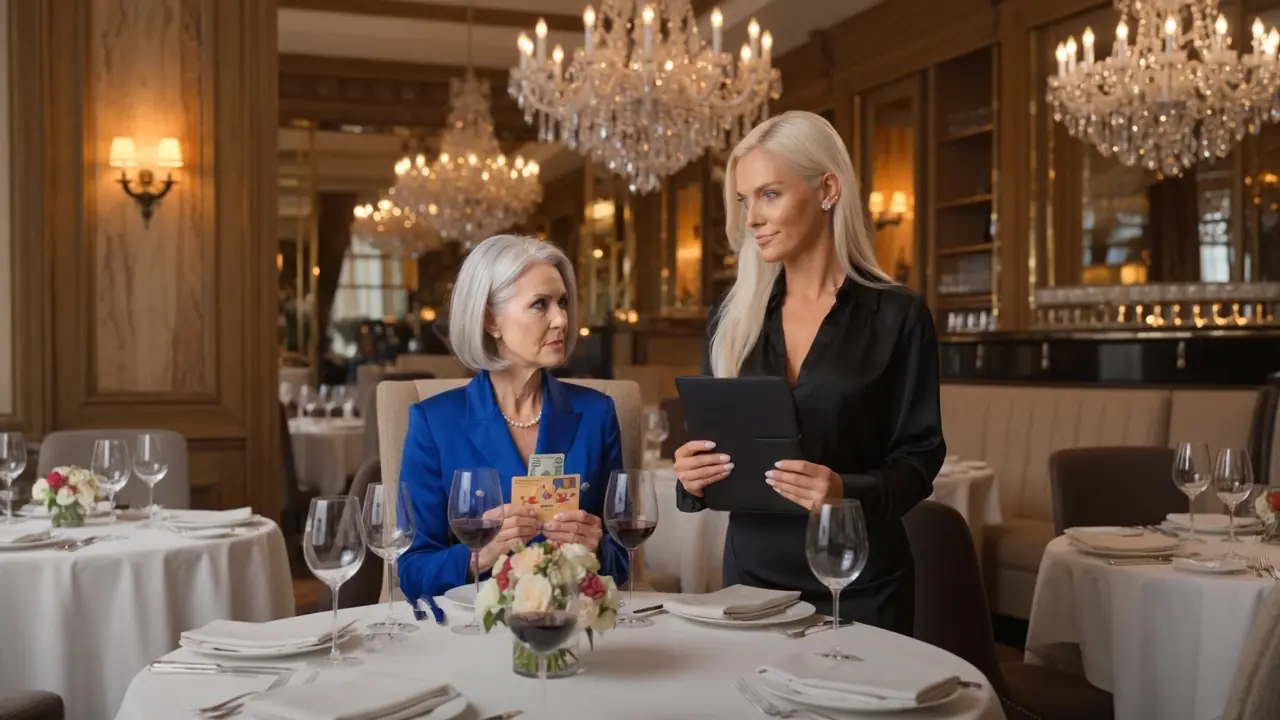
My daughter-in-law Madison slid the dinner check across the white tablecloth with two polished fingers and said, “Shut up and pay.”
She said it softly enough that only our table heard, but loudly enough to make sure I understood my place. The crystal chandeliers above us glittered over the restaurant like judgment, flashing against the wine glasses, the silverware, and the black folder holding a bill I had not created. My son Brandon lowered his eyes to his steak as if the plate had suddenly become the most important thing in the room.
My grandson Noah sat beside him, only eight years old, staring at me with wide frightened eyes.
I was still holding Madison’s birthday card in my hand. Inside it were two hundred dollars in crisp bills, because even after everything, I had come prepared to be kind. I had bought the card that afternoon from a small stationery shop near my office, choosing one with pale flowers and gold lettering because Madison liked expensive-looking things.
Now her manicured hand rested on top of the bill like she had conquered something.
The server stood frozen beside our table, her smile disappearing inch by inch. She was young, probably in college, and she looked like she wanted to vanish into the marble floor. I almost felt sorry for her. No stranger should have to witness a family learning what it has become.
The check was six hundred and eighty-four dollars.
I had ordered soup and water. Madison had ordered lobster, filet mignon, imported wine, two appetizers, and three desserts “for the table.” She took two bites of each dessert and pushed them away because she was too full.
Then she turned to me like I was not a person, but a payment method.
“You wanted to be included, Evelyn,” Madison said, smiling. “This is what included looks like.”
Brandon whispered, “Maddie…”
Madison lifted one finger without even looking at him.
He stopped.
That hurt worse than her insult. Not because my son was cruel at that moment, but because he was weak, and I had helped make him that way. I had paid his rent when he was twenty-two and “finding himself.” I had covered his car payments when he was twenty-seven and “between opportunities.”
I had written the down payment check on their first house because Madison cried in my kitchen and said they would lose it otherwise.
But the house they lived in now was not their first house. It was mine. My late husband Richard and I bought it thirty-three years ago, back when Brandon was a toddler and the backyard had nothing but mud, weeds, and a broken fence.
I had let Brandon, Madison, and Noah move in after Brandon’s business failed.
“Only for six months,” he had promised.
That was three years ago.
Little by little, Madison took over the house. She changed the curtains, replaced my dishes, moved my books to the basement, and turned Richard’s old study into what she called her “wellness room.” She never asked. She announced.
And I let her.
I told myself it was for Noah. I told myself Brandon needed time. I told myself family meant patience, sacrifice, and swallowing the words that would make dinner uncomfortable.
But sitting in that restaurant, with my daughter-in-law telling me to shut up and pay, I finally understood the difference between love and surrender.
I placed Madison’s birthday card back into my purse.
Her eyes followed the movement.
“No gift?” she asked, her smile sharpening. “After all that attitude?”
I looked at her calmly.
Then I reached for the black folder.
“You’re right,” I said.
Madison blinked. “Excuse me?”
“You told me to shut up and pay.” I opened the folder and placed my platinum card on top of the bill. “So that is exactly what I’m going to do.”
Madison leaned back, satisfied. “See? Was that so hard?”
“No,” I said. “Not at all.”
Brandon finally looked up.
There it was.
He knew me well enough to know something Madison never learned. I did not shout when I was furious. I did not cry when I was finished. When I became very calm, something had already ended.
The server took my card and hurried away.
Under the table, I opened my phone. A message from my banker, Andrew Vale, waited on the screen.
Evelyn, the documents are ready whenever you give the word.
I typed one word.
Tonight.
The server returned with the receipt. I signed it carefully, adding a proper tip because Madison’s cruelty was not the server’s fault. Then I stood, lifted my purse, and looked directly at my daughter-in-law.
“I’ll pay for dinner,” I said. “Now I’m taking back my house.”
Madison’s smile froze.
Brandon went pale.
Noah whispered, “Grandma?”
I looked at him, and my heart softened for one second. “It’s all right, sweetheart.”
Madison gave a short laugh, but it came out cracked.
“What did you just say?”
I slid the signed receipt toward her.
“I said I paid for dinner. Now I am taking back my house.”
Brandon stood so quickly his chair scraped against the floor.
“Mom, don’t do this here.”
I turned to him.
“You should have said that to your wife.”
His face tightened with shame, but shame was not enough anymore. Shame did not pay back years of disrespect. Shame did not undo the nights I sat alone in my own guest room while Madison hosted brunches in my kitchen and introduced me as “Brandon’s mother” instead of the woman who owned the roof over her head.
Madison crossed her arms.
“You’re being dramatic.”
“No,” I said. “I have been dramatic in silence for three years. Tonight, I am being accurate.”
People at nearby tables had gone quiet. Madison noticed and straightened her back, trying to regain control of the room. She was very good at performance. She could turn tears on and off like a faucet, and Brandon had drowned in them for years.
But I had paid too much to keep confusing performance with pain.
I walked out of the restaurant alone.
The cold night air hit my face when I stepped onto the sidewalk. My driver, Ellis, opened the car door without asking any questions. He had worked for me part-time for six years, ever since I sold my accounting firm and stopped driving at night.
“Home, Mrs. Hart?” he asked.
I looked through the glass doors of the restaurant and saw Madison standing over Brandon, whispering fiercely. Noah sat small in his chair, twisting his napkin with both hands.
“Yes,” I said. “Home.”
The house lights were on when we pulled into the driveway at 9:47 p.m.
Not my porch light.
Their lights.
Madison’s white Range Rover sat in the driveway like a trophy. The upstairs guest room glowed behind linen curtains I bought in Charleston fifteen years earlier. Through the kitchen window, I could see the pendant lights Madison installed without asking me, the ones she charged to my household account because she said they “raised the value of the property.”
My house looked occupied.
Not lived in.
Occupied.
There is a difference.
I sat in the car for a moment, looking at the front door Richard painted navy blue the summer before he died. He had stood there in old jeans, paint on his cheek, laughing because I told him the shade was too bold. He said, “A house should know who it belongs to.”
For three years, I had forgotten.
Tonight, I remembered.
Ellis opened my door.
“Do you want me to stay?” he asked.
“Yes,” I said. “Andrew should arrive soon. So should Ms. Bell.”
Ms. Bell was my attorney, Clarissa Bell, a woman Madison once called “terrifying” after meeting her at a charity luncheon. Madison meant it as an insult. I considered it an endorsement.
I entered through the front door with my own key.
The foyer smelled of Madison’s floral candles. My grandmother’s side table was gone, replaced by a tall white vase full of fake branches. A framed photo of Madison and Brandon hung where my wedding portrait used to be.
I did not react.
I walked to Richard’s old study, now Madison’s wellness room. There were yoga mats on the floor, a diffuser on the desk, and a decorative sign that read: Protect Your Peace.
I almost laughed.
The irony deserved its own room.
In the corner behind a built-in shelf was the wall safe. Madison had never known about it. Brandon knew it existed, but he believed I kept old jewelry inside. He had no idea that the important documents were not in a bank vault downtown.
Richard had trusted walls more than institutions.
I entered the code.
The safe clicked open.
Inside were files arranged in my own handwriting: house deed, trust documents, insurance policies, tax records, loan records, utility accounts, credit lines, bank transfers, and one folder labeled Brandon and Madison.
That folder was thick.
Too thick.
I took it out and placed it on the desk.
The doorbell rang fifteen minutes later.
Andrew arrived first, wearing a charcoal coat and carrying a leather briefcase. Clarissa Bell arrived two minutes after him, silver-haired, sharp-eyed, and dressed in black like she had come to bury someone legally. Ellis remained near the foyer, silent and steady.
We sat at the dining table I bought with Richard after our tenth anniversary.
Andrew opened his briefcase.
“The cancellations are prepared,” he said. “Household expense account access can be terminated immediately. Credit card authorizations for Madison Hart and Brandon Hart can be revoked tonight. The Range Rover payment is through the family trust, so that can also be stopped, but the lender will issue notice directly.”
Clarissa placed her glasses on her nose.
“Their occupancy status?”
I slid the house deed across the table.
“My name only.”
Clarissa nodded. “Then they are guests whose permission to remain can be revoked. Because there is a minor child involved, I recommend formal notice rather than immediate lockout. However, if there is any threat, harassment, or financial fraud, we escalate.”
“There is financial abuse,” Andrew said quietly.
Clarissa looked at him.
He opened the Brandon and Madison folder.
“For three years, Mrs. Hart has paid the mortgage, utilities, Brandon’s business debt, Madison’s vehicle payment, private school tuition for Noah, and multiple credit cards Madison used for luxury purchases. Brandon and Madison have contributed less than four percent of total household expenses.”
Clarissa’s eyes lifted to me.
I felt no pride in those numbers.
Only exhaustion.
Andrew continued. “Madison also attempted two months ago to obtain home equity information from the bank by presenting herself as Mrs. Hart’s daughter-in-law and ‘authorized family representative.’ The bank refused.”
Clarissa’s expression hardened.
“Did she tell you?”
“No,” I said.
“Do you want that included in the notice?”
“Yes.”
At 10:38 p.m., Brandon called.
I let it ring.
At 10:39, Madison called.
I let that ring too.
Then the texts began.
Mom, please call me.
Mom, Madison is upset.
Mom, you embarrassed us.
Mom, don’t do anything crazy.
Mom, let’s talk like adults.
I stared at the last message for a long time.
Then I typed back.
Adults pay their own bills.
I turned off the phone.
Clarissa smiled faintly.
“Good line.”
“It took sixty-seven years to earn it.”
By midnight, the first steps were done. Access revoked. Cards frozen. Household account closed. Automatic payments stopped. A formal notice drafted and ready for service the following morning.
I slept in my own bed that night for the first time in eight months.
The master bedroom smelled faintly of Madison’s perfume because she had used it whenever she felt like it. Her robe hung behind my bathroom door. Her skincare bottles covered my counter.
I gathered every item into a laundry basket and placed it outside the bedroom.
Then I locked the door.
I expected to cry.
I did not.
The next morning, Madison discovered the credit cards first.
She arrived home around nine in the morning, sunglasses on, coffee in hand, moving like a woman prepared to win an argument. Brandon followed her, pale and tired. Noah walked between them, silent.
I was waiting in the living room with Clarissa.
Madison stopped when she saw us.
“What is this?” she asked.
Clarissa stood. “Madison Hart, Brandon Hart, I represent Evelyn Hart. You are being served formal notice that your permission to occupy this property is being revoked.”
Madison stared at her. “Excuse me?”
Clarissa handed Brandon the envelope.
Brandon took it with shaking fingers.
Madison turned to me.
“Evelyn, this is ridiculous. We had one awkward dinner. You’re seriously doing all this because I told you to pay a bill?”
I looked at her.
“No. I am doing this because you thought the bill was proof that I would always obey.”
Her mouth tightened.
“You’re punishing your own family.”
“No,” I said. “I am removing my money from people who confused it with love.”
Brandon opened the envelope and scanned the first page. His face collapsed as he read. Madison snatched it from him and read faster, her eyes jumping across the words.
“This says we have thirty days.”
Clarissa spoke calmly. “Correct.”
“This is Noah’s home.”
“This is Mrs. Hart’s property.”
Madison laughed sharply. “You wouldn’t throw your grandson out.”
I looked at Noah.
He stood near the staircase clutching the strap of his backpack, watching adults turn his life into a battlefield. My anger softened, but my decision did not.
“Noah will always have a home with me,” I said. “But you and Brandon will not use him as a shield.”
Madison’s face went red.
“You think you can just cut us off?”
Andrew stepped forward and handed her another document.
“As of this morning, Mrs. Hart has revoked your access to all personal credit lines, household accounts, vehicle support, and discretionary transfers.”
Madison blinked.
“My Range Rover payment is due next week.”
“I know,” I said.
“You can’t just stop paying it.”
“I can. I did.”
Brandon sank into the armchair.
Madison turned on him. “Say something.”
He looked at me, and for one second I saw the little boy he used to be.
Then he whispered, “Mom, how are we supposed to manage?”
That almost broke me.
Not because he was frightened.
Because even then, his first instinct was not remorse.
It was dependence.
I sat across from him.
“By working. By budgeting. By selling what you cannot afford. By living the way people live when they are not spending an old woman’s money.”
His eyes filled with tears.
“I’m your son.”
“Yes,” I said. “And I was your mother before I was your bank.”
Madison scoffed.
“There it is. The martyr speech.”
I turned to her slowly.
“You wore a six-hundred-dollar dress last night while telling me to shut up and pay.”
Her lips parted.
“You drank wine I purchased, drove a car I financed, slept under my roof, and mocked me in public because you believed I was too lonely to stop you.”
The room went silent.
Even Madison had no immediate reply.
Then she found one.
“You liked helping us. Don’t pretend you didn’t. It made you feel important.”
The words landed deep because part of them was true.
I had liked being needed.
That was my weakness.
I stood.
“You are right about one thing, Madison. I did like helping. I liked believing my help meant family. But you taught me the difference between being needed and being used.”
Madison’s eyes flashed.
“This house will feel very empty when Noah is gone.”
I looked at my grandson again.
He was crying quietly now.
“Noah,” I said gently, “come here.”
He ran to me.
I knelt as much as my knees allowed and held him.
“Grandma,” he whispered, “are you mad at me?”
My heart cracked wide open.
“No, sweetheart. Never at you.”
“Are we leaving?”
“Your parents have grown-up things to fix. But you and I are still us. Nothing changes that.”
He hugged me tightly.
Over his shoulder, I looked at Brandon.
For the first time, he seemed ashamed.
Truly ashamed.
Madison did not.
The next thirty days revealed who everyone really was.
Brandon tried, in his clumsy way, to apologize. The first apology was useless.
“I’m sorry Madison said that.”
I replied, “I am waiting for you to be sorry you allowed it.”
The second apology came two days later, when he arrived alone and found me in the garden. He stood by the rose bushes Richard planted and looked smaller than I had seen him in years.
“I failed you,” he said.
I kept trimming dead branches.
“Yes.”
His eyes filled.
“I got used to you fixing things.”
“Yes.”
“And I let Madison talk about you like you were… like you were in the way.”
I cut a dead bloom and let it fall into the basket.
“You did more than let her, Brandon. You benefited from it.”
He covered his face with one hand.
That was the first honest moment between us in a long time.
Madison, meanwhile, turned vicious.
She told friends I was unstable. She posted vague quotes online about toxic mothers-in-law. She called my attorney cruel, Andrew corrupt, and me manipulative. Then her Range Rover payment failed, and the panic set in.
The credit cards declined next.
The private school payment bounced after that.
That was the only one I quietly handled, directly with the school, under Noah’s name, with instructions that his parents were not to be informed of the source. Noah would not pay for adult stupidity.
Madison never knew.
Or if she did, she never thanked me.
On the twenty-seventh day, Madison moved out.
Not gracefully.
She filled the foyer with suitcases, shouted into her phone, accused Brandon of being spineless, and called me a lonely old woman who would die surrounded by furniture.
I stood by the staircase and listened.
When she ran out of insults, I opened the front door.
“This time,” I said, “you can leave without handing me a bill.”
Her face twisted.
Then she walked out.
Brandon stayed three more days, not because I wanted him to, but because I wanted Noah’s transition to be gentle. He found a small apartment fifteen minutes away. It was not elegant. It did not have chandeliers, marble counters, or a wellness room.
But it was his.
For the first time in years, he paid the deposit himself.
On the last morning, he stood in the doorway with Noah’s suitcase in his hand.
“I don’t know how to fix this,” he said.
I looked at my son.
He had lost weight. His shirt was wrinkled. His face looked tired in a way money could not solve.
“You start by becoming someone your son can respect.”
He nodded slowly.
“And with you?”
I held his gaze.
“You start by understanding I forgive slowly now.”
He swallowed.
“I deserve that.”
“Yes,” I said. “You do.”
Noah hugged me before they left.
“Can I come Saturday?” he asked.
“Every Saturday,” I said. “And any day you need me.”
When the door closed behind them, the house became quiet.
For the first time, it did not feel empty.
It felt returned.
I spent the next week reclaiming each room.
Madison’s white vases went to donation. Her fake branches went to the trash. I brought my books back upstairs, rehung my wedding portrait, and moved Richard’s leather chair back by the window.
In the kitchen, I removed the pendant lights Madison had installed and replaced them with simpler ones I actually liked.
Doris, my neighbor and oldest friend, came over with muffins and helped me clean the pantry.
“You look taller,” she said.
“I am the same height.”
“No,” she said, smiling. “You are not.”
Maybe she was right.
A month later, Brandon came for dinner with Noah. Madison did not come. She and Brandon were separated by then, though not yet divorced. I did not ask questions that were not mine to ask.
Brandon washed the dishes after dinner without being told.
It was such a small thing.
It made me cry later.
Not because dishwashing fixed betrayal, but because growth often begins with ordinary acts no one applauds.
That night, after Noah fell asleep in the guest room, Brandon stood in the hallway outside Richard’s study.
“I remember Dad sitting in there,” he said.
“So do I.”
“He’d be ashamed of me.”
I looked at the wedding portrait on the wall.
“Yes,” I said quietly. “But he would still want you to become better.”
Brandon nodded, tears running down his face.
“I’m trying, Mom.”
For the first time in years, I believed he might be.
Not because he cried.
Because he did not ask me for anything afterward.
Six months passed.
Madison sent one email through her lawyer demanding reimbursement for “home improvements.” Clarissa replied with a detailed accounting of every dollar I had paid for her lifestyle. We never heard about reimbursement again.
Brandon kept his apartment, kept his job, and started therapy. Noah spent weekends with me and helped plant herbs in the backyard. He asked hard questions sometimes, the kind children ask when adults break their world.
“Did Mom hate you?” he asked once while watering basil.
I thought carefully.
“I think your mother loved what I gave more than she loved who I was.”
He nodded solemnly, as if that made sad sense.
“Do you hate her?”
“No,” I said. “But I will not let her hurt me again.”
“That’s good,” he said. “Dad says boundaries.”
I smiled. “Your dad is learning.”
On my sixty-eighth birthday, Brandon cooked dinner at my house.
He burned the chicken slightly.
Noah made a card with a crooked drawing of me standing in front of the house, wearing a crown. Inside, he had written: Grandma, you are the queen because it is your house.
I laughed so hard I cried.
After dinner, Brandon stood and lifted his glass of water.
“I want to say something,” he said.
My stomach tightened from old habit.
But his voice was steady.
“Mom, I spent years treating your love like something I was owed. I let Madison disrespect you because it was easier than standing up. I let you pay for my comfort and then acted like you were the problem when you finally stopped.”
His eyes shone.
“I can’t undo that. But I can say in front of Noah that what I did was wrong. You were never a burden. You were the reason we had anything at all.”
Noah looked from him to me.
I did not speak immediately.
Some wounds need silence around them before they can accept words.
Then I raised my glass.
“Thank you,” I said.
That was all.
It was enough.
Later that night, after they left, I sat alone in Richard’s study. The house was quiet, but not lonely. The curtains were mine again. The books were mine again. The air was mine again.
I thought about the restaurant.
The black folder.
Madison’s smile.
“Shut up and pay.”
I had paid that night.
I paid for the lobster, the wine, the desserts, the performance, the humiliation, and the final lesson.
Then I took back everything my silence had been funding.
My house.
My dignity.
My name.
People think revenge has to be loud. They imagine shouting, slammed doors, dramatic confrontations, and public ruin. But sometimes revenge is a paid bill, a signed receipt, a frozen credit card, and a woman finally understanding that kindness without boundaries becomes an invitation.
I still help my family.
I pay for Noah’s school because he is a child, not a weapon.
I cook for Brandon when he comes over, because he is my son, and love does not vanish just because trust was damaged.
But I do not pay Madison’s bills.
I do not fund disrespect.
And I do not sit quietly while someone uses my generosity to build a throne above me.
The house knows who it belongs to now.
So do I.