“Check room 14, please.”
Four words, said without looking up from the chart.
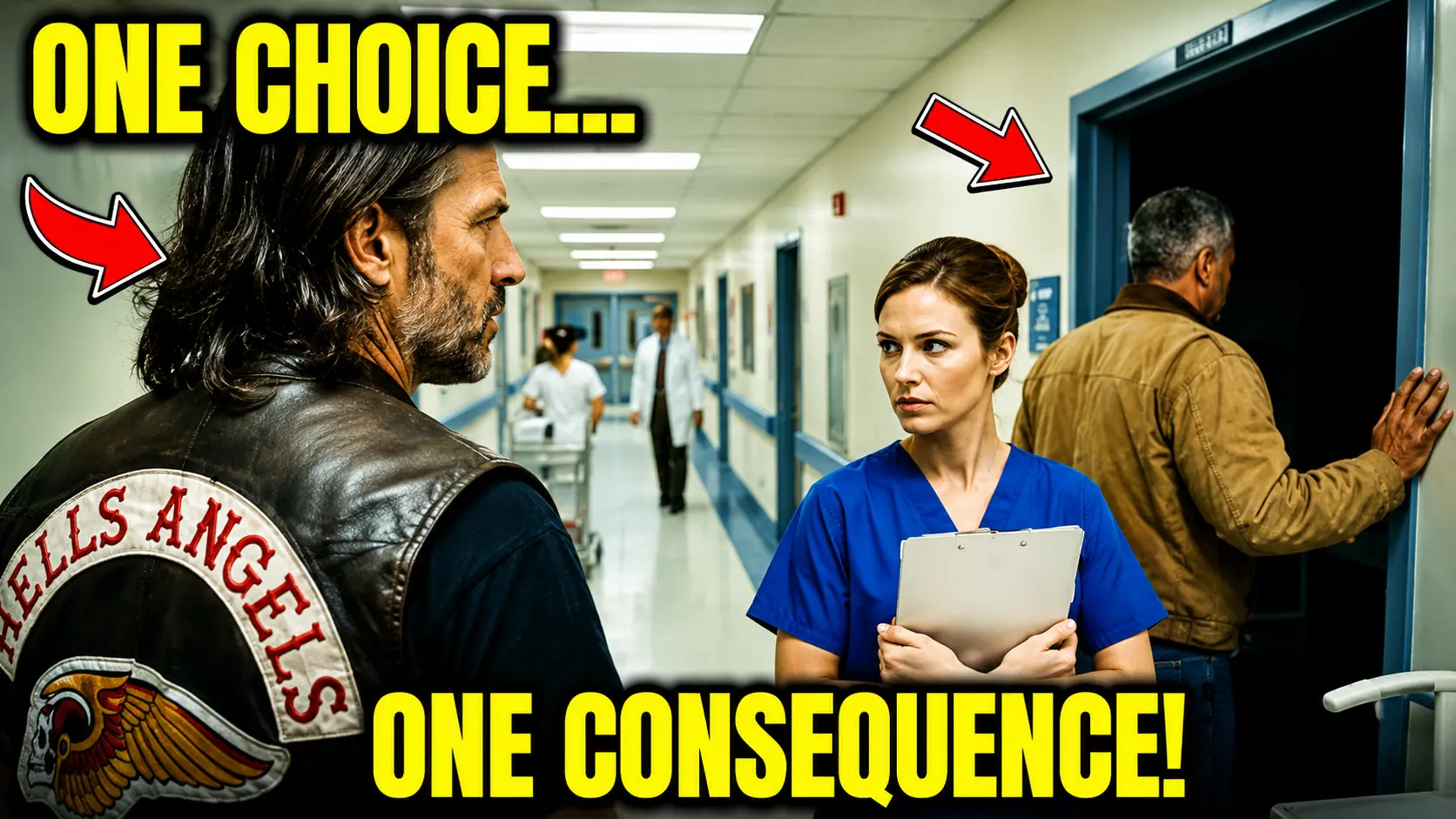
Wade Bristow looked at her. The nurse’s pen never stopped moving across the page, but her jaw had gone tight, and her shoulders had changed in the last ten seconds in a way that had nothing to do with the chart.
“Room 14,” she said again. “End of this hall. Left side.”
She picked up her clipboard and walked out.
Wade Bristow, president of the Oklahoma City chapter of the Hells Angels, sat in exam room three for a long moment looking at the closed door. He’d come in for stitches. Nothing serious. No particular reason to be anywhere near the east wing of this hospital.
Then he stood, put on his vest, and walked left.
What he found at the end of that hallway would put eleven motorcycles in that parking lot before the night was over.
At 5:12 that afternoon, none of them had known each other existed.
Her left wrist was wrapped in a compression bandage. Hairline fracture. The kind that happens when someone grabs you and you pull away at the wrong angle.
Lacey Mercer had not spoken to anyone outside that hospital in four days. The man coming to take her home tonight was the same man who put her there.
Everyone at Mercy Ridge Medical Center knew something was wrong. Nobody had done anything about it. Nobody who worked there, anyway.
Wade Bristow rode into the Mercy Ridge Medical Center lot at 4:47 that afternoon, when the Oklahoma City sky had gone the flat gray of old concrete and the wind off the plains found every gap in his jacket. A shop rag was wrapped tight around his forearm, stiff with dried blood at the edges. Sheet metal. A construction site off Classen Boulevard. Not serious. He’d had worse from fence wire. From broken glass. From things he’d stopped thinking about years ago.
But it had been open since two in the afternoon, and at forty-seven Wade had learned the difference between things that could wait and things that couldn’t.
He cut the engine and sat for a moment before swinging off the bike and walking inside. The patch on the back of his vest caught the parking-lot light. A woman loading groceries two rows over moved to the far side of her car without a word and kept her eyes down until he passed.
Wade had stopped noticing that a long time ago.
Inside, the waiting room went quiet in stages as he crossed it. The young man at the desk—Tyler, name tag, maybe twenty-two—went very still without reaching for anything. A security guard found a reason to stand near the corridor door.
“I need stitches,” Wade said, unwrapping the rag. “Sheet metal. It’s clean.”
Thirty-six minutes later a nurse called his name. She walked toward him without hesitating. Didn’t glance at his vest. Didn’t look at the guard still watching from the wall.
“Mr. Bristow. I’m Nora. I’ll be taking care of you today.”
“Wade,” he said.
She led him back with the brisk economy of someone who’d walked the hall a thousand times. Eight stitches. Clean wound. No editorializing. Twenty-two minutes. Precise and unhurried.
When she was done, she peeled off her gloves and started writing in his chart.
Then her voice changed. Quieter. Stripped of its clinical edge. She didn’t look up from the page.
“Mr. Bristow. Before you leave. Check room 14, please.”
He looked at her. Her handwriting never stopped moving, but her jaw had gone tight and she was breathing the careful rhythm of someone who just stepped off a ledge.
“End of this hall,” she said. “Left side.”
She picked up her tablet and walked out.
The corridor thinned to near silence by the east end of the wing. Room numbers counted down. Sixteen. Fifteen. Fourteen.
Wade pushed the door open.
The woman in the bed sat with both hands folded in her lap. Late twenties. The particular stillness of someone who’d learned to take up as little space as possible. Compression bandage on the left wrist. A bruise along the cheekbone—four or five days old. Yellow.
She looked at his vest. Then at his face. She didn’t flinch.
“Hey,” he said.
“Hey,” she said back. Steady. Carefully steady.
He pulled the visitor’s chair over and sat.
“I’m Wade.”
“Lacey.”
“What happened to your wrist?”
“I fell,” she said. The words coming out smooth and immediate, the way words come out when they no longer need the part of the brain that deals with memory.
Wade recognized the tone. He’d used it himself once, a long time ago. He didn’t push.
“How long have you been here?”
“Four days. Derek came yesterday. My boyfriend.” She said the word like one she’d decided to stop giving power to, but hadn’t quite managed. “He’s coming tonight. He wants to talk to Doctor Carmichael about taking me home.”
Something moved behind her eyes. Not anticipation. The opposite.
“What time does he usually come?” Wade asked.
“Around 6:30. After work.”
“I’ll be right back,” Wade said.
He found Nora at the nursing station.
“Tell me,” he said quietly.
“Lacey Mercer. Admitted four days ago. Hairline fracture, left wrist. Contusions to the face and ribs. Official story is she fell down the back stairs of her apartment building.” Nora kept her eyes on the chart. “Doctor Carmichael reviewed the file day one and found no basis for a domestic-violence referral.”
She looked up. He could see what she’d been keeping carefully contained. Not fear, but something in its neighborhood. The exhaustion of someone who’d tried every legitimate channel and found them closed.
“I filed two internal reports. My supervisor told me I was overreading it. I called the hotline this morning from my own phone. They said without Lacey’s cooperation they can’t open a case. And she won’t talk. Not officially.”
“Why me?” Wade said.
“Because in my experience,” she said carefully, “people who look like you don’t get told to stand down and then stand down.” She paused. “And because her boyfriend gets here at 6:30, and I am out of options.”
“What’s his name?”
“Derek Holt. General contractor. Holt Construction and Renovation. Southside.”
Wade checked his watch. 5:12. One hour and eighteen minutes until Derek Holt walked through that door believing nothing at this hospital had changed since yesterday.
He stepped into the stairwell and called his vice president. Russ Tanner picked up on the second ring, a compressor running somewhere behind him.
“I need you to run someone. Derek Holt. Contractor. Southside. Find out what you can. Give me twenty minutes.”
“Anything I should know before I start digging?”
“He’s good at this,” Wade said. “Find out how good.”
Wade went back and sat with Lacey through the slow hour that followed. Neither of them talked much, which was sometimes the only thing a situation required. Outside the window the last gray light went flatter behind a bank of clouds moving in from the west.
5:40. A monitor beeped somewhere down the hall in its steady, indifferent rhythm. A dinner tray came and went untouched. Something pale under gravy. A carton of juice Lacey didn’t open.
“How many times have you watched that clock since you got here?” Wade asked.
She didn’t answer right away.
“Every day,” she said finally. “Same time. 6:30. I used to think if I just got the room arranged right before he came—the right words ready—it wouldn’t go the way it always goes.” She looked at her hands. “I don’t think that anymore.”
6:05. His phone buzzed in the corridor.
“He’s got a prior,” Russ said. “Domestic-disturbance call three years back. Different address. Different woman. No charges filed. She left the state two months later. There’s more. A restraining order from a woman named Patricia Combs. Lapsed after a year. She never renewed it. One more thing. He’s not just good at talking his way out of rooms. He’s good at making the people around him talk it back in. Doctor included.”
“How many of you are around tonight?”
A pause. Counting.
“Eleven. Maybe twelve.”