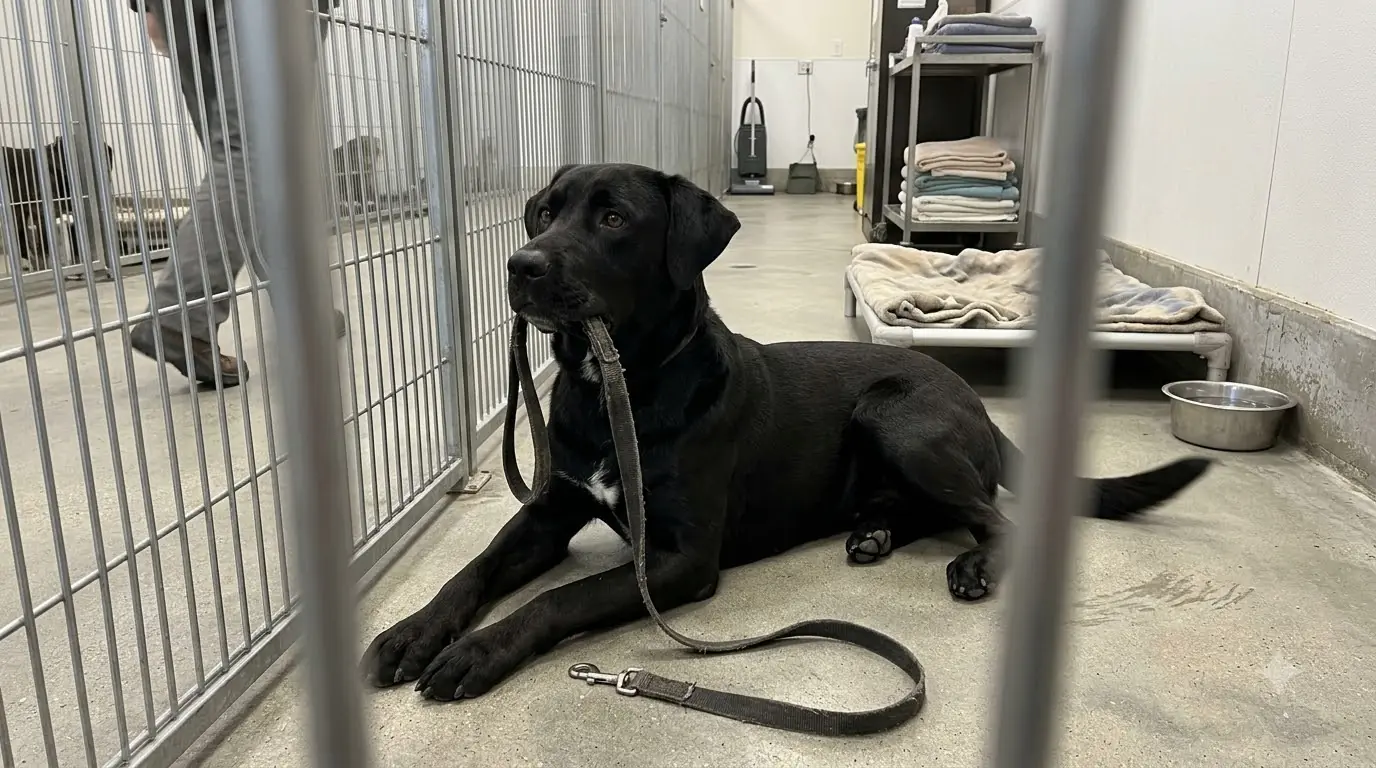
By the time Charlie had been in our shelter for nearly five months, staff could predict part of his morning routine almost exactly.
The building would begin to wake.
Kennel doors opened.
Water bowls were checked.
Breakfast carts rolled down the hallway.
Voices became more frequent.
And Charlie would look for the leash.
It was an older shelter leash that remained inside his kennel under supervision because Charlie had developed a habit of carrying it without chewing or ingesting it.
Every morning, he picked it up carefully in his mouth.
Then he walked to the gate.
Charlie was a 6-year-old Labrador mix with a broad head, soft expression, and the kind of tail that could make itself heard whenever he became excited.
When footsteps approached, that tail started hitting the floor.
Thump.
Thump.
Thump.
His entire attention went toward the hallway.
Sometimes the person stopped.
Often, they did not.
If the footsteps continued past his kennel, Charlie watched for a moment.
His tail slowed.
Then he lowered his head and let the leash fall.
After several seconds, he picked it up again.
He carried it back to his bed.
And he waited for the next sound.
Charlie Had Not Arrived as a Medical Emergency
Charlie’s intake months earlier had been fairly routine.
He entered our care as an adult dog with limited reliable background information.
We could confirm his approximate age and identify him as a Labrador mix, but much of his previous history was unknown.
We did not have complete records explaining where he had lived before entering the shelter.
We could not verify whether he had previously been walked on a leash regularly, whether he had lived in a house, or why the leash became such an important object during shelter care.
We also could not responsibly say that Charlie was “waiting for his owner.”
That interpretation might feel natural, but it would go beyond what his behavior could prove.
What we could observe was simpler.
Charlie associated the leash with activity and people.
He carried it toward the gate when he heard someone approaching.
He often appeared disappointed when the person continued walking.
And over many weeks, the pattern became one of the most recognizable parts of his day.
His First Veterinary Examination
At intake, Charlie received a complete physical examination.
His temperature was normal.
His heart and lungs sounded clear.
His abdomen was soft without obvious pain.
His eyes and ears showed no major acute problem.
His mouth had mild to moderate dental tartar but nothing requiring immediate emergency care.
His skin and coat were generally healthy.
There were no significant wounds.
His joints moved through a functional range, and he walked comfortably on all four limbs.
Charlie was slightly above his ideal body weight at intake, something not uncommon in adult Labrador-type dogs.
That was addressed with measured feeding and appropriate activity rather than treated as a crisis.
Baseline bloodwork did not reveal a major systemic illness.
His kidney and liver values were acceptable.
His blood cell counts were within expected ranges.
Routine parasite screening and preventive care were completed according to shelter protocol.
Medically, Charlie appeared stable.
That did not mean shelter life would be easy for him.
The First Month
Charlie adjusted reasonably well during his first several weeks.
He ate consistently.
He enjoyed walks.
He was social with familiar staff.
He showed particular enthusiasm whenever a leash appeared.
The first time a staff member noticed him carrying the spare leash inside his kennel, it seemed almost playful.
Charlie picked it up.
Walked to the door.
Waited.
When someone entered, he backed up just enough to allow the gate to open while keeping the leash in his mouth.
Outside, he became energetic but manageable.
He loved sniffing.
He liked walking through grassy areas.
He showed interest in people passing at a distance.
He also enjoyed simple enrichment games.
Food puzzles worked well.
So did scattered kibble in safe outdoor areas.
A soft toy could hold his attention for a few minutes, but the leash was different.
He returned to it again and again.
Month Two Brought More Waiting
As Charlie’s shelter stay lengthened, the behavior became more consistent.
He learned the rhythm of the hallway.
He recognized the sound of cleaning carts.
He learned which footsteps often belonged to staff members taking dogs outside.
He began lifting his head before some people even came into view.
Then he found the leash.
Sometimes staff could hear his tail before reaching his kennel.
That enthusiasm was initially encouraging.
Charlie still wanted interaction.
He still wanted to leave the kennel.
He still showed interest in his environment.
But the repeated cycle of anticipation and disappointment began raising behavioral concerns.
Shelter dogs do not experience waiting the same way humans do, and we cannot know exactly what Charlie thought each time someone passed.
What we could measure was his increasing vigilance toward hallway activity.
He was resting less deeply during busy periods.
He stood up more frequently.
He began spending longer stretches near the gate.
That mattered.
Shelter Stress Does Not Always Look Dramatic
People often imagine a stressed shelter dog as one who barks constantly, spins, destroys bedding, or refuses food.
Those signs can occur.
But stress can also be quieter.
Charlie did not become aggressive.
He did not begin lunging at the kennel gate.
He did not stop eating entirely.
Instead, his changes were subtle.
He slept more lightly.
He became more reactive to footsteps.
He sometimes abandoned enrichment to watch the hallway.
He began eating breakfast more slowly during the busiest part of the morning.
He remained friendly, but his attention was increasingly difficult to redirect once he heard someone approaching.
The behavior team began documenting these patterns carefully.
Weight Became an Unexpected Concern
Charlie had entered slightly above ideal weight.
Over the first several months, measured meals and regular exercise brought him closer to a healthier body condition.
That was expected.
Then the trend continued.
Staff noticed that he was becoming leaner than planned.
His food portions had not been reduced further.
His activity had not increased enough to explain the continued loss.
A weight check confirmed that Charlie had dropped below the target range.
That change required medical evaluation.
Weight loss in a shelter dog can have many causes.
Stress may contribute.
So can dental disease, gastrointestinal problems, parasites, endocrine disease, kidney or liver disease, cancer, chronic infection, or reduced calorie intake.
We did not assume the answer was behavioral just because Charlie had been in the shelter a long time.
Repeating the Medical Workup
Charlie returned to the veterinary team for a recheck.
His physical examination remained largely reassuring.
His temperature was normal.
There was no obvious abdominal mass.
His heart and lungs sounded stable.
His joints remained comfortable.
His mouth still showed only moderate dental disease.
He was thinner than before but not severely underweight.
Bloodwork was repeated.
His complete blood count remained within acceptable limits.
Kidney and liver values did not reveal a new major organ failure.
His blood glucose was normal.
A fecal examination did not identify a significant parasite burden.
Urinalysis was also unremarkable.
There was no clear medical explanation for the weight change.
That shifted attention back toward intake and behavior.
Charlie Was Eating, but Not Always Enough
Staff began measuring his food more precisely.
Instead of recording simply “ate” or “didn’t eat,” caregivers documented how much remained after each meal.
A pattern became clear.
Charlie usually ate well in quieter periods.
During noisy mornings, he often stopped.
If footsteps approached, he left the bowl.
If someone passed, he stood at the gate.
Sometimes he returned to the meal later.
Sometimes he did not finish.
His total calorie intake had gradually fallen below what his body needed.
This did not mean Charlie had a psychiatric diagnosis.
It meant environmental stress and vigilance were affecting normal behavior enough to have physical consequences.
That was something we could act on.
Changing His Feeding Routine
Charlie’s meals were moved to quieter periods whenever possible.
Visual barriers reduced some hallway stimulation.
His food was divided into portions so he had more opportunities to eat when the kennel area was calm.
Some calories were delivered through enrichment.
The goal was not to force him to consume more.
It was to make eating easier.
The change helped.
Charlie began finishing a greater percentage of his meals.
His weight stabilized.
That was encouraging.
But the larger behavioral issue remained.
He was still spending too much time monitoring the hallway.
The Leash Could Not Be the Only Good Part of His Day
The behavior team expanded Charlie’s enrichment plan.
He received scheduled walks at predictable times.
That predictability mattered.
When possible, the same caregivers handled him.
Charlie began learning that certain routines reliably led outside.
This reduced some of the uncertainty surrounding every random footstep.
He also received sniff-focused outings rather than only exercise walks.
Charlie loved using his nose.
He could spend several minutes investigating one patch of grass.
That was allowed.
Mental engagement can be as important as physical activity for shelter dogs.
Simple training sessions were also introduced.
Sit.
Touch.
Wait briefly at a doorway.
Follow a hand target.
The exercises were short.
The purpose was not obedience for its own sake.
They gave Charlie opportunities to succeed and interact with people in predictable ways.
His Behavior Around the Leash Was Carefully Managed
Because Charlie carried the old leash gently, it remained part of his routine for a period.
Staff inspected it frequently for damage.
A frayed leash can become an ingestion hazard.
If Charlie had begun chewing pieces off, it would have been removed.
Instead, he continued carrying it.
Sometimes he brought it to a caregiver.
Sometimes he placed it near the gate.
One day, staff offered him a soft tug toy shaped roughly like a loop.
Charlie showed little interest.
He sniffed it and walked away.
Then he returned to the leash.
That suggested the object had a specific learned association.
Again, we could not know exactly what it represented to him.
But we respected the behavior while keeping safety first.
Month Three Was Harder
By the third month, Charlie had become one of the shelter’s longer-stay dogs.
Long shelter stays can affect dogs differently.
Some adapt.
Some deteriorate behaviorally.
Some fluctuate between good days and difficult ones.
Charlie still had many good moments.
Outside the kennel, he could relax.
He leaned against familiar people.
He rolled onto one hip during quiet petting.
He enjoyed scent games.
He could nap deeply in the office after a walk.
Back in the kennel, however, the vigilance returned.
Footsteps mattered too much.
The leash remained near the gate more often.
On especially busy days, Charlie paced between the bed and the door.
That was the point when the team began discussing whether a foster placement had become medically and behaviorally important, not just desirable.
His Sleep Was Being Disrupted
Staff began monitoring Charlie’s rest more deliberately.
During quiet afternoons, he slept normally.
During peak kennel activity, he rarely remained asleep for long.
A door slammed.
Head up.
Footsteps.
Stand.
Dog barking.
Move toward the gate.
Cart wheels.
Watch the hallway.
Sleep disruption can affect behavior, appetite, and overall welfare.
The shelter adjusted his environment as much as possible.
Charlie received more time in quieter rooms.
He sometimes spent portions of the day in an office with a staff member.
The difference was immediate.
After checking the room for several minutes, Charlie lay down.
Once asleep, he stayed asleep.
That told us he was still capable of settling.
The kennel environment was the problem.
A Foster Search Began
Finding the right foster home for Charlie required more than simply finding an empty couch.
We wanted a household that could provide routine.
Charlie needed regular walks.
He needed enough enrichment to stay engaged.
He also needed time to decompress without constant visitors or overstimulation.
There were no major medical treatments to administer, but his weight needed monitoring.
His eating habits needed continued observation.
We also wanted to see whether the leash-carrying behavior would change in a home.
Would he still wait at doors?
Would he monitor footsteps?
Would he settle more deeply?
The only way to know was to give him that environment.
While We Waited, Month Four Arrived
Charlie’s fourth month in the shelter brought more staff concern.
His weight remained stable, which was good.
His appetite had improved with quieter feeding.
But his emotional recovery after disappointment seemed slower.
When someone passed his kennel without stopping, Charlie sometimes stood at the gate for nearly a minute before returning to bed.
The old leash remained part of the sequence.
Pick it up.
Walk forward.
Tail thumping.
Watch.
Drop it.
Wait.
Carry it back.
Lie down.
Repeat.
It was impossible not to notice.
But we did not frame Charlie as “heartbroken” in his medical record.
We documented behavior.
Duration.
Frequency.
Context.
Those details allowed the team to make better decisions.
A Second Behavioral Assessment
Charlie was evaluated outside the kennel in a quiet room.
Away from the hallway, he behaved differently.
He explored.
He took treats.
He responded to familiar cues.
He sought contact.
When the assessor stopped interacting, Charlie settled within several minutes.
That was reassuring.
He had not lost the ability to relax.
His stress appeared highly environment-dependent.
That made foster care even more appropriate.
He did not need punishment.
He did not need more intense training.
He needed less exposure to the trigger pattern that had become so important.
The Medical Team Continued Watching Him
Although no major disease had been found, Charlie remained under medical observation.
Long-term shelter stress should not become a convenient explanation for every future symptom.
If he lost weight again, stopped eating, developed vomiting, diarrhea, coughing, increased thirst, urinary changes, pain, or lethargy, new medical evaluation would be necessary.
For now, his body condition stabilized.
His coat remained healthy.
His stool was normal.
His water intake was appropriate.
His mobility remained good.
Physically, Charlie was ready for a home.
Emotionally, he needed one.
The Fifth Month Began
By the time Charlie reached nearly five months, many staff members knew his morning ritual.
Some intentionally stopped for a short greeting when schedules allowed.
Others took him outside.
But a shelter hallway contains people doing many different jobs.
Not every footstep can belong to Charlie.
That reality made the behavior difficult to watch.
One morning, a caregiver saw Charlie pick up the leash before the cleaning cart even reached his row.
He moved to the gate.
The footsteps came closer.
Charlie’s tail thumped rapidly.
The person turned into another room.
Charlie waited.
Then he lowered the leash.
This time, he did not immediately carry it back.
He stood over it.
After several seconds, he lay down near the gate.
That moment accelerated the foster search.
A Home Finally Opened
An experienced foster caregiver volunteered to take Charlie.
The home was relatively quiet.
There were no constant visitors.
The caregiver worked from home much of the week.
There was a fenced yard for controlled outdoor time, though Charlie would still be supervised.
The transition plan was intentionally simple.
Keep the same food.
Keep meal times predictable.
Do not overwhelm him with guests.
Give him multiple resting places.
Continue regular walks.
Allow him to explore.
The old leash went with him.
Not because anyone wanted to create a sentimental scene.
Because it was a familiar object and safe for him under supervision.
Charlie’s First Minutes in Foster Care
When Charlie entered the house, he immediately began sniffing.
He investigated the entryway.
The wall.
A chair leg.
The kitchen doorway.
He looked back at the front door several times.
The foster caregiver did not call him repeatedly.
Charlie was allowed to move at his own pace.
A bed had been placed in the living room.
Another was in a quieter side room.
The old leash was set beside the first bed.
Charlie sniffed it.
Then he walked away.
That alone was interesting.
In the kennel, the leash had almost always been central.
Here, there were too many new scents to investigate.
The First Evening
Charlie ate his full dinner.
He did not stop when the foster caregiver moved through the room.
He watched briefly.
Then he kept eating.
Afterward, he followed the caregiver into the living room.
He stood near the couch.
Then he lay down.
No one asked him to.
No one touched him.
He simply settled.
Later, when the caregiver walked toward the front door to retrieve a package, Charlie stood quickly.
His tail began moving.
He looked toward the leash.
For a second, the old pattern seemed ready to return.
But the caregiver came back inside almost immediately.
Charlie watched.
Then he followed into the kitchen.
The leash stayed on the floor.
The First Night
Charlie slept in the living room.
At first, he woke whenever the house made an unfamiliar sound.
The refrigerator cycling on.
A car passing.
The heating system.
A floorboard creaking.
His head came up.
Then it went back down.
There was no chorus of barking.
No endless hallway traffic.
After midnight, Charlie stretched onto his side.
He slept for several uninterrupted hours.
The foster caregiver noticed that his paws twitched occasionally in sleep.
For the first time in months, Charlie appeared to be getting the depth of rest staff had struggled to provide consistently in the shelter.
Morning Was the Real Test
At the shelter, morning meant footsteps.
At the foster home, morning meant one person walking from the bedroom to the kitchen.
Charlie heard the movement.
He stood.
His tail began thumping.
Then he looked toward the leash.
It was beside the bed.
Charlie picked it up.
He carried it toward the hallway.
The caregiver smiled but did not immediately turn the moment into a walk.
Instead, breakfast came first.
Charlie hesitated.
Then he put the leash down.
He ate.
After breakfast, the caregiver picked up the leash and took him outside.
That predictable sequence became important.
Leash.
Walk.
Not every footstep.
Not every sound.
A real routine.
His Appetite Improved Quickly
In foster care, Charlie began finishing meals more consistently.
His portions remained measured.
We did not want him regaining unnecessary weight.
His body condition was now close to ideal.
The main goal was maintenance.
He ate breakfast.
He ate dinner.
He took treats during training.
His stool remained normal.
Water intake was appropriate.
After several weeks, his weight was rechecked.
Stable.
That was exactly what the veterinary team wanted.
The Leash Ritual Began Changing
Charlie still liked carrying the leash.
But the context changed.
He started bringing it to the foster caregiver around the time of scheduled walks.
That made sense.
He had learned the routine.
He was less likely to grab it simply because someone moved through the house.
Footsteps no longer predicted possible escape from a kennel.
They were just footsteps.
One afternoon, the caregiver walked from the office into the kitchen.
Charlie lifted his head.
Then went back to sleep.
At the shelter, that movement would almost certainly have brought him to the gate.
The difference was significant.
He Learned That People Could Leave and Return
Another important challenge appeared when the foster caregiver left the house.
The first absence was very short.
Charlie watched the door.
He paced for several minutes.
Then he settled.
A camera allowed the caregiver to observe him without interfering.
Charlie did not destroy the house.
He did not bark continuously.
He did not remain in frantic motion.
He eventually lay down near the living room entrance.
When the caregiver returned, Charlie became excited.
His tail moved rapidly.
He picked up the leash.
Then he dropped it and approached.
Future absences were increased gradually.
This helped determine that Charlie could tolerate normal separation in a home.
His Walks Became Less Urgent
At the shelter, Charlie often moved quickly toward the exit.
In foster care, walks lost some of that urgency.
He still enjoyed them.
He still became excited when the leash appeared.
But once outside, he slowed down.
He sniffed.
He checked bushes.
He stood quietly when distant dogs passed.
His foster caregiver used a secure harness and leash.
Charlie’s recall had not been tested enough to justify off-leash freedom.
Safety remained important regardless of how relaxed he became.
Quiet Affection Replaced Constant Watching
Charlie began spending more time near his foster caregiver without demanding interaction.
He would lie several feet from the desk during work.
Sometimes he rested his chin on the floor and watched.
Sometimes he slept.
In the evening, he occasionally leaned against a leg while receiving slow chest scratches.
If petting stopped, he might nudge once.
Then he settled.
This was a different kind of connection from the one staff saw at the kennel gate.
Charlie was no longer waiting for a person to choose his door.
He was sharing space with someone already there.
Follow-Up Veterinary Examination
Charlie returned for a scheduled recheck after several weeks in foster care.
His weight remained stable.
His muscle condition was good.
His coat was healthy.
His heart and lungs sounded normal.
His abdomen remained comfortable.
There were no new orthopedic concerns.
His dental disease remained mild to moderate and would require routine future care but not immediate major intervention.
No additional bloodwork was necessary at that visit based on his stable condition and recent normal results.
The main change was behavioral.
Staff who had known him at the shelter noticed it immediately.
Charlie still recognized them.
His tail moved.
He greeted people enthusiastically.
But he was less frantic about doors and hallways.
Returning to the Shelter Briefly Did Not Undo Everything
During the recheck, Charlie spent a short period in a familiar shelter room.
Footsteps passed outside.
His head came up.
He looked toward the door.
For a moment, staff wondered whether he would search for the leash.
He did not.
He listened.
Then he turned toward his foster caregiver.
That did not mean months of learned behavior had disappeared.
It meant Charlie now had another expectation available to him.
The hallway was no longer his entire world.
Adoption Preparation Began
Charlie’s foster placement gave the team enough information to begin more focused adoption planning.
He appeared well suited to a home that could provide regular exercise, predictable routines, companionship, and adequate mental stimulation.
He did not require a household where someone was home every minute.
He had shown that he could tolerate reasonable periods alone when introduced gradually.
He enjoyed walks.
He enjoyed food enrichment.
He liked being near people.
He also needed rest.
Any resident animals would require appropriate introductions and compatibility assessment.
His future family would also need to understand that another move could temporarily bring back some old behaviors.
He Might Carry the Leash Again
A permanent home would be another transition.
Charlie might watch doors more closely during the first days.
He might follow people.
He might pick up a leash repeatedly.
He might sleep lightly.
Those behaviors would not necessarily mean the adoption was failing.
Adjustment takes time.
The same strategies that helped in foster care would likely help again.
Routine.
Exercise.
Choice.
Quiet rest.
Predictable departures and returns.
Positive reinforcement.
No punishment for anxious or attention-seeking behavior.
What Charlie’s Story Does Not Prove
We cannot say Charlie understood adoption.
We cannot say he knew each person walking the hallway might be a potential family.
We cannot say the leash represented hope in a human sense.
Those interpretations are emotionally compelling, but they are not scientifically verifiable.
What we can say is that Charlie repeatedly carried a leash to the kennel gate when people approached.
His tail wagged.
He watched.
When they passed, he often dropped the leash and returned to bed.
The behavior decreased significantly once he entered a predictable home environment.
That is the story we can document.
Five Months Left a Mark
Long shelter stays do not automatically cause permanent behavioral damage.
But they can change routines.
Charlie had learned to monitor sound.
He had learned that footsteps might lead to a walk.
He had learned to be ready.
That readiness became excessive over time.
Foster care helped replace it with something healthier.
He learned that walks happened on a schedule.
Meals came reliably.
A person could leave and return.
He could sleep through movement.
He did not need to stand up for every sound.
Those changes happened gradually.
The Leash Found a New Place
One day, the foster caregiver noticed that the old leash had been moved.
It was no longer beside Charlie’s bed.
It was near the front door.
That made sense.
Walks began there.
Charlie still occasionally carried it.
But he no longer took it back to bed after someone walked past him.
The object had become practical again.
A leash meant going outside.
Not waiting.
That may seem like a small difference.
For Charlie, it represented a major change in daily life.
Charlie Today
Charlie is physically stable.
His weight is healthy.
His appetite is consistent.
His stool and urination are normal.
He remains active without showing significant mobility problems.
His routine veterinary needs are appropriate for a 6-year-old adult dog.
Behaviorally, he has made even more visible progress.
He sleeps more deeply.
He is less vigilant about every household sound.
He can remain settled while someone walks through the room.
He tolerates normal periods alone.
He still becomes excited for walks.
And yes, he still likes the leash.
Sometimes, shortly before his usual evening outing, Charlie walks toward the front door.
He picks it up.
He carries it into the room.
His tail starts moving.
This time, there is no kennel gate between him and the person he is watching.
The foster caregiver finishes what they are doing.
They stand.
Charlie’s tail speeds up.
The leash is clipped on.
The door opens.
And Charlie goes outside.
Later, he comes home.
That part may be even more important.
For nearly five months, Charlie spent his mornings responding to footsteps that often disappeared down the shelter hallway.
He carried the leash to the gate.
He waited.
He dropped it.
Then he carried it back to bed.
Now the footsteps he hears most often belong to someone moving through the same home he is resting in.
He no longer needs to get up every time.
Some mornings, the caregiver walks past Charlie’s bed while he remains stretched on his side.
His eyes open briefly.
His tail taps once.
Then his head lowers again.
The leash stays by the door.
Charlie goes back to sleep.
He knows there will be another walk.
Another meal.
Another evening.
And when someone walks away, they are capable of coming back.